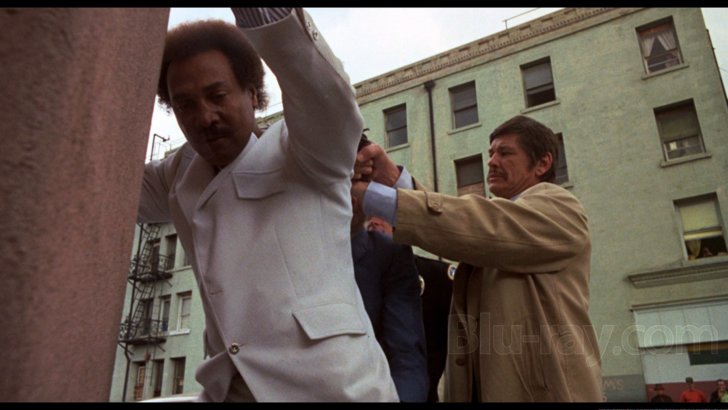
Brad reviews THE STONE KILLER (1973), starring Charles Bronson!


THE STONE KILLER opens in Spanish Harlem with detective Lou Torrey (Charles Bronson) following a young man, who had just shot a cop, into an abandoned building. When the young man refuses to turn himself in, and even tries to shoot Torrey, he gets blown away. In trouble with his superiors on the force, and being dragged in the press for the shooting, Torrey decides to change locations and continue his law enforcement career under his friend Les Daniels (Norman Fell) in Los Angeles. Soon after he arrives in Los Angeles, Torrey and his partner Mathews (Ralph Waite) are working a case against a drug dealer, when they arrest “Bootlace” Armitage (Eddie Firestone), a drug addict, but also a well-known hitman from New York. Torrey is delivering the “mechanic” back to New York for outstanding warrants when Armitage says that he is willing to give up some big information on “Wexton” in exchange for a reduced sentence. When Armitage is gunned down in what is obviously a professional hit, it’s clear that there is something going on that involves the name Wexton. We soon learn more as we meet mafia leader Al Vescari (Martin Balsam). As Vescari walks through a cemetery, he tells the leader of his operation, Lawrence (Stuart Margolin), of his plans to get revenge for a string of mafia killings that occurred 42 years earlier by using “stone killers,” in this case, former military men with no connection to the mob. As the film moves forward, Detective Lou Torrey and his fellow cops will eventually put the pieces together and find themselves taking on these “stone killers” and the mob! 

I’ll just go ahead and say up front that I’m a big fan of THE STONE KILLER these days, but that’s because the movie has grown on me over the years with repeat viewings. When I first watched the film as a teenager in the 1980’s, I enjoyed it as a tough cop film, but it wasn’t one of my favorites. I think that part of the reason I didn’t appreciate it as much back then is the more convoluted plot of the film. Most Bronson films have simple and easy to follow plot lines, but THE STONE KILLER includes a somewhat complicated mafia assassination plan, and it also sends the cops on wild goose chases that have nothing to do with the actual story. Watching the film as an adult, I appreciate Director Michael Winner taking us with him on some of those 1970’s flavored tangents that include getting to hang out with some hippies at an ashram, as well as some unjustly accused black militants. 

Even though the plot is more complicated than the average Charles Bronson film, director Michael Winner gives us some of the best action sequences of Charles Bronson’s career. There are two sequences in particular that stand out to me. After the impressive opening scenes where Torrey blows away the gun wielding young man in Spanish Harlem, it takes a while to get to the next extended action sequence, but it’s definitely worth the wait. The scene involves Detective Torrey in a car chase where he’s after one of the stone killers, Albert Langley (Paul Koslo), who’s on a motorcycle. In an era of great car chases, this is a doozy that features many amazing and dangerous stunts. The late 60’s and early 70’s are an embarrassment of riches for cinematic car chases and this one stands the test of time. The next great action sequence occurs later in the film when Detective Torrey and the cops bust the home and facility where the killers have trained for the planned massacre. Bronson is still in his physical prime in 1973, and his athletic prowess is clearly on display as he slides across floors, jumps on tables, and does anything else that is required to take down the bad guys. The film is not wall to wall action, but what’s here is as badass as it gets. 

Detective Lou Torrey is a really good role for Charles Bronson. In his best roles, Bronson is tough, but you can also tell that he cares about other people. That’s definitely the case here as he consistently shows empathy for some of the people he’s after. For example, at the beginning of the film, he has to shoot the young man in Spanish Harlem in self-defense, but he later explains to his sister that he didn’t want to do it, even expressing some understanding of how the young man may have found himself in that situation. A little later while arresting a drug dealer with his partner Mathews, Torrey is clearly disgusted when his partner uses racial slurs during the arrest. Torrey then talks to the man with respect and gets the needed information to arrest the man buying the drugs. There are further examples later in the film as he deals with other drug addicts and militants. I say none of this to insinuate that Bronson’s character is weak in any way. Rather, he seems to want to do his job and arrest criminals in a professional manner. He’s also a complex character in some ways as he will bend the rules to get what he needs if he has to. He does end up punching the car thief, Jumper (Jack Colvin), a couple of times during an interview. While this is definitely not legal, in the context of this film, it’s required in order to get to the facts of the case. Bronson is actually quite great in the film. 

Besides international superstar Charles Bronson, Michael Winner put together an amazing cast for THE STONE KILLER. Martin Balsam had won an Oscar a few years earlier, and he’s good here as the mafia boss with four decades worth of patience for revenge. Ralph Waite is also excellent as Bronson’s incompetent, racist partner Mathews. It’s hard to believe the guy would go on to play Papa Walton based on the ignorance he shows in both this film and in the Bronson/Winner collaboration CHATO’S LAND from the prior year. It’s fun watching both Norman Fell and John Ritter work together in this film, especially knowing that they would be making television history a few years later on the classic TV sitcom “Three’s Company.” The last two actors I want to mention are Stuart Margolin as the leader of the stone killers, Lawrence, and Paul Koslo as the bi-sexual badass musician Albert Langley. Both actors, especially Koslo, are good here and would have important roles with Bronson the next year as well. Margolin was an important character in DEATH WISH, and Koslo may have even outdone his work here the next year as a particularly slimy weasel in MR. MAJESTYK. Oh yeah, be sure to look for a short, uncredited cameo from B-movie queen Roberta Collins! I also want to shout out the musical score from Roy Budd, who also did the score for GET CARTER (1971). Thanks to Budd’s work, the opening credits are very cool and memorable. 

THE STONE KILLER was marketed as Charles Bronson’s “Dirty Harry” and meant to be his breakout hit in America. Unfortunately, while the film was an international hit, the actual grosses in the United States were respectable but not as much as the filmmakers had hoped for. As such, we didn’t get any more entries in the case log of Detective Lou Torrey and Bronson would have to wait another year for his American box office breakout with DEATH WISH. But that’s okay because THE STONE KILLER has stood the test of time as an excellent 1970’s cop film, emerging in my personal rankings as a major feather in the cap of Charles Bronson’s career. 
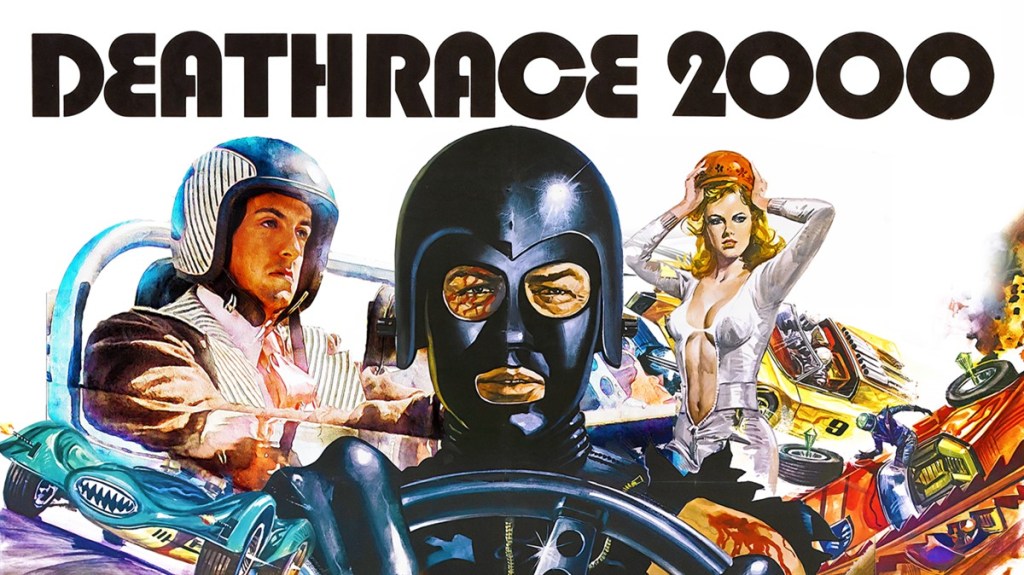
#MondayMuggers – Why DEATH RACE 2000?


Every Monday night at 9:00 Central Time, my wife Sierra and I host a “Live Movie Tweet” event on X using the hashtag #MondayMuggers. We rotate movie picks each week, and our tastes are quite different. Tonight, Monday December 2nd, we’re watching DEATH RACE 2000 starring David Carradine, Sylvester Stallone, Simone Griffith, Mary Woronov, Roberta Collins, and Martin Kove.

So why did I pick DEATH RACE 2000, you might ask? It’s pretty simple. I think it will be a fun movie to watch with a group. Unlike most of my choices, which are movies I’ve seen many times, I’ve only seen DEATH RACE 2000 one time before and it’s been awhile. I’m looking forward to seeing it again myself. I like that it’s a B-movie from legendary producer Roger Corman. That’s usually a good thing. I like that it’s directed by Paul Bartel. Bartel’s EATING RAOUL was one of those movies that helped me appreciate black comedy when I was growing up. I really like the cast, especially David Carradine and Sylvester Stallone. And finally, I like that it’s 80 minutes long. In today’s world where every film feels the need to be between 2 and 3 hours, I’ve grown to really appreciate movies clocking in at 90 minutes or less! 

It’s on Amazon Prime and Tubi. Join us if you’d like!

The TSL Horror Grindhouse: Sweet Kill (dir by Curtis Hanson)


As the saying goes, everyone has to start somewhere and, for Curtis Hanson, that somewhere was with 1973’s Sweet Kill.

Curtis Hanson, of course, would go on to become one of Hollywood’s top genre directors, directing films like The River Wild, Bad Influence, Wonder Boys, The Hand That Rocks The Cradle, 8 Mile, and the Oscar-nominated L.A. Confidential.  But, in the early 70s, he was just one of the many recent film school grads who approached Roger Corman for a job.

Having previously worked on the script for the Corman-produced Dunwich Horror, Hanson approached Roger and told him that he had an idea for a Psycho-inspired movie about a female serial killer.  Corman replied that he would help finance the film if Hanson made the killer into a man.  Hanson did so but Corman still ended up only putting up a third of the film’s budget as opposed to the two/thirds that he had originally offered.  Hanson ended up convincing his parents to take out a mortgage on their home to help finance the movie.

Hanson shot the film in 1971.  Corman said that the film showed promise but that it needed more nudity and a better title if it was going to be successful.  Corman re-edited the film and additional nude scenes were shot and inserted into the film.  Despite this, Sweet Kill was a box office disappointment when it was originally released.  Corman re-titled the film Kisses For Eddie but it didn’t help at the box office.  Finally, the film was released under a third title, The Arousers.  Despite a lurid ad campaign built around “the arousers,” the film once again failed at the box office.  It wouldn’t be until years later, when Hanson started to achieve some mainstream success, that Sweet Kill would be rediscovered.

After all of the drama that went into post-production, it would be nice to be able to report that Sweet Kill was some sort of overlooked masterpiece but, to be honest, it’s pretty bad.  The film stars Tab Hunter as Eddie Collins.  When Eddie was a kid, he used to hide in the closet and watch as his mother lounged around her bedroom in lingerie.  Now that Eddie is a grown-up and working as a high school gym coach, he is still so haunted by his mother that he’s impotent.  As a result, Eddie spends his time breaking into apartments, stealing underwear, and having a prostitute dress up like his mother so that he can undress her while sobbing.  After a chance meeting with a hippie girl leads to Eddie once again failing to get it up, he shoves the girl hard enough to kill her.  The film implies that this act of violence leads to Eddie getting aroused for the first time and soon, Eddie is killing people and …. well, that’s pretty much the whole movie.  There’s not really a plot, beyond Eddie looking confused and trying to keep his sympathetic neighbor from finding out that he’s a serial killer.

Sweet Kill has gotten some attention because of the casting of former teen idol Tab Hunter in the role of psycho Eddie.  Tab Hunter has the right blonde look for Eddie, who is basically a homicidal beach bum, but otherwise, Hunter’s performance is fairly dull.  Watching the film, it’s obvious that he wasn’t particularly comfortable with the role of Eddie and, as such, he sleepwalks through the performance.  (Ironically, Eddie was based on Norman Bates, who was played by Hunter’s former partner, Anthony Perkins.)  There are a few creepy moments where Hunter stares off into the distance with a blank look on his face but otherwise, this isn’t a particularly memorable performance nor is Sweet Kill a particularly interesting film.

That said, Curtis Hanson went on to have quite a career so, on that level, Sweet Kill‘s bland badness is inspiring.  If the director of Sweet Kill could still go on to direct and produce some of the best films of the past 50 years, there’s hope for everyone looking to achieve their dreams.  Don’t let one failure get you down.

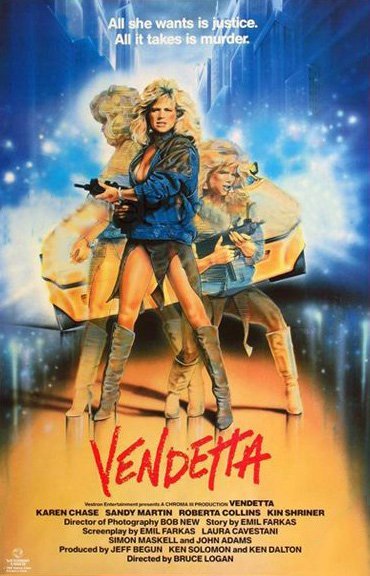
Vendetta (1986, directed by Bruce Logan)


After killing her rapist in self-defense, young and pretty Bonnie (Michelle Newkirk) is sentenced to two years in prison.  It’s one of those tough women’s prisons where all of the inmates dress like they’ve just come back from shooting an 80s music video and where the prisoners only have arcade games, a Olympic-size swimming pool, and a fully stocked gym to help them pass the time.  It’s so tough that, when it comes to conjugal visits, the prisoners have to settle for being driven to a nearby motel.  It’s the toughest prison since Leavenworth.

Because she’s blonde and innocent-looking, Bonnie is targeted by the predatory Kay Butler (Sandy Martin).  After Bonnie rejects Kay’s advances in the public shower room (while all of the other prisoners watch), Kay get her revenge by giving Bonnie a hot dose and then shoving her over a railing.  Even though all the evidence indicates that Bonnie was murdered, the official cause of death is ruled to be suicide.

What no one considered was that Bonnie’s older sister, a Hollywood stuntwoman named Laurie (played by real-life stuntwoman Karen Chase), would want revenge.  Determined to investigate the prison on her own, Laurie steals a judge’s car.  When that same judge attempts to suspend Laurie’s sentence, Laurie attacks him in the courtroom.  (Why would a judge be allowed to oversee a trial that directly involved him as a witness?)  Laurie finally gets her wish and is sentenced to prison.  Having now compiled the type of criminal record that will probably make her unemployable for the rest of her life, Laurie sets out to discover who is responsible for the death of her sister.  Soon, Laurie is tracking down and murdering every member of Kay’s gang, all the while trying to avoid getting caught by the head guard, Miss Dice (Roberta Collins).

In many ways, Vendetta is a typical 80s women-in-prison movie.  It has everything that you would expect to find in one of these movies: predatory lesbians, a victimized innocent, corrupt guards, and a gratuitous shower scene.  What sets Vendetta apart from similar films is that the prison is more of a health club than a prison and, while she’s hardly the world’s greatest actress, Karen Chase looks very credible when she’s beating the other inmates to death.  As a result, the fight scenes are more exciting than they usually are in a film like this and Karen Chase’s Laurie is a stronger heroine.  She can hold her own against anyone who comes at her.  Sandy Martin is also an effective villain and there’s actually some unexpected depth to her character.  She actually gets upset when her gang start to get killed, not just because she’s losing people who are willing to do her bidding but also because she’s losing the only people that she feels close to.  Thanks to Karen Chase’s fight skills and Sandy Martin’s unexpected performance, Vendetta is better the than the average 80s prison flick.

Horror on TV: Kolchak: The Night Stalker 1.1 “The Ripper” (dir by Alan Baron)


For tonight’s excursion into the horrific side of television, we have the very first episode of Kolchak: The Night Stalker!

The Kolchak of the title was a reporter named Carl Kolchak (played by Darren McGavin).  Kolchak was kind of a nervous fellow because every story that he reported on seemed to involve some sort of terrible supernatural creature!  Seriously, that would make anyone anxious.

In his first episode, Kolchak investigates a series of murders and comes to suspect that Jack the Ripper might be haunting the streets of 1970s Chicago.

This episode originally aired on September 13th, 1974.

Enjoy!