14 Days of Paranoia #3: The Passover Plot (dir by Michael Campus)


First released in 1976 and based on a book that had come out ten years previously, The Passover Plot is a film that asks, “What if Jesus was a political revolutionary who faked his own death?”

Even when the film was first released, that wasn’t a particularly novel or new theory.  Ever since the Crucifixion, there have been conspiracy theorists who have claimed that the entire thing was staged.  Indeed, the early days of the Church were defined by conflicts between different sects debating the true nature of Jesus, with those who believed that he was the son of God and that he had risen from the dead eventually winning out over sects who claimed that Jesus was not divine or that he had actually escaped from the Romans and was instead hiding out in Egypt or even on the island that would eventually become known as Britain.  (The fact that so many Gnostics and other heretics were executed by the Church and their texts suppressed only served to lend them credibility with future theorists.)  Still, every few decades, some new book or film will claim that Jesus faked his death or married Mary Magdalene and gullible people will act as if this is somehow a new argument.  It’s been over 20 years since all of that Da Vinci Code nonsense convinced bored suburbanites across America that they could be experts on both boxed wine and historical conspiracy theories.  We’re about due for a new version of the old story.

As for The Passover Plot, it features Zalman King as Yeshua of Nazareth, an angry young man who dreams of the day when Judea will be free of the Romans.  Having a knowledge of the prophecies of a messiah and also knowing that he is descended from King David, Yeshua specifically patterns his life after the prophecies and presents himself as being not just another revolutionary but instead as being sent by God.  However, he is also aware that it will be necessary for him to “die” and “rise from the dead,” so he goes out of his way to force the hand of Pontius Pilate (Donald Pleasence).  Having seen plenty of crucifixions when younger, Yeshua arranges for the local revolutionaries to drug him so that he’ll appear to be dead.  When he later wakes up, everyone will believe that he has returned from the dead.  The film ends with several title cards, all arguing that the Gospels were written long after Yeshua’s death (“Mark lived in Italy!” one title card proclaims with almost comical indignation) and were subsequently rewritten by “unknown” hands.

The Passover Plot is a weird combination of biblical epic and conspiracy thriller.  Scenes of Yeshua preaching feel as if they could have come from any traditional Biblical epic but they are awkwardly placed with scenes of Yeshua having secret, melodramatic meetings with various conspirators.  It would make for an interesting contrast if not for the fact that the film itself is so slowly paced and boring.  Zalman King, who is best-known for his subsequent career as a softcore filmmaker, spends a lot of time yelling and smoldering intensely but he still doesn’t have the charisma or screen presence necessary to be convincing in the role.  In the scene were he’s meant to be passionate, he shrieks with such abandon that he makes Ted Neeley’s performance in Jesus Christ Superstar feel restrained.  This film asks us to believe that people would not only abandon their previous lives to follow Yeshua but that they would also take part in an elaborate conspiracy that could have gone wrong at any time.  For that to be believable, Yeshua needs to be played by someone who doesn’t come across like the drama student that everyone dreads having to do a scene with.  Far more impressive is Donald Pleasence, whose portrayal of a ruthless and unfeeling Pilate is a marked contrast to some of the more sympathetic interpretations of the character that tend turn up in the movies.

On the plus side, the film does look good.  It was shot on location in Israel and there is a certain authenticity to the film’s recreation of the ancient world.  Along with Pleasence, character actors like Scott Wilson (as Judas!) and Dan Hedaya get a chance to shine.  But otherwise, The Passover Plot is too slowly paced and kooky for its own good.  Conspiracy theorists never seem to understand that the more elaborate a conspiracy theory becomes, the less convincing it is to anyone who isn’t already a true believer.  In the end, how one feels about the film’s conclusions will probably be connected to how one already views Jesus and the Church.  The Passover Plot is not a film that’s going to convince anyone who wasn’t already convinced.

14 Days of Paranoia:
  1. Fast Money (1996)
  2. Deep Throat II (1974)

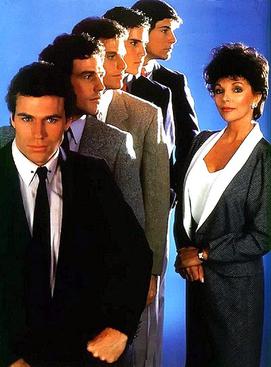
Retro Television Reviews: Making of a Male Model (dir by Irving J. Moore)


Welcome to Retro Television Reviews, a feature where we review some of our favorite and least favorite shows of the past!  On Sundays, I will be reviewing the made-for-television movies that used to be a primetime mainstay.  Today’s film is 1983’s Making of a Male Model!  It  can be viewed on YouTube!

While visiting the set of an outdoor shoot in Nevada, high-powered modeling agent Kay Dillon (Joan Collins) spots a ranch hand named Tyler Burnett (Jon-Erik Hexum).  Tyler is tall, athletic, handsome, and polite.  When Kay asks Tyler if he’s ever modeled, Tyler scoffs at the idea.  Him?  A model?  He’d rather stay in Nevada and work on the ranch.  However, when the girl he likes turns him down because he doesn’t have any money, Tyler reconsiders Kay’s offer.

Before you can say Midnight Cowboy, Tyler is walking around Times Square while dressed like a cowboy.  At first, Tyler is resistant to Kay’s suggestions on how to improve his look.  He doesn’t want anyone messing with her ear or trimming his eyebrows.  But, after a humiliating meeting with a photographer who tells him that he just doesn’t have the right look, Tyler agrees to let Kay turn him into a male model.  Not only does she fix his look but she also takes him to bed.

Soon, Tyler is one of the country’s most well-known faces.  He branches out into commercials, using his sex appeal to sell products to the men who want be him.  And yet, Tyler still feels lost.  He’s not sure if Kay actually loves him or if she’s just using him.  Meanwhile, his roommate, Chuck Lanyard (Jeff Conaway), is a former model who is now hooked on drugs and who constantly warns Tyler that all models are washed up by the time they hit 35.  Tyler becomes disillusioned with his life as a model but is he capable of giving up the fame and the money and returning to Nevada?  Or is he destined to follow in Chuck’s footsteps and head down a path of drugs and self-destruction?

Welcome to the world of decadence, 80s style!  Making of a Male Model is one of those films where the synthesizer-heavy soundtrack plays through every scene and the only thing more dramatic than the line readings is the hair and the shoulder pads.  It’s all a bit silly, none more so that when Tyler and Kay go to a costume party.  Kay dressed up like Cleopatra.  Tyler wears a cowboy hat.  One random extra wears an oversized headpiece with two gigantic eyes painted at either end.  It’s not so much Studio 54 as much as it’s Studio 54 as imagined by someone who has heard of the place but never visited.  It’s decadent but it’s never quite authentic.  The film captures the joy of not only looking good but also knowing that you look good but it never captures the tedium that can go into being on a shoot.  It’s a film about the reality of modeling that never bothers to get that real but so what?  You don’t watch a film called Making of a Male Model because you’re looking for reality.

Joan Collins appears to be having fun in the role of Kay.  John-Erik Hexum, who was a real-life model, gives a rather stiff performance in the role of Tyler.  He looks good but he struggles whenever he has to show any emotion beyond being slightly annoyed.  If anyone really stands out in the cast, it’s Jeff Conaway.  Conaway brings a bit of genuine sadness to his role but you’ll guess what’s going to happen to Chuck long before it actually does.  Finally, Kevin McCarthy (the actor, not the Congressman) plays one of Kay’s business rivals.  He doesn’t get to do much but it’s always nice to see Kevin McCarthy playing yet another sophisticated but ruthless businessman.

In the end, the film doesn’t have anything surprising to say about the world of modeling and Tyler is never that interesting of a protagonist.  However, there’s just enough 80s melodrama and 80s fashion to keep things watchable.

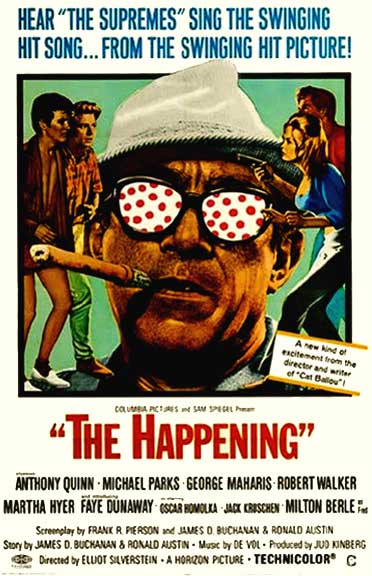
An Offer You Can Refuse #5: The Happening (dir by Elliot Silverstein)


https://www.youtube.com/watch?v=lAupa3dICGs

The 1967 film, The Happening, opens with two “young” people — Sureshot (Michael Parks) and Sandy (Faye Dunaway) — waking up on a Florida beach.  The previous night, they attended a party so wild that the beach is full of passed out people, one of whom apparently fell asleep while standing on his head.  (It’s a happening!)  From the dialogue, we discover that, despite their impeccably clean-cut appearances, both Sureshot and Sandy are meant to be hippies.

After trying to remember whether or not they “made love” the previous night (wow, how edgy!), Sandy and Sureshot attempt to find their way off of the beach.  As they walk along, they’re joined by two other partygoers.  Taurus is played by George Maharis, who was 38 when this film was shot and looked about ten years older.  Taurus is a tough guy who carries a gun and dreams of being a revolutionary and who says stuff like, “Bam!  Et cetera!”  Herbie is eccentric, thin, and neurotic and, presumably because Roddy McDowall wanted too much money, he’s played by Robert Walker, Jr.

Anyway, the four of them end up stealing a boat and talking about how life is a drag, man.  Eventually, they end up breaking into a mansion and threatening the owner and his wife.  Since this movie was made before the Manson murders, this is all played for laughs.  The owner of the mansion is Roc Delmonico (Anthony Quinn).  Roc used to be a gangster but now he’s a legitimate businessman.  The “hippies” decide to kidnap Roc because they assume they’ll be able to get a lot of money for him.

The only problem is that no one is willing to pay the ransom!

Not Roc’s wife (Martha Hyer)!

Not Roc’s best friend (Milton Berle), who happens to be sleeping with Roc’s wife!

Not Roc’s former mob boss (Oscar Homolka)!

Roc gets so angry when he find out that no one wants to pay that he decides to take control of the kidnapping,  He announces that he knows secrets about everyone who refused to pay any money for him and unless they do pay the ransom, he’s going to reveal them.  We’ve gone from kidnapping to blackmail.

Along the way, Roc bonds with his kidnappers.  He teaches them how to commit crimes and they teach him how to be anti-establishment or something.  Actually, I’m not sure what they were supposed to have taught him.  The Happening is a comedy that I guess was trying to say something about the divide between the young and the middle-aged but it doesn’t really have much of a message beyond that the middle-aged could stand to laugh a little more and that the young are just silly and kind of useless.  Of course, the whole young/old divide would probably work better if all of the young hippies weren’t played by actors who were all either in their 30 or close enough to 30 to make their dorm room angst seem a bit silly.

It’s an odd film.  The tone is all over the place and everyone seems to be acting in a different movie.  Anthony Quinn actually gives a pretty good dramatic performance but his good performance only serves to highlight how miscast almost everyone else in the film is.  Michael Parks comes across like he would rather be beating up hippies than hanging out with them while Faye Dunaway seems to be bored with the entire film.  George Maharis, meanwhile, goes overboard on the Brando impersonation while Robert Walker, Jr. seems like he just needs someone to tell him to calm down.

But even beyond the weird mix of acting style, the film’s message is a mess.  On the one hand, the “hippies” are presented as being right about the establishment being full of hypocritical phonies.  On the other hand, the establishment is proven to be correct about the “hippies” being a bunch of easily distracted idiots.  This is one of those films that wants to have it both ways, kind of like an old episode of Saved By The Bell where Mr. Belding learns to loosen up while Zack learns to respect authority.  This is an offer that you can refuse.

And that’s what’s happening!

Previous Offers You Can’t (or Can) Refuse:

  1. The Public Enemy
  2. Scarface
  3. The Purple Gang
  4. The Gang That Could’t Shoot Straight

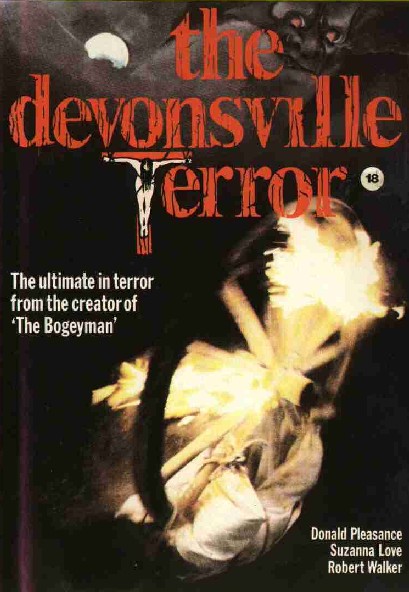
Horror Film Review: The Devonsville Terror (dir by Ulli Lommel)


DevonsvilleTerror

Who is the world’s worst director?

That’s a question that can really lead to lot of conflict.  First off, it’s a deceptively simple question.  The more you think about it, the more you realize how fragile concepts like good and bad truly are.  Some of the greatest films ever made were critical flops.  Some of the films that have been embraced by contemporary critics will definitely be less acclaimed by future viewers.  There’s a lot to take into consideration when it comes to determining whether or not a filmmaker is good, mediocre, or one of the worst of all time.  It’s something that requires a lot of careful thought and consideration and research.

Of course, if you don’t have time for all that, you can just say that the world’s worst director is Ulli Lommel and save yourself the trouble.

This German director has been making movies for longer than I’ve been alive.  He got his start in the early 70s, as an actor who frequently collaborated with the great German filmmaker Rainer Werner Fassbinder.  With Fassbinder as his producer, Lommel made a few surrealistic (and, it should be stated, critically acclaimed) films in Germany and then, in 1977, he moved to the U.S, and became friends with Andy Warhol.  He also married Suzanna Love, an actress who was the heiress to the Standard Oil Fortune and who starred in a handful of Lommel’s early films.

Today, Lommel’s reputation for being the world’s worst director is largely the result of an endless series of low-budget, straight-to-DVD films that he’s made about various real-life serial killers.  I’ve seen quite a few of these movies (and I reviewed Lommel’s Curse of the Zodiac three years ago) and they are truly bad.  Normally, I can find something to love about almost every movie that I watch but Lommel’s serial killer films are beyond terrible.  They’re so bad that they are almost impossible to review.  I mean, how many different ways can you find to say that a movie sucks so much that it will make you question whether Eadweard Muybride should ever have filmed Sallie Gardner at a Gallop in the first place?

But here’s the thing with Ulli Lommel and this what makes it especially so frustrating to see him currently doing a thousand variations on Curse of the Zodiac.  His first two horror films — both of which were filmed in the early 80s and starred Love — are not that bad.  Don’t misunderstand me.  They’re not particularly good but they still feature enough hints of genuine talent and inspiration that you have to wonder just what the Hell happened.

The first (and best known) of Lommel’s horror films was 1980’s The Boogeyman, an incredibly stupid film that still featured some good atmosphere and a few memorable deaths.  Lommel followed The Boogeyman with 1983’s The Devonsville Terror.

The Devonsville Terror may not have the same cult status as The Boogeyman but it’s actually a far more interesting film.  The film opens in the 17th Century.  In the Massachusetts town of Devonsville, three women are executed for being witches.  After the final witch is burned, her spirit appears in the sky and announces that the town is now cursed.

We then jump forward 300 years.  Dr. Warley is researching the Devonsville curse.  By researching, I mean that he continually invites citizens in Devonsville into his office and hypnotizes them, which leads to them having flashbacks to 1683 and those of us in the audience having to continually rewatch the first few minutes of the movie.  The spirit of the witch curses Dr. Warley and soon, he’s having to pull maggots out of his arm.  It doesn’t add up too much but Dr. Warley is played by Donald Pleasence so he’s at least entertaining.

Meanwhile, a new school teacher, Jenny (played by Suzanna Love), has moved into town and she’s teaching the kids to think for themselves and even goes as far as to suggest that God might be a woman!  The town leaders are shocked and more than a few of them start to suspect that she might be a reincarnated witch…

At the same time, a loser named Walter (Paull Wilson) has just murdered his wife and soon finds himself having nightmares where Jenny allows him to drown in a swamp.  “The legend’s true!” Walter shouts in his dream, “You are a witch!”

On top of that, two other liberated women have recently moved into town, which leads to a panic as the townfathers realize that their town — best known for executing three witches — is now home to three feminists!

Of course, it all leads to an attempt to duplicate the executions of 1683.  Heads explode.  Faces melt.  Don’t mess with the witches, y’all.  That’s all I’m saying.

The Devonsville Terror is a huge mess but, much like The Boogeyman, the film has a lot of atmosphere and features a good performance from Suzanna Love.  (As well, just as The Boogeyman features John Carradine not doing much of anything, Devonsville Terror features Donald Pleasence not doing much of anything.)  But the main thing I liked about The Devonsville Terror was its feminist subtext, which is not something you would typically expect to find in a horror film from the early 80s.

You have to ask yourself — how did the director of The Devonsville Terror ends up becoming the guy who directed Curse of the Zodiac and Mondo Americana?  One huge clue is probably found in the fact that Suzanna Love is nowhere to be found in any of Lommel’s later films.  According to the imdb, Lommel and Love divorced in 1987.

With Suzanna Love, Ulli Lommel was an occasionally interesting, if uneven, filmmaker.

Without her, he’s just the guy who directed Curse of the Zodiac.