Embracing the Melodrama Part II #27: The Caretakers (dir by Hall Bartlett)


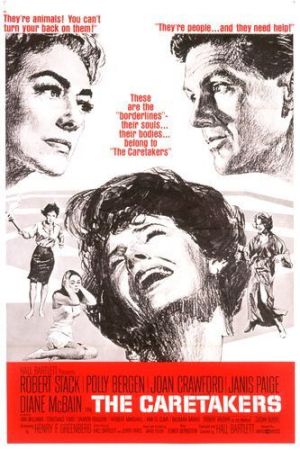
The_Caretakers_(1963_movie_poster)Whenever I go to Half-Price Books, I always seem to end up spending most of my time browsing the “nostalgia” section.  This is where they keep all of the old paperbacks that were published long before I was born.  This is where you can find old romance novels, “for adults only” novels, detective novels, and occasionally you’ll even find mainstream novels that were apparently considered to be quite daring when they were originally released.  These novels usually carry cover blurbs that brag about how controversial they are and how they deal with the “real issues of today.”

Usually, these novels are pretty silly and over-the-top which is why I always seem to end up buying a lot of them.  About a year ago, I bought a novel from 1959.  It was by Dariel Telfer and it was called The Caretakers.  The cover features a naked woman standing in front of several nurses and doctors.  The cover blurb announces that The Caretakers is “A shattering novel about nurses, doctors, and patients in a state hospital where emotions readily explode!”  The back cover features a pull quote from Time: “Will shock as well as arouse compassion.”

Now, I have to admit that I have yet to get around to actually reading The Caretakers.  However, thanks to TCM, I recently saw the 1963 film version and it’s a film that definitely embraces the melodrama.

How melodramatic is The Caretakers?  It’s melodramatic enough that it opens with Lorna Medford (Polly Bergen) stumbling into a movie theater and having a nervous breakdown.  Since this film was made in 1963, her mental breakdown is represented by spinning the camera around and getting hyperactive with the zoom lens, all while Bergen shrieks and tears at her hair.

Lorna is sent to a mental hospital, where she meets several other patients and is treated by Dr. MacLeod (Robert Stack), who is a rebel.  We know that he’s a rebel because everyone else at the hospital keeps telling him that he’s a rebel and complaining about his use of radical use of group therapy.  Under Dr. MacLeod’s guidance, Lorna reveals that she hasn’t gotten over the tragic death of her child.

As the film progresses, Lorna gets to know the rest of the patients.  They’re a mixed bunch, all played by actresses who clearly saw this as their chance to pick up an Oscar for Best Supporting Actress and were determined to make as big an impression as possible.  For instance, Barbara Barrie plays Edna, who never speaks but who does enjoy setting fires and who, whenever she’s feeling persecuted, poses as if she’s hanging from a cross.  And then there’s grandmotherly Irene (Ellen Corby), who is supposed to be the nice one but always looks like she’s on the verge of very sweetly shoving a pair of knitting needles into someone’s eyes.

However, my favorite patient was the cynical Marion (Janis Paige), precisely because she was so cynical and, as a result, she got all the best lines.  Marion is a former prostitute who now hates all men and Paige has a lot of fun playing the role.  Whenever Paige is giving one of her long, angry monologues, she practically grabs the film and refuses to let it go.

And then, of course, there’s Joan Crawford.  Crawford doesn’t play a patient.  Instead, she’s the head nurse and she doesn’t approve of Dr. MacLeod’s methods.  Crawford announces early on that she’s been attacked by a patient in the past and her main concern is protecting her staff.  She teaches a self-defense class.  If you’ve ever wanted to see a middle-aged Joan Crawford flip someone over, The Caretakers is a film to watch.

And that’s The Caretakers for you.  It’s one of those films that takes itself so seriously that it becomes humorous despite itself.  As a result, the film is a lot of unintentional fun.

And who knows?

Maybe someday, I’ll get around to reading the book!


Embracing the Melodrama #28: The Towering Inferno (dir by John Guillermin)


The_Towering_Inferno_1974-500x300

I have a weakness for the old, all-star disaster movies of the 1970s.  It could be because those movies remind me of how fragile life really is and encourage me to make the most of every minute.  Or maybe it’s because I have my phobias and, by watching those movies, I can confront my fears without having to deal with a real-life tornado, hurricane, tidal wave, avalanche, or fire.

Or maybe I just have a weakness of glitz, glamour, and melodrama — especially when it involves a huge cast of stars and character actors.  Yes that’s probably the reason right there.

Case in point: the 1974 best picture nominee, The Towering Inferno. 

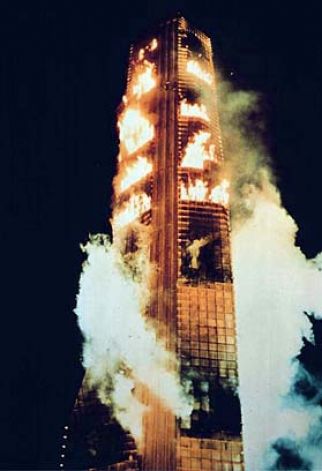
As is the case with most of the classic disaster films, The Towering Inferno is a long and big movie but it has a very simple plot.  The world’s tallest building — known as the Glass Tower — has been built in San Francisco.  On the night of the grand opening, a fire breaks out, trapping all the rich and famous guests on the 135th floor.  Now, it’s up to the fire department to put out the fire while the trapped guests simply try to survive long enough to be rescued.  Some will live, some will die but one thing is certain — every member of the all-star cast will get at least 15 minutes of screen time and at least one chance to scream in the face of the film’s still effective special effects.

628x471

As for the people trapped by the towering inferno, we don’t really get to know them or their motivations.  (Add to that, once the fire breaks out, everyone pretty much only has one motivation and that’s to not die.)  As a result, we don’t so much react to them as characters as we do to personas of the actors who are playing them.

Steve-McQueen-in-The-Towe-001

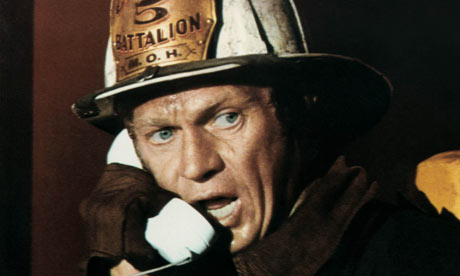
For instance, we know that Fire Chief O’Halloran is a fearless badass and a natural leader because he’s played by Steve McQueen.  McQueen brings a certain blue collar arrogance to this role and it’s a lot of fun to watch as he gets progressively more and more annoyed with the rich people that he’s been tasked with rescuing.

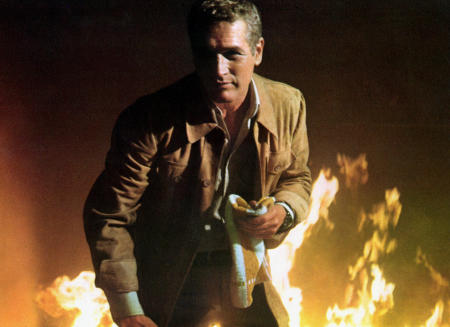
We know that architect Doug Roberts is a good guy because he’s played by Paul Newman.  Reportedly, Newman and McQueen were very competitive and, in this movie, we literally get to see them go-head-to-head.  And, as charismatic as Newman is, McQueen pretty much wins the movie.  That’s because there’s never a moment that O’Halloran isn’t in charge.  Doug, meanwhile, spends most of the movie begging everyone else in the tower to exercise the common sense necessary to not die.  (Unfortunately, despite the fact that he looks and sounds just like Paul Newman, nobody in the tower feels like listening to Doug.  If Towering Inferno proves anything, it’s that most people are too stupid to survive a disaster.)
paul-newman-inferno1

The tower’s owner, James Duncan, is played by William Holden so we know that Duncan may be a ruthless businessman but that ultimately he’s one of the good guys.  Holden gets one of the best scenes in the film when, after being told that people in the building are catching on fire, he replies, “I think you’re overreacting.”

Roger Simmons is Duncan’s son-in-law and we know that he’s ultimately to blame for the fire because he’s played by Richard Chamberlain.  Roger might as well have a sign on his back that reads “Doomed.”  The same can be said of publicity executive Dan (Robert Wagner) and his girlfriend, Lorrie (Susan Flannery).

The_Towering_Inferno_1974_Faye_Dunaway_Mike_Lookinland

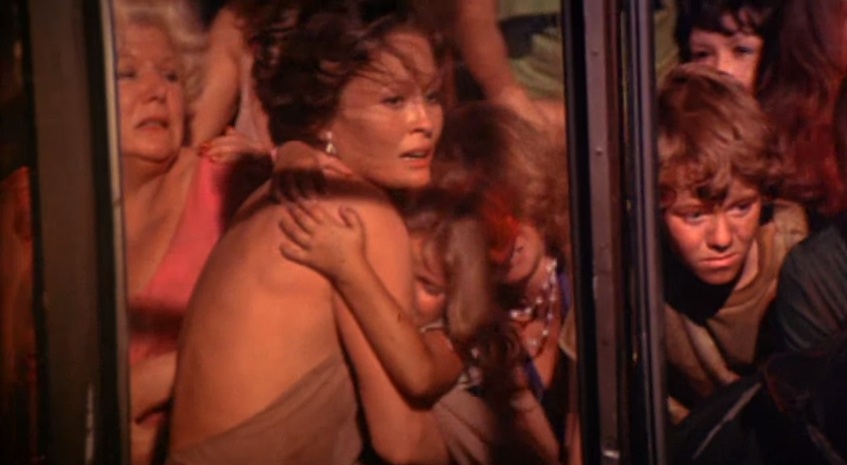
Faye Dunway is Susan.  She is Doug’s fiancée and she really doesn’t do much but she does get to wear a really pretty dress.  The same can be said of Susan Blakely, who plays Roger’s dissatisfied wife, and Jennifer Jones, who plays a recluse.  And good for them because if you’re going to be stuck in an inferno without much to do, you can at least take some comfort in looking good.

Then there’s Fred Astaire, who does not dance in this film.  Instead, he plays a kind-hearted con artist who ends up falling in love with Jennifer Jones.  Fred Astaire received his only Oscar nomination for his brief but likable performance in The Towering Inferno.

And finally, there’s the building’s head of security, Jernigan.  We know that he’s a murderer because he’s played by O.J. Simpson and … oh wait.  Jernigan is actually probably the second nicest guy in the whole film.  The only person nicer than Jernigan is Carlos, the bartender played by Gregory Sierra.

OJ

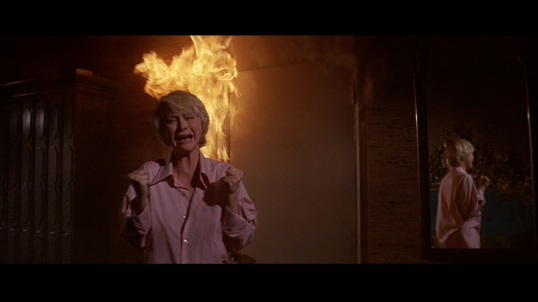
The real star of the film, of course, is the fire.  In the 40 years since The Towering Inferno was produced, there’s been a lot of advances in CGI and I imagine that if the film was made today, we’d be watching the fire in 3D and it would be so realistic that we’d probably feel the heat in the theater.  That said, the fire effects in The Towering Inferno are still pretty effective.  Now, I have to admit that I have a phobia (and frequent nightmares) about being trapped in a fire so, obviously, this is a film that’s specifically designed to work itself into my subconscious.  But that said, the scenes with various extras thrashing about in the flames are still difficult to watch.  There’s a scene where Robert Wagner and Susan Flannery find themselves trapped in a blazing reception area and it is pure nightmare fuel.
The Towering Inferno 9

The Towering Inferno is an undeniably effective disaster film.  At the same time, when one looks at the 1974 Oscar nominees, it’s odd to see The Towering Inferno nominated for best picture along with The Godfather Part II, Chinatown, and The Conversation.  Unlike those three, The Towering Inferno is hardly a great film.

But it is definitely an entertaining one.

toweringinferno2

Horror On The Lens: Starship Invasions (dir by Ed Hunt)


sinvs10

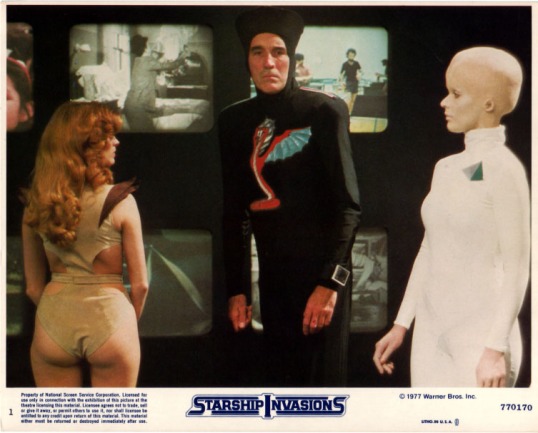
Today’s horror movie on the Shattered Lens is a 1977 Canadian film called Starship Invasions.  While at first glance, Starship Invasions may appear to be more of a science fiction film than a horror film, things do get pretty horrific once Christopher Lee starts shooting his suicide ray.

Here’s what you need to know about Starship Invasions:

1) Judging from the look of the film, it must have cost hundreds of dollars to make.

2) All of the aliens communicate through telepathy so, while you get to hear Christopher Lee’s voice, you never actually see his lips move.  I presume this was done because the filmmakers wanted to save money by shooting the majority of the film without sound.

3) In the UK, the film was released under the title Project Genocide, which just doesn’t have the same oddly generic charm as Starship Invasions.

4) Christopher Lee reportedly considers this to be one of his worst films.

5) However, the film is kind of fun in a bad, 1970s sort of way.

Add to that, how can you have a horror month without featuring at least one Christopher Lee film?

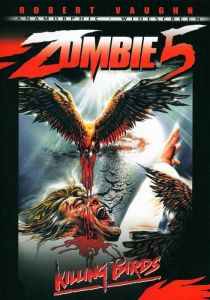
Film Review: Zombie 5: Killing Birds (dir. by Claudio Lattanzi and Joe D’Amato)


Thanks to the wonderful people at Anchor Bay, I recently watched Zombie 5: Killing Birds, one of the last of the old school Italian horror films.

Admittedly, when I first hit play on the DVD player, I was expecting the worst.  Of all the various official and unofficial sequels to Lucio Fulci’s masterpiece Zombi 2 (which, of course, was itself an unofficial prequel to Dawn of the Dead), Zombie 5: Killing Birds has the worst reputation.  While most Italian horror fans seem to agree that Zombie 4 is enjoyable on its own stupid terms and even Zombi 3 has a few brave defenders, its hard to find anyone willing to defend Killing Birds.  The general consensus has always seemed to be that Killing Birds is a generic and rather forgettable splatter film that, title aside, had absolutely nothing in common with the Fulci classic.

Having now seen Killing Birds, I can say that the general consensus, in this case, is largely correct.  Killing Birds is generic, predictable, and ultimately forgettable.  However, taken on its own terms, it’s a perfectly enjoyable way for a lover of zombie cinema to waste 90 minutes.  As long as you don’t compare it to Zombi 2, i’ts a perfectly tolerable piece of trash that actually has one or two memorable moments tossed randomly through its running time.  At the very least, its a hundred times better than Umberto Lenzi’s similar Black Demons.

The film deals with a bunch of grad students who, while searching for a nearly extinct species of Woodpecker, end up spending the night at a deserted house in Louisiana.  Many years ago, a brutal murder was committed at this house and, well, you can guess the rest.  The grad students end up falling prey to a bunch of zombies, largely because the students are all remarkably stupid.  Meanwhile, B-movie veteran Robert Vaughn shows up as Dr. Fred Brown, a blind man who spends his days studying birds.  There’s a lot of birds in this movie and its never quite clear how they link up to the living dead but they certainly do look menacing flying past the camera.

With the exception of Vaughn (who overacts just enough to keep things interesting without going so far over the top as to become ludicrous), the film’s cast is likeable but not memorable.  Everyone’s playing a stereotype (i.e., the leader, the computer geek, the slut, the girl with looks and brains) and no one makes much of an effort to be anything more than a stereotype.  While this certainly keeps Killing Birds from displaying anything resembling nuance, it’s also strangely comforting.  Its lets a neurotic viewer like me know, from the start, that there’s no need to think too much about anything she might see for the next hour and a half.  Since this movie was made in the late 80s, most of the men sport a mullet and all of the women wear those terribly unflattering khaki pants that I guess were all the rage back then.

As I stated before, the film does have its occasional strengths.  Some of the deaths are memorably nasty (even if the gore effects are decidedly cut-rate, pun not intended).  As well, the film does an excellent job at capturing the hot, humid atmosphere of the Louisiana bayous.  I’ve spent enough time in that part of the country that I can attest that the movie perfectly captures the stagnant heat and the way dehydration can cause your mind to play tricks on you.  While the zombies themselves are hardly as impressive as Fulci’s, the filmmakers wisely keep them in the shadows for most of the film and, if nothing else, this allows the viewer to imagine something scarier than what they’re actually seeing.  Finally, this movie does have one of the most effective nightmare sequences that I’ve ever seen.  Lasting barely a minute and not really having much to do with the overall plot, this nightmare still features some rather disturbing imagery.  One image, in particular, has so stuck with me that I found myself paying homage to it in a my own writing.

Though the movie’s director is credited as being Claudio Lattanzi, it is pretty much an open secret that the movie was actually directed by the infamous Joe D’Amato (who, regardless of what else he may have done during his storied life, also directed one of my favorite movies ever, Beyond The Darkness).  I’ve read a few interviews where D’Amato said that he allowed Lattanzi to be credited as director because he wanted to help Lattanzi’s launch his own career.  To judge by the movie itself, however, it seems more probable that Lattanzi wasn’t delivering the movie that D’Amato wanted and D’Amato stepped in as a result.  Regardless, Killing Birds is hardly the best example of D’Amato’s work but, at the same time, it’s hardly the worst either. 

In the end, Killing Birds is a movie that will probably be best appreciated by those who already have a good working knowledge of Italian exploitation films.  It’s hardly a masterpiece (and, despite enjoying it, I would hesitate to even call it a “good” movie) but it’s not really deserving of all the criticism that it’s received over the years either.  As a bonus, the Anchor Bay DVD come with a lengthy interview with Robert Vaughn in which he discussed his career in B-movies and, while Vaughn says nothing about Killing Birds during the interview, he’s still interesting and enjoyable to listen to.  Unlike a lot of “reputable” actors who have made B-movies, Vaughn never condescends to the films that both started and ended his movie career.