Masters of the Universe (1987, directed by Gary Goddard)


On the distant planet Eternia, the evil Skeletor (Frank Langella) has finally taken over Castle Grayskull and imprisoned the Sorceress (Christina Pickles).  When He-Man (Dolph Lundgren) and his allies Teela (Chelsea Field), Man-At-Arms (Jon Cypher), and Gwildor (Billy Barty) launch a rescue mission, they find themselves overwhelmed by Skeletor’s forces and are forced to use an interdimensional key to escape.

He-Man and his friends end up in 1980s California.  The key is lost in the process and discovered by two teenagers, one of whom is played by a pre-Friends Courteney Cox.  Skeletor sends Evil-Lyn (Meg Foster), Beast Man (Tony Carroll), and a host of other henchmen after the key.

The first (and, as of this writing, only) live action film to be based on the famous Mattel action figures, Masters of the Universe was produced by Cannon and it should have been a lot better than it actually was.  The idea of He-Man and Skeletor in modern-day California was a good one and it’s easy to imagine scenes of He-Man and Skeletor wandering around downtown Los Angeles and being as shocked by the locals as the locals are by them.  Big, blonde Dolph Lundgren seemed like the ideal pick for the role of He-Man.  Best of all, from the perspective of many, is that there was no Orko.  The most annoying member of the He-Man ensemble was left out of the film.  (Billy Barty’s Gwildor may have sometimes been annoying but he was still better than Orko.)

Unfortunately, the movie did not live up to anyone’s expectations.  Taking more inspiration for Star Wars and Conan than from any of the He-Man mythology, Cannon’s version of Masters of the Universe is a generic action movie in which He-Man is reduced to being just another forthright hero with a sword.  (He’s not Prince Adam in this movie.  He’s just He-Man.)   Teela doesn’t even wear her famous costume.  The main problem with Masters of the Universe is that so few of the Masters actually appear in the movie.  This was a Cannon/Mattel co-production but apparently, Mattel was stingy when it came to delivering their half of the budget.  There wasn’t enough money to bring He-Man’s rogue’s gallery (not to mention the majority of his allies) to life.  The means no Trap-Jaw and no Mer-Man.  Not even Ram Man makes the cut and this movie could have really used Ram Man.

Fortunately, Skeletor and Evil-Lyn are present to pick up the slack.  (When it came to the Masters of the Universe franchise as a whole, the villains were always more entertaining than the heroes.)  With the help of a surprisingly convincing makeup job that give him a skull face, Frank Langella appears to be having the time of his life as the evil Skeletor and I wasn’t surprised to recently read that this was one of Langella’s favorite roles.  Langella seems to having a blast playing such a thoroughly evil and cartoonish character and his scenes have a playful energy that the rest of the film is lacking.  Meg Foster, she of the piercing eyes, is the perfect choice for Evil-Lyn and is magnetically evil.  They provide some of the most entertaining villainy since Max von Sydow announced, “Klytus, I’m bored,” at the start of Flash Gordon.

Masters of the Universe was a critical failure when it was released in 1987, which isn’t a surprise.  A film based on a toy line and a children’s cartoon?  Maybe that would be an Oscar nominee today but, in 1987, there was no way the critics were going to go for it.  But Masters of the Universe was also a box office failure, one of many high-profile Cannon films that failed to score when it was first released.  (It did find a cult following when it was released on video.)  A proposed sequel — in which Lundgren would be replaced as He-Man by surfer Laird Hamilton — was abandoned.  The sets that had been built for Masters of the Universe 2 were instead used for Cyborg, starring Jean-Claude Van Damme.

A new live action Masters of the Universe film is scheduled to be released in 2026.  Jared Leto will be playing Skeletor.  That is probably all that needs to be said.


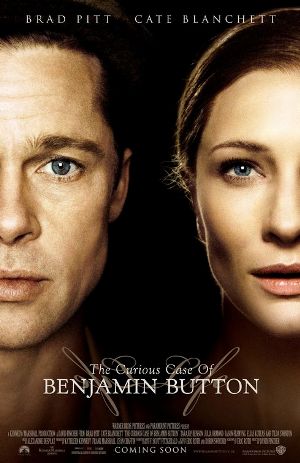
Embracing the Melodrama Part II #112: The Curious Case of Benjamin Button (dir by David Fincher)


Curious_case_of_benjamin_button_ver32010 will always be considered, by many of us, to be the year that Oscar journalism first jumped the shark.  That was the year that a group of self-styled award divas (which Awards Daily’s Sasha Stone being the most obnoxious culprit) went batshit crazy over a film called The Social Network.  

From the minute that David Fincher-directed film premiered, the Sasha Stones in the world not only declared it to be the greatest film ever made but also insinuated that anyone who disagreed had to be stupid, crazy, and evil.  It actually got rather silly after a while.  That is until The Social Network lost best picture to The King’s Speech.  Suddenly, what was once merely enthusiastic advocacy transformed into fascistic fanaticism.  Suddenly, these people started to view the 2010 Oscar race (and each subsequent Oscar race) as a rather tedious battle between good and evil.  For these people, David Fincher represented the forces of good.  And Tom Hooper, the director of The King’s Speech, represented all that was evil.  They took this to such an absurd extreme that they not only subsequently heaped undeserved praise on Fincher’s bastardization of The Girl With The Dragon Tattoo but also unnecessary scorn on Hooper’s Les Miserables.

Of course, what was forgotten in all of that drama was that — before Hooper and The King’s Speech came along, the 2010 Oscar race was predicted be some to be a rematch between Fincher and Danny Boyle (whose 2010 film, 127 Hours, was indeed nominated for best picture, alongside The Social Network, King’s Speech, and Black Swan).  When Fincher and Boyle previously competed during the 2008 Oscar race, Danny Boyle’s Slumdog Millionaire defeated Fincher’s The Curious Case of Benjamin Button.

And indeed, the case of Benjamin Button was curious one!

Loosely based on a short story by F. Scott Fitzgerald, The Curious Case of Benjamin Button told the story of a man who aged in reverse.  When Benjamin is a baby, he has the wrinkled face of an elderly man.  When he’s a teenager, he’s walking with a cane.  When he’s middle-aged, he looks like Brad Pitt in Legends of the Fall.  (In that regard, it helps that Benjamin is played by Brad Pitt.)  And when he’s an old man, he’s a baby.  Though the film, wisely, refrains from offering up a definite reason why Benjamin ages in reverse, it hints that it could have something to do with a clock that was built to run backwards as an anti-war statement.

Benjamin is born in New Orleans in 1918 and raised in a nursing home by Queenie (Oscar nominee and future Empire star Taraji P. Henson).  The love of Benjamin’s life is Daisy Fuller (Elle Fanning when young, Cate Blanchett as an adult), a dancer who also loves Benjamin but who, unlike him, is not aging in reverse.  For this reason, Benjamin and Daisy cannot be together.  That’s the way tragic love works.

The film itself features a framing device.  Daisy, now an elderly woman, is dying and gives her estranged daughter, Caroline (Julia Ormond), the diary of Benjamin Button.  As Caroline reads, Hurricane Katrina rages outside.  I’ve never really been comfortable with the way that the film uses Katrina as a plot point, for much the same reason that it bothered me when Hereafter used the real-life Thailand typhoon and London terrorist bombings to tell its story.  The real-life tragedy of Katrina feels out-of-place in a story about Brad Pitt aging backwards.

As for the rest of the film, The Curious Case of Benjamin Button is … well, it’s a curious film.  Visually, it’s definitely a David Fincher film but, at the same time, there’s something curiously impersonal about it.  You almost get the feeling that this was Fincher’s attempt to show that he was capable of making a standard big budget Hollywood film without getting too Fincheresque about it.  Brad Pitt and Cate Blanchett have chemistry and they look good together but Fincher has never been a sentimental director and his heart never truly seems to be in their love story.  (Ben Affleck and Rosamund Pike in Gone Girl feel more like a natural couple than Brad Pitt and Cate Blanchett do in this film.)  There’s only a few scenes, mostly dealing with the more morbid aspects of Benjamin’s odd condition, towards which Fincher really seems to feel any commitment.

As a result, The Curious Case of Benjamin Button becomes a curious misfire.  It’s a film that struggles with the big picture but is occasionally redeemed by some of its smaller moments.  (The scenes with the elderly Benjamin as a dementia-stricken baby are haunting and unforgettable.)  Ultimately, The Curious Case of Benjamin Button is probably the weakest of the five 2008 films nominated for best picture but it’s still an interesting film to watch.