Horror Film Review: The Mummy’s Ghost (dir by Reginald Le Borg)


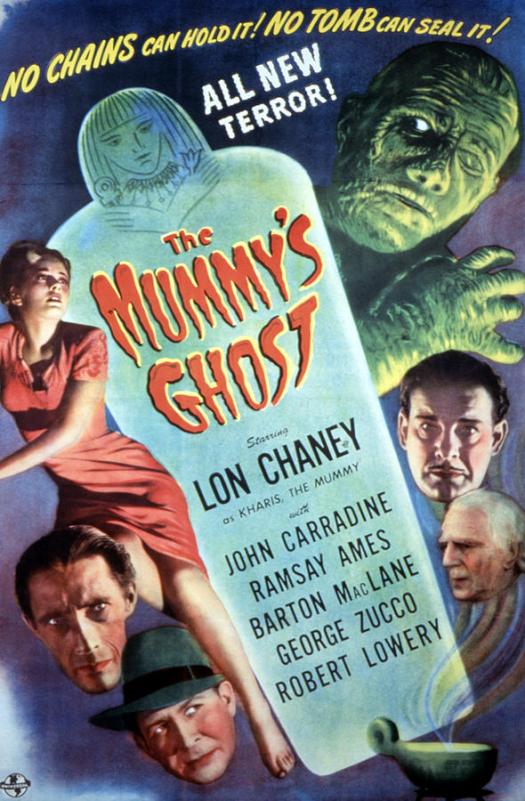
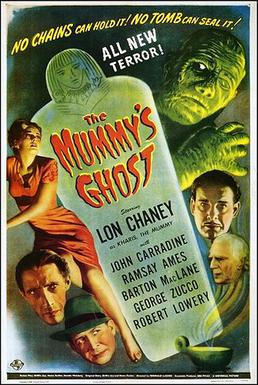
When we last checked in with Kharis the Mummy, he was trapped in the middle of an inferno in Massachusetts.  Having come to America to kill the members of the expedition that discovered the Tomb of Ananka and who brought Princess Ananka’s body to the United States, Kharis (Lon Chaney, Jr.) was trapped by the citizens of the town of Mapleton who, in the best tradition of Universal horror, cornered Kharis in a house and then set the place on fire.

1944’s The Mummy’s Ghost begins with the revelation that Kharis did not die in that inferno.  Somehow, he managed to escape and, rather improbably, he’s spent the last few years wandering around town without anyone ever noticing him.  The film presents Kharis as being largely a nocturnal creature but, even if he is only coming out at night, it still seems strange that no one would notice a mummy wandering around, especially since the entire town was traumatized by Kharis’s previous reign of terror.  As well, it’s also been established that Kharis owes his eternal life to an ancient Egyptian plant.  One reason why Kharis has always needed a “minder” is because Kharis needed someone who could keep him supplied with the plant.  So, if Kharis has been wandering around Massachusetts for the past few years, from where has he been getting the plant?

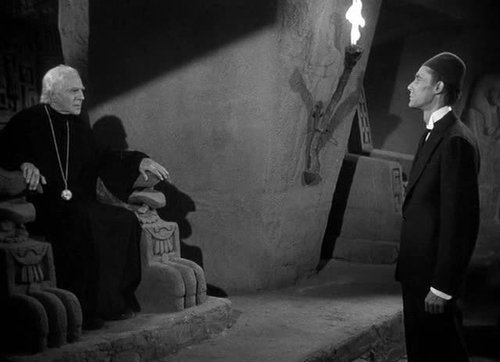
The Mummy’s Ghost also established that, in Egypt, High Priest Andoheb (Georg Zucco) is still alive.  This is somewhat surprising, considering that Andoheb died in both The Mummy’s Hand and The Mummy’s Tomb.  But no matter!  Andoheb is apparently still alive.  He’s really old and his hands shake but he’s still alive and he’s still determined to bring both Kharis and Princess Ananka back to Egypt.  This time, he sends Yousef Bey (John Carradine) to Massachusetts.

Yusef Bey takes over managing Kharis and he’s even able to supply Kharis with more of the special plant the keeps him alive.  However, Kharis grows upset when it discovers that Bey has tracked down the reincarnation of Ananka in the person of Amina (Ramsay Ames) and that, rather than return her safely to Egypt, Bey wants to give her eternal life with the help of the plant and then marry her.  This leads to Kharis going on a rampage and carrying Amina into a nearby swamp while Amina’s boyfriend, Tom Hervey (Robert Lowery), chases after them.

Full of plot holes and inconsistencies, The Mummy’s Ghost is about as silly as a mummy film can be.  If the previous films about Kharis managed to create a feeling of tragic inevitability as Kharis tracked down all of the people who had entered Ananka’s tomb, The Mummy’s Ghost presents Kharis as being something more akin to Frankenstein’s Monster, an inarticulate and easily frustrated creature who does things with little rhyme or reason.  That said, the film does make good use of Lon Chaney Jr’s hulking physicality as Kharis.  He’s still an intimidating figure when he goes after someone.  And John Carradine’s pained expression as Yousef Bey is memorable as a reminder of how much Carradine disliked most of the Universal monster films in which he found himself.  Otherwise, The Mummy’s Ghost is fairly forgettable.
Previous Universal Horror Reviews:

  1. Dracula (1931)
  2. Dracula (Spanish Language Version) (1931)
  3. Frankenstein (1931)
  4. Island of Lost Souls (1932)
  5. The Mummy (1932)
  6. The Invisible Man (1933)
  7. The Bride of Frankenstein (1935)
  8. Dracula’s Daughter (1936)
  9. Son of Frankenstein (1939)
  10. Black Friday (1940)
  11. The Invisible Man Returns (1940)
  12. The Mummy’s Hand (1940)
  13. The Wolf Man (1941)
  14. Ghost of Frankenstein (1942)
  15. Invisible Agent (1942)
  16. The Mummy’s Tomb (1942)
  17. Frankenstein Meets The Wolf Man (1943)
  18. Son of Dracula (1943)
  19. House of Frankenstein (1944)
  20. The Invisible Man’s Revenge (1944)
  21. House of Dracula (1945) 
  22. Creature From The Black Lagoon (1954)

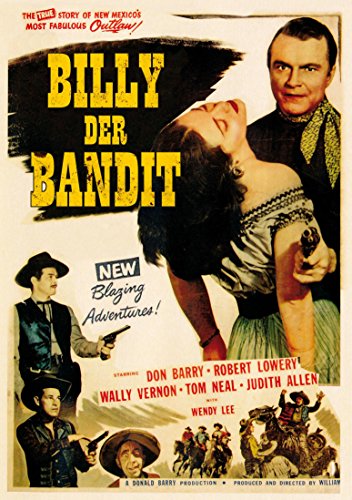
I Shot Billy The Kid (1950, directed by William Berke)


Sheriff Pat Garrett (Robert Lowery) tells the story of his friendship and later pursuit of Billy the Kid (Don “Red” Berry). As Garrett explains it, Billy could be a charming and likable outlaw but he just refused to go straight.  After Billy rescued Garrett from an Indian attack, Garrett even tried to arrange for Billy to get a pardon from New Mexico’s governor, Lew Wallace (Claude Stroud), but when the pardon didn’t arrive in time, Billy felt had been betrayed and continued his life as an outlaw.  Eventually, it fell upon Garrett to track down and put his old friend out of commission.

This film really should have been called I Shot Billy The Man because Don Berry was nearly 40 when he played Billy and he looked like he was closer to 50.  Berry makes the mistake of wearing  hair piece, which just makes it seem as if George Constanza somehow got cast as a notorious western outlaw.  As was true in even his worst westerns, Berry is a convincing gunslinger but he’s just not a very convincing kid.  Meanwhile, Robert Lowery is a boringly upright Pat Garrett.  There’s none of the moral ambiguity that’s present in some of the better retellings of the life of Billy the Kid.

Tom Neal, an authentic tough guy who is best remembered for starring in Detour and for sabotaging his own career by nearly beating actor Franchot Tone to death, appears as a member of Billy’s gang.  Neal was almost as old as Berry but it still seems like the film would have worked better if Neal has played Billy, Berry had played Pat, and Lowery would have taken the less important role of Charlie.  Neal would have brought some authentic toughness to the role while Berry’s onscreen charisma would have countered how boring the film’s version of Pat Garrett comes across as being.  As it is, with Berry miscast and Lowery giving a bland peformance and the entire movie limited by its low budget (it was produced by Robert Lippert, who made Roger Corman seem extravagant by comparison), I Shot Billy The Kid is one of the more forgettable films about the life of William Bonney.

Halloween Havoc!: THE MUMMY’S GHOST (Universal 1944)


gary loggins's avatarcracked rear viewer

THE MUMMY’S GHOST, Kharis the killer mummy’s third time around, finds the plot wearing a bit thin in this rehash, as once again the High Priests of Arkham… wait, what? Arkham? What happened to Karnak? Did the High Priests suddenly change religions? Just another example of continuity shot to hell in this series, though we do get an upgrade in the High Priest department with John Carradine boiling the tanna leaves instead of Turhan Bey .

At least George Zucco as Andoheb is still around to brief Yousef Bey (Carradine) on the plot up til now, dispatching him to Mapleton to fetch back Princess Ananka and Kharis to the temple, though the usual tanna leave spiel is upped from three to nine. There are no more Bannings in Mapleton, but still plenty of victims for Kharis to kill. Frank Reicher is back too, as Professor Norman, giving a lecture on…

View original post 435 more words

Film Review: The Rise and Fall of Legs Diamond (1960, directed by Budd Boetticher)


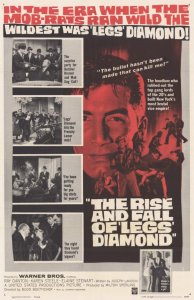
TheRiseFallofLegsDiamondIt’s the 1920s.  Prohibition is the law of the land and gangsters control the streets of New York City.  Jack Diamond (Ray Danton) and his tubercular brother, Eddie (Warren Oates), arrives in town.  Jack and Eddie are small-time jewel thieves but Jack has ambitions to be something more.  He works with his girlfriend, Alice (Karen Steele), as a dance instructor but he dreams of being the most powerful mobster in the world.  His first step is to get a job working as a bodyguard for New York crime lord (and fixer of the 1919 World Series), Arnold Rothstein (Robert Lowery).  Though Rothstein never trusts him, Jack works his way into his inner circle and even gets a nickname.  Because he is a dancer, he is renamed “Legs” Diamond.
From the minute that he starts working with Rothstein, Legs Diamond’s cocky personality and ruthless ambition make him enemies.  When he is shot three times, Legs shocks everyone by surviving and announces that he is invulnerable and cannot be killed.  After Rothstein is mysteriously gunned down, Diamond goes to war against Leo “Butcher” Bremer (Jesse White, better known as the original Maytag repairman) for control of the New York underworld.

The Rise and Fall of Legs Diamond was directed by the legendary Budd Boetticher, a bullfighter-turned-director who is best known for directing a series of low-budget westerns in the 1950s.  The violent and hard-boiled The Rise and Fall of Legs Diamond was Boetticher’s only gangster film and it’s a good one.  The Rise and Fall of Legs Diamond is tightly-written, fast-paced, and Lucien Ballard’s black-and-white cinematography ranks with the best of film noir.

The role of Legs Diamond was originally offered to future producer Robert Evans (of The Kid Stays In The Picture fame) but when Evans turned it down, the role was given to Ray Danton.  Though he is occasionally a little stiff, Danton still gives a good and tough performance as Diamond but it is still hard not to wonder what Evans would have been like in the role.  The rest of the cast is full of recognizable B-movie actors, all of whom do a good job.  Actress Dyan Cannon made her film debut in Legs Diamond, playing one of Diamond’s girlfriends.  Meanwhile, in only his third film role, Warren Oates is memorable and sympathetic as the sickly Eddie.  Though Oates does not get to do much in the film, his performance still shows why he went on to become one of the most popular and well-respected character actors of all time.

Though hardly historically accurate (in real life, Arnold Rothstein never knew Jack Diamond and Diamond received his nickname not because he was a dancer but because of the speed with which he ran away from the police), The Rise and Fall of Legs Diamond is an exciting and entertaining Depression-era gangster film.

LegsDiamond

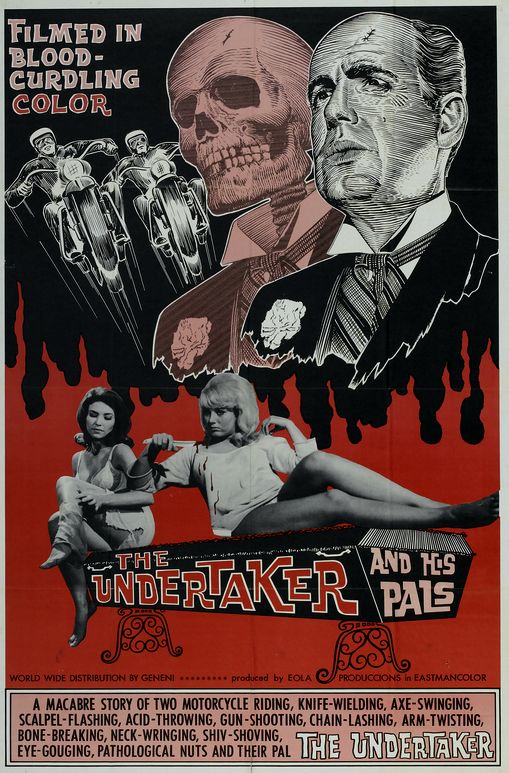
The Daily Grindhouse: The Undertaker and His Pals (dir by T.L.P. Swicegood)


undertaker_and_his_pals_poster_01

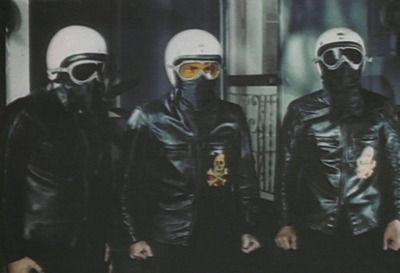
Say what you will about the overall quality of the 1966 horror-comedy, The Undertaker And His Pals, it has an absolutely brilliant opening shot.  One man on a motorcycle drives around in a circle in a parking lot.  He’s wearing a leather jacket and his features are hidden underneath a white helmet.  Soon, another man wearing a leather jacket and white helmet rides up on another motorcycle.  And again, they circle the parking lot.  And then, they’re joined by a third identically dressed man on yet another motorcycle and the three of them circle the parking lot before then driving off into the city.  The night is dark, the city streets are otherwise deserted, and the entire scene is tinted an otherworldly yellow.  It’s a truly creepy scene and, for those first few moments of the film, those three faceless riders are truly frightening.  If you ever watch The Undertaker and His Pals, be sure to appreciate that opening scene because nothing else in the film matches it.

It turns out that our three motorcycle riders are up to no good.  Two of them own a restaurant and, because they’re too cheap to actually order fresh meat, they kill people and serve them up as the special of the day.  The third one is the local undertaker.  Business has apparently been struggling so he’s started killing people so that he can get paid to provide them a funeral.  Apparently, half of each corpse is turned into lunch meat while the other half is put in a cheap, wooden casket at Shady Rest Funeral Parlor.

Now, here’s what makes The Undertaker and His Pal such a strange movie.  The murders are graphic and gory (and I imagine they were quite extreme for 1966) but the rest of the movie is an over-the-top comedy, full of bad puns and slapstick.  At the start of the film, while the latest victim is being stabbed to death, the camera continually cuts to a photograph of her sailor boyfriend, looking more and more upset with each cut.  Later, the undertaker accidentally steps on a skateboard and we watch as he uncontrollably careens into the middle of the street while everyone else in the film points and laughs.  When the undertaker finally falls off the skateboard, we even hear a waa waa on the soundtrack.  After the undertaker has his accident, the owner of the diner accidentally insults a customer and literally gets a custard pie thrown in his face.  (And again, we hear that waa waa.)

And then there’s the names!  The film’s first victim is named Sally Lamb.  The next day, the special at the diner is literally “Leg of Lamb.”  When an administrative assistant named Ann Poultry complains about the poor quality of her leg of lamb and threatens to call the health department, the next day’s special is “Breast of Chicken.”

Ann worked for and was dating a detective named Harry Glass (James Westmoreland, appearing here under the name Rad Fulton).  After her death, Harry is … well, Harry really doesn’t seem to care.  Harry is the film’s nominal hero but he really doesn’t do anything.  In fact, he is remarkably stupid.  Though he claims that he’s trying to solve his girlfriend’s murder, he seems to spend most of his time unknowingly eating her down at the diner.

The Undertaker and His Pals is weird and yet strangely watchable.  Of course, it helps that the film is only 66 minutes long and that the acting so cartoonish (and, I think, intentionally so) that it’s impossible to take the movie seriously.  (If the film was, in any way, believable, it would be almost unbearably grim and misogynistic.)  Fortunately, the film ends with clips of the entire cast coming back to life and laughing, letting us know that no one was intentionally harmed or traumatized and apparently, everyone had a great time making The Undertaker and His Pals.

I imagine the film was made to capitalize on the success of Herschell Gordon Lewis’s similarly over the top Blood Feast.  Ultimately, The Undertaker and His Pals works best as a weird time capsule of what was shocking in 1966.

undertakerpals5

The Daily Grindhouse: Revenge of the Zombies (dir by Steve Sekely)


revengeofzombies36

Last night, the Late Night Movie Crew and I watched the 1943 film, Revenge of the Zombies.

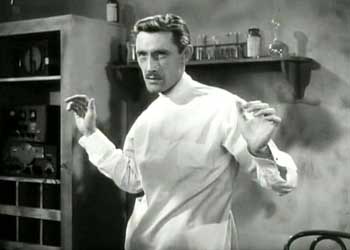
Revenge of the Zombies deals with the mysterious Dr. von Aldermann (John Carradine), who has a house on the Louisiana bayous and who is involved in weird, 1940s-style scientific experiments.  As is evident from his name (but not particularly from Carradine’s disinterested performance), von Aldermann is from Germany and his experiments are designed to create an army of zombies who will destroy American from within for the benefit for the Third Reich.  This is a pretty big deal and von Aldermann isn’t particularly subtle about his schemes but, as the film’s begins, nobody has figured out what’s going on.

I guess you can get away with anything on the bayous.

Von Aldermann’s wife Lila (Veda Ann Borg) has recently died but, thanks to the mad scientist, she’s still walking around Louisiana and leading an army of zombies.  Lila’s brother (Robert Lowery) shows up with a private investigator (Mauritz Hugo) and yet another mad scientist (Barry Macollum)  and they eventually figure out that something weird is happening.  With the help of von Aldermann’s secretary (Gale Storm), they try to thwart von Aldermann’s plans and keep the world safe for democracy.

There are a few good points about Revenge of the Zombies.  For one thing, the film is only 61 minutes long so the suffering is short.  As with any low-budget John Carradine horror film, Revenge of the Zombies is fun to watch with a group of snarky friends.  Historically, this film is significant for being one of the first zombie movies.  It’s always interesting to see how non-threatening zombies were in the days before George Romero and The Walking Dead.

revengeofzombies25

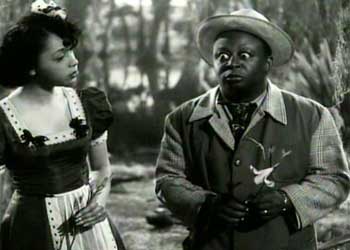
And then there’s the character of Jeff (Mantan Moreland), who is a chauffeur and who provides most of the film’s comic relief. It’s always difficult for contemporary audiences to deal with the racial attitudes displayed in the films and literature of the past.  On the one hand, Jeff is written as a complete and total stereotype and, as you listen to his dialogue, you’re painfully aware of the fact that the goal was to get audiences to laugh at him as opposed to with him.  On the other hand, Moreland is literally the only actor in the film who actually gives a good performance.  Even when delivering the most cringe-worthy of dialogue, Moreland does so with a conviction and commitment that holds your interest.  As you watch Revenge of the Zombies, you really don’t care what happens to most of the bland and interchangeable characters.  But you really do want Jeff to survive.

And, ultimately, you do take some comfort in that.  Moreland was given a role that, as written, was very demeaning but, in the end, Jeff is the only character that you care about.

As for the rest of Revenge of the Zombies, it’s short, it’s pretty bad but it’s not terrible, and you can watch it below!

http://www.youtube.com/watch?v=AOBM9kxpkoU