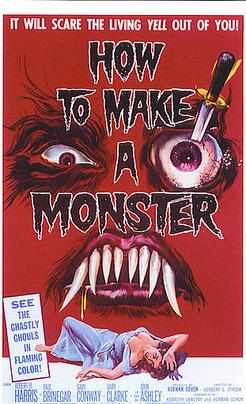
Released in 1958, How To Make A Monster is a clever little horror satire from American International Pictures in which the stars of Teenage Werewolf and Teenage Frankenstein are hypnotized into believing that they actually are the monsters that they played! The main culprit is a movie makeup artist (Robert H. Harris) who has been deemed obsolete by the new bosses at AIP.
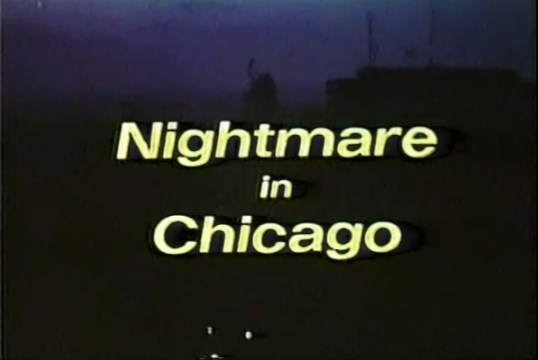
Taking place over the course of one very long day and night in December, this 1964 made-for-television movie opens with the discovery of a murdered woman in Indiana. She is the latest victim of a killer that the press has nicknamed “Georgie Porgie.”
Georgie Porgie, who has killed five blondes in the Midwest, is actually a nondescript man named Myron Ellis (Philip Abbott). Myron is middle-aged, short, and fairly normal-looking. That, along with the fact that he’s always moving, is one reason why he has yet to be captured. The only thing that really stands out about Myron is that, due to a medical condition, he is extremely sensitive to light and always wears dark glasses, even at night. When Myron isn’t murdering someone or stealing a car, he’s haunted by the voice of his dead sister.
Because he is a nomadic killer, the authorities in Chicago are worried that Myron is coming to their town next and it turns out that they’re correct. Myron is already in Chicago and he’s looking for his next victim. In a rather disturbing scene, he strangles a woman that he meets at a strip club, managing to do so without any of the many people around them even noticing. Myron wanders up and down the streets of Chicago, looking for his next victim. With his polite manners and his bland appearance, no one suspects that the polite man on the street corner is actually a murderer.
Police Commissioner Lombardo (Ted Knight) and Detectives McVea (Robert Ridgley) and Brockman (Charles McGraw) decide that the best way to catch the killer would be to set up a dragnet on the highway, stopping cars and shining flashlights at the drivers to see who has the weakest eyes. The only problem is that there is also a nuclear missile convoy scheduled to move through the city at the same time. With the highways congested and the killer not above wrecking his own car to throw the police off his trail, Lombardo tries to both capture the killer and make sure nothing happens to the convoy.
Nightmare In Chicago is a short and efficient thriller. It’s well-acted and rather serious in its approach. Especially when compared to more recent films with similar plots, Nightmare In Chicago deserves some credit for not trying to turn its serial killer into some sort of diabolical mad genius. Myron, like all serial killers in real life, is a maladjusted and rather stupid person who has only gotten away with his crimes due to pure luck. He’s not a Hannibal Lecter-style supergenius. Instead, he’s just a creep who has many, many issues. The film also does a good job of capturing the manic energy and eventual exhaustion of pulling an all-nighter. It’s an effective little film with a memorably sordid story.
For modern audiences, probably the most interesting thing about Nightmare in Chicago is that it was directed by Robert Altman and was, in fact, his second non-documentary film after The Delinquents. At the time he made this film, Altman was largely working in television. Nightmare In Chicago was one of the first made-for-TV movies and it was a ratings and critical success. Seen today, it’s easy to spot Altman’s trademark attention to detail in the film. While it’s far more straight-forward than the majority of his feature films, Nightmare in Chicago still displays the talent that eventually led to Robert Altman become one of Americas most important filmmakers.
Released in 1958, How To Make A Monster is a clever little horror satire from American International Pictures in which the stars of Teenage Werewolf and Teenage Frankenstein are hypnotized into believing that they actually are the monsters that they played! The main culprit is a movie makeup artist (Robert H. Harris) who has been deemed obsolete by the new bosses at AIP.
That’s the question at the heart of the 1975 film, The Man In The Glass Booth.
When we first meet Arthur Goldman (Maximilian Schell), he is a wealthy businessman who lives in a Manhattan high-rise and who appears to rarely leave the safety of his penthouse. He is waited on by two assistants, Jack (Henry Brown) and Charlie (Lawrence Pressman), both of whom he talks to and treats as if they are members of his own family. His most frequent visitor is his psychiatrist, Dr. Weissburger (Robert H. Harris), who frequently stops by and asks Arthur if he’s been taking his medication.
Arthur Goldman is a man who loves to talk. Indeed, the first hour of the film feels almost like a nonstop monologue on the part of Goldman, with just occasional interjections from the other characters. Goldman was born in Germany. He talks about how, when he was young, he and his family were sent to a concentration camp and it was there that he witnessed the murder of his father by the camp’s sadistic commandant, Dorff. Dorff is one of the many Nazis who disappeared to South America at the end of the war.
When Goldman spots a car that always seems to be parked across the street from his building, he becomes paranoid. He says that he’s being watched and even suggests that Dorff has come to capture him. Instead, it turns out that Mossad come for him. As the agents explain it to Charlie, dental records prove that Arthur Goldman is actually Commandant Dorff. Goldman/Dorff is taken back to Israel to stand trial for his crimes.
Are Arthur Goldman and Dorff the same man? Once in Israel, Goldman tells anyone who will listen that he is Dorff and that he feels no guilt for his actions. He insists on being allowed to wear his SS uniform during the trial. Because of threats to his safety, a booth made of bullet-proof glass has been placed in the courtroom. As the trial commences, The Man in the Glass Booth continues to rant and rave and declare his guilt. However, the prosecutor (Lois Nettleton) comes to doubt that the man is who he says he is.
The Man In The Glass Booth is based on a novel and play by Robert Shaw. (The same year that The Man In The Glass Booth was released, Shaw played Quint in Jaws.) The film was produced as a part of an experiment called American Film Theatre, in which well-known plays would be adapted to film and then would be shown at 500 participating movie theaters in America. Each production would only be shown four times at each theater and subscriptions were sold for an entire “season” of films. It sounds like an interesting experiment and the type of thing that I would have enjoyed if I had been around back then. Today, of course, these productions would have just premiered on a streaming service.
The Man In The Glass Booth is a film that very much feels like a filmed play. There are only three locations — Goldman’s penthouse, his cell, and the courtroom where he is put on trial. The three act structure is very easy to spot. Maximilian Schell’s performance is also very theatrical. In fact, it’s so theatrical that, for the first hour or so, I found myself wishing that he would just stop talking for a few second or two. He was so dramatic and so flamboyant and so intentionally over-the-top that he became somewhat exhausting. But, during the second hour, I came to see that all of that “overacting” was actually setting up the film’s final act. Schell talks so much that, when he finally does find himself unable to explain himself, it’s a shocking moment and one that perfectly captures not just the evil of the Nazis and the Holocaust but also how the legacy of that evil lives on after the fall of the Third Reich and the deaths of the majority of the Holocaust’s perpetrators. At that moment, I realized that The Man In The Glass Booth never stopped speaking because silence would force him to confront the horrors of the past and the trauma, guilt, and uncertainty lurking in his subconscious. Maximilian Schell was nominated for an Oscar for his performance here and, by the end of the film, I totally understood why.
The Man In The Glass Booth requires some patience. Actually, it requires a lot of patience. However, those who stick with it will discover an intelligent and thought-provoking film about not only the horror of the past but also how those in the present deal with and rationalize those horrors. Though the film is a bit too stagey for its own good, it’s also one that sticks with you even after the curtain falls and the end credits roll.
According to this 1958 film, the man to ask is Pete Dumond!
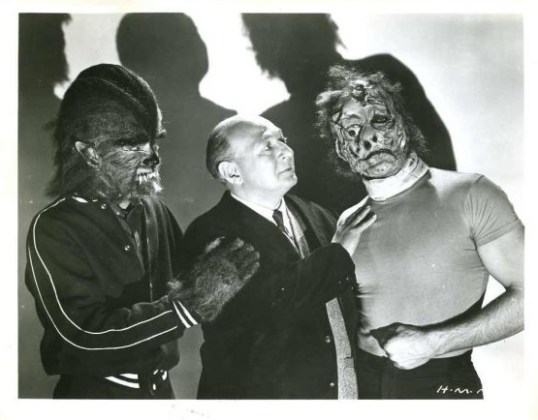
As played by Robert H. Harris, Pete Dumond is the chief make-up artist at American International Pictures. He’s so good that he can easily transform handsome teen idols like Tony Mantell (Gary Conway) and Larry Drake (Gary Clarke) into convincing monsters. Everyone loves Pete but there’s a problem. As the new studio head explains it, horror just isn’t that popular anymore. Teenagers are no longer interested in seeing movies about werewolves and Frankenstein’s Monster. Instead, teens now only care about rock and roll. Elvis has killed horror!
(Actually, the film argues that a recording artist named John Ashley killed horror. At the time this movie was made, John Ashley was under contract to American International Pictures and the film even includes a dance number where Ashley performs his latest hit. Ashley wasn’t a bad singer but it’s still hard to believe that he could have killed horror. That said, the choreography is fun and every horror movie needs at least one random dance number.)
Sadly, Pete is about to be out of a job. However, what the studio heads don’t realize is that Pete is more than just a makeup artist! He’s also a master hypnotist! Soon, Pete is using a special foundation cream to hypnotize Tony and Larry. Once he has them under his control, he sends them, in full costume, on a mission to kill anyone who thinks that horror is dead!
There’s a lot of enjoyment to be found in How To Make A Monster. The film not only takes place at American International Pictures but it was produced by AIP as well, so the entire movie is basically full of in-jokes that would only be appreciated by B-movie fans. For instance, the makeup effects that Pete creates are the same ones that were used in I Was A Teenage Frankenstein and I Was A Teenage Werewolf. (Gary Conway wore the Frankenstein makeup in both Teenage Frankenstein and this film.) Towards the end of the film, when Larry and Tony confront Pete at his home, the walls are decorated with all of the monsters that Pete has created throughout the years and attentive viewers will recognize them as coming from such previous AIP films as The She-Creature, It Conquered The World, and Invasion of the Star Creatures. (Seriously, I loved seeing the big crab monster from It Conquered The World hanging on Pete’s wall. I’m sure horror and sci-fans in the 1950s felt the same way.) While the majority of the film is in black-and-white, the scenes in Pete’s home are in full and vibrant color, as if AIP was announcing, “This is what makes the movies fun!”
Needless to say, How To Make A Monster is not a film that was ever meant to be taken seriously. Instead, it’s a rather cheerful send-up of both the film business and AIP’s own status as a B-studio. (At times, I felt like the film could just as easily have been called Sam Arkoff’s The Player.) Watching the film, one gets the feeling that it was largely made as a lark, an inside joke amongst friends. As such, it’s impossible to dislike this energetic little film. Director Herbert L. Strock keep the action moving along and, in the lead role, Robert H. Harris gives exactly the type of over-the-top performance that this material needs.
If you’re a fan of 50s drive-in movies, How To Make A Monster is a film that you simply must see!
Released in 1958, How To Make A Monster is a clever little horror satire from American International Pictures in which the stars of Teenage Werewolf and Teenage Frankenstein are hypnotized into believing that they actually are the monsters that they played! The main culprit is a movie makeup artist (Robert H. Harris) who has been deemed obsolete by the new bosses at AIP.
Released in 1958, How To Make A Monster is a clever little horror satire from American International Pictures in which the stars of Teenage Werewolf and Teenage Frankenstein are hypnotized into believing that they actually are the monsters that they played! The main culprit is a movie makeup artist (Robert H. Harris) who has been deemed obsolete by the new bosses at AIP.
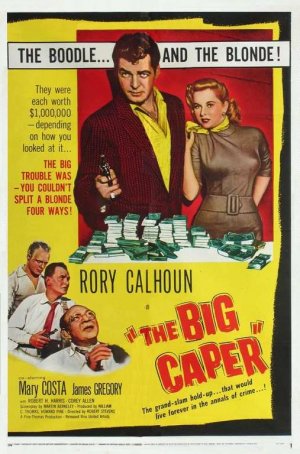
For our next Netflix Noir, we take a look at a heist film from 1957, The Big Caper.
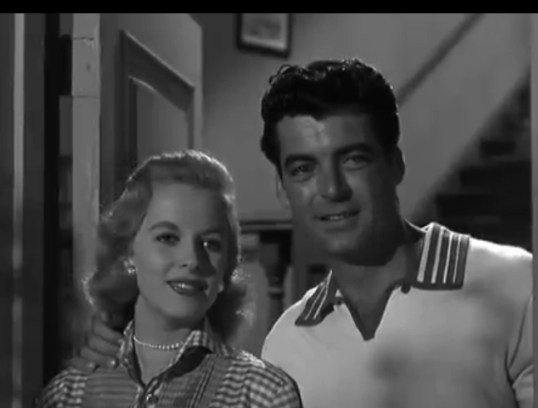
Frank (Rory Calhoun) is a small time criminal with a plan. He knows that there’s a Marine base near the small town of San Felipe, California and he also knows that, during the weekend before payday, the San Felipe bank will be holding a million dollar payroll for those Marines. He proposes to Flood (James Gregory), a wealthy crime boss whom Frank idolizes, that they should find a way rob that bank over the weekend. Flood agrees to the plan.
While Flood recruits some help for the robbery, Frank and Flood’s girlfriend, Kay (Mary Costa), move into the town and set themselves up as a part of the community. Using Flood’s money, Frank buys a gas station and he and Kay move into a nice suburban house. At first, Frank resents being forced to live like a “square.” He bitterly complains that the local San Felipe newspaper doesn’t even tell him “how the horses did.”
But then something odd happens. Frank starts to enjoy being a member of the community. Soon, the gas station is making a profit and Frank is even thinking about buying a second one. Oddly enough, his becomes best friends with the local cop.
As for Kay, she transitions to respectability even before Frank does. As she eventually confesses to Frank, she’s tired of being treated like Flood’s property. She wants to stay in San Felipe and make a life for herself. Wearily, Frank tells her that she better hope that Flood doesn’t find out…
Meanwhile, Flood has recruited together his gang and they’re not exactly the most impressive bunch of criminal masterminds. There’s Roy (Corey Allen), a physical fitness fanatic who is almost childlike in his devotion to Flood. There’s Harry (Paul Picerni), who demands that his girlfriend Doll (Roxanne Arlen) be a part of the scheme.
And then there’s Zimmer (Robert H. Harris), a bald, sweating pyromaniac who spends most of his time begging for alcohol and lighting matches. Zimmer arrives at Frank’s house unannounced and Frank is forced to pretend that Zimmer is his uncle.
Once Flood and the rest of the gang arrive, Frank starts to prepare for the robbery but he soon discovers that he’d rather be barbecuing with the neighbors.
The Big Caper is a clever little film, one that features excellent performances (especially from Gregory, Calhoun, Allen, and Harris) and tons of hard-boiled dialogue. What makes this film especially memorable is the way that it contrasts the fake respectability of the wealthy Flood with the newfound, but genuine, respectability of Frank and Kay.
If The Big Caper was made today, it would probably be directed by the Coen Brothers and Ben Affleck and Ray Liotta would play Frank and Flood respectively. However, the film works just as well with Rory Calhoun and James Gregory and is totally worth seeing.

 Through the Shattered Lens