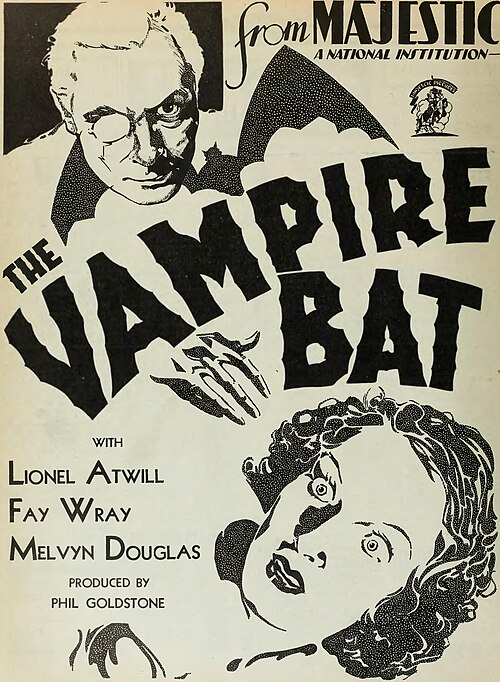
In 1933’s The Vampire Bat, people are dying in a small German village, victims of blood loss. A woman named Martha Mueller (Rita Carlisle) was recently attacked by a bat, leading to rumors of a vampire. When the local town eccentric, a twitchy man named Hermann Glieb (Dwight Frye), argues that bats are actually harmless and admits that he likes bats because they are “soft” and “nice,” people start to suspect that he might be the vampire. Another man named Kringen (George E. Stone) claims that he was attacked by a vampire and insinuates that it was Glieb. Glieb may seems like a strange man who likes to collect bats but could he be something even more sinister?
Two town leaders have opposite feelings about the claim that a vampire is attacking the town. Karl Brettschneider (Melvyn Douglas) is the local police inspector and he deals with facts. He doesn’t believe in superstition and he initially scoffs at the idea that a vampire is attacking the village. Meanwhile, Dr. Otto von Niemann (Lionel Atwill) is the town’s doctor. He’s been treating the victims of the bat attacks and he’s even be letting some of his patients live at his home. Everyone knows that Dr. von Neimann is a kindly man of science. Karl is even dating Ruth (Fay Wray), one of Otto’s boarders. But is the doctor as benevolent as everyone assumes?
When answering that question, consider these four facts:
- Dr. von Neimann is the one who encouraged Kringen to spread stories about a vampire haunting the town, despite the fact that Kringen himself said that he didn’t want to start a panic.
- Dr. van Niemann is played by Lionel Atwill.
- Glieb is played by Dwight Frye.
- Karl is played by Melvyn Douglas.
Indeed, for horror fans, the casting of Lionel Atwill gives the game away. Lionel Atwill appeared in a number of horror films and it was rare that he wasn’t cast as the villain. (One of his non-villainous role was as the one-armed Inspector Krogh in The Son of Frankenstein.) From the minute the viewer sees Atwill, he seem to give off sinister vibes and it’s not really a surprise when he turns out to be less than trustworthy.
As for Dwight Frye, horror fans love him for playing a number of unhinged weirdos, like Renfield in the Lugosi-version of Dracula and the torch-bearing servant in Karloff’s Frankenstein. Frye was good at playing twitchy types but one thing that all of Frye’s characters had in common is that they were pretty much destined to be victims. Even when Frye played an unlikeable character, like in Frankenstein, it was obvious that he was going to end up getting killed at the hands of the Monster.
Finally, Melvyn Douglas was the epitome of propriety in every film in which he appeared. If Douglas thinks that there is something more going on than just a vampire attacking people, there probably is. And since we know Douglas can’t be the main bad guy, that pretty much just leaves Lionel Atwill.
The Vampire Bat is a short and enjoyable B-movie that puts an interesting spin on the typical vampire legend. Though the budget may be low, the cast of Atwill, Douglas, Frye, and Wray can’t be beat and all of them give fully committed performances. Dwight Frye, in particular, gives one of his best performance as the unfortunate Glieb. As always, Lionel Atwill makes for an entertaining villain. At its best, The Vampire Bat comments on the power of hysteria. Convinced that there is a vampire in their midst, the town goes mad and it directs its anger towards those who are seen as being on the outside, men like Glieb.
The Vampire Bat is more than worthy of your Halloween viewing.
 Treasury agent Pat Doyle (John St. Polis) is sent to investigate a counterfeiting ring in Wyoming but ends up getting kidnapped by gang leader Sharpe (Karl Hackett) instead. With Doyle’s daughter, Joan (Suzanne Kaaren), demanding that the government rescue her father and generating all sorts of bad publicity for the Secret Service, the decision is made to send in Tim Hayes (Tim McCoy). Hayes, who will be working undercover, is selected because he’s not a “city boy.” He’s a cowboy, through and through. If you want to tame the west, you have to send a cowboy.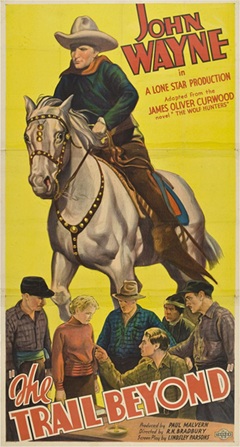
 Through the Shattered Lens