Horror On TV: The Dead Don’t Die (dir by Curtis Harrington)


For today’s horror on television, we have a 1975 made-for-television movie called The Dead Don’t Die!

The Dead Don’t Die takes place in Chicago during the 1930s.  George Hamilton is a sailor who comes home just in time to witness his brother being executed for a crime that he swears he didn’t commit.  Hamilton is convinced that his brother was innocent so he decides to launch an investigation of his own.  This eventually leads to Hamilton not only being attacked by dead people but also discovering a plot involving a mysterious voodoo priest!

Featuring atmospheric direction for Curtis Harrington and a witty script by Robert Bloch, The Dead Don’t Die is an enjoyable horror mystery.  Along with George Hamilton, the cast includes such luminaries of “old” Hollywood as Ray Milland, Ralph Meeker, Reggie Nalder, and Joan Blondell.  (Admittedly, George Hamilton is not the most convincing sailor to ever appear in a movie but even his miscasting seems to work in a strange way.)

And you can watch it below!

Enjoy!

Last Night Retro Television Review: Monsters 1.7 “The Legacy”


Welcome to Late Night Retro Television Reviews, a feature where we review some of our favorite and least favorite shows of the past!  On Wednesdays, I will be reviewing Monsters, which aired in syndication from 1988 to 1991.  The entire show is streaming on Tubi.

Tonight’s episode of Monsters is …. surprisingly good!

Episode 1.7 “The Legacy”

(Directed by Jeffrey Wolf, originally aired on December 3rd, 1988)

Dale (David Brisbin) is a film teacher and a writer who is hoping to make his name and reputation by writing the authoritative biography of actor Fulton Pierce.  Pierce was silent film horror actor who, much like Lon Chaney Sr, was noted for his ability to physically transform himself into the monsters that he was playing.  Dale not only wants to write about the events of Pierce’s life but he also wants to explain how Pierce was able to play so many different monsters.

In order to get into Pierce’s mind, Dale moves into Pierce’s former home.  When Dale comes across Pierce’s old makeup box, he is convinced that he’s finally found the secret of Pierce’s success.  When he opens the makeup box and looks at the mirror within, he seems not his face but instead the face of some of Pierce’s most fearsome characters, including a disfigured monster and a cackling mad scientist.

For the record, the mirror apparitions are inspired by The Cabinet of Dr. Caligari, Thomas Edison’s Frankenstein, Phantom of the Opera, and maybe London after Midnight.

Dale’s girlfriend, a model named Debbie (Lara Harris), fears that Dale is wasting his time on a book that no one is going to care about.  When she drops by the house and discovers that Dale hasn’t even been able to come up with an opening line for his masterpiece, she gives him an ultimatum.  He can either spend the rest of his life trying to write his book or he can marry her but she’s not going to wait forever.  She tells him to “Make up your mind!” Dale latches onto the phrase “Make up your mind!,” shouting that he now knows how Fulton Pierce pulled off his amazing transformations.
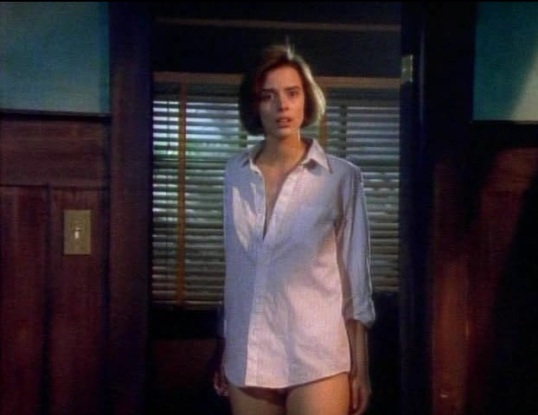
I was pretty much wearing the same outfit when I watched this episode.

At first Debbie thinks that she has made a real break-through with Dale but later, that night, she wakes up to find Dale standing in front of a mirror and staggering around like one of Fulton Pierce’s monsters.  She also discovers that the first chapter of the book is just the phrase Make Up Your Mind written over and over again.  Has Dale’s obsession led him to madness or has he truly been possessed by the spirit of Fulton Pierce?

Someone’s losing it.

This episode of Monsters was based on a short story by Robert Bloch and certainly, the plot is more intriguing than any of the stories that preceded it.  How exactly does an actor become a character and, more importantly, can you play a monster without becoming one yourself?  Can one enter the mind of a madman without becoming mad themselves?  (One wonders if Bloch, who was reportedly very much a no-nonsense personality, was satirizing the excesses of method acting.)  Though the episode is only 21 minutes long, the story doesn’t feel rushed and the deliberate pace helps to create a properly ominous atmosphere.  Add in two strong performances from David Brisbin and Lara Harris and you have the best episode of Monsters so far.
Horror on TV: Ghost Story 1.8 “House of Evil” (dir by Daryl Duke)


Tonight’s episode of Ghost Story is full of stars!

Evil grandpa comes to visit his family and, with the help of voodoo cookies (you read that right), he tries to manipulate his deaf and mute granddaughter into helping him kill everyone!  Grandpa is played by Melvyn Douglas.  His granddaughter is played by Jodie Foster!  And the script was written by none other than Robert Bloch and Richard Matheson!

This episode originally aired on November 10th, 1972.

Horror On The Lens: The Dead Don’t Die (dir by Curtis Harrington)


For today’s horror on the lens, we have a 1975 made-for-television movie called The Dead Don’t Die!

The Dead Don’t Die takes place in Chicago during the 1930s.  George Hamilton is a sailor who comes home just in time to witness his brother being executed for a crime that he swears he didn’t commit.  Hamilton is convinced that his brother was innocent so he decides to launch an investigation of his own.  This eventually leads to Hamilton not only being attacked by dead people but also discovering a plot involving a mysterious voodoo priest!

Featuring atmospheric direction for Curtis Harrington and a witty script by Robert Bloch, The Dead Don’t Die is an enjoyable horror mystery.  Along with George Hamilton, the cast includes such luminaries of “old” Hollywood as Ray Milland, Ralph Meeker, Reggie Nalder, and Joan Blondell.  (Admittedly, George Hamilton is not the most convincing sailor to ever appear in a movie but even his miscasting seems to work in a strange way.)

And you can watch it below!

Enjoy!

Horror Book Review: Psycho II by Robert Bloch


So, first things first.

This 1982 novel by Robert Bloch is indeed a sequel to the novel that inspired Alfred Hitchcock’s legendary horror film.  Yes, Norman Bates does return.  For that matter, so do Lila and Sam Loomis.  However, this novel should not be mistaken for Richard Franklin’s film, Psycho II, which came out a year later.  In fact, according to a later interview with Robert Bloch, Universal actually pressured him not to release this novel because they disliked the story Bloch had come up with and they also felt it would harm the financial prospects of their sequel.  Bloch, of course, did what he wanted to and was subsequently not invited to any screenings of Franklin’s film.

As for Bloch’s novel, it’s easy to see why Universal wasn’t enthusiastic about it.  It’s perhaps one of the most anti-Hollywood books ever written.  When Norman Bates escapes from a mental asylum and goes on another rampage, his doctor, Adam Claiborne, is convinced that Norman is heading to Hollywood to try to stop production of a movie called Crazy Lady, a movie that’s based on Norman’s crimes.  Even though everyone else is convinced that Norman’s been killed, Claiborne remains convinced that Norman faked his own death and is still out there.

Needless to say, the book’s Norman is considerably different from the vulnerable manchild that Anthony Perkins played in the films.  However, Norman is off-stage for the majority of Bloch’s sequel, the better to keep you wondering whether or not he actually is dead.  The majority of the book is dedicated to Claiborne getting to know the cast and crew of Crazy Lady, the majority of whom turn out to be sleazy Hollywood stereotypes.  Reading the book, it’s easy to see why Universal didn’t care much for it but, at times, Bloch occasionally comes across as if he think he’s the first person to ever be critical of Hollywood.

Another reason why Universal may have balked at adapting Bloch’s novel was because of a surreal chapter in which Paul Morgan, the actor who has been cast to play Norman, goes undercover at a brothel where all of the escorts look like then-Hollywood stars.  Since each escort is referred to by his star’s name, the entire chapter is basically Robert Redford, Clint Eastwood, and John Travolta making bitchy comments about Hollywood and religion.  It’s an odd chapter that doesn’t advance the story but, at the same time, it’s also Bloch at his most subversive.

Though the book’s take on Hollywood was hardly revolutionary, Bloch was a born storyteller and the story moves at a good pace.  It all ends with an effective twist, one that provides a proper ending to Bloch’s version of the Norman Bates story.  For Psycho and Bloch fans, it’s a must read.

Horror On TV: Thriller 1.28 — Yours Truly, Jack The Ripper (dir by Ray Milland)


Since I reviewed Robert Bloch’s novel, The Night of the Ripper, earlier today, it seems only appropriate that tonight’s excursion into televised horror should be based on another Robert Bloch story about Jack the Ripper!

Yours Truly, Jack The Ripper is a classic episode of the 60s anthology series, Thiller.  This episode aired on April 11th, 1961 and it was directed by the Oscar-winning actor, Ray Milland!

Enjoy!

http://www.youtube.com/watch?v=CtILSL5bDsY


Book Review: Night of the Ripper by Robert Bloch


As you might guess from the title, Night of the Ripper is set in London in 1888.  A shadowy figure is haunting the foggy alleyways of Whitechapel, savagely murdering prostitutes, terrifying the public, and leaving the police baffled.  In the taunting letters that he writes to the authorities, he says that his name is Jack.

Jack the Ripper, to be exact.

With both high and low society demanding an end to the murders, can the respected and determined Inspector Abberline discover the true identity of Jack the Ripper and bring his reign of terror to an end?  Helping him out will be an American doctor named Mark Robinson.  Robinson is an expert in a developing science called psychology but will that be enough?

*sigh*

This 1984 novel from Robert Bloch is an unfortunate misfire.  I say that as someone who has spent a countless amount of time reading about the murders and all of the identified suspects.  (Back in March, when Jeff and I were in London, we went on one of those Jack the Ripper walking tours.  It was wonderfully creepy!)  A century after his crimes, Jack the Ripper continues to fascinate us because, not only was he the first widely identified serial killer, but it also appears that he got away with it.  The police may have speculated that Jack was a disgraced lawyer who committed suicide after the murder of Mary Kelly but they never actually presented any evidence to back that up.  Over the last 130 years, countless people have been accused of being Jack the Ripper, everyone from an anonymous Russian doctor to Lewis Carroll to the son of Queen Victoria.  Solely based on the fact that she didn’t care much for his paintings, Patricia Cornwell wrote an entire book arguing that the artist Walter Sickert was the murderer.  In all probability, Jack the Ripper was an anonymous nobody but he’s become such a huge figure in the popular imagination that it’s difficult for many to accept that he was probably just a sexually dysfunctional loser who hated women.  Instead, elaborate conspiracy theories are pursued and films like Murder by Decree and From Hell are produced.

Bloch’s novel features plenty of prominent Victorians, though none of them are identified as suspects.  Oscar Wilde, Joseph Merrick, Conan Doyle, and Robert Lees all show up and then quickly disappear from the story.  When Bloch does eventually reveal the identity of Jack the Ripper, he turns out to be a minor character who was first introduced just a few chapters previously.  It’s a bit of a letdown.

Actually, the whole book is a letdown.  It comes across as if it was written in haste and Bloch’s attempt to give the story some gravitas by opening the final few chapters be describing ancient torture methods doesn’t really have the effect that I presume he was going for.  It’s a disappointment because, after all, this is Robert Bloch that we’re talking about.  Bloch not only wrote Psycho but he also wrote Yours Truly, Jack the Ripper, one of the best short stories ever written about Jack.

Read the short story but avoid the novel.  And if you ever get a chance to take a Jack the Ripper walking tour, do it!

Horror on TV: Thriller 2.16 “Waxworks” (dir by Herschel Daugherty)


In this episode of the Boris Karloff-hosted anthology series, Thriller, murders are being committed all over Europe.  What do all of the murders have in common?  They have all happened outside of the same traveling wax museum!

Is it a coincidence or are the wax figures coming to life and committing murder?

This episode was written by Robert Bloch of Psycho fame and originally aired on January 8th, 1962.

http://www.youtube.com/watch?v=4zBYLUP_Pu8

Horror on TV: Thriller 2.4 “The Weird Tailor” (dir by Herschel Daugherty)


On tonight’s episode of Thriller, we see what happens when an aspiring sorcerer (George MacReady) accidentally kills his son.  In order to brings his son back to life, he has to have a special suit made by the weird tailor of the title (played by Henry Jones).

This is one of the better episode of Thriller.  For once, the use of the word “weird” in the title is not a misnomer!  This one was written by Robert Bloch, who adapted his own short story.  It originally aired on October 16th, 1961.

http://www.youtube.com/watch?v=UO4JK90dQss