Horror Film Review: The Tomb of Ligeia (dir by Roger Corman)


Did Roger Corman have an issue with cats?

That’s the question I asked myself as I watched 1964’s The Tomb of Ligeia.  Loosely based on a short story by Edgar Allan Poe, The Tomb of Ligeia tells the story of Verden Fell (Vincent Price).  Fell’s wife, Ligeia, has recently died but Fell worries that her spirit is still haunting and watching him.  One gets the feeling that Fell hated his late wife but, at the same time, was obsessed with her.  Fell has an eye condition which causes him to wear dark glasses on the rare occassions that he leaves his manor.  He’s definitely a creepy guy but that doesn’t stop Rowena (Elizabeth Shepherd) from falling in love with him and leaving her fiancé, Christopher Gough (John Westbrook), to marry him.  Unfortunately, Rowena is soon feeling the spirt of Ligeia as well, in the form of a black cat who keeps attacking Rowena.

Now, in all honesty, I doubt that Roger Corman specifically had an issue with cats.  It’s possible the Edgar Allan Poe had an issue with cats, as he lived at a time when cats were rarely kept as pets and were instead just used to catch and kill mice and rats.  (And, in fairness to the 19th century, that was a very important job in those days of bad hygiene and outhouses.)  There’s no cats to be found in Poe’s short story about Ligeia but there was one very prominently featured in The Black Cat.  As Ligeia was not exactly one of Poe’s most detailed stories, it’s probable that Corman and screenwriter Robert Towne just included the evil black cat because that story was one of Poe’s best-known.

That said, for me, it was difficult to watch an entire movie about people hating and attempting to destroy a cat.  It’s certainly not the cat’s fault that it’s been possessed by the spirit of Ligeia.  As I watched the film, it occurred to me that cats may not have been as popular in the 1960s as they are today.  I mean, there was no internet when this film was made and, as a result, people weren’t constantly being bombarded by cute cat pictures.  Instead, people probably just knew cats for their habit of hissing at people and scratching their owners.  Today, we find that behavior to be cute.  Perhaps back in 1964, people felt differently.

If I seem to be rambling on about the cat, that’s because there’s not really a lot to be said about The Tomb of Ligeia.  It was the last of Corman’s Poe films and neither Corman nor Price seem to be particularly invested in the material.  Price is actually rather miscast as Verden Fell.  Fell is meant to be a mysterious aristocrat, in the spirit of Maxim de Winter from Rebecca.  But Vincent Price is …. well, he’s Vincent Price.  Vincent Price was a wonderful actor and personality but he wasn’t particularly enigmatic.  From the first minute we see Price, we know that he’s being haunted by his dead wife because he’s Vincent Price and the same thing happened to him in several other films.

The Tomb of Ligeia is full of the ornate sets and beautiful costumes that were featured in all of Corman’s Poe films.  And even a miscast Vincent Price is still fun to watch.  But, when compared to the other films in the Poe Cycle, this one falls flat.

Lisa Reviews An Oscar Winner: Gandhi (dir by Richard Attenborough)


Gandhi-poster

I just finished watching the 1982 best picture winner Gandhi on TCM.  This is going to be a tough movie to review.

Why?

Well, first off, there’s the subject matter.  Gandhi is an epic biopic of Mohandas Gandhi (played, very well, by Ben Kingsley).  It starts with Gandhi as a 23 year-old attorney in South Africa who, after getting tossed out of a first class train compartment because of the color of his skin, leads a non-violent protest for the rights of all Indians in South Africa.  He gets arrested several times and, at one point, is threatened by Daniel Day-Lewis, making his screen debut as a young racist.  However, eventually, Gandhi’s protest draws international attention and pressure.  South Africa finally changes the law to give Indians a few rights.

Gandhi then returns to his native India, where he leads a similar campaign of non-violence in support of the fight for India’s independence from the British Empire.  For every violent act on the part of the British, Gandhi responds with humility and nonviolence.  After World War II, India gains its independence and Gandhi becomes the leader of the nation.  When India threatens to collapse as a result of violence between Hindus and Muslims, Gandhi fasts and announces that he will allow himself to starve to death unless the violence ends.  Gandhi brings peace to his country and is admired the world over.  And then, like almost all great leaders, he’s assassinated.

Gandhi tells the story of a great leader but that doesn’t necessarily make it a great movie.  In order to really examine Gandhi as a film, you have to be willing to accept that criticizing the movie is not the same as criticizing what (or who) the movie is about.

As I watched Gandhi, my main impression was that it was an extremely long movie.  Reportedly, Gandhi was a passion project for director Richard Attenborough.  An admirer of Gandhi’s and a lifelong equality activist, Attenborough spent over 20 years trying to raise the money to bring Gandhi’s life to the big screen.  Once he finally did, it appears that Attenbrough didn’t want to leave out a single detail.  Gandhi runs three and a half hours and, because certain scenes drag, it feels ever longer.

My other thought, as I watched Gandhi, was that it had to be one of the least cinematic films that I’ve ever seen.  Bless Attenborough for the nobility of his intentions but there’s not a single interesting visual to be found in the entire film.  I imagine that, even in 1982, Gandhi felt like a very old-fashioned movie.  In the end, it feels more like something you would see on PBS than in a theater.

The film is full of familiar faces, which works in some cases and doesn’t in others.  For instance, Gandhi’s British opponents are played by a virtual army of familiar character actors.  Every few minutes, someone like John Gielgud, Edward Fox, Trevor Howard, John Mills, or Nigel Hawthorne will pop up and wonder why Gandhi always has to be so troublesome.  The British character actors all do a pretty good job and contribute to the film without allowing their familiar faces to become a distraction.

But then, a few American actors show up.  Martin Sheen plays a reporter who interview Gandhi.  Candice Bergen shows up as a famous photographer.  And, unlike their British equivalents, neither Sheen nor Bergen really seem to fit into the film.  Both of them end up overacting.  (Sheen, in particular, delivers every line as if he’s scared that we’re going to forget that we’re watching a movie about an important figure in history.)  They both become distractions.

I guess the best thing that you can say about Gandhi, as a film, is that it features Ben Kingsley in the leading role.  He gives a wonderfully subtle performance as Gandhi, making him human even when the film insists on portraying him as a saint.  He won an Oscar for his performance in Gandhi and he deserved one.

As for Gandhi‘s award for best picture … well, let’s consider the films that it beat: E.T., Tootsie, The Verdict, and Missing.  And then, consider some of the films from 1982 that weren’t even nominated: Blade Runner, Burden of Dreams, Class of 1984, Fast Times At Ridgemont High, My Favorite Year, Poltergeist, Tenebrae, Vice Squad, Fanny and Alexander…

When you look at the competition, it’s clear that the Academy’s main motive in honoring Gandhi the film was to honor Gandhi the man.  In the end, Gandhi is a good example of a film that, good intentions aside, did not deserve its Oscar.

http://www.youtube.com/watch?v=6oWqlb_TlLQ

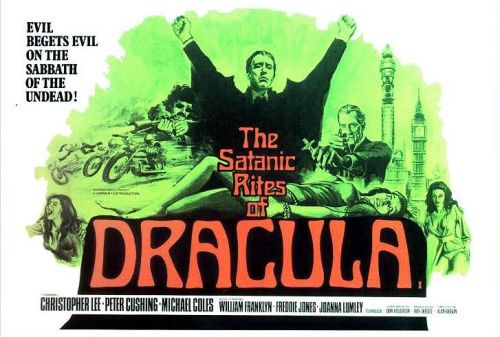
Horror Film Review: The Satanic Rites of Dracula (dir by Alan Gibson)


The_Satanic_Rites_of_Dracula_posterFirst released in 1973 and, like Dracula A.D. 1972, set in what was then the present day, The Satanic Rites of Dracula was the 8th entry in the Hammer Dracula series.  It was also the last to feature Christopher Lee in the role of Dracula and that perhaps is why, judging by some of the other reviews that I’ve read online, The Satanic Rites is one of the more reviled entries in the series.

Judging from a lot of those reviews, the attitude seems to be that The Satanic Rites of Dracula was so bad that it was the film that made Christopher Lee say, “No more!”  Reportedly, Lee felt that the film itself was both poorly written and that it was too violent.  And, even though the film is rather tame by the standards of today’s horror films, The Satanic Rites is still probably one of the more extreme entries in the series.  The film features a graphic and drawn-out flashback in which we see a naked woman sacrificed by a Satanic cult, a scene that’s bloody even by the standards of Hammer.  Later, when Jessica Van Helsing (played by Joanna Lumley, who took the role over from Dracula A.D. 1972‘s Stephanie Beacham) is menaced by a pack of female vampires, the vampires literally claw at her body like wild animals.  And finally, when one of Dracula’s brides is staked, blood literally splashes across the screen.

Christopher Lee was not a fan of The Satanic Rites of Dracula and neither are a lot of critics but you know what?  I think The Satanic Rites of Dracula is actually rather underrated.  If nothing else, it’s certainly far more unpredictable than some of the far more critically embraced Dracula films.

Satanic Rites opens with a British secret agent (Maurice O’Connell) escaping from a country house in which he had previously been held prisoner.  Though he’s fatally wounded during the escape, the agent manages to tell his superiors that, at the house, he witnessed a Satanic ritual that involved some of the most important people in the British government.  Since one of the accused occultists is a government minister, the secret service passes the case on to Scotland Yard’s Inspector Murray (Michael Coles, reprising his role from Dracula A.D. 1972) and then provide him with clandestine assistance.  (Or something like that.  To be honest, I get the feeling that the main reason Murray was called in was to maintain some continuity between Dracula A.D. 1972 and The Satanic Rites of Dracula.)  Murray suspects that vampires may be involved so he calls in Lorrimar Van Helsing (Peter Cushing).

After discovering that his old friend, scientist Julian Keeley (Freddie Jones), is a part of the cult, Van Helsing deduces that it’s all part of huge conspiracy headed by none other than Dracula himself.  The plan is to release a mutated form of bubonic plague and wipe out humanity.

Why is Dracula planning on destroying humanity?

Van Helsing theorizes that this might be Dracula’s way of committing suicide.  By wiping out humanity, Dracula will no longer have anyone to feed upon and his undead existence will finally end.  And, if nothing else, you have to admit that is a pretty interesting motivation!

How can you not enjoy a film that’s as strange as The Satanic Rites of Dracula?  It may not be a typical Hammer Dracula film and it may be a bit too obviously an attempt to revitalize a fading franchise by tossing everything that was then trendy at it but so what?  This is one of those movies that could have only been made at a certain point in time by a certain group of filmmakers and, as such, it’s valuable as both history and entertainment.

Christopher Lee may have hated The Satanic Rites of Dracula but he’s being way too hard on the film.  If nothing else, it provided a nice excuse for Christopher Lee and Peter Cushing to face off and how can you not appreciate that?