Bob Dudley (Richard Cromwell) is the wimpy son of Coach Dudley (Jack Holt), who is in charge of the local college’s football team. Bob joins the team out of a sense of family obligation but he turns out to be a cowardly player who would rather fumble the ball than take a hard hit. Coach Dudley is disgusted with his son. Bob’s girlfriend (Joan Marsh) dumps him. Bob drops out of school and disappears for two years and no one seems to care. Then, on the day of a big game, Bob reappears playing for another college. Despite Coach Dudley’s team being led by All-American Dusty Rhoades (John Wayne!), Bob leads the rival team to victory. He’s won Coach Dudley’s respect. Coach Dudley is probably going to get fired.
This was one of the weirdest sports films that I’ve ever seen. Usually, you would expect Coach Dudley to bring out the best in his son or to understand that his son is just not meant to be a football player. Instead, Bob is forced to drop out of college! Bob returns just so he can defeat his father. The slight Richard Cromwell is not a convincing football player. On the other hand, John Wayne is a convincing football player but his role is tiny. The movie is a little over an hour long and 20 minutes of that running time is taking up with grainy footage of an actual football game.
The best thing about the film? It reminds us that everyone, even John Wayne, had to start somewhere.
The 1935 adventure film, The Lives of a Bengal Lancer, is a film that probably could not be made today.
Of course, that’s true of a lot of films from the 30s. In some cases, that’s a good thing and, in some cases, that’s a bad thing. The Lives of Bengal Lancer is an entertainingly old-fashioned adventure story but it’s also a shameless celebration of the British Empire. The fact that it was made in Los Angeles and featured all-American Gary Cooper in the lead role doesn’t diminish the fact that it’s pretty much a celebration of British colonialism.
Gary Cooper plays Lt. Alan MacGregor, a Scottish-Canadian who serves in British Calvary. He’s a member of the Lancers and is currently serving in India, which, at the time that this movie was set (and made), was still under British control. When the film begins, MacGregor is greeting the new arrivals. Among those arrivals are Lt. John Fosythe (Franchot Tone) and Lt. Donald Stone (Richard Cromwell). Lt. Forsythe is an experienced officer who has been sent to India as a replacement for another officer who managed to get himself killed while out on a patrol. Meanwhile, Lt. Donald Stone is a newly commissioned officer who is desperate to win the approval of his father (and McGregor’s superior), Col. Tom Stone (Guy Standing). Unfortunately, Donald quickly discovers that winning the approval of his father isn’t going to be easy. Col. Stone, after all, has a lot to deal with.
For instance, there’s Mohammed Khan (Douglas Dumbrille). Kahn is a local prince and he boasts that he has got an Oxford education. He pretends to be an ally of the British but instead, he is plotting a revolution. The first step in that revolution is to intercept a convoy of British weapons but how can Kahn discover the convoy’s route? Maybe he could kidnap a lancer who is close to the unit’s commanding officer? With the help of a Russian femme fatale named Tania (Kathleen Burke), Khan is able to capture Donald. When MacGregor and Forsythe defy the colonel’s orders and attempt to rescue Donald on their own, they end up getting captured as well!
“We have ways to make men talk!” Khan declares and soon, the three men are having their fingernails ripped out and the skin underneath burned with fiery bamboo. It’s a shocking act of sadism, one that caught me by surprise in 2020. I can only imagine how audiences in 1935 reacted to Gary Cooper and Franchot Tone being so graphically tortured on the big screen. Though the men swear that they will not reveal the location of the convoy, how much torture can they take before they break?
As I said at the start of this review, The Lives of a Bengal Lancer is an old-fashioned film and, with its depiction of savage rebels and heroic colonizers, it would probably cause a riot if it were released today. However, if you can set aside the whole pro-imperialist theme of the film, this is a fairly entertaining film. It gets off to a slow start and, to modern eyes, some of the acting is bit creaky but Gary Cooper is, not surprisingly, well-cast as the film’s hero and he’s ably supported by Tone and Cromwell. Douglas Dumbrille and Kathleen Burke are entertainingly campy villains and the film’s final battle is well-done.
A box office success, The Lives of a Bengal Lancer was nominated for Best Picture but it lost to an even bigger hit (and a film that was a bit more critical of the British Empire), Mutiny on the Bounty.
We started out this day by taking a look at Bette Davis in Of Human Bondage so it seems only appropriate that today’s final entry in Embracing the Melodrama should be another film in which Bette Davis plays a potentially unlikable character who is redeemed by being the most interesting person in the film.
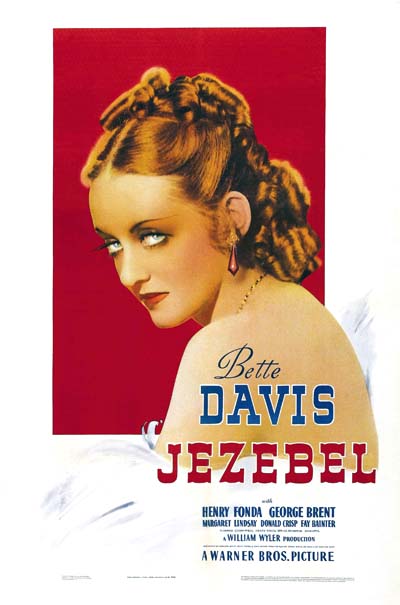
The 1938 best picture nominee Jezebel stars Bette Davis as Julie Marsden, a strong-willed Southern belle who lives in pre-Civil War New Orleans. Julie is looking forward to an upcoming ball but is frustrated when her fiancée, boring old Pres (Henry Fonda), says that he has to work and declines to go shopping for a dress with her. Impulsively, Julie does exactly what I would do. She buys the most flamboyant red dress that she can find.
Back in the old South, unmarried women were expected to wear white to formal balls, the better to let everyone know that they were pure and innocent and waiting for the right man. When Julie shows up in her red gown, it’s a scandal and, upon seeing the looks of shock and disdain on everyone’s faces, Julie wants to leave the ball. However, Pres insists that Julie dance with him and he continues to dance with her, even after the orchestra attempts to stop playing music.
And then he leaves her. At first, Julie insists to all who will listen that Pres is going to return to her but it soon becomes obvious that Pres has abandoned both Julie and Southern society. Julie locks herself away in her house and becomes a recluse.
Until, a year later, Pres returns. At first, Julie is overjoyed to see that Pres is back and she’s prepared to finally humble herself if that means winning back his love. But then she discovers that the only reason that he’s returned to New Orleans is to warn people about the dangers of Yellow Fever.
Oh, and he’s also married.
To a yankee.
For the most part, Jezebel is a showcase for another fierce and determined Bette Davis performance. It’s easy to be judgmental of a character like Julie Marsden but honestly, who doesn’t wish that they could be just as outspoken and determined? It helps, of course, that the film surrounds Julie with a collection of boring and self-righteous characters, the type of people who you love to see scandalized. Henry Fonda gives one of his more boring performances in the role of Pres while Margaret Lindsay, in the role of Pres’s Northern wife, is so saintly that she reminds you of the extremely religious girl in high school who would get offended whenever you came to school wearing a short skirt. In a society as rigid, moralistic, and judgmental as the one portrayed in Jezebel, it’s impossible not to cheer for someone like Julie Marsden.
Add to that, I totally would have worn that red dress too! In a world that insisted that all women had to act a certain way or look a certain way and think a certain way, Julie went her own way and, regardless of what boring old Pres may have thought, there’s a lesson there for us all.
When watching Jezebel, it helps to know a little about film history. Bette Davis very much wanted to play Scarlett O’Hara in Gone With The Wind and was reportedly very disappointed when the role went to Vivien Leigh. Depending on the source, Jezebel is often described as either being Davis’s audition for the role of Scarlett or as being a consolation gift for losing out on the role. Either way, Jezebel is as close as we will ever get to seeing Bette Davis play Scarlett. Judging from the film, Davis would not have been an ideal Scarlett. (Whereas Gone With The Wind works because Leigh’s Scarlett grows stronger over the course of the film, Davis would have started the film as strong and had nowhere left to go with the character.) However, Davis was a perfect Julie Marsden.
Way back in 1939, at the same time that Jimmy Stewart was conquering Washington in Frank Capra’s Mr. Smith Goes To Washington, the great director John Ford was making a film about another man who would eventually go to Washington.
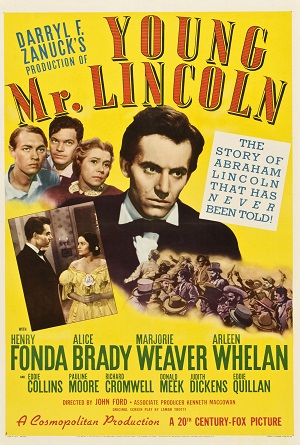
In Young Mr. Lincoln, Henry Fonda plays the future 16th President. Even though Fonda was probably far better looking than Abraham Lincoln ever was, he’s ideally cast in the role. Along with being a very natural actor, Fonda personified a certain middle-of-the-country, stoic decency. He played characters who were smart but never elitist and who were guided mostly by common decency. In short, his screen persona was everything that people tend to think about when considering Abraham Lincoln.
As for the film itself, it begins with Lincoln as a simple storekeeper who accepts, as payment for groceries, a barrel of old books. After reading the books and having a conversation with his doomed first love, Anne Rutledge (Pauline Moore), Lincoln decides to learn the law.
Years later, now a poor-but-honest lawyer, Abraham Lincoln arrives at Springfield, Illinois, sitting a top mule because he can’t afford a horse. Lincoln opens a law office, awkwardly courts the rich and spoiled Mary Todd (Marjorie Weaver), and eventually defends two brothers who have been accused of murder. While the case’s prosecutor (played by Donald Meek) may have a better education, he can’t compete with Lincoln’s common sense and ability to relate to the common people.
Obviously, the whole point behind Young Mr. Lincoln is that it’s about the early life of an American hero. You watch the entire film with the knowledge that Lincoln is going to be the man who eventually leads the U.S. during the Civil War and who frees the slaves. The viewer knows that Lincoln is going to be a great man, even if nobody else does and a good deal of the film’s effectiveness come from the moments when Fonda will strike an iconic pose or will casually deploy a familiar phase and you’re reminded of just who exactly it is he’s playing.
But, and this is why Young Mr. Lincoln remains a great film, the important thing is that the film is just effective when viewed as being a portrait of a dedicated lawyer trying to prove the innocence of his clients. Fonda is compelling as both a future President and as an honest man trying to do the right thing. Ultimately, the film would be just as compelling even if it was called Young Mr. Jones and didn’t open with soaring, patriotic music and end with a shot of the Lincoln Memorial.
It’s interesting to compare Young Mr. Lincoln to some of the other films made about Abraham Lincoln. It’s a far more assured film than D.W. Griffith’s Abraham Lincoln and, needless to say, Henry Fonda makes for a better Lincoln than Walter Huston did. At the same time, it’s far more naturalistic and less overly manipulative film than Steven Spielberg’s Lincoln.In the end, it’s a good film and a great tribute to our 16th President.
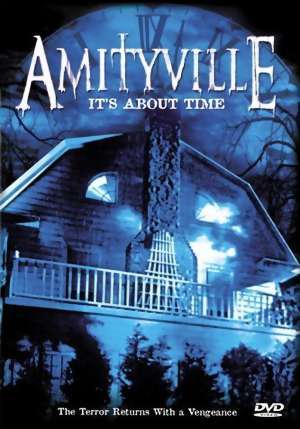
Today’s horror on the lens is a haunted house film from 1992. In Amityville — It’s About Time, Jacob (Stephen Macht) buys a new clock for his home but what he doesn’t realize is that the clock comes from the infamous Amityville House! Soon, everyone in the family is acting strange. Has the clock brought evil spirits with it or–
Well, let’s not even consider the other possibilities. Of course the clock is full of evil spirits!
As I watched this film on YouTube last month, a lot of it seemed very familiar. I quickly realized that this was because Amityville — It’s About Time used to show up on HBO all the time when I was a kid. And while I never sat through the whole film, I did always somehow seem to manage to catch the most gruesome bits and pieces whenever it was on. And yes, it did give me nightmares!
Of course, the movie would not give me nightmares today but still, it’s good for what it is. Some of the scare scenes still work, especially the one involving the dog. Stephen Macht makes for a good psycho and, in the spirit of Halloween, you can even forgive the plot for not making a bit of sense.
Interesting to note: The uber annoying Lenny is played by Jonathan Penner, who would later find some fame as a three-time contestant on Survivor.
(Also, needless to say, this film is rather tame by today’s standards but it’s still NSFW!)
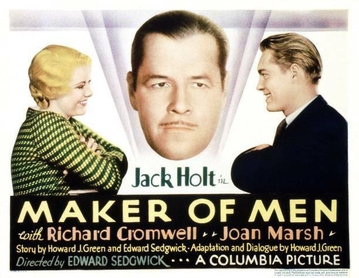 Bob Dudley (Richard Cromwell) is the wimpy son of Coach Dudley (Jack Holt), who is in charge of the local college’s football team. Bob joins the team out of a sense of family obligation but he turns out to be a cowardly player who would rather fumble the ball than take a hard hit. Coach Dudley is disgusted with his son. Bob’s girlfriend (Joan Marsh) dumps him. Bob drops out of school and disappears for two years and no one seems to care. Then, on the day of a big game, Bob reappears playing for another college. Despite Coach Dudley’s team being led by All-American Dusty Rhoades (John Wayne!), Bob leads the rival team to victory. He’s won Coach Dudley’s respect. Coach Dudley is probably going to get fired.
 Through the Shattered Lens