Confessions of a TV Addict #8: The Amazing Sci-Fi Worlds of Irwin Allen Pt. 1


gary loggins's avatarcracked rear viewer

Irwin Allen  (1916-1991) wore many different hats during his long career: magazine editor, gossip columnist, documentarian, producer, director. He helped usher in the Age of the Disaster Movie with such 70’s hits as THE POSEIDON ADVENTURE and THE TOWERING INFERNO, but before that he was best known as the producer of a quartet of sci-fi series from the Swingin’ 60’s. From 1964 to 1970 he had at least one sci-fi show airing in prime time… during the 1966-67 season, he had three, all complete with cheezy-looking monsters, campy humor, stock footage, guest stars (some on their way up… some down!), special effects by Oscar winner L.B. Abbott, and music by John Williams (who later scored a little thing called STAR WARS )! Here’s a look at the Amazing Sci-Fi Worlds of Irwin Allen:

Allen’s first foray into sci-fi TV was VOYAGE TO THE BOTTOM OF THE SEA (ABC, 1964-68), based…

View original post 699 more words

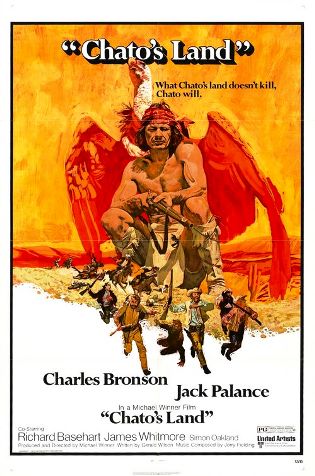
A Movie A Day #170: Chato’s Land (1972, directed by Michael Winner)


Don’t mess with Charles Bronson.

That’s the main lesson that can be taken away from Chato’s Land.  In this western, Bronson plays Chato, an Apache who enters the wrong saloon and is forced to shoot a racist sheriff in self-defense.  Former Confederate Captain Quincey Whitemore (Jack Palance) forms a posse to track Chato down but soon discovers that his posse is not made up of the best and brightest.  Instead, most of them are sadistic racists who just want to kill Apaches.  Despite Whitemore’s efforts to stop them, the posse rapes Chato’s wife and kills his best friend.  Chato trades his white man’s clothes for a loin cloth and sets out for revenge.

Chato’s Land is historically significant because it was the first of many films that Charles Bronson made with Michael Winner.  The most famous Bronson/Winner collaboration was Death Wish, which also featured Charles Bronson as a man who seeks revenge after his wife is raped.  What is surprising about Chato’s Land is how little screen time Bronson actually has.  Most the film is spent with the posse, which is full of familiar faces (Richard Jordan, Simon Oakland, Victor French, Ralph Waite, and James Whitmore all report for duty).  It actually works to the film’s advantage, making Bronson even more intimidating than usual.  There’s never any doubt that Chato is going to kill every member of the posse but since almost every member of the posse is loathsome, that’s not a problem.

It’s possible that Chato’s Land was meant to be an allegory for the Vietnam War, which is probably giving Michael Winner too much credit.  (In an interview, the author of Death Wish, Brian Garfield, once shared an anecdote about Winner inserting a shot of three nuns into Death Wish and bragging about how the shot was meaningless but that it would fool the critics into thinking he was making a grand statement about something.)  Like most of Winner’s films, Chato’s Land is good but not great.  There are parts of the movie that drag and Jack Palance and Charles Bronson don’t get to share any big scenes together, which seems like a missed opportunity.  Bronson, who was always underrated as an actor, gives one of his better performances as Chato.  Chato does not say much but Bronson could do more with one glare than most actors could do with a monologue.  In Europe, Bronson was known as Il Brutto and Chato’s Land features him at his most brutal.

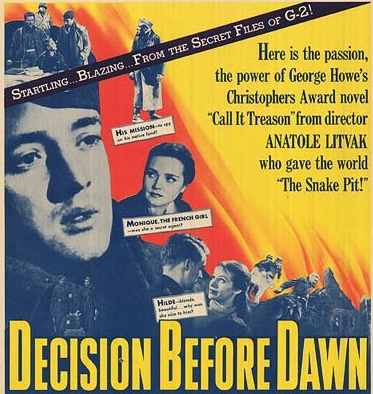
Cleaning Out The DVR, Again #14: Decision Before Dawn (dir by Anatole Litvak)


MPW-55716

So, I’m currently in the process of cleaning out my DVR by watching the 40 films that I recorded from March to June of this year.  Yesterday, I watched the 14th film on my DVR, the 1951 film Decision Before Dawn.  

Decision Before Dawn aired on April 9th on FXM and I specifically recorded it because it was nominated for best picture.  It only received one other nomination (for editing) and it’s one of those nominees that often seems to be dismissed by Oscar historians.  Whenever Decision Before Dawn is mentioned, it’s usually because it’s being unfavorably compared to the other nominees: A Place In The Sun, A Streetcar Named Desire, and An American In Paris.  I went into Decision Before Dawn with very low expectations but you know what?

Decision Before Dawn is not a bad film.  In fact, I would even go as far as to say that it’s actually a damn good film.  If you’re into war films — and, admittedly, I am not — you will love Decision Before Dawn.  If, like me, you’re a history nerd, you’ll be fascinated by the fact that, since this film was shot on location, Decision Before Dawn offers a chance to see what Europe looked like in the years immediately following the destruction of World War II.

As I mentioned, I’m not really into war movies but fortunately, Decision Before Dawn takes place during World War II.  World War II is one of the few wars where there’s no real ambiguity about whether or not the war needed to be fought.  When it comes to picking a villain that everyone can hate, Adolf Hitler and his followers are petty much the perfect villains to go with.

In Decision Before Dawn, Oskar Werner plays Karl Maurer, a German soldier who deserts after his best friend is executed for insubordination.  Though Karl loves his home country, he hates the Nazis who have taken it over.  Karl surrenders to the Americans and volunteers to return to Germany to act as a spy.  Karl finds himself in a strange situation.  Though he’s fighting against the Nazis, he is also mistrusted by the Allies.  He is literally a man without a country.

When word comes down that a German general is willing to surrender, Karl and another German soldier-turned-spy, the greedy and cowardly Sgt. Barth (Hans Christian Bleth), are sent into Germany to both find out if the information is true and to find out where another division of German soldiers is located.  Accompanying the two Germans is a bitter American, Lt. Dick Rennick (Richard Basehart).  Rennick doesn’t trust either of the Germans.

While Rennick and Barth track down the surrendering General, Karl is sent to track down the other division.  Along the way, Karl visits many bombed out German towns and meets Germans of every political persuasion.  Some of them still vainly cling to hope for victory over the Allies but the majority of them are like Hilde (Hildegard Knef), a young war widow who just desperately wants the fighting to end.  Thanks to the deeply empathetic performances of Werner and Knef, the scenes between Hilde and Karl elevate the entire film.  In those scenes, Decision Before Dawn becomes more than just a war film.  It becomes a portrait of men and women trapped by circumstances that they cannot control.

Decision Before Dawn is an exciting and well-acted thriller, one that starts slow but then builds up to a truly thrilling conclusion.  Anatole Litvak directs the film almost as if it were a film noir, filling the entire screen with menacing shadows and moody set pieces.  Decision Before Dawn is a war film that does not celebrate war but instead mourns the evil that men do and argues that sometimes the most patriotic thing that one can do is defy his or her government.  It may be one of the more obscure best picture nominees but it’s still one that deserves to be rediscovered.

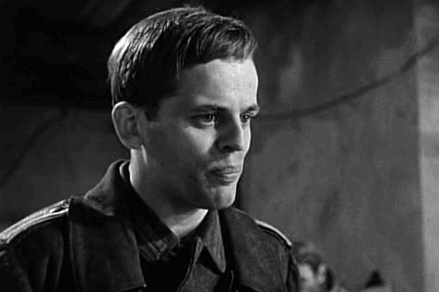
By the way, if you do watch Decision Before Dawn, be sure to keep an eye out for Klaus Kinski.  He only appears for a minute or two and he’s not even credited but you’ll recognize him as soon as you see him.  The eyes give him away as soon as he shows up.

DBD_Kinski

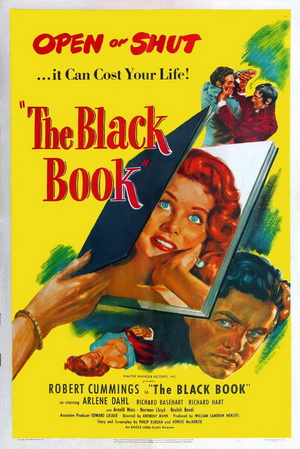
The Fabulous Forties #3: The Black Book (dir by Anthony Mann)


The_Black_Book_Poster

The third film in Mill Creek’s Fabulous Forties box set was 1949’s The Black Book, which was also released under the title Reign of Terror.

The Black Book takes place during the French Revolution.  It is, to quote Dickens, both the best of times and the worst of times.  Actually, mostly it’s just the worst of times.  The Black Book portrays revolutionary France as being a dark and shadowy country, one where the only things that hold the people together are paranoia and terror.  It’s a country where anyone can be executed at any moment and where power mad tyrants excuse their excesses by saying that they are only doing the people’s will.  Considering that the The Black Book was made in 1949, its vision of revolutionary France can easily been seen as a metaphor for Nazi Germany or Communist Russia.  Or perhaps even America at the start of the Red Scare.

(It’s probably not a coincidence that the Nazis also had a document known as the Black Book, one that listed everyone who was to be arrested and executed if Hitler succeeded in conquering Great Britain.)

Maximilien Robespierre (Richard Basehart, giving a disturbingly plausible performance that will make you think of more than a few contemporary political figures) is on the verge of having himself declared dictator of France.  Unfortunately, his little black book has disappeared.  Inside that black book is the name of everyone that he is planning to send to the guillotine.  If the book ever became public, then Robespierre would be the one losing his head.

Robespierre summons a notorious prosecutor named Duval (Robert Cummings) to Paris and gives him 24 hours to track down the book.  He gives Duval the authority to imprison and interrogate anyone in France.  He also informs Duval that, if the book is not found, Duval will be the next to lose his head.

However, what Robespierre does not know is that Duval is not Duval.  He is Charles D’Aubigny, a rebel against the Revolution.  Charles murdered Duval and took his place.  Now, Charles has to find the book without his own identity being discovered.  Not only do some of Robespierre’s allies suspect that Duval may not actually be Duval but some of Charles’s former allies also start to suspect that Charles may secretly be working for Robespierre, even as he claims that he’s trying to bring him down.  At times, even the viewer is unsure as to who is actually working for who.

Oh my God, this is such a good film!   In fact, it was so good that I was surprised that I hadn’t heard of it before watching it last night.  The chance to discover a hidden gem like The Black Book is the main reason why I continue to take chances on Mill Creek box sets.

The Black Book was definitely made on a very low-budget but director Anthony Mann (who is best known for directing several landmark westerns) uses that low-budget to his advantage.  There’s little spectacle to be found in this historical epic but then again, there was little spectacle to be found in the reign of terror.  This is a film that takes place in shadowy rooms and dark, almost claustrophobic streets.  It’s a historical film that looks and plays out like the most cynical of film noirs.  Despite the fact that all of these well-known French figures are being played by very American actors, the cast all does an excellent job of capturing the fear and desperation of people living under oppression.  The subtext of The Black Book was undoubtedly clear in 1949 and it’s just as clear today.  Fanaticism remains fanaticism, regardless of when it happened or what ideology is used to justify it.

There is a somewhat awkward moment towards the end of the film when a French army officer is asked for his name.

“Bonparte,” the officer replies, “Napoleon Bonaparte.”

“I’ll remember that name,” someone snarkily replies.

But, other than that one moment (which immediately made me think of Titanic‘s infamous “Something Picasso” line), The Black Book is an intelligent and effective thriller.  And because it’s in the public domain, you watch it below!


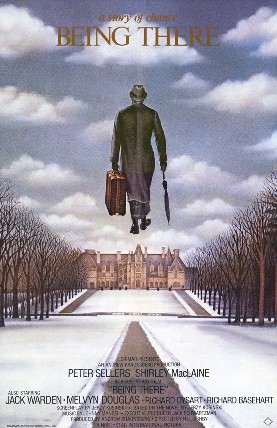
Shattered Politics #43: Being There (dir by Hal Ashby)


Original_movie_poster_for_Being_There

As a general rule, I don’t watch the news.  However, a few nights ago, I made an exception and I watched CNN.  The reason was because it was snowing in New York City and apparently, CNN anchorman Don Lemon was broadcasting from something called the Blizzardmobile.  I just had to see that!

Well, the Blizzardmobile turned out to be huge letdown.  I was hoping for something like the Snowpiercer train but instead, it just turned out to be a SUV with a camera crew and a pompous anchorman who hilariously kept insisting that he was knee-deep in a blizzard when even a Texas girl like me could tell that the Blizzardmobile was only encountering a few snow flurries.

So, I flipped around to see if any of the other news stations had anyone in a blizzardmobile.  What I discovered was that only CNN had a blizzardmobile but one thing that every news station did have was a panel of experts.  An anchorperson would say something like, “What does the future look like?” and the panel of experts would tell us what the future looked like to them.  What I found interesting was that I had no idea who these experts were but yet I was supposed to just believe that their opinions were worth considering.

I mean, for all I knew, those experts could have just been people who were spotted wandering around New York at night.  But, because they were introduced as experts and looked directly at the camera whenever they spoke, they were suddenly authoritative voices.

Oddly enough, the very next night, I watched a movie from 1979 that dealt with the exact same issue.

Being There tells the story of Chance (Peter Sellers), a dignified, middle-aged man who lives in Washington, D.C. and works as a gardener for a wealthy older man.  Chance cannot read.  Chance cannot write.  Chance goes through life with a blank smile on his face.  Chance has never experienced the outside world.  Instead, he spends all of his time working in the old man’s garden and obsessively watching TV.  When the old man dies, Chance finds himself exiled from the house.  Wandering around Washington D.C., Chance asks a random woman to make him dinner.  He politely speaks with a drug dealer who pulls a knife on him.  Finally, he finds himself entranced by a window display of televisions.  Backing away from the window, Chance stumbles into the street and is struck by a car.

Though he’s not seriously injured, the owner of the car, Eve Rand (Shirley MacClaine), insists that Chance come back to her mansion with him so that he can be checked out by her private physician (Richard Dysart).  As they drive back to the house, Eve asks Chance for his name.

“Chance the Gardner,” Chance replies.

“Chauncey Gardiner?” Eve asks.

Chance blankly nods.

Back the house, Chance meets Eve’s husband, Ben (Melvyn Douglas).  Ben is a wealthy industrialist who is dying of leukemia.  Ben takes an immediate liking to Chance.  Because Chance is wearing the old man’s suits, everyone assumes that Chance is a wealthy businessman.  When Chance says that he had to leave his home, they assume that his business must have failed due to government regulation.  When Chance talks about his garden, everyone assumes that he’s speaking in metaphors.

Soon, Ben is introducing Chance to his friend, Bobby (Jack Warden).  Bobby happens to be the President and when he quotes Chance in a speech, Chance the Gardner is suddenly the most famous man in the country.  When he appears on a TV talk show, the audience mistakes his emotionless comments for dry wit.  When he talks about how the garden reacts to different seasons, they assume that he’s an economic genius.  By the end of the film, Bobby has become so threatened by Chance’s popularity that he’s been rendered impotent while wealthy, rich men plot to make Chance the next President of the United States.
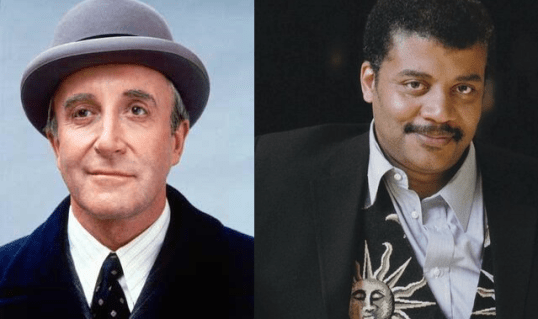
Chance and Neil

In many ways, Chauncey Gardiner was the Neil deGrasse Tyson of his era.

Being There is a one joke film and the idea of someone having no emotional skills beyond what he’s seen on television was probably a lot more mind-blowing back in 1979 than it is in 2015.  But I still enjoyed the film.  Peter Sellers gave a great performance as Chance, never sentimentalizing the character.  As well, the film’s point is still relevant.  If Being There were made today, Chance would be the subject of clickbait articles and Facebook memes.  (Chauncey Gardiner listed his ten top movies and number 8 will surprise you!  Or maybe This boy asked Chauncey Gardiner about his garden and his response was perfect.)

At its best, Being There is a film that will encourage you to question every expert you may see.  Especially if he’s just stepped out of a blizzardmobile…