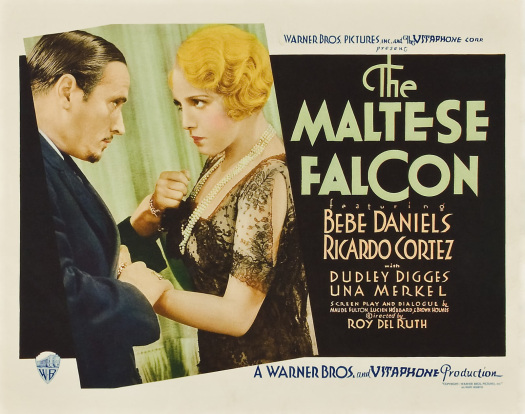
Detective Sam Spade (Ricardo Cortez) may be an immoral lech but when his partner, Miles Archer, is murdered, Sam sets out to not only figure out who did it but to also eliminate himself as a suspect. Sam was having an affair with Miles’s wife, Ivy (Thelma Todd). Sam’s investigation leads to him falling for the mysterious Miss Wonderly (Bebe Daniels) and getting involved with a trio of flamboyant criminals who are searching for a famous relic, the Maltese Falcon. Dudley Digges plays Casper Gutman. Otto Matieson plays Dr. Joel Cairo. Dwight Frye plays the gunsel, Wilmer, who Gutman says he “loves … like a son.”
The first film adaptation of Dashiell Hammett’s classic detective novel is overshadowed by the version that John Huston would direct ten years later. That’s not surprising. There’s a lot of good things about the first version but it’s never as lively than John Huston’s version and neither Dudley Digges nor Otto Matieson can compare to Sydney Greenstreet and Peter Lorre. Of the supporting cast, Dwight Frye makes the best impression as the twitchy Wilmer and Bebe Daniels and Thelma Todd are both sexy as the story’s femme fatales. That doesn’t mean that they’re better than their counterparts in John Huston’s film. It just means they all bring a different energy to their roles and it’s interesting to see how the same story can be changed by just taking a slightly different approach. Elisha Cook, Jr. was perfect for Huston’s version of the story. Dwight Frye is similarly perfect for Roy Del Ruth’s version.
Needless to say, Ricardo Cortez can’t really compare to Humphrey Bogart. But, if you can somehow block the memory of Bogart in the role from your mind, Cortez actually does give a good performance as Spade. Because this was a pre-code film, Cortez can lean more into Spade’s sleaziness than Bogart could. Also, because this was a pre-code film, the first MalteseFalcon doesn’t have to be as circumspect about the story’s subtext. Spade obviously tries to sleep with every woman he meets and is first seen letting a woman out of his office. (The woman stops to straighten her stockings.) Gutman and Cairo’s relationship with Wilmer becomes much more obvious as well. What’s strange is that, even though this MalteseFalcon is pre-code, it still ends with the type of ending that you would expect the production code to force onto a film like this.
If you’re going to watch TheMalteseFalcon, the Huston version is the one to go with. But the first version isn’t bad and it’s worth watching for comparison.
Yeah, yeah, I know. That sounds kinda silly, doesn’t it? However, November is traditionally the month that classic film bloggers tend to concentrate on writing about film noir. It provides a bit of grit and cynicism in between the horror fun of October and the holiday schmaltz of December.
I have to admit that I’m a little bit torn when it comes to taking part in Noirvember. On the one hand, I love a good film noir and there’s quite a few obscure and underrated ones available on YouTube right now. On the other hand, as a natural-born contrarian, I don’t like the idea of hopping on any bandwagons.
In the end, my love of film noir won out. So, welcome to my first entry in 30 More Days of Noir.
The 1950 film, Bunco Squad, tells the story of Tony Weldon (Ricardo Cortez), a con man who specializes in using a phony psychic routine to swindle rich people out of their money. He runs a fake enlightenment center and he claims that he can speak to the dead. His latest target is the wealthy Jessica Royce (Elisabeth Risdon). After he finds out that her son was killed during the invasion of Normandy, he and his associates go out of their way to trick her into believing that Tony can contact her son and that her son wants her to leave all of her money to Tony’s organization. It’s actually kind of interesting watching as Tony and his gang manage to track down information about Jessica and her son, asking the most mundane of questions to find out things that Jessica believes only her son would know. Watching Tony operate, I was reminded of those documentaries and news reports that you see about phony faith healers and other people who claim they can speak to the dead but who actually just go on very vague fishing expeditions. (“I’m sensing something about the letter L. Does that mean anything to you?”)
Tony is not just a con artist. He’s also a murderer, one who specializes in cutting brake lines on cars. If you try to expose Tony, you’re probably going to end up driving off of a cliff. I guess you can get away with that when you’re a con artist in California. Myself, I live in North Texas where the land is totally flat. Someone could cut my brake lines and I would probably just keep going forward until I eventually ran out of gas. Once that happened, someone would probably pull over and offer to give me a lift to the nearest gas station. That’s one reason why someone like Tony Weldon could never pull off any of his crimes in my home state.
Fortunately, the detective of the LAPD’s Bunco Squad know what Tony’s doing. The only problem is that they have to get some proof that Tony is swindling Ms. Royce and they have to manage to do it before Tony gets a chance to tamper with all of their brakes. Leading the Bunco Squad is Steve Johnson (Robert Sterling) and you better believe that there’s no way someone named Steve Johnson is going to be anything other than honest and upright. Working with a real-life magician named Dante, Johnson attempts to expose all of Tony’s tricks.
It’s probably open for debate whether or not Bunco Squad is a true noir. On the one hand, Tony and his schemes are very noirish. On the other hand, Steve and the members of the Bunco Squad are so upright that there’s none of the ambiguous morality that you find in the best film noirs. I guess I would call this a half-noir.
The best thing about Bunco Squad is that it’s only 67 minutes long, which is all the time that it needs to tell a compact and occasionally interesting story. There’s no excessive padding to try to force the story out to an unwieldy 90 minutes. Instead, Bunco Squad jumps right into its story and it doesn’t let up until things come to an end. The other good thing about Bunco Squad is that you’ve got Ricardo Cortez, giving a charmingly evil performance as Tony Weldon. The film’s heroes are a pretty dull bunch but Cortez brings a nice charge of danger to the proceedings.
Bunco Squad is an obscure film but it moves quickly and the story is interesting enough to hold your attention for an hour. It can be found on YouTube.
This post has been preempted as many times as tonight’s State of the Union Address!
John Ford’s penchant for nostalgic looks back at “the good old days” resulted in some of his finest works. The sentimental Irishman created some beautiful tone poems in his 1930’s films with Will Rogers, and movies like HOW GREEN WAS MY VALLEY and THE QUIET MAN convey Ford’s sense of loss and wistful longing for simpler times. The director’s THE LAST HURRAH continues this theme in a character study about an Irish-American politician’s final run for mayor, running headfirst into a new era of politics dominated by television coverage and media hype instead of old-fashioned boots-on-the-ground handshaking and baby-kissing. It’s not only a good film, but a movie buff’s Nirvana, featuring some great older stars and character actors out for their own Last Hurrah with the Old Master.
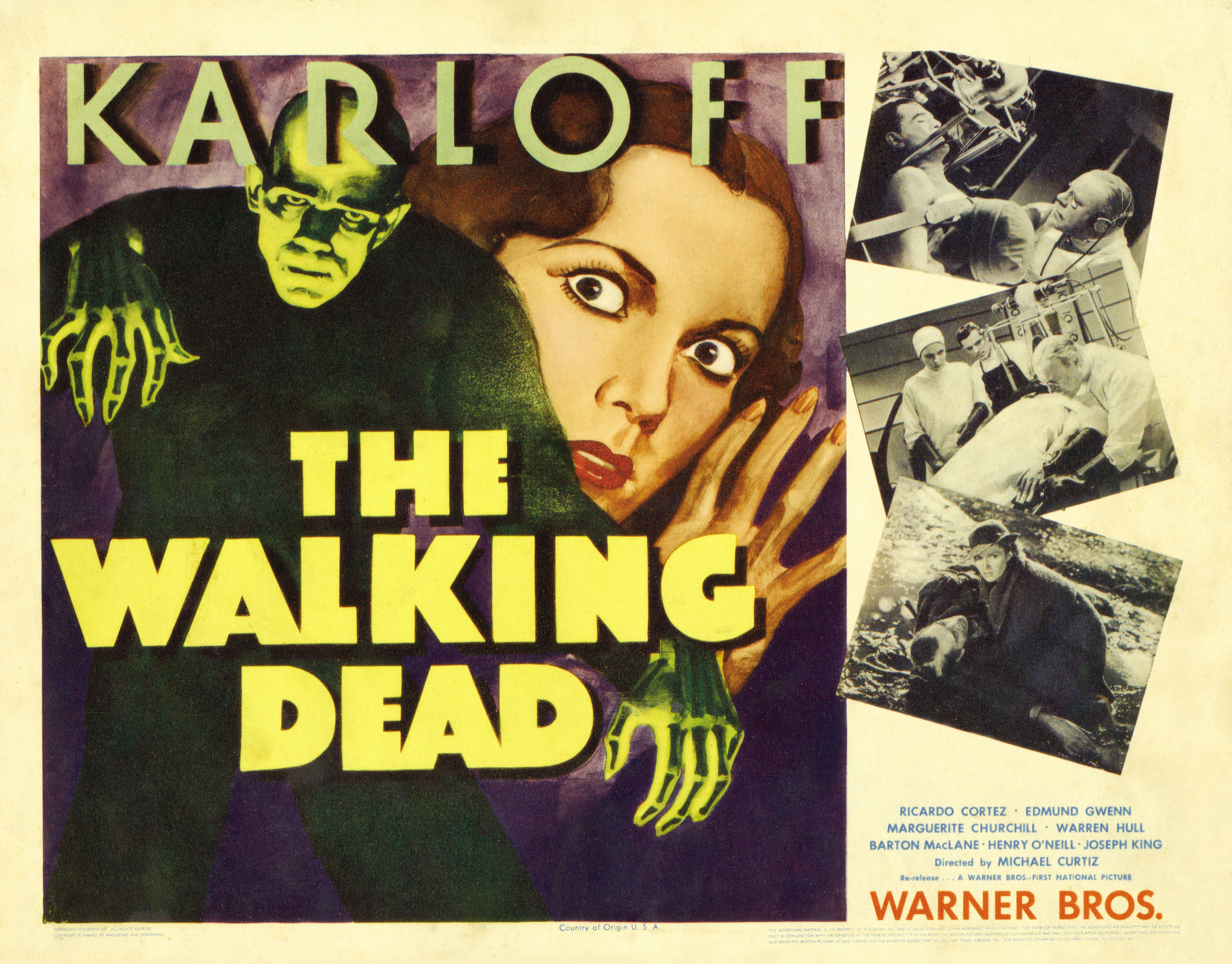
In this 1936 film (which has absolutely no relation to the AMC zombie show), Boris Karloff plays John Ellman. John Ellman is perhaps one of the unluckiest guys ever. Seriously check this out:
John Ellman was once an acclaimed concert pianist. However, he was wrongly convicted of killing his wife and spent ten years in prison. Now that he’s finally been paroled, he can’t get anyone to hire him. Meanwhile, the judge who originally sent him to prison is in the news for having defied the mob and sentenced a well-known gangster to prison. The mob is out for revenge but, rather than take the fall themselves, they’d rather frame a patsy. And who could be a better patsy than a man who everyone already knows has a grudge against the judge?
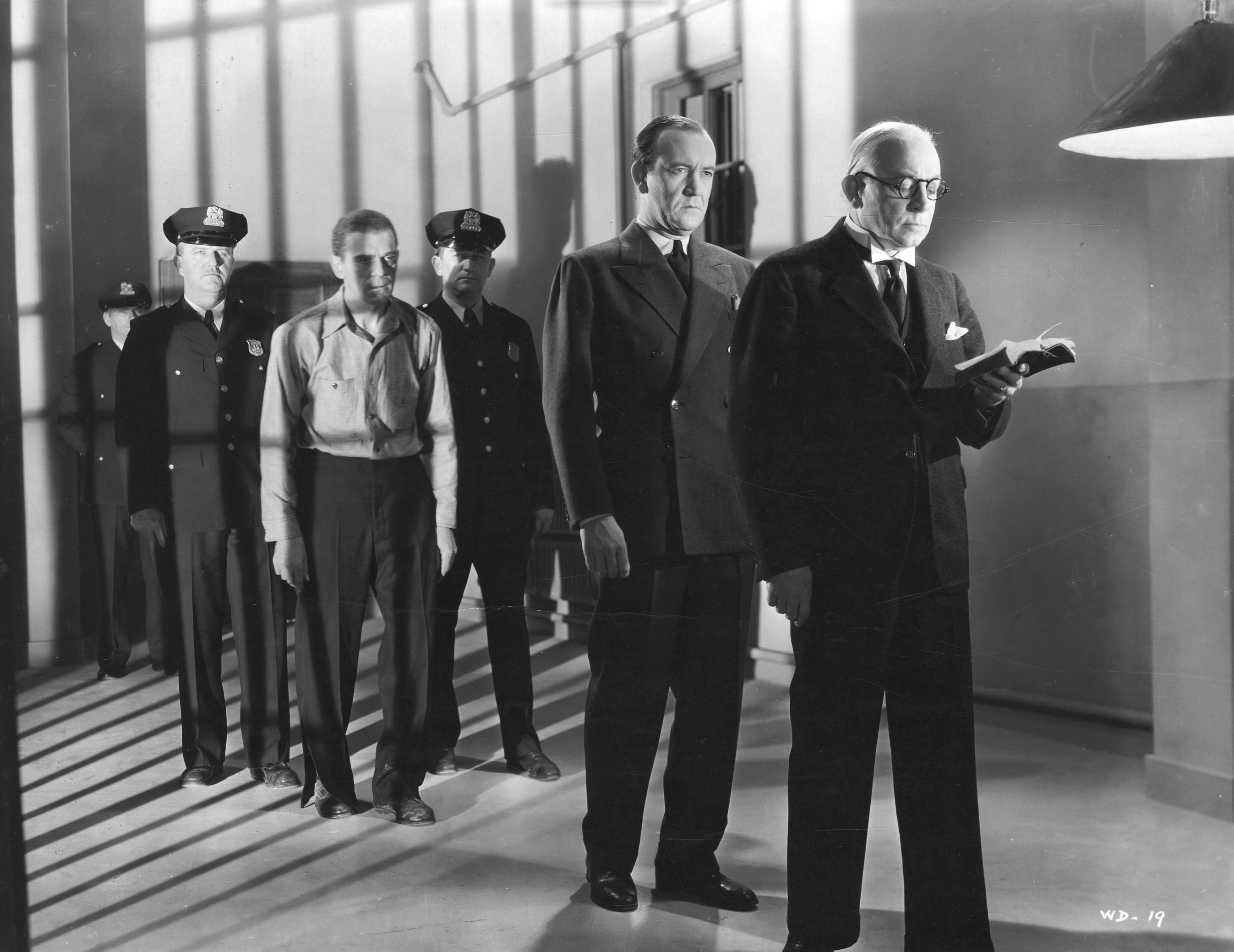
Nolan (Ricardo Cortez), a crooked lawyer, arranges for Ellman to be given a job. Ellman is told that he simply has to spy on the judge for a few nights to determine whether the judge is having an extramarital affair. Ellman agrees and soon finds himself being set up. The gangsters kill the judge and plant the body in Ellman’s car. Ellman is arrested and sentenced to die. It doesn’t matter that there are witnesses who know that Ellman’s innocent. No one is willing to cross the mafia.
Ellman is convicted and promptly executed but his story isn’t over. A scientist named Dr. Beaumont (Edmund Gwenn, who later played the man who might be Santa Claus in Miracle on 34th Street) knows that Ellman is innocent. He takes Ellman’s body and, through an artificial heart and a bunch of other science-y things, he manages to revive Ellman. John Ellman lives again! Of course, he’s a bit of a zombie now and he doesn’t have any memory of his former life. And yet, he instinctively knows who set him up to be executed and he sets out for revenge.
What’s interesting is that Ellman doesn’t kill anyone. Even after he’s revived and presumably has no concept of right and wrong, John Ellman remains a rather passive zombie. For the most part, the racketeers die because of how they react to the sight of the previously dead Ellman coming towards them. For that matter, Beaumont isn’t the typical mad scientist that you might expect to turn up in a film like this. He’s a benevolent man who was simply doing what he thought was the right thing. Though the film ends with a warning about playing God, one can’t hep but get the feeling that, unlike Frankenstein, the film is overall very supportive of the idea of reviving the dead.
Directed by Michael Curtiz (who also did Casablanca, Mildred Pierce, The Adventures of Robin Hood, and countless other classic films), The Walking Dead is a combination horror/gangster film. The film’s plot is a bit too convoluted for its own good but, overall, The Walking Dead works because of Boris Karloff’s performance. He’s poignantly pathetic as the living John Ellman and then rather chilling as the vengeance-driven, recently revived Ellman. The film’s most effective scenes are the ones where he just stares at his enemies, fixing them with a gaze that takes no prisoners and offers no hope. It’s a great performance that elevates an otherwise uneven film.
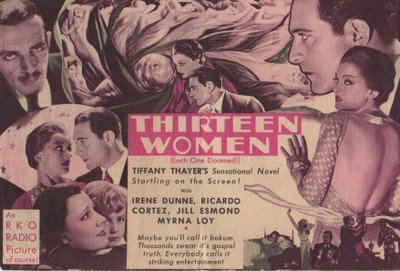
I pride myself on having seem almost every horror film made during the 1930’s, though once in a while an obscure title comes along whose attention has escaped me. But how on Earth did I miss THIRTEEN WOMEN, especially with a cast headlined by Irene Dunne (of all people!) and Myrna Loy ? This fast-paced thriller involving hypnosis, astrology, and serial murder is downright nasty, and has been cited as a precursor to the “slasher” genre… not to mention a whole lot of fun!
We begin with circus performer June Raskob receiving a letter from the mysterious Swami Yogadashi with her horoscope attached, predicting impending doom in the stars for her. But it’s her sister who dies, plunging to her death during their trapeze act (shown in gruesome detail), and poor June goes hopelessly insane. The scene shifts to exotic half-caste Ursula Georgi, who has the Swami under her hypnotic…
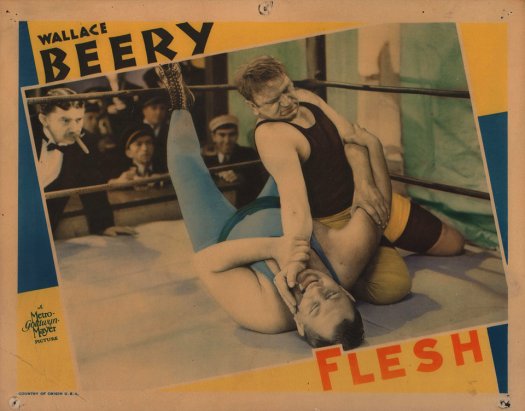
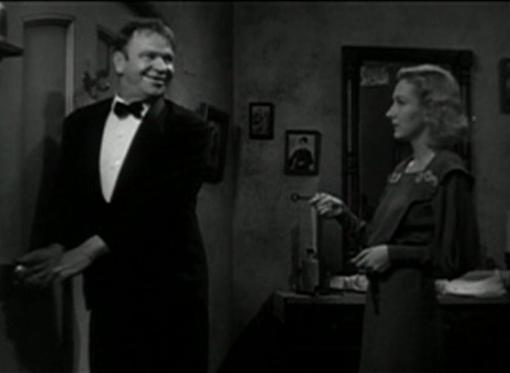
Long before his John Wayne collaborations, John Ford had worked to perfect his own style as a filmmaker. Even though the cranky, idiosyncratic Ford, who directed his first film way back in 1917, had his directing credit removed from 1932’s FLESH, it is credited as “A John Ford Production”, and one can tell this is definitely a “John Ford Picture”. The man himself thought the film was lousy, and most critics agreed, but I’m in the minority opinion. I think it’s worthy of reappraisal for film lovers to get a glimpse of some vintage Ford, with solid performances by Wallace Beery, Karen Morley, and Ricardo Cortez. Plus, as a long-time pro wrestling buff, the grappling game setting appeals to me, as do the many Pre-Code themes and moments.
Beery once again is a good-natured lug, a German wrestler named Polakai who doubles as a waiter in a rowdy beer garden, toting a keg on his massive…
Everybody knows the 1941 Humphrey Bogart/John Huston classic THE MALTESE FALCON, but only true film fanatics watch the original 1931 version. Since I fall squarely into that category, I recently viewed the first adaptation of Dashiell Hammet’s seminal private eye yarn. The film, like it’s more famous remake, follows the novel’s plot closely, with the added spice that Pre-Code movies bring to the table.
Cortez is no Bogie, but he’ll do
The odds are six-two-and-even if you’re reading this post, you don’t need a plot recap. What I intend to do is go over some of the differences between the two versions. Let’s start with Sam Spade himself, the prototype hard-boiled detective. Suave, slick-haired Ricardo Cortez interprets the role as a grinning horndog who’s never met a skirt he didn’t like. We meet Spade in the opening shot, clinching a dame in silhouette at the door to his office. Then the door…
1936’s THE WALKING DEAD has absolutely nothing to do with the wildly popular AMC TV series. This WALKING DEAD stars Boris Karloff , making the first of a five-picture deal he signed with Warners, an interesting hybrid of the gangster and horror genres about an unjustly executed man who’s revived by science exacting vengeance on those who set him up. The result was a fast paced (clocked at 66 minutes) entry in the first horror cycle, and one of the last horror films made until their 1939 revival (more about that later).
Boris stars as John Ellman, newly released from a stretch in prison. A gangland cartel, looking to get rid of a law-and-order judge, set Ellman up as a patsy, hiring him to stake out the judge’s home, murdering the guy, and dumping the body in Ellman’s car. He goes on trial, defended by crooked lawyer Nolan, and sentenced to death…
Down here in Dallas, we have a county commissioner named John Wiley Price. Even if you don’t live in Texas, you might have heard about him. A few years ago, Price stormed out of a commissioners meeting while shouting, “All of you are white! Go the Hell!” It was a popular YouTube video for a while and attracted all of the usual type of comments that you see online. It even made the national news.
Nobody down here in Dallas was surprised by Price’s outburst. To us, that was just John Wiley being John Wiley. For that matter, nobody was particularly surprised when it was reported that he was being investigated by the FBI. Everyone always took it for granted that John Wiley Price was taking bribes and receiving kickbacks. That’s just the way that things are done down here in Dallas, by politicians both white and black. (Of course, most of the white politicians who do it don’t get publicly investigated by the FBI.)
Now, if you ask the majority of people in Dallas county what they think about John Wiley Price and they’ll probably say something negative. I’ll admit that I would probably be among them. But the thing is — John Wiley Price’s constituents love him. John Wiley Price was first elected to the commissioner’s court before I was even born and, as long as he’s on the ballot, he will be reelected. Even if Price is convicted on corruption charges, he will still be reelected.
I can still remember the night that it was announced that John Wiley Price was on the verge of being arrested by the FBI. All across his district, emergency meetings were held in churches and ministers stood behind the pulpit and, while the TV cameras rolled, they called upon everyone to pray for John Wiley Price. In Price’s district, he’s known as “our man downtown,” the idea being that John Wiley Price is standing up to the rich and white Dallas establishment and, if he makes some money for himself in the process, so be it. As long as he’s doing right for the people who elected him, who cares how he does it?
And, as much as we may want to judge the John Wiley Prices of the world, the fact that of the matter is that he’s a part of a long American political tradition. That political tradition is also the driving force behind today’s final entry in Shattered Politics.
First released in 1958 and directed by John Ford, The Last Hurrah tells the story of Frank Skeffington (Spencer Tracy), the mayor of an unnamed city in New England that’s obviously meant to be Boston. Skeffington is the flamboyant head of a large and powerful (but, as the film makes clear, aging) Irish-American political machine. He’s preparing to run for his fifth term for mayor, a campaign that he says will be his last.
Whether Frank Skeffington is a good mayor or not depends on who you ask. The poor and the disenfranchised love him. Skeffington, after all, is the son of Irish immigrants. He was born poor. His mother worked as a maid and was even fired by a member of the wealthy and influential Force family. They know that Skeffington has had to cut corners and that he’s gone out of his way to reward his cronies but they also know that Skeffington is on their side. Though the phrase is never used in the film, Skeffington is “their man downtown.”
Meanwhile, the wealthy and the upper class see Frank Skeffington as being a crook, a man who has run a corrupt administration and who uses class warfare to keep the city divided against itself and to make himself and his cronies rich. Newspaper editor Amos Force (John Carradine) has thrown his considerable influence between Skeffington’s opponent, a wealthy but dull man named Kevin McCluskey.
Reporter Adam Caulfield (Jeffrey Hunter) is in an interesting position. On the one hand, he is Skeffington’s nephew. On the other hand, as a journalist, he works for Amos Force. Skeffington invites Adam to follow and record his final campaign for posterity.
It’s interesting to compare The Last Hurrah to films like The Boss or All The King’s Men. Whereas those two films came down squarely on the sides of the reformers, The Last Hurrah is firmly on the side of Frank Skeffington. It presents Skeffington as being a sentimental figure, the type of old-fashioned, populist politician who won office by going out and meeting the people face-to-face and personally giving them a reason to vote for him. As Skeffington himself points out, he’s the type of politician that will soon be made obsolete by television and modern campaigning.
And it’s impossible not to enjoy The Last Hurrah‘s refusal to pass judgment on its lead character. It helps, of course, that Spencer Tracy plays Skeffington with a twinkle in his eye while all of his opponents are played by villainous and aristocratic character actors like John Carradine and Basil Rathbone. Yes, the film says, Skeffington may have been corrupt but at least he wasn’t boring!
Finally, I enjoyed the film because all of the “good” guys were Irish Catholic and all of the bad guys most definitely were not.
So, with that last hurrah, we conclude Shattered Politics for today. We’ll be back tomorrow, when we’ll start to get into the 1960s.
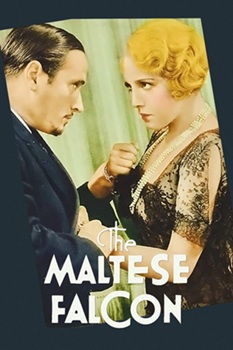 Detective Sam Spade (Ricardo Cortez) may be an immoral lech but when his partner, Miles Archer, is murdered, Sam sets out to not only figure out who did it but to also eliminate himself as a suspect. Sam was having an affair with Miles’s wife, Ivy (Thelma Todd). Sam’s investigation leads to him falling for the mysterious Miss Wonderly (Bebe Daniels) and getting involved with a trio of flamboyant criminals who are searching for a famous relic, the Maltese Falcon. Dudley Digges plays Casper Gutman. Otto Matieson plays Dr. Joel Cairo. Dwight Frye plays the gunsel, Wilmer, who Gutman says he “loves … like a son.”




 Through the Shattered Lens