Retro Television Review: The American Short Story #12: The Man That Corrupted Hadleyburg


Welcome to Retro Television Reviews, a feature where we review some of our favorite and least favorite shows of the past!  On Saturdays, Lisa will be reviewing The American Short Story, which ran semi-regularly on PBS in 1974 to 1981.  The entire show can be purchased on Prime and found on YouTube and Tubi.

This week, we have an adaptation of a Mark Twain novella.

Episode #12: The Man That Corrupted Hadleyburg

(Dir by Ralph Rosenblum, originally aired in 1980)

In this loose adaptation of one of Mark Twain’s darkest novellas, Robert Preston stars as The Stranger.  When we first meet The Stranger, he’s looking down on the small town of Hadleyburg and it’s hard not to notice that he looks a lot like Mark Twain.  The Stranger explains that the people of Hadleyburg consider themselves to be honest and free of sin.  The town’s motto is “Lead us not into temptation!”  The Stranger has a plan to test them.

Riding into town, the Stranger stops at the home of Edward and Mary Richards (Tom Aldredge and Frances Sternhagen).  The Stranger gives them a sack that he claims is filled with $40,000 worth of gold bars.  The Stranger says that he was once a poor man and someone in Hadleyburg gave him $20 and some meaningful advice.  Now that’s he rich, he wants to pay back the person who helped him.  The Stranger explains that there is an envelope inside the sack.  In the envelope, the Stranger has written out the advice he was given by his benefactor.  The Stranger’s instruction is for the man who helped him to write out that advice and give it to Rev. Burgess (Fred Gwynne), who recently lost his church when the citizens of Hadleyburg tired of him calling them out for their hypocrisies.  The honest man who remembers the advice he gave the Stranger will be very rich as a result.  The Stranger then leaves.

News of the sack and the gold travels throughout town and eventually the rest of the nation.  The most powerful families in Hadleyburg, including the Richards family, receive a letter telling them that the advice given to the stranger was “You are far from being a bad man, go and reform.”  Burgess is soon swamped by notes, all featuring that same phrase.  At the town meeting, Burgess reads each note, revealing that everyone wrote down the same phrase and that none of the town leaders is as honest as they claim.

The Man That Corrupted Hadleyburg is one of Twain’s most stinging satires, featuring an ending that is surprisingly dark.  This adaptation takes a much lighter approach to the material, altering Twain’s ending to something much more gentle and friendly.  Unfortunately, changing the ending causes the adaptation to lack the bite of the original short story.  Twain’s portrayal of greed and guilt instead becomes a mild story about a quirky town that learns a lesson.  It’s well-acted, especially by Fred Gwynne, but this adaptation doesn’t honor Twain’s intentions.  It just doesn’t add up to much.
Retro Television Review: The American Short Story Episode 8 “The Blue Hotel”


Welcome to Retro Television Reviews, a feature where we review some of our favorite and least favorite shows of the past!  On Saturdays, I will be reviewing The American Short Story, which ran semi-regularly on PBS in 1974 to 1981.  The entire show can be purchased on Prime and found on YouTube and Tubi.

This week, we have an adaptation of a Stephen Crane short story.

Episode 1.8 “The Blue Hotel”

(Dir by Jan Kadar, originally aired in 1977)

In the dying days of the Old West, a train pulls into a station in a small frontier town.  Getting off the train, a Cowboy (John Bottoms), an Easterner (Geddeth Smith), and a Swede (David Warner) head to the town’s only hotel.  A blizzard is coming and the three men are seeking shelter for the night.  The owner of the hotel, Scully (Rex Everhart), is happy to provide it.  As the men wait for dinner to be served, they play a card game with Scully’s son, Johnnie (James Keach).

At first, the game plays out without incident.  The men are all friendly, with the exception of the Swede.  The Swede remains quiet and seems distrustful.  After a few hands of the game, the Swede accuses Johnnie of cheating.  Over the next few hours, as the wind howls outside, the Swede rants and raves.  Convinced that the wild west is truly full of outlaws and that it’s all exactly like the dime-store novels that he read before boarding the train, he cannot bring himself to accept that the men mean him no harm.  It all leads to violence and tragedy.

This episode made excellent use of the shadowy Blue Hotel and the desolate wind blowing outside.  Over the course of an hour, the hotel went from being a friendly shelter to an ominous location that seemed to pulse with paranoia.  David Warner gave a strong performance as the unstable Swede and the final act of violence (which was changed slightly from the short story’s original conclusion) comes as a genuine shock as does the final twist in the tale.  The Blue Hotel becomes a look at how people unknowingly shape their own destiny, for better or worse.

THE SEVEN-UPS (1973) – Roy Scheider in a gritty 70’s cop thriller!


I’m guessing it started with JAWS (1975) and JAWS 2 (1978) since they played often on Fox-16 out of Little Rock when I was a kid, but I’ve been a fan of actor Roy Scheider for as long as I can remember. He’s one of those actors who has his own section in my massive collection of physical movie media. I’ve read about every film he’s ever made, and I’ve watched most of them. Surprisingly, THE SEVEN-UPS is the first Roy Scheider film I’ve written about on The Shattered Lens. 

NYPD detective Buddy Manucci (Roy Scheider) leads a team of elite cops, known as the “seven-ups.” They’ve acquired this nickname because most of the criminals they arrest receive sentences that are 7 years and longer, which makes their superiors on the force very happy. Granted, the team does use a variety of unorthodox methods to find and arrest the criminals, which can also rub their superiors and some of their fellow cops the wrong way. Buddy’s childhood friend Vito Lucia (Tony Lo Bianco), an undertaker by trade who has his finger on the pulse of the criminal activities in his community, serves as an important snitch for the team, with his information often leading to major busts. Unbeknownst to Buddy, prominent members of various organized crime families and other white-collar criminals start getting kidnapped and held for ransom in the community. Buddy’s unaware of the full extent of the kidnappings, but he asks his old friend / snitch Vito about this when he actually witnesses the abduction of a crooked bail bondsman he’s following named Festa. We know that Vito is the mastermind behind all of the kidnappings, and his two main henchmen, Moon (Richard Lynch) and Bo (Bill Hickman), are impersonating cops just long enough to confuse and abduct the various criminals. When the Seven-Ups stake out a funeral meeting of various mobsters in the area, squad member Ansel (Ken Kercheval) is killed as part of a screwed-up abduction attempt. Buddy spots Moon and Bo trying to flee the area and tries to chase them down in an incredible car chase that ends when Buddy is almost decapitated in a violent collision with a parked 18-wheeler. With one of their own dead and with the wild chases through the streets, the members of the team are placed on suspension and even investigated as suspects for the kidnappings. Not content to just lay low during their suspensions, the seven-ups continue to try to figure out what’s going on, doing whatever it takes to get the information they need. When Buddy and his group start applying incredible pressure to some of the local mobsters about who shot Ansel, he gets information that ties the killing and the kidnappings to his friend Vito. This time when he meets with Vito, Buddy feeds him false information, thus setting a trap to bring the whole operation down.

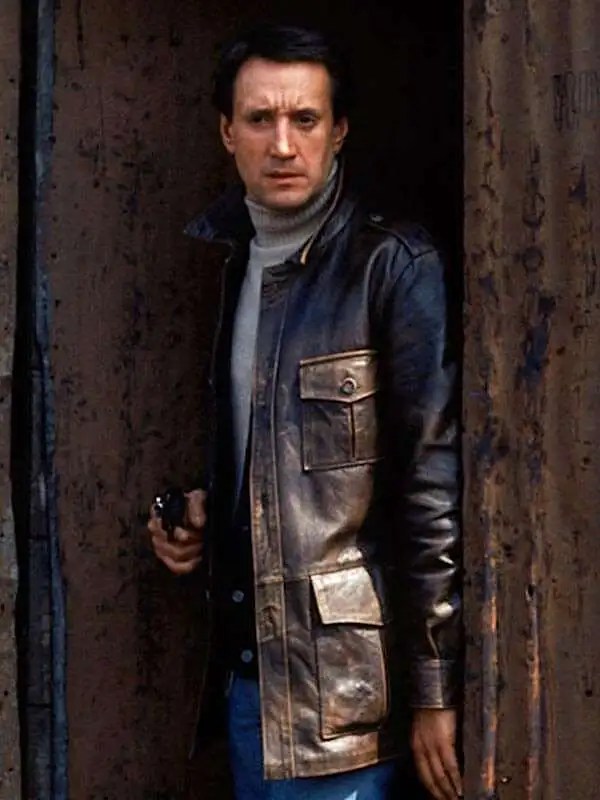
After viewing THE SEVEN-UPS again for the first time in a while, it continues to be my opinion that this movie is severely underrated. It’s a great cop film from the early 70’s, anchored by an excellent lead performance from Roy Scheider, who’s wearing one of the coolest leather jackets in the history of cinema. Coming in hot off the heels of THE FRENCH CONNECTION (1971), and with many connections to the Oscar winner, it seems that somehow this great film has fallen through the cracks over the years. I mean, how often do you hear people talk about this movie? THE SEVEN-UPS is directed by Philip D’Antoni, his only directorial credit, although he did serve as the Producer for both BULLITT (1968) and THE FRENCH CONNECTION. D’Antoni clearly values a good car chase sequence. THE SEVEN-UPS contains a thrilling car chase, which really isn’t that big of a surprise when you learn that stunt coordinator Bill Hickman, who plays the bad guy Bo in this film, coordinated the car chase sequences in BULLITT and THE FRENCH CONNECTION. This film features my personal favorite car chase sequence from any film that I’ve seen to date. Don Ellis composed the memorable musical score, a service that he also provided in THE FRENCH CONNECTION. I point out all of these ties to THE FRENCH CONNECTION because, in my humble opinion, the talent behind that film created another classic in THE SEVEN-UPS. 

Complimenting Roy Scheider’s lead performance, THE SEVEN-UPS has a strong supporting cast. Tony Lo Bianco, Ken Kercheval (of DALLAS fame), Bill Hickman, and Richard Lynch are all quite memorable in their respective roles. I also like the 1973 New York City setting for the film. In movies like this and the following year’s DEATH WISH, we get to see a New York that no longer exists. To me, this only adds to the gritty realism of the film. 

Overall, THE SEVEN-UPS is a movie I recommend without any reservations. If you’re a fan of 70’s cop thrillers, you simply can’t go wrong with this one. 

I share the trailer for THE SEVEN-UPS below: