
Lifetime Film Review: Friends Who Kill (dir by Richard Switzer)


Ah, a friend who kills.

Now, on the one hand, I guess you could make an argument that it would be good to have a friend who kills because then you wouldn’t ever have to kill.  You could just ask your friend to do a favor for you.  I can certainly understand why some people would see that as being one of the benefits that comes with having a friend who kills.  Myself, if I had a friend who killed, I would want to take them with me whenever I knew I’m going to have stand in a long line.  I mean, God knows that patience is a virtue but sometimes, you really just need to speed things up.

On the other hand, having a friend who kills probably means that you have to spend a lot of time cleaning up after them.  And if your friend is one of those people who kills in the middle of the night, you might not got much sleep.  Instead, they’ll constantly be calling you at 4 in the morning, asking you to bring a garbage bag and some bleach to a house on the other side of town.  Ultimately, it just doesn’t seem to be worth the trouble.

Lifetime’s Friends Who Kill stars Sarah Fisher as Lacy, a high school student who is struggling with failing grades and the recent divorce of her parents.  When Lacy first meets Cassie (Alexa Rose Steele), it seems like Cassie is just the type of fun-loving, parent’s-signature-forging friend that she needs but it turns out that Cassie is actually a bit unstable.  She’s a friend who kills, though she doesn’t really kill that many people in this film.  She does beat a lot of people up.  She puts one person in a coma and she hits another with a shovel.  She does commit one murder with a hockey stick and it looks like pretty messy.  I hate it when murders are committed in a living room because it totally ruins all the furniture.  I mean, just try getting a blood stain out of a couch.

Harper (Reha Sandill), who was Lacy’s best friend until Cassie showed up, tries to warn Lacy that Cassie isn’t as good of a friend as she says she is but Lacy is ready for a dangerous friend and who can blame her.  Lacy’s mother (Natalie Brown) is too busy dealing with the fallout of her divorce to really notice the murderous gleam in Cassie’s eyes.  These things happen when you’ve got a friend who kills, I suppose.

Friends Who Kill suffers a bit because it’s never quite clear why Cassie wants to be Lacy’s friend or why Lacy’s mom is so quick to assume the worst when Cassie frames Harper for revealing the circumstances of the divorce.  This is one of those films where you quickly get frustrated because no one seems to have much common sense.  Everyone is strangely quick to believe anything that Cassie says and you can understand why Harper gets so annoyed with Lacy.  On the plus side, fans of Degrassi will be happy to see that this film features two members of that classic show’s cast.  On Degrassi, Sarah Fisher played ultra-religious Becky while Alexa Steele played by Angela Jeremiah and Tori Santamaria.  Steele does a pretty good job playing up the sociopathic side of Cassie.

In the end, this film has a good message.  Friends who kill may seem like a solution to all of life’s troubles but, in the end, they’re just not worth the trouble.

Lifetime Film Review: Cheerleader Abduction (dir by Michelle Oullet)


So, here you are.

You’re 17 years old.  You’ve got your entire future ahead of you.  You’re popular.  You’re a cheerleader.  In fact, you’re not just a cheerleader but you’re also the team captain!  Your mother is the mayor of the town in which you live and she’s thinking of running for governor!  You’re looking forward to going to Michigan River University and spending your summers reading a book on the beach.

Except….

Well, you’ve been throwing up a lot.  Could it have something to do with what happened at that party a few weekends ago?

Yep!  You are pregnant!  But you can’t tell your mom, because she’s got so much going on right now.  And you can’t tell your friends because they’ll spread it all over the school.  They still haven’t forgiven you for missing the last cheerleading competition.  However, there’s a nice woman who claims that she’s been through the same thing that you’re going through.  And, she just happens to run an underground adoption agency!

That’s pretty much the plot of Cheerleader Abduction.  According to the imdb, this film was originally entitled A Secret To Keep, which is actually a far more appropriate title.  The entire film is about Olivia (Jerni Stewart) trying to keep her mother, Trish (Kristen Harris), for discovering that she’s pregnant.  While Trish is busy running for governor, Olivia is secretly quitting the cheer squad and hanging out with Pam (Sarah Constible).  Pam seems to be friendly but, whenever Olivia turns her back to her, Pam’s smile quickly disappears.  In a Lifetime film, that’s all the evidence that you need to know that someone is up to no good.

To be honest, the fact that Olivia’s a cheerleader really isn’t that important to the plot.  She could just as easily have been a theater student who missed her cue because she was getting an ultrasound in the middle of a performance.  I guess her being a cheerleader is meant to establish her as being one of the popular kids at school but still, it’s not really enough of a plot point to justify changing the film’s title.  As far as the abduction is concerned …. well, nothing that could really be considered an abduction occurs until pretty late in the film.  Instead, the majority of the film is taken up by Olivia attempting to prevent Trish from picking up on the fact that she’s pregnant.  (“I hope she’s not sick.  She just got over that stomach flu.”)  It’s all about Olivia trying to keep her secret.  A Secret To Keep is a far more appropriate title, though it doesn’t quite have the same melodramatic snap to it as Cheerleader Abduction.

Anyway, this one was okay.  As everyone should know by now, I like Lifetime movies in general and Cheerleader Abduction featured all of the things that I tend to look for when watching a Lifetime film.  There were enough lies and melodrama to hold my attention and I thought Sarah Constible did a good job playing the outwardly friendly Pam.  That said, I had a hard time taking the idea of Trish being a candidate for governor seriously.  It may be because I’ve just lived through an election but there was nothing about Trish’s political career that rang true.  Not that it really matters, of course.  You don’t watch Lifetime movies for a realistic portrait of American politics.  You watch them for the secrets and the lies and Cheerleader Abduction featured enough of both to be entertaining.

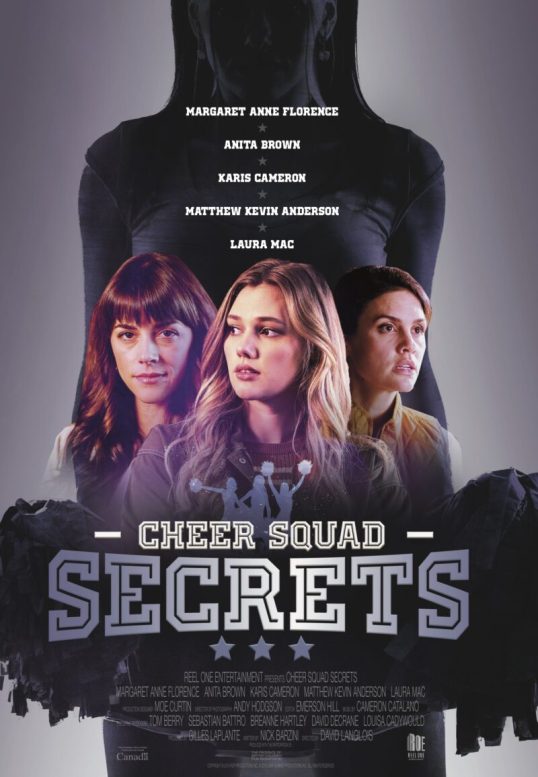
Lifetime Film Review: Cheer Squad Secrets (dir by David Longlois)


It’s a dangerous life, being a cheerleader.

Most people already know that from watching countless horror movies and Lifetime films.  Of course, I know that because my sister was a cheerleader and she told me about all of the dangerous things went on once the cheering stopped.  I was often invited to become a cheerleader when I was in high school.  At the time, I refused because I wanted to carve out my own identity and all of that other good stuff.  Looking back, though, I should have refused because apparently, there’s nothing more dangerous than being a cheerleader in high school.

Take Cheer Squad Secrets, for instance.  In this film, Coach Nina (Anita Brown) is so obsessed with winning a championship and also so haunted by her own traumatic experiences as a cheerleader that she ends up giving the members of the squad steroids in order to make sure that they’re always performing at 110%.  Unfortunately, steroids also leads to mood swings, violence, sprained arms, and potential jail time!  Nina, however, is so obsessed with winning a championship that she’s even willing to commit murder to make sure that everyone gets their “supplements.”  She shows no hesitation when it comes time to stab a drug dealer to death.  And when it looks like some bothersome bystander might reveal the squad’s secrets, Nina promptly drowns her in a swimming pool.

And you know what?  It’s easy to say that Coach Nina is crazy and that she’s taking things too far but Nina gets results!  I mean, I made my sister watch this movie with me and she agreed that Nina was definitely putting together a championship-worthy squad.  Nina may have been a bit intense and she may have been a bit unconventional in her methods but isn’t that what we want from our teachers?  Don’t we want teachers and coaches who will do anything to help our children succeed?

Well, Kelly Regan (Margaret Anne Florence) isn’t quite as enthused about Nina’s methods as perhaps some parents would be.  Kelly was a cheerleader when she was in high school.  In fact, she was such a great cheerleader that she’s something of a legend.  Her daughter, Amelie (Karis Cameron), wants to live up to her mom’s example.  Kelly is overjoyed when Amelie becomes a cheerleader but she’s less happy once the violent fights start to break out.  I guess it’s understandable but seriously, Nina is doing what she has to do.  I mean, doesn’t Kelly want Amelie to go to college on a cheerleading scholarship?

Anyway, Cheer Squad Secrets was an enjoyably silly melodrama.  I’m going to enjoy any film that mixes steroids with a crazy coach who occasionally has conversations with the ghost of her younger self.  I mean, really, who wouldn’t?  Anita Brown gives an appropriately intense performance as Coach Nina and director David Langlois does a good job of embracing the melodrama.  A good Lifetime film will always push the limits of how far it can take its storyline and Cheer Squad Secrets certainly does that.  This is a good one to watch for the next time you need an extra push to succeed.

Lifetime Film Review: Birthmother’s Betrayal (dir by John Murlowski)


So, you’ve been betrayed by your birthmother!

Well, these things happen.  Especially if you’re a character in a Lifetime movie.  I’ve always argued that Lifetime movies can best be viewed as wish fulfillment and, in this one, the fulfilled wish belongs to every mother who has ever hoped that their daughter would admit that they should have listened to them.  In this film, Amy (Tanya Clarke) warns his adopted teenage daughter, Tara (Monica Rose Betz), about trying to track down her birthmother, Grace (Aria Pullman).  And wow, is Amy ever proven right!

Of course, it’s understandable that Tara would want to track down her birthmother.  First off, Tara has all sorts of weird allergies and it would really help her understand her medical history if she knew who her mother was.  Secondly, Amy is kind of overprotective and won’t even let Tara date or buy a bikini, despite the fact that Tara is nearly 17 years old.  I mean, that’s extreme!  So, even though Amy is a loving mom and owns a big house and works for Habitat for Humanity, it’s understandable that Tara would want to see what else is out there.  Amy shouldn’t have sheltered her daughter but then again, Tara should have listened to Amy about the whole “your birthmother could be dangerous” thing.

At first, Tara is overjoyed when she manages to track down Grace.  Grace seems like the perfect birthmother.  She teaches Tara how to drive.  She buys Tara that forbidden bikini.  She encourages Tara to live her own life.  Yet, there are some strange things about Grace.  For instance, Grace refuses to divulge too much information about her own background.  Grace also insists that Tara not tell Amy about her.

Eventually, though, Amy tracks down Grace on her own and invites Grace to come over to the house and meet her daughter “for the first time.”  However, when Grace arrives at the house, she’s no longer acting like the confident and unpredictable Grace that Tara met.  Instead, Grace is now jumpy and nervous and suffers from terrible dizzy spells.  Even more strangely, Grace acts as if she barely knows Tara.  What’s happening?

You may be tempted to say that Grace is just unbalanced but actually, there’s more to it than that.  There’s a neat little twist to this story and I won’t spoil it but I will say that it took me by surprise when it was revealed.  A surprise twist is always a good thing and Birthmother’s Betrayal executes it well.  Admittedly, the twist itself is a bit over-the-top but that’s what we love Lifetime movies for.  Save the normal twists for movies on other networks.  This is Lifetime we’re talking about!

Anyway, I enjoyed Birthmother’s Betrayal, largely because of the twist.  Right when you think the movie is going to be one thing, it turns out to be something else.  Aria Pullman does a good job playing Grace, as both a confident sociopath and a rather frail and neurotic woman who suffers from suddenly dizzy spells.  Keep an eye out for Birthmother’s Betrayal and remember that, when it comes to sending your DNA off to a website, it’s sometimes best to listen to the people who raised you.

Music Video Of The Day: Dear Prudence, covered by Siouxsie and The Banshees (1983, dir by Tim Pope)


Happy birthday, Erin Nicole!

To be honest, the main reason that I picked this for today’s music video of the day is because Erin and I both love this song and it’s one that we’ve both listened to several times of the past few months.  (When you’re basically stuck inside for the majority of the year, you really do come to appreciate good music.)  Add to that, this song always makes me think of my sister, even if she isn’t listening to it with me.  The sun is beautiful and so is she. As I always say, one of the best things about being involved with TSL is that I get to work with my sister.   She’s always been there for me.  She’s always put up with me, even when I was at my worse.  I don’t know where I’d be without her.

This, of course, is a cover of a Beatles song.  If you think you spotted The Cure’s Robert Smith in this video, you are correct.  At the time this song was recorded (and this video made), Robert Smith was temporarily a member of the band.  This video was filmed in Venice, which is a wonderful city that I hope I get to once again visit with everyone who I care about.

Enjoy!

Music Video of the Day: Everybody Here Hates You by Courtney Barnett (2020, dir by Danny Cohen)


Oh hell yeah!  That’s more of a reaction to the sound of the song than to the song’s message, which is kind of depressing.

Seriously, we all know the feeling, right?  Judging from this video, Courtney is actually inside of someone’s brain and reminding them that everybody here hates them.  Everyone has felt that way at some point in their life.  Of course, to be honest, I’d rather be disliked than unknown or ignored.  Of course, I’d rather be loved than disliked.  I want people to be scared of how much they love me.

Anyway, this is a good song and a good video and it’ll get stuck in your head and you’ll hear it every time you start to feel insecure about something.

Enjoy!

Film Review: Small Axe: Mangrove (dir by Steve McQueen)


Say whatever else you might want to say about 2020 as a cinematic year, at least it’s giving us five new films from Steve McQueen.

This British director is one of the most consistently interesting filmmakers working today and anytime we get new work for him, it’s a cause for celebration.  His latest project is Small Axe, an anthology of five feature-length films that examines the real-life history of London’s West Indian community.  In the UK, the film are premiering on the BBC while, here in the States, they’ll be premiering on Prime.  Through mid-December, we’ll be getting a new Steve McQueen film every week.

The first of these films is Mangrove.  The film opens in the late 60s, with activist Frank Crichlow (Shaun Parkes) opening a restaurant in London’s Notting Hill neighborhood.  The restaurant is called The Mangrove and it quickly becomes a base for the community.  It also becomes a target for the Metropolitan Police.  PC Pulley (Sam Spruell) claims that the Frank has a history of tolerating petty crime and that the Mangrove is probably just a front for some nefarious operation.  Of course, what quickly becomes obvious is that Pulley’s main problem with the Mangrove is that its owner is black and so are the majority of its customers.  Pulley is an unrepentant racist, the type of man who sits in his patrol car and complains that the military hasn’t been called in to enforce the law in the neighborhood.  (As obsessed as he is with the military, Pulley also says, with some pride, that he’s never actually served in the army.)  When a new rookie shows up, Pulley informs him that his priority for the night is to arrest the first black person that he sees.

Every chance that he gets, Pulley raids the Mangrove.  When Frank complains, he loses his liquor license.  When the members of the community stage a peaceful protest (“Hands Off The Mangrove!” goes one chant), Frank and eight others are arrested and charged with inciting a riot and affray, charges that could lead to all of them spending several years in prison.  (Affray is the legal term for “disturbing the peace.”)  Among those arrested, along with Frank, are activist Darcus Howe (Malachi Kirby) and British Black Panther leader Altheia Jones-LeCointe (Letitita Wright).  Both Darcus and Altheia insist on acting as their own counsel during the trial, giving them the chance to cross-examine the police and to also take their case directly to the jury.

Though Mangrove is a courtroom drama, the trial doesn’t being until almost an hour into the film’s running time.  Wisely, McQueen instead spends the first sixty minutes of the film introducing us to the neighborhood surrounding the Mangrove and also allowing us to get to know the people who not only work there but also the ones who eat there.  The film shows how, for a community of outsiders, the Mangrove became more than just a restaurant.  It became a center for the entire neighborhood, a place where the members of the London’s West Indian community could safely gather.  For someone like Pulley, the Mangrove was a symbol of everything that he couldn’t control and therefore, it had to be destroyed and its owners had to be humiliated.  As well-handled as the courtroom scenes are, they would be considerably less effective if the film hadn’t shown us why it was felt that the Mangrove was something worth fighting for.  When the Mangrove Nine go on trail, they’re not just nine people who have been unjustly accused.  Instead, they represent an entire community that refuses to continue to bow down to their oppressors.

It’s an often effective film, one that is all the more powerful for being based on a true story.  Much as he did with Shame, Steve McQueen makes effective use of the harsh and rather cold urban landscape that his characters inhabit. One needs only watch Frank walk down a dreary London street to understand why the Mangrove was so important to the community.  As presented by McQueen, the Mangrove provides not only an escape from the harshness of the world but also a safe place to discuss how to make that world maybe a little bit less harsh for future generations.  McQueen is brave enough to allow his camera to keep running, even beyond the point that most directors would have said “Cut.”  McQueen shows us Frank yelling after being brutally pushed into a prison cell, as any director would.  However, McQueen doesn’t cut away once Frank falls silent.  Instead, his camera remains on Frank, making us feel his isolation and his feeling of hopelessness.  It takes just a minute to go from the exhilaration of hearing Frank curse out his jailers to the horror of realizing that Frank is basically at their mercy.

For the most part, the actors make a strong impression, with the only false note coming from Rochenda Sandall, who plays Darcus’s partner and often seems to be performing in a different movie from everyone else.  Malachi Kirby and Shaun Parkes have several strong moments as Darcus and Frank while Sam Spruell plays Pulley as being an all-too familiar monster.  That said, the film is pretty much stolen by Letitia Wright, who brings both fury and wit to the role of Altheia.  Whether she’s exposing the Crown’s medical examiner as a fraud or angrily reprimanding a defendant who is considering pleading guilty, Letitia Wright dominates every scene in which she appears.

Is Mangrove eligible for the Oscars?  Under normal circumstances, it wouldn’t be.  But, with the rule changes and the fact that Mangrove was not only selected to compete at Cannes (before Cannes was cancelled, of course) but that it also opened the BFI London Film Festival, I think a case can be made for considering Mangrove to be a feature film as opposed to being a television movie.  This is a strange year so who knows?  Personally, I think Mangrove deserves to be considered.  If it’s not nominated for any Oscars, it’ll definitely be nominated for the Emmys.  That’ll be determined in the future.  For now, it can be viewed on Prime.

30 More Days Of Noir #12: No Man’s Woman (dir by Franklin Adreon)


This 1955 film tells the story of a murder.

When we first meet Carolyn Elleson Grant (Marie Windsor), she refuses to give her husband, Harlow Grant (John Archer) a divorce, despite the fact that they’ve been separated for several years and Harlow now wants to marry Louise Nelson (Nancy Gates) and Carolyn is now involved with an art critic named Wayne Vincent (Patrick Knowles).  Carolyn only married Harlow for his money and, while she has other rich lovers, she just enjoys making Harlow’s life as difficult as possible.  It’s hard to blame her because Harlow is kind of whiny.

However, Carolyn has grown bored with Wayne Vincent and she’s now decided that she would rather get involved with Dick Sawyer (Richard Crane), who is rich and owns a boat.  However, Dick is engaged to Carolyn’s personal assistant, Betty (Jill Jarmyn).  Carolyn thinks it would be perfectly amusing to not only seduce Dick but to also destroy Betty’s happiness.

Why?

As one character put it, Carolyn is “a witch!”

(Someone then adds that Carolyn is a word that “rhymes” with witch.  They don’t actually say the word because this film was made in 1955 but still….)

With Carolyn casually trying to destroy everyone’s lives and happiness, is it really a shock when some unseen person shows up at her art studio late at night and shoots her?

With Carolyn dead, it falls to Detectives Colton (Louis Jean Heydt) and Wells (John Gallaudet) to figure out the identity of the murder.  They immediately suspect that it had to have been Harlow Grant.  Not only does he have the motive and the opportunity but his name is Harlow Grant and I defy you to find anyone named Harlow Grant who hasn’t subsequently turned out to be involved in something shady.  Harlow, however, insists that he’s innocent and the investigation is about to get a lot more complicated….

Well, okay, maybe not a lot more complicated.  To be honest, it’s really not that difficult to figure out who the murderer actually is No Man’s Woman but that’s okay.  The investigation itself only takes the last third of this 70-minute film.  No Man’s Woman is a like a low-budget version of Gosford Park.  The murder is less important than all of the drama surrounding it.

And make no mistake, there’s a lot of drama!  This is a fun movie, specifically because Carolyn is such a wonderfully evil character and Marie Windsor has so much fun playing her.  Carolyn doesn’t really have any deep motivation for why she does the terrible things that she does.  She just does them because she can and she believes that she can get away with it.  A good deal of the film’s entertainment comes from just seeing how bad Carolyn can be.  In fact, you’re a bit disappointed when she’s murdered because Carolyn is the most enjoyable character in the movie.  She’s someone who is literally willing to do and say anything and she makes an apologies for her actions.  You wouldn’t necessarily want to work with her but she’s fun to watch.

The rest of the cast is adequate.  John Archer and Nancy Gates are a bit on the dull side as the “good” characters but I liked the performances of the other suspects.  Richard Crane and Jill Jarmyn, in particular, are memorable as Dick and Betty.  I loved how going out on someone’s boat was apparently the height of decadence in 1955.

No Man’s Woman is an entertaining mix of noir and soap opera.  Find it on Prime!

30 More Days of Noir #11: The Mysterious Mr. Nicholson (dir by Oswald Mitchell)


There’s been a murder!

Another one?

Yes, indeed.  It would seem that during the 1940s and the 1950s, people were just dropping left and right.  Mysterious murders were just a part of everyday life and you can be sure that every murder would bring with it an effort would be made to frame an innocent man.  The 1947 British noir, The Mysterious Mr. Nicholson, opens with Peggy Dundas (Lesley Osmond) stumbling across a dead body.  The body belongs to a man who was planning on changing his will and disinheriting his nephew.  It seems like the nephew should be the obvious suspect, right?

Except …. the dead man has a letter pinned to his chest!  And the letter is signed by VLS, a notorious cat burglar who, in the days before World War II, was famous for robbing the French and then sending the authorities taunting letters.  So, obviously, VLS must be back and he must now be a murderer!

Except …. why would you kill a man and then leave behind a note letting everyone know that you did it?  That makes no sense at all.  Especially since VLS is actually a man named Mr. Nicholson (Anthony Hulme) and this mysterious Mr. Nicholson not only helped the British defeat the Germans but he also has a solid alibi for where he was on the night of the murder.  Obviously, VLS is innocent!

Except …. Peggy says that she saw a man who looked exactly like Mr. Nicholson at the scene of the crime!

Could the Mysterious Mr. Nicholson have a look-alike?  Yes, actually, he does.  We learn this very early in the film so it doesn’t count as a spoiler.  The murderer is man named Raeburn (also played by Anthony Hulme).  Raeburn just happens to look exactly like Mr. Nicholson and he figured he would use that resemblance to his advantage by framing Nicholson for the crime!

So now, Nicholson has to not only prove his innocence but also track down the man who looks exactly like him!

That’s a lot of plot for a low-budget, 78 minute film.  What’s odd is that, even with all of that scheming and the short running time, The Mysterious Mr. Nicholson still has some odd moments of blatant padding.  In the middle of the film, all of the action comes to a halt so that we can watch a lengthy dog act.  This is followed by a musical interlude.  Why?  Who knows?  Neither adds much to the plot.

Anyway, I was actually kind of hoping that The Mysterious Mr. Nicholson would turn out to be one of those really fun, old movies that you just happen to stumble across on Prime or on TCM late at night.  But it’s actually pretty boring.  There’s only a handful of locations in the film, which gives the whole thing a stagey feel and, though short, the movie often seems to drag.  Another huge problem is that Hulme plays Nicholson and Raeburn the exact same way, so it’s often difficult to keep track of which is which.  I was hoping for at least some split photography so Hulme could act opposite himself but we don’t even get that.  Instead, Nicholson and Raeburn are rarely on screen at the same time and, whenever they are, it’s obvious that a stand-in was used for the other man.

From a historical point of view, the film is interesting in that it was obviously made while London was still rebuilding from World War II.  The few location shots reveal a city that’s in the process of being recreated.  Nicholson is presented as being someone who was basically reformed as a result of fighting on the side of the good guys during World War II.  As one Scotland Yard inspector explains it, Nicholson may have been a criminal before the war but, once the war started, he remembered that was British first and he did what had to be done to help defeat Germany.  It’s a nice touch.

The historical aspect aside, The Mysterious Mr. Nicholson is pretty forgettable.  When it comes to British noirs, I’ll take The Criminal.