Late Night Retro Television Reviews: Degrassi Junior High 1.5 “The Great Race”


Welcome to Late Night Retro Television Reviews, a feature where we review some of our favorite and least favorite shows of the past!  On Sunday, I will be reviewing the Canadian series, Degrassi Junior High, which aired on CBC and PBS from 1987 to 1989!  The series can be streamed on YouTube!

This week, Degrassi goes there!

Episode 1.5 “The Great Race”

(Dir by Clarke Mackey, originally aired on February 15th, 1987)

Degrassi goes there!” was the catch phrase that was often used to describe Degrassi: The Next Generation because Degrassi had a reputation for being the show that would deal with the type of issues that other teen shows didn’t have the guts to take on.  Indeed, it’s generally agreed that Degrassi did, at the beginning, “go there.”  The general point of contention amongst fans is when Degrassi stopped going there and became too much of a soap opera for its own good.  A lot of fans will tell you that it was Season 10.  Personally, I think it was when the show moved to Netflix.  But no matter.  That’s something that we will get to far in the future.

This week’s episode of Degrassi Junior High proves that Degrassi was willing to go there before the cast members of the Next Generation had even been born.  This episode opens with Melanie (Sara Ballingall) worrying that her breasts aren’t developing as quickly as they should be and complaining that her mother refuses to allow her to wear a bra because she says that Melanie doesn’t need one.  When her friend, L.D. (Amanda Cook), secretly takes Melanie bra shopping, Melanie feels good about herself for exactly 12 hours before she goes to school and is immediately made fun of by Joey (Pat Mastoianni) and his idiot friends.  Myself, I had the opposite issue of Melanie when I was in middle school.  I developed before everyone else and I had to deal with stupid and hurtful comments about actually having breasts, not just from the boys and girls who had the excuse of being immature but also from adults who really should have known better.  Growing up is not easy.

Melanie has a crush on a classmate who is named Archie but who is known as …. OH MY GOD, IT’S SNAKE!  As any fan of Degrassi knows, Archibald “Snake” Simpson (Stefan Brogren) is destined to become one of the most important characters in the history of the franchise.  Though he starts out as just another student, Snake is destined to become a teacher at Degrassi, Emma Nelson’s stepfather, a cancer survivor, and eventually the school’s principal.  All of that is far in the future, of course.  In this episode, Snake is just a friendly and tall guy who wears a loud Hawaiian shirt and occasionally flashes an appealing smile.  In fact, Snake is not even friends with Joey or Wheels in this episode.  (That will change, with their friendship coming to define Degrassi for many people.)

Everyone in this episode is fascinated by Snake.  Yick and Arthur, who are worried that they’re not getting as tall as their classmates, decide to follow around the very tall Snake to see what he eats.  Meanwhile, Jason (Tyson Talbot), the captain of the soccer team, wants Snake to join the soccer team because he’s a good swimmer.

What?  Okay, allow me to explain….

Basically, when the totally sexist Jason makes an announcement asking people to come out and support the Boys’ Soccer Team, L.D. and Melanie demand to know why he didn’t mention the fact that the Girls’ Swim Team, of which they are both members, won their last swim meet.  Jason replies that no one cares about girls’ sports.  This leads to the swim team challenging the soccer team to a swimming competition.  Because Snake is a championship swimmer, Jason wants him to swim for the boys but Snake would have to join the soccer team to do so and, as Snake himself admits, he sucks at soccer.  (Awwwww!  That’s our Snake!  Always honest!  Except for that time he cheated on Spike but again, that’s far in the future….)

Anyway, Melanie is so tired of being made ridiculed that she’s not sure that she even wants to swim anymore.  But Snake encourages her to do so because she’s really good at swimming.  (Snake has realized that Jason just wanted him to join the soccer team so he could swim and being the most ethical student at Degrassi, Snake wants not part of that.)  Melanie shows up for the meet and the girls totally humiliate the boys.  YAY!  Plus, the girls’ team gets revenge on Joey by tossing him in the pool.  YAY AGAIN!

This was a good episode and a good example of Degrassi going there and handling a subject to which its viewers could relate with sensitivity.  Plus, after walking around in the background for the previous 4 episodes, Snake finally got to speak.  It’s just not Degrassi without Snake!
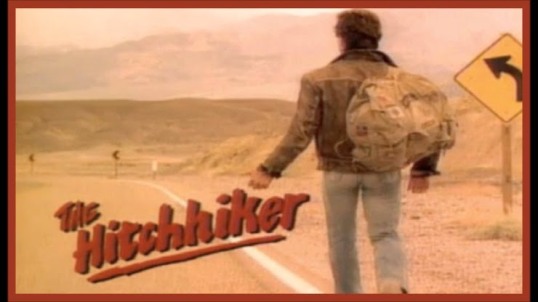


Horror on TV: The Hitchhiker 5.12 “Spinning Wheel” (dir by George Mihalka)


On tonight’s episode of The Hitchhiker, Patti D’Arbanville is perfectly cast Wendy, a performance artist who uses her disturbing nightmares for inspiration and who finds herself losing her grasp on reality.

The episode originally aired on August 5th, 1989.

The TSL Horror Grindhouse: The Psychotronic Man (dir by Jack M. Sell)


If you can figure out what’s going on in 1979’s The Psychotronic Man, you’re definitely doing better than most people who have sat through this film.

Filmed on location in Chicago (at a time when the original Mayor Richard Daley was supposedly encouraging filmmaker to shoot anywhere but Chicago because he didn’t want anyone to film anything that could make his city look bad), The Psychotronic Man tells the story of an alcoholic barber named Rocky (Peter Spelson).  One day, after work, Rocky decides to drive the long way home, which apparently means driving through every inch of rural Illinois.  Seriously, you really do have to wonder just where exactly Rocky lives.  Rocky decides to pull over so that he can get some sleep.  Suddenly, his car is floating in the air.  Was Rocky just having a dream or were aliens trying to abduct him?  Rocky’s concerned and so is his wife and so is his mistress.

Rocky goes to a doctor but the doctor has nothing useful to tell him, beyond prescribing his some aspirin for his headaches.  Rocky tries to investigate on his own but this just leads to him getting a shotgun pulled on him by a suspicious farmer.  This is when Rocky discovers that he can kill people with his mind.

How has Rocky developed the power to kill people with his mind?  Your guess is as good as mine, though the film does feature an professor at the University of Chicago who suggests that Rocky’s power is one that we all have, buried deep in our subconscious.  Perhaps Rocky’s meeting with the aliens caused this powers to be unlocked.  I mean, it’s as good an explanation as any, though you have to wonder why aliens would suddenly want to give an unappealing barber the ability to kill people with his mind.  That seems pretty irresponsible on the part of the aliens.

Well, no matter!  Rocky’s in a lot of trouble now and he’s got not only the police but also a government agent after him.  (The government would like to learn how Rocky developed his “psychotronic powers.”)  This leads to several scenes of Rocky and the police walking around Chicago, looking for each other.  I would say that probably about 75% of this film is just filler.  The plot gets repetitive in record time, as does the bell-dominated soundtrack.  Every few minutes, a bell rings as if we need to be reminded that Rocky is one step closer to meeting his psychotronic destiny.

Personally, I enjoyed seeing the location footage of Chicago and the surrounding countryside.  It was obvious that the film was shot without bothering to get permits so the majority of the people in the background were probably just people trying to either shop or get to work.  That said, The Psychotronic Man plays out a torturously slow pace and Rocky is not at all an appealing main character.  Even before he turns into a psycho mind killer, he’s a drunk who slips from a flask while driving and who is cheating on his wife.  As far as I’m concerned, Rocky deserved whatever he got!

Finally, this film has lived on due to the fact that it introduced the word Psychotronic to the world.  Michael J. Weldon later borrowed the term for The Psychotronic Encyclopedia of Film, The Psychotronic Video Guide, and Psychotronic Video magazine.  Psychotronic is usually a term used to describe low-budget B-movies, the majority of which are better than The Psychotronic Man.

Retro Television Reviews: The Failing of Raymond (dir by Boris Sagal)


Welcome to Retro Television Reviews, a feature where we review some of our favorite and least favorite shows of the past!  On Sundays, I will be reviewing the made-for-television movies that used to be a primetime mainstay.  Today’s film is 1971’s The Failing of Raymond!  It  can be viewed on YouTube!

Poor Raymond!

Played by a young Dean Stockwell, Raymond is patient at a mental hospital who blames everything that has gone wrong on his life on one failed test.  During his senior year of high school, he got a 61 on an English test and, as a result, he not only only failed the class but he also wasn’t allowed to graduate.  The test was administered by a substitute teacher named Mary Bloomquist (Jane Wyman), one who did not know that Raymond had a reputation for being a bit eccentric.  When Raymond tried to ask her whether or not the final two questions were for extra credit, Mary refused to call on him because she was more preoccupied with her failed affair with another teacher (Dana Andrews).  Raymond didn’t answer the final two questions, even though he believed that he had the correct answers.  Now, locked away in a hospital, Raymond comes across an article announcing that beloved teacher Mary Bloomquist will soon be retiring and moving to England.

Seeking revenge, Raymond escapes from the hospital.  While police Sgt. Manzek (Murray Hamilton) search for Raymond, Raymond returns to his old school.  When he finds Mary in her classroom, Mary mistakes Raymond for a mover responding to a classified ad asking for help in getting all of her things packed up.  Raymond may be a homicidal but he also craves direction and praise so he helps Mary with her packing.  As he packs, Mary talks about her decision to retire and it turns out that she’s not quite the monster that Raymond imagined her to be.  Mary is retiring because she feels that she has never made a difference as a teacher.

That said, Raymond is still determined to get his revenge.  He wants Mary to give him the test a second time and to give him a passing grade.  And if she doesn’t, he’s prepared to kill her.  Unfortunately, despite claiming to have spent years studying the material, Raymond still thinks that Robert Browning wrote the Rhyme of the Ancient Mariner.

As the old saying goes, you never know how much your actions might effect someone else’s life.  Mary is a dedicated and well-meaning teacher who cares about her students but her decision to fail Raymond, made on a day when she was distracted by her own personal problems, is something that Raymond has never forgotten or forgiven.  Mary can barely remember it happening but Raymond has based his entire life around that moment and, as the film progresses, it becomes clear that he’s incapable of understanding that the entire world doesn’t revolve around what happened to him during his senior year.  On the one hand, Mary definitely should have answered Raymond’s question about whether or not the final two questions were multiple choice.  On the other hand, Raymond has clearly been using the incident as an excuse to justify every mistake that he’s made sense.  Ironically, Raymond’s quest for revenge gives Mary the chance to finally be the teacher that she truly wants to be.

It’s an intriguing premise.  Unfortunately, like so many made-for-TV movies from the early 70s, The Failing of Raymond is occasionally a bit too stagey for its own good.  Despite only being 73 minutes long, it never really develops any sort of narrative momentum.  That said, Dean Stockwell gives a performance that makes clear why Alfred Hitchcock was planning on casting him as Norman Bates if Anthony Perkins somehow fell through.  As played by Stockwell, Raymond is unfailingly polite and so obviously wounded that it’s impossible not to feel sympathy for him, even when he’s threatening to kill his former teacher.  Jane Wyman, as well, gives a sympathetic performance as Mary, who, despite that one bad day with Raymond, really is the type of teacher we all wish we could have had.

This film was directed by Boris Sagal, who did several made-for-TV movies and also directed Charlton Heston in The Omega Man.  His daughter, Katey Sagal, makes her film debut in a small role as one of Raymond’s fellow patients.

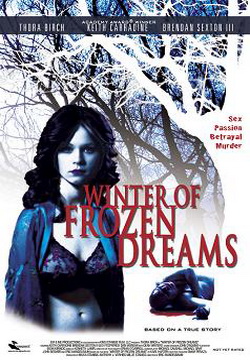
October True Crime: Winter of Frozen Dreams (dir by Eric Mandlebaum)


The 2009 film, Winter of Frozen Dreams, opens with a young woman named Barbara Hoffman (Thora Birch) in a Wisconsin courtroom in 1980.  She is on trial, having been accused of committing two murders.  The jury reads their verdict and the film flashes back three years to show us how how Barbara ended up in that courtroom.

It’s a bit of an odd way to open the film, one that robs the story of any suspense.  The story of Barbara Hoffman is a true one but, unlike other true crime stories, it’s not a commonly known one.  I had not heard of Barbara Hoffman until I watched this film and, after the film ended, I immediately went to Google to make sure that the film was actually telling the truth when it claimed to be based on a true story.  Barbara Hoffman and her trial apparently were a big deal in 1980.  (Her trial was the the first murder trial to ever be televised.)  But it is now so obscure that it doesn’t even have a Wikipedia entry.

As seen in the film, Barbara Hoffman was a genius.  She had a 145 IQ and was the valedictorian of her high school class.  She went to college to study chemistry and was doing quite well academically.  However, when she got a job answering the phones in a massage parlor, she realized that she could make a lot more money as a sex worker than as a chemist.  She dropped out of college before starting her final semester and went to work for a pimp named Ken Curtis (Dean Winters).

Barbara was engaged to two different men.  One was Harry Berge (Dan Moran), who has a taste for bondage and being ritually humiliated.  At first, his co-workers thought he was kidding when he started introducing the much younger Barbara as being his fiancée but Harry actually signed over all of his property to her and allowed Barbara to take out a life insurance policy on him.

It was Barbara’s other fiancé, a mild-mannered video clerk named Jerry Davies (Brendan Sexton III), who Barbara called on Christmas to tell him that she had discovered Harry’s dead and battered body in her bathroom.  Convinced that Harry had been murdered by Ken, Jerry helped Barbara to hide the body in the Wisconsin snow.  Of course, even while Jerry was helping Barbara cover up Harry’s death, Barbara was taking out a considerable life insurance policy on him.

After Jerry has an attack of conscience and leads the police to the body, it falls to the pipe-smoking Detective Lulling (Keith Carradine) and his partner (Leo Fitzpatrick) to figure out who was responsible for Harry’s murder.  Lulling’s instinct is to suspect Barbara but everyone else seems to think that either Ken or Jerry is the more obvious suspect.  After all, Barbara’s a genius.  Why would she kill someone?

It’s an interesting story, though Winter of Frozen Dreams is never quite as compelling as one might wish.  Some of that is because, despite her genius IQ, Barbara herself never becomes that interesting of a character and Thora Birch never seems to be that invested in her performance.  She delivers her lines in a rather flat manner, never really showing the charisma necessary to be convincing as a real-life femme fatale.  That said, you do feel sorry for the two men, especially Brendon Sexton III.  And Keith Carradine and Leo Fitzpatrick make for an amusing detective team.  I almost wish the two of them had starred in their own series, where they traveled the Pacific Northwest and solved small town murders.

Of course, the biggest problem with this movie is that it opens with the verdict so we already know what’s going to happen.  We know who is going to die and we know what’s going to happen to Barbara as a result.  There’s zero suspense as to how things are going to work out.  It’s an error on the part of the filmmakers and an unfortunate one.

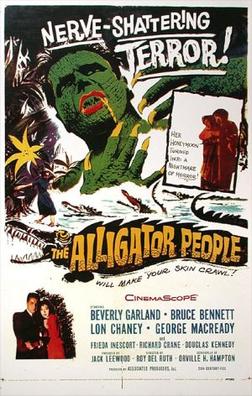
Horror Film Review: The Alligator People (dir by Roy Del Ruth)


You know what the worst bayou is?

Bayouself.

Thank you!  I’ll be here all night and don’t forget to tip your server!

Anyway, the 1959 film, The Alligator People, largely takes place in the bayous of Louisiana.  Nurse Jane Marvin (Beverly Garland) is suffering from amnesia so she allows two psychiatrist to give her a dose of truth serum and then, when she’s in a hypnotized state, she proceeds to remember her former life as Joyce Webster.

Joyce married a handsome and seemingly perfect man named Paul Webster (Richard Crane) but, right when they were about to go on their honeymoon, he received a telegram that disturbed him.  After he made a phone call, he vanished from Joyce’s life.  Joyce did some research of her own and discovered that Paul’s former home was the Cypresses Plantation in the small town of Bayou Landing, Louisiana.

When Joyce travels down to Bayou Landing, she discovers that there’s really not much there, other than a bunch of hungry alligators.  She meets the owner of the plantation, Lavinia Hawthorne (Frieda Inescort).  She also meets the handyman, Manon (Lon Chaney, Jr.), a one-handed brute who spends most of his day shooting at alligators.  And, eventually, Joyce comes across her husband but Paul is no longer the man that she remembers.

Paul’s skin is scaly and he only comes out at night.  It turns out that Paul was, long ago, injected with a serum that would allow him to grow back a missing limb.  The serum worked as far as the limb was concerned but an unfortunate side effect is that Paul is now turning into an alligator!  Dr. Mark Sinclair (George Macready), the man who came up with the serum in the first place, is hopeful that he can reverse the process but, to do so, he’s going to need a lot of radioactive material.

Complicating things is that Manon has decided that he wants Joyce for himself and he’s certainly not going to compete with some alligator man for her attention.  Of course, Joyce despises Manon from the first moment she sees him but Manon’s not that smart.  Can Paul be cured before Manon destroys everything?

The Alligator People is one of those 1950s B-movies that is probably better-known for its name than anything else.  That said, when taken on its own terms, it’s an entertaining watch.  It was one of the final films to be directed by Roy Del Ruth, who had previously been one of Hollywood’s top directors of musicals and comedies.  There’s not much music or deliberate comedy to be found in The Alligator People but Del Ruth does manage to capture the humid stillness of the bayous.  As always, Beverly Garland gives a strong performance as a determined woman who isn’t going to be told what to do and Richard Crane is about as convincing as one can be while turning into an alligator.

As for Lon Chaney, Jr, he plays Manon as being a total monster and he gives a convincing performance, even if it is hard not to mourn the loss of the shadings that he brought to his monster roles while he was with Universal.  Manon is a rough and determinedly unintelligent character, one who exists only to destroy.  Significantly, he’s not one of the Alligator People.  Instead, he’s just a man who doesn’t care about anyone but himself.

The Alligator People is an effective B-movie, full of a bayou atmosphere.

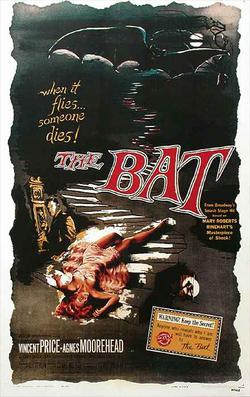
Horror on the Lens: The Bat (dir by Crane Wilbur)


Today’s Horror on the Lens is 1959’s The Bat.  A simple case of bank embezzlement leads to a murder that may or may not be connected to a series of other murders that are apparently being committed by a mysterious killer known as “The Bat.”  The Bat is said to have no face and steel claws and, needless to say, everyone in town is worried about becoming the next victim.

Who is the Bat?  Is Dr. Malcolm Wells (Vincent Price), the shady scientist whose work has led to him doing experiments on bats?  Is it Victor Bailey (Mike Steele), the bank clerk who is a prime suspect in the embezzlement case?  Is it the butler (John Sutton) with a secret past?  Could it even be one of the cops (Gavin Gordon and Robert B. Williams) who has been tasked with capturing The Bat?  Can mystery novelist Cornelia van Gorder (Agnes Moorehead) solve the mystery before becoming The Bat’s next victim!?

The Bat is based on a play and it’s definitely a bit stagey but when you’ve got performers like Agnes Moorehead and Vincent Price onscreen, it really doesn’t matter.  The Bat is an entertaining and atmospheric mystery, featuring a Vincent Price playing another one of his charmingly sinister cads.

Enjoy!

October Positivity: Cutback (dir by Lance Bachelder and Johnny Remo)


You have to feel bad for Luke (Justin Schwan).

I mean, here he is.  He’s a senior in high school.  He’s about to graduate.  He’s also one of the best surfers on the beach.  Just about everyone who sees him surf says that he should go pro.  More than one person says that God has blessed Luke with amazing surfing ability and obviously, that wouldn’t happen unless Luke was actually meant to do something with that talent.

But his parents …. agck!  His mother (Raquel Gardner) keeps pressuring him to go to church and to say grace before dinner and to attend youth group.  She even invites the new youth pastor (Danny Smith) over to the house so that he can meet Luke.  The youth pastor is so cool that his name is Pastor Shane but Luke’s really not interested in any of that.

Meanwhile, Luke’s father (Greg Carlson) is a hardass cop who is hardly ever home because, according to him, he’s got to go on a stakeout.  Luke’s father has decided that Luke is going to go to college and that he’s not going to waste his time as a pro surfer.  When Luke tries to argue with his dad, Luke is sent to his room and told that he is “under restriction.”  Luke’s a senior in high school but his father treats him like a kid who can be ordered around.   When Luke comes home from a party drunk, his father totally freaks out.  His father freaks out a lot.

Luke’s closest friend is Casey Sanchez (Angel Cruz), who is a natural-born joker who keeps talking about how he’s going to learn how to surf someday.  He encourages Luke to pursue his dreams.  He also encourages Luke to talk to the new girl at school, Jessica (Jessie Nickson).  When you’ve got a friend like Casey, what could go wrong, right?  Unfortunately, Casey is killed in a tragic car accident shortly after attending Shane’s youth group and announcing that he has decided to become a Christian.

Casey’s dead and Luke no longer knows what he wants to do with his life.  Jessica’s attempts to comfort him by telling him that it’s all part of a bigger plan do not provide him with much comfort.  (And, to be honest, saying that God planned for Casey to die so that it can somehow benefit Luke does seem to be a bit callous.)  With the try-outs coming for the national surf team, will Luke be able to get it together or will he lose the spot to his rival and frenemy, Matt McCoy (Andy Shephard)?

Though there’s nothing particularly surprising about the plot, Cutback is a likably earnest film.  Justin Schwan, in particular, gives a sympathetic performance and the film captures the beauty of the beach and the ocean.  If anything, it probably works better as a commercial for surfing than one for religion.  In the end, Luke finds some success and he finds some peace and you’re happy for him, even if it is difficult to accept the idea that Casey had to die for him to do it.

Late Night Retro Television Reviews: Check It Out 1.2 “Labor and Other Relations”


Welcome to Late Night Retro Television Reviews, a feature where we review some of our favorite and least favorite shows of the past!  On Saturdays, I will be reviewing the Canadian sitcom, Check it Out, which ran in syndication from 1985 to 1988.  The entire show is currently streaming on Tubi!

This week, Canada goes on strike!

Episode 1.2 “Labor And Other Relations”

(Dir by Stan Harris, originally aired on October 9th, 1985)

I am two episodes into Check It Out and my favorite character is Marlene, the cashier played by Kathleen Laskey.  She’s my favorite specifically because she has the same attitude that I would have if I was working as a cashier.  She doesn’t care about the customers, she doesn’t worry about showing up for work on time, and she takes her first break ten minutes after the store opens.  Plus, out of everyone who works at the store, she has the best fashion sense.

This episode also established that Marlene is the “shop steward” of the Cobb’s union.  No one has ever joined the union, other than Marlene.  But that changes when mean old Mrs. Cobb (Barbara Hamilton) announces that employees of Cobb’s will, from now on, only be allowed to take two coffee breaks a day.  Marlene declares this to be an outrage and invites everyone — except for manager Howard (Don Adams) and assistant manager Christian (Jeff Pustil) — to a union meeting at her apartment.  Soon, every employee of the store is outside, picketing.  Meanwhile, Howard and Christian are forced to bag groceries and deal with customers.

Frustrated by the fact that everyone has joined the union, Howard goes outside to confront the picketers.  Murray (Simon Reynolds), the young bagger who has a crush on Marlene, asks Howard to hold his sign so that he can run into the store and use the bathroom.  (Wouldn’t that count as crossing the picket line?  I’ve never been a member of a union so I’m not really sure how all of this works.)  Howard agrees to hold Murray’s “Cobbs Is Unfair” sign.  Of course, a local reporter snaps a picture of Howard and soon, he’s on the front page of the newspaper.

Howard is just not having a good week.  First off, we learn, in a scene that goes on for way too long, that he’s still struggling with impotence and hasn’t had sex with Edna (Dinah Christie) for weeks.  (Edna is also Howard’s secretary and a member of the union so really, it seems like there’s all sorts of issues here.)  And now, he’s on the front page of the newspaper, picketing his own store.  Ms. Cobb shows up to fire him, saying that she was also responsible for “firing the Shah of Iran” back in 1979.  (What?)

Fortunately, the other employees of Cobb’s come to the rescue by barging into Howard’s office and announcing that they’ve voted him into the Union and therefore, Ms. Cobb can’t fire him for picketing.  Howard gets to keep his job, even though I was under the impression that members of management are not allowed to join a union.  Howard agrees to give everyone back their coffee breaks, even though that was a corporate policy and it was established early on that Howard didn’t have the power to change it.

This was a weird episode.  I’m going to guess that it was not at all a realistic depiction of a labor dispute.  There was way too much time devoted to Howard and Edna discussing their lack of a sex life.  That said, Marlene’s attitude saved the episode.  Even though she didn’t care about her job, she still brought the company to its knees.  Woo hoo, you go, Marlene!

Horror On TV: The Hitchhiker 5.8 “Code Liz” (dir by Bruno Gantillon)


On tonight’s episode of The Hitchhiker, Marc Singer plays a real loser, a deadbeat husband who spends almost all of his time talking to a phone sex operator named Liz (Paulina Mlynarska).  When Liz suggests that the husband murder his wife (Katrine Boorman), who is left to wonder whether he should follow her advice or if she even exists to begin with.

This episode, featuring a wonderful turn from Marc Singer, originally aired on July 21st, 1989.