Music Video of the Day: Heart of Glass by The Associates (1988, dir by ????)


This video popped up in my YouTube recommendations, I assume because I’ve been watching a lot of Blondie videos recently.  This has an enjoyably weird feel to it, with its caged clown on a typewriter and all the other carnival folks.  I relate to the woman at the start of the video.  That’s definitely the job and costume that I would want if I worked for a traveling circus.

Enjoy!

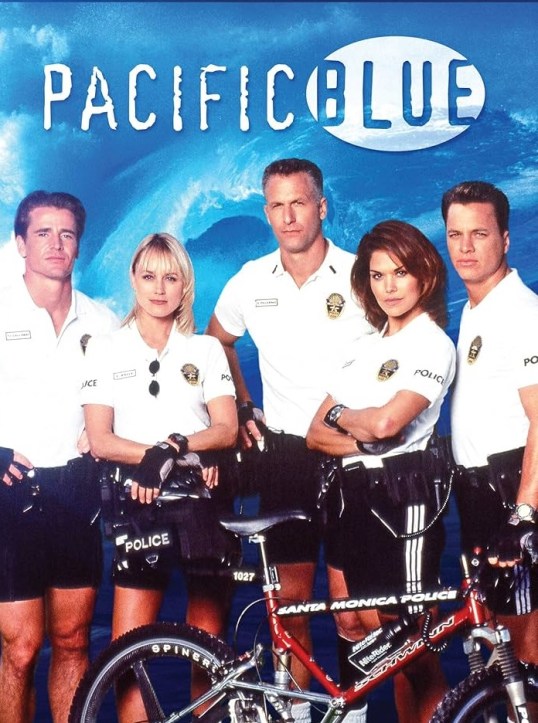
Late Night Retro Television Review: Pacific Blue 1.3 “No Man’s Land”


Welcome to Late Night Retro Television Reviews, a feature where we review some of our favorite and least favorite shows of the past! On Tuesdays, I will be reviewing Pacific Blue, a cop show that aired from 1996 to 2000 on the USA Network!  It’s currently streaming everywhere, though I’m watching it on Tubi.

It’s time for another trip to the beach!

Episode 1.3 “No Man’s Land”

(Dir by Michael Levine and John Bush, originally aired on March 16th, 1996)

Uh-oh!  There’s Nazis on the beach.

We know that Carl (Ryan Alosio) is a Nazi because he owns a bar that is decorated, on the outside, with a swastika.  Then, on the inside, there are many more swastikas and a German flag and a picture of Adolf Hitler hanging on the wall.  My question is who sold the bar to Carl and how exactly is he not violating any zoning laws?  Throughout the show, we’re constantly told that Carl can do whatever he wants on his property but don’t most towns have rules about what you can and cannot display in a business district?  We’re told that Carl has a criminal record and his arms are covered in Nazi tattoos so, once again, I have to wonder who sold him the bar.  There are a lot regulations and paperwork involved in opening up your own small business.  That’s especially true if your business is going to be selling alcohol.  I guess my point is that I just have a hard time believing that Carl’s Nazi bar would be allowed to stay open on the boardwalk.

Bizarrely, ordinary non-Nazis keep entering Carl’s Nazi bar.  Wouldn’t the swastika turn most people away?  I’m just saying that personally, I would not go in a building that was decorated with a swastika.  Anytime anyone who  is not a Nazi goes in Carl’s bar, Carl beats them up.  You really have to wonder how Carl is managing to stay in business.  I mean, let’s just accept that there’s enough Nazis in Santa Monica for Carl to have a steady customer base.  Carl is still asking those people to step into a building that is decorated with a swastika and basically announce their opinions to the world.  I would think at least some of the Santa Monica Nazis would be like, “No, I’d rather keep it a secret and go drink at a politically neutral bar.”  I mean, this isn’t some isolated club, like the place in Green Room.  This bar is sitting right in the middle of the boardwalk, where hundreds of people walk by each day.  Apparently, Santa Monica Nazis have no fear of being outed.

Like all Nazis, Carl is a jerk.  He beats up a vendor for selling churros in front of his bar.  He also harasses all of the non-white surfers.  You would think that this episode’s hero would be Officer Del Toro but instead, it falls to the very white T.C. Callaway to stand up to Carl and eventually drag him off to jail.  Callaway explains that he hates bullies.  That’s fine but it’s still more emotionally satisfying to watch a bully get beaten up by the bullied as opposed to by a concerned bystander.

We also get B-plot about a young graffiti artist named Melo (Christopher Babers) and Cory’s attempt to get Melo to see the error of his ways and instead use his artistic talent for something good.  And Mayor Mickey Dolenz spends the episode panicking because there’s an election to coming up to determine whether or not to allow on the nudity on the beach.  It’s pretty dumb but it’s hard not to smile at Mickey Dolenz playing himself.

The main problem with this episode and the show as a while is that the cops look silly riding around on their bikes.  When Cory and Victor head down a flight of stairs to catch Melo tagging a tunnel, they have to pick up and carry their bikes with them and it was hard not to laugh.  Whenever someone says, “This is Bike 1 responding,” to a crime call, I just imagine a dispatcher grimacing and thinking, I was hoping for a real cop.  Watching CHiPs and then this episode made me appreciate how much better motorcycles are than bicycles.

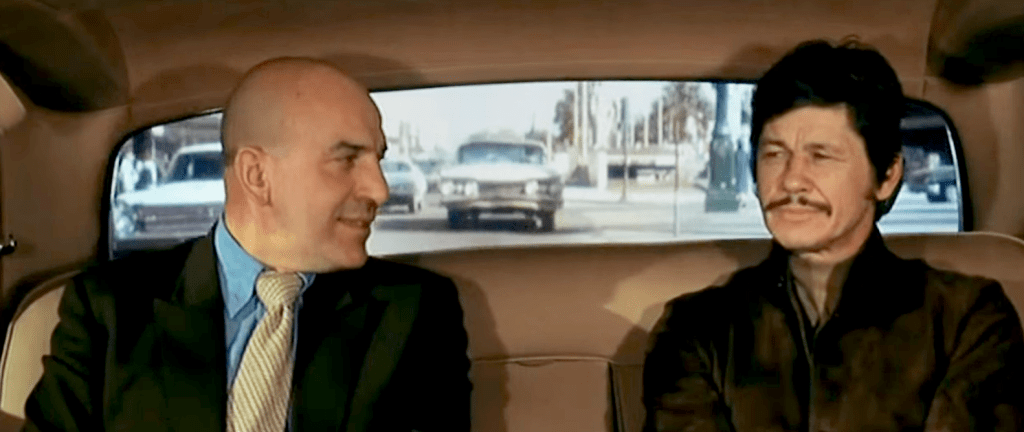
Happy Birthday in heaven, Telly Savalas! Who loves ya, baby??


Telly Savalas was born on January 21, 1922 and he died on January 22, 1994. When I think of Savalas, I first think of his most famous character, KOJAK (1973-1978).

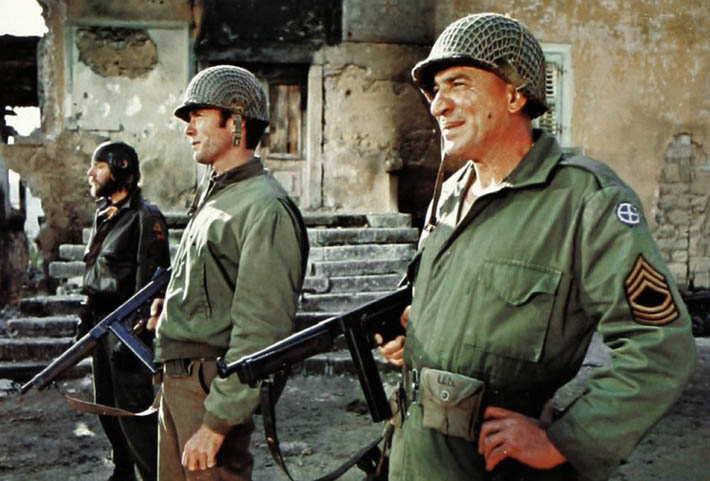
After that I think of his work with my movie hero, Charles Bronson. They worked together on THE DIRTY DOZEN (1967) and VIOLENT CITY (1970). They were also in the BATTLE OF THE BULGE (1965), but they didn’t share any scenes together. I’ll always remember Savalas in the movie KELLY’S HEROES (1970). This was one of my son’s favorite movies when he was growing up. He watched it constantly.

Based on this work, Telly Savalas will always be one of my favorite actors! Happy birthday, sir, and thanks for countless hours of entertainment in my life!

Lisa Marie Reviews An Oscar Nominee: The Insider (dir by Michael Mann)


In the 1999 Best Picture Nominee, The Insider, the American media takes a beating.

Al Pacino plays Lowell Bergman.  Bergman is a veteran newsman who, for several years, has been employed as a producer at 60 Minutes.  He is a strong believer in the importance of the free press and he’s proud to be associated with both 60 Minutes and CBS News.  He’s one of the few people who can manage the famously prickly correspondent, Mike Wallace (Christopher Plummer).  When we first see Bergman, he and Wallace are in the Middle East and arranging a tense interview with the head of Hezbollah.  It’s easy to see that Bergman is someone who will go anywhere and take any risk to get a story.  It’s also apparent that Bergman thinks that the people that he works with feel the same way.

That all changes when Bergman meets Jeffery Wigand (Russell Crowe), a recently fired tobacco company executive who initially agrees to serve as a consultant for one of Bergman’s story but who leaves Bergman intrigued when he reveals that, due to a strict confidentiality agreement, he’s not allowed to discuss anything about his time as an executive.  As the tobacco companies are currently being sued by ambitious state attorney generals like Mississippi’s Mike Moore (who plays himself in the film), Bergman suspects that Wigand knows something that the companies don’t want revealed.

And, of course, Bergman is right.  Wigand was fired for specifically objecting to his company’s effort to make cigarettes more addictive, something that the tobacco industry had long claimed it wasn’t doing.  Wigand’s pride was hurt when he was fired but he knows that breaking the confidentiality agreement will mean losing his severance package and also possibly losing his marriage to Liane (Diane Venora) as well.  However, Wigand is angered by the heavy-handed techniques that his former employer uses to try to intimidate him.  He suspects that he’s being followed and he can’t even work out his frustrations by hitting a few golf balls without someone watching him.  When Wigand starts to get threats and even receives a bullet in the mail, he decides to both testify in court and give an interview to Wallace and 60 Minutes.

The only problem is that CBS, after being pressured by their lawyers and facing the risk of taking a financial loss in an upcoming sell, decides not to run the interview.  Bergman is outraged and assumes that both Mike Wallace and veteran 60 Minutes producer Don Hewitt (Philip Baker Hall) will support him.  Instead, both Wallace and Hewitt side with CBS.  Left out in the cold is Jeffrey Wigand, who has sacrificed almost everything and now finds himself being attacked as merely a disgruntled employee.

Directed by Michael Mann and based on a true story, The Insider is what is usually described as being “a movie for adults.”  Instead of dealing with car chases and super villains and huge action set pieces, The Insider is a film about ethics and what happens when a major media outlet like CBS News fails to live up to those ethics.  (No one is surprised when the tobacco company tries to intimidate and silence Wigand but the film makes clear that people — or at least people in the 90s — expected and hoped for more from the American press.)  Wigand puts his trust in Bergman and 60 Minutes largely because he believed Bergman’s promise that he would be allowed to tell his story.  It’s a promise that Bergman made in good faith but, in the end, everyone from the CBS executives to the tobacco companies is more interested in protecting their own financial future than actually telling the truth.  Wigand loses his family and his comfortable lifestyle and Bergman loses his faith in the network of Edward R. Murrow.  It’s not a particularly happy film but it is a well-made and thought-provoking one.

Pacino and Crowe both give excellent performances in the two lead roles.  Pacino, because he spends most of the film outraged, has the flashier role while Crowe plays Wigand as a rather mild-mannered man who suddenly finds himself in the middle of a national news story.  (Crowe’s performance here is one of his best, precisely because it really is the opposite of what most people expect from him.)  Crowe does not play Wigand as being a crusader but instead, as an ordinary guy who at times resents being put in the position of a whistleblower.  (Director Mann does not shy away from showing how Bergman manipulates, the reluctant Wigand into finally testifying, even if Bergman’s motives were ultimately not malicious.)  That said, the strongest performance comes from Christopher Plummer, who at first seems to be playing Mike Wallace as being the epitome of the pompous television newsman but who eventually reveals the truth underneath Wallace’s sometimes fearsome exterior.

The Insider was nominated for Best Picture.  Somehow, it lost to American Beauty.

Retro Television Review: Fantasy Island 6.2 “Dancing Lady/The Final Round”


Welcome to Retro Television Reviews, a feature where we review some of our favorite and least favorite shows of the past!  On Tuesdays, I will be reviewing the original Fantasy Island, which ran on ABC from 1977 to 1984.  Unfortunately, the show has been removed from most streaming sites.  Fortunately, I’ve got nearly every episode on my DVR.
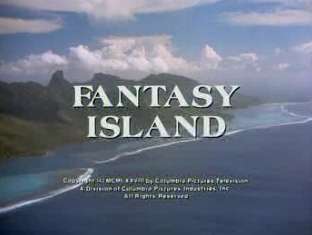
This week, Fantasy Island feels familiar.

Episode 6.2 “Dancing Lady/The Final Round”

(Dir by Cliff Bole, originally aired on October 23rd, 1982)

It’s another dancing and boxing episode!

I have lost track of how many Fantasy Island stories have centered around either dancing or boxing but I know that they’ve been the subject of multiple episodes every season.  The fantasies always seem to play out the same as well.  A young boxer has a shot at the championship but taking one wrong blow could end their career or even their life.  And a woman with a boring job — usually, she’s a receptionist — wants to be the world’s greatest dancer but, in the end, discovers that love is the most important thing.  Usually, the familiarity of the stories is a part of Fantasy Island‘s charm but I have to admit that I spent this entire episode wondering if I had seen it before.  The fantasies felt so familiar that, ultimately, everyone just seemed to be going through the motions.

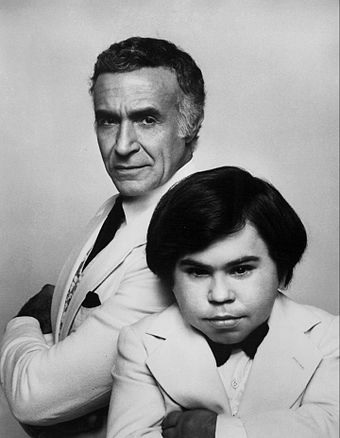
The dancer was Kristy Lee (Lynda Goodfriend), who was given a special powder that would give her the ability to be the world’s greatest dancer.  I know what you’re thinking and no, it was not cocaine.  Instead, it was dust that had been gathered from the world’s greatest theaters and which had magical powers only when used on Fantasy Island.  Using the dust, Kristy auditioned for a spot in a musical showcase starring Ray Tucker (Ken Berry), a down-on-his-luck dancer looking to make a comeback.  Unfortunately, Kristy was so good that Ray feared she would overshadow him.  Ray had to find his confidence and Kristy had to learn that she could dance beautifully even without the magic dust because, according to Roarke, the power of love is all one needs.  (That laughter you hear is coming from every dance teacher I’ve ever had.)  The highlight of this fantasy was Ray Bolger, playing a Broadway producer who happened to be an old friend of Roarke’s.  Bolger and Ricardo Montalban, two old show business pros, seemed to really enjoy working together.  As well, Bolger’s producer had a nice scene where he and Tattoo spoke in French to each other.  It was a fun little moment and, if nothing else, it indicated that both Roarke and Tattoo have lives outside of greeting people on Fantasy Island.

The boxing story featured Al Molinaro as Max, a trainer who wanted to train someone for an exhibition match against the world champion.  Max got his chance to train the enthusiastic Tommy Rudolph (William R. Moses) but, when Max’s ex-girlfriend (Rue McClanahan) warned him that one more concussion could possibly kill Tommy, Max had to make a decision.  Would he push Tommy to keep fighting or would he thrown in the towel after Tommy took a few shots to the head?  Max, of course, did the right thing.

As I said, it was all pretty predictable and familiar.  At least Tattoo got to have some fun.  Along with speaking French, he also got to put on a bookie outfit and then take bets on the outcome of the fight.  When Roarke told Tattoo to cancel all the bets, Tattoo replied that being a bookie was his fantasy!

Hey, it made me laugh,
Song of the Day: Super Snooper by The Oceans


I watched the classic Terence Hill film Super Fuzz last night.  As anyone who has seen the movie can tell you, the movie features a theme song that just won’t quit.  It’s been stuck in my head since last night.  And now, it can be stuck in yours!

There’s a man, do you see?
And he looks just like you and me
Didn’t he know?
Everything he got don’t show

There’s a cop, do you see?
And he looks like every cop on the street
You will discover
You can’t judge this cop by his cover

He’s a super snooper
Really super trooper
A wonder cop, a one like you never saw

He’s a super snooper
Really super trooper
A wonder cop, who roll the side of the law

There’s a stir on the floor
Super snooper open the door
Didn’t he know?
Everything he got don’t show

He’s a super snooper
Really super trooper
A wonder cop, a one like you never saw
He’s a super snooper
Really super trooper

He’s a super snooper
Really super trooper
A wonder cop, a one like you never saw
He’s a super snooper
Really super trooper

He’s a super snooper
Really super trooper
A wonder cop, a one like you never saw

He’s a super snooper
Really super trooper
A wonder cop who roll the side of the law

Songwriters: Angelo La Bionda / Carmelo La Bionda / Timothy Touchton

The Films of 2024: Reagan (dir by Sean McNamara)


In Reagan, Dennis Quaid stars at the 40th President of the United States.

Framed as a story being told by a former KGB agent (Jon Voight) who is attempting to make a younger politician understand why Russia lost the Cold War, Reagan starts with Reagan’s childhood, includes his time as an actor and as the anti-communist head of the SAG, and then gets into his political career.  Along the way, several familiar faces pop up.  Robert Davi plays a thuggish Russian leader.  Mena Suvari plays Reagan’s first wife while Penelope Ann Miller plays his second.  Xander Berekely plays George Schultz (who was just previously played by Sam Waterston in The Dropout miniseries.)  C. Thomas Howell, Kevin Dillon, Dan Lauria, and Lesley-Anne Down all have small but important roles.  And the usual suspects when it comes to conservative filmmaking — Nick Searcy, Kevin Sorbo, and Pat Boone — are there to compliment Voight and Davi.  I was a little surprised to see that Dean Cain was not present.

As usually happens to films that feature sympathetic Republicans, Reagan was slammed by critic but better-appreciated by the audience for which the film was made.  I wasn’t particularly surprised.  Movie critics tend to be liberal and Reagan is very much not that.  For a professional film critic, a film like Reagan must be met with snark and derision because otherwise, one would risk cancellation.  Don’t get me wrong.  I’m not saying that there aren’t things to criticize about Reagan the film.  I’m just saying that one should always keep in mind that critics have their own individual biases.  One reason why the Rotten Tomatoes score is such an unfortunate development is because it ignores the fact that most films have things that work and things that don’t work and that quality is often in the eye of the beholder.  Instead, it just tells us that a film is either a 90% or a 10%.

As for Reagan, it’s definitely a bit on the heavy-handed side but, then again, I think the same can be said for just about every political film that’s come out over the last few decades.  For those who claim Reagan is somehow more heavy-handed than most, I invite them to sit through Rob Reiner’s LBJ.  Indeed, the only director who has really shown a willingness to admit that a President can be both good and bad was Oliver Stone and when was the last time anyone watched NixonReagan is at its weakness when it tries to recreate Reagan’s time as an actor.  Dennis Quaid gives a good and charming performance throughout the film but he’s also 70 years old and, in the scenes where he plays the youngish Ronald Reagan, all of the soft-lighting and Vaseline on the lens ends up making him look like a wax figure.  Once Reagan gets older, Quaid is allowed to act his age and both he and the film become much more convincing.  I enjoyed the film once Reagan became President, though you should understand that I have biases of my own.  I’m a fan of low taxes and individual freedom, which is why I’m also not a fan of communism or, for that matter, any extreme ideology that attempts to tell people how to live or think.  “Tear down this wall!” Regan says while standing in front of the Berlin Wall and it’s a rousing moment, both in reality and on film.

In the end, Reagan is a film that will be best appreciated by people who already like Ronald Reagan.  Yes, the film is heavy-handed and the framing device is a bit awkward.  But Dennis Quaid’s heartfelt (and, towards the end, heartbreaking) performance carries the film.  The film is not at all subtle but you know what?  I’ve seen a countless number of mediocre films that have portrayed Reagan negatively, often with as little nuance and just as heavy-handed an approach as Reagan uses in its positive portrayal of the man.  I sat through The Butler, for God’s sake.  There’s nothing wrong with having a film that looks at the man from the other side.  Those who like Ronald Reagan will feel vindicated.  Those who don’t will say, “What was up with that Pat Boone scene?”

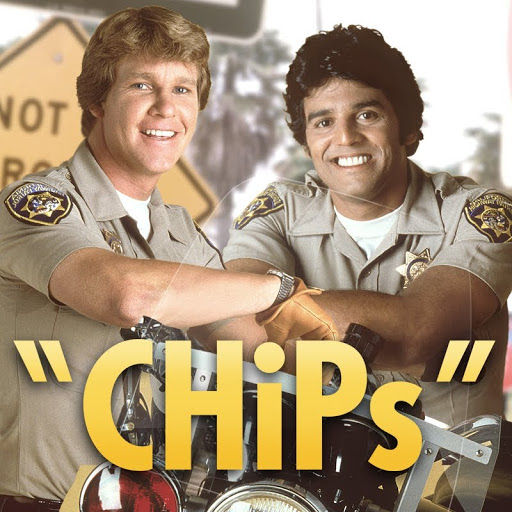
Late Night Retro Television Review: CHiPs 3.5 “Death Watch”


Welcome to Late Night Retro Television Reviews, a feature where we review some of our favorite and least favorite shows of the past!  On Mondays, I will be reviewing CHiPs, which ran on NBC from 1977 to 1983.  The entire show is currently streaming on Prime!

This week, someone dies!  OH MY GOD!

Episode 3.5 “Death Watch”

(Dir by Barry Crane, originally aired on October 13th, 1979)

Dennis (Christopher Stone) is a veteran movie stunt driver who has never gotten over the tragic death of his child and the way he was treated by a heartless insurance company.  He now drives up and down the freeway, looking for drivers who look like they have good insurance.  Using his stunt skills, he causes accidents and then, under one of many assumed names, he files an insurance claim.  Dennis’s wife (played by Dee Wallace, who was married to Stone at the time) thinks that Dennis is taking things too far but Dennis is convinced that he’s earned the right to commit insurance fraud.  As he puts it, the companies have enough money that it’s not going to hurt them if he steals some of it.

Unfortunately, his latest attempt to cause an accident results in a delivery van swerving to the side of the road and striking two policemen who have pulled over a drunk driver.  One of the policeman is series regular Bear (played by Brodie Greer).  The other is a guy named Steve (Stephen Parr) who we’ve never seen before but who is quickly established as being everyone’s best friend.  Or, I guess, he was everyone’s best friend as he dies shortly after being taken to the hospital.  I have to admit that Steve dying was a bit jarring.  It’s rare that anyone on CHiPs is seriously injured, much less killed.

The highway patrol officers are shaken by Steve’s death.  Ponch and Baker go to the station’s gym and work off their frustration.  Jon lifts weights.  Ponch takes off his shirt and starts hitting a punching bag and, despite the tragedy of the situation, it was hard not to laugh at the show using it as an excuse for Erik Estrada to once again take off his shirt.

The members of the highway patrol attend Steve’s funeral.  It’s pretty somber until Bear rolls into the church in his wheelchair and everyone breaks out into a huge smile.  They’re happy that Bear survived but I do have to wonder how Steve’s family felt when they saw all those smiles and heard the officers joking amongst themselves.  I guess they should have been happy that Ponch actually wore pants and a shirt to the funeral as opposed to showing up in a speedo.  Seriously, if anyone would do that, it would be Ponch.

All of the bad drivers are brought to justice.  The driver of the delivery van loses his job.  Dennis goes to prison.  By the end of the episode, everyone’s in a good mood again.  Rest in peace, Steve!

This episode deserves some credit for trying to deal with a serious issue.  Death is a big deal.  Unfortunately, CHiPs really isn’t the best format for heart-rendering drama.  Even after Steve was killed, the show still teased the audience with the promise of another crash.  In the end, the main message seemed to be that it was better to lose Steve than Bear …. or, God forbid, Ponch!

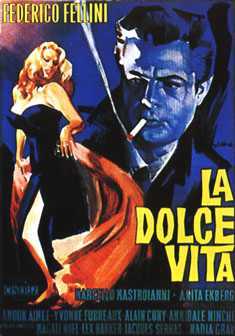
Film Review: La Dolce Vita (dir by Federico Fellini)


The great director Federico Fellini was born, on this day, 125 years ago.

He was born in Rimini.  That’s in Northern Italy.  (The Italian side of my family comes from Southern Italy and yes, there is a difference.)  Fellini was 19 years old when he enrolled in law school but records, which were admittedly spotty at the time, seem to indicate that he never attended a single class.  Instead, Fellini found work as a writer, working first as a journalist and then a screenwriter.  (He was one of the many credited for writing the screenplay for Rome, Open City.)  He began his directing career as a neorealist in the 50s but soon crafted his own unique style, one which openly mixed humor with drama and fantasy with earthiness.  Fellini established himself as one of the world’s best directors, a filmmaker who made art films that not only entertained but also provoked thought.  Fellini was a director who embraced life’s contradictions as well as being a strong anti-authoritarian who rarely commented on politics but did make known his distaste for communism.  He was also one of Mario Bava’s best friends.

My favorite Fellini film is 1960’s La Dolce Vita.

Ah, to be rich, decadent, and jaded in Rome in the early 60s!  Or maybe not.  Sometimes, being jaded is not as much fun as it seems.

La Dolce Vita is largely remembered for the scene in which actress Sylvia (Anita Ekberg) and journalist Marcello (Marcello Mastroianni) wade into Rome’s Trevi Fountain.  While that it is a great and sensual scene and justifiably famous (and, in fact, the film’s poster was originally a shot of Ekberg in the fountain despite the fact that the scene is only a small part of a 3-hour movie), it’s often overlooked that the scene itself does not have a happy ending.  When Marcello and Sylvia return to Sylvia’s hotel, Sylvia is slapped by her loutish boyfriend (played by Lex Barker).  Marcello, meanwhile, has a fiancée named Emma (Yvonne Furneaux) who is recovering from a recent overdose.  Even though Marcello swears that he loves Emma and that he would do anything for her, he is still compulsively unfaithful.

When we first meet Marcello, he’s in a news helicopter, watching as a statue of Jesus is flown over Rome.  However, Marcello is distracted by the sight of a group of women sunbathing on a nearby rooftop and he tries to get their phone numbers before returning to following the statue.  That pretty much sets the tone for most of what we see of Marcello over the course of La Dolce Vita.  He’s searching for the profound and transcendent but he frequently gets distracted by his own more earthy desires.

The film follows Marcello as he encounters different people in Rome and the surrounding area.  Some of them are rich and some of them are poor.  All of them are looking for something but none of them seem to be quite sure what it is.  A possible sighting of the Madonna brings a crowd of people to the outskirts of Rome, where everyone asks for something but the end result is only chaos.  A meeting with an intellectual friend of Marcello seems to offer a solution to Marcello’s ennui until a tragedy reveals that his friend was even more lost than Marcello.  (The film’s sudden tragic turn took me very much by surprise when I first saw it, despite the fact that countless filmmakers have imitated the moment since.)  A possibly important conversation on a beach is made unintelligible by the crashing waves and, instead of providing enlightenment, it ends with a shrugs and an enigmatic smile.  There’s a definite strain melancholy running through the film though there’s also a certain joi de vivre to many of Marcello’s adventures.  Marcello is torn between seeking transcendence and seeking pleasure.  Fellini shows us that both are equally important.  It’s left to use to decide whether the pleasure is worth the heartache and vice versa.

La Dolce Vita is visually stunning portrait of life in Rome at a very particular cultural moment.  Marcello Mastroianni is the epitome of decadent cool in the lead role but he’s also a good enough actor to let us see that Marcello is never quite as proud of himself or as happt with his life as everyone assumes he is.  La Dolce Vita may be about a specific cultural moment but, as a film, it is timeless.