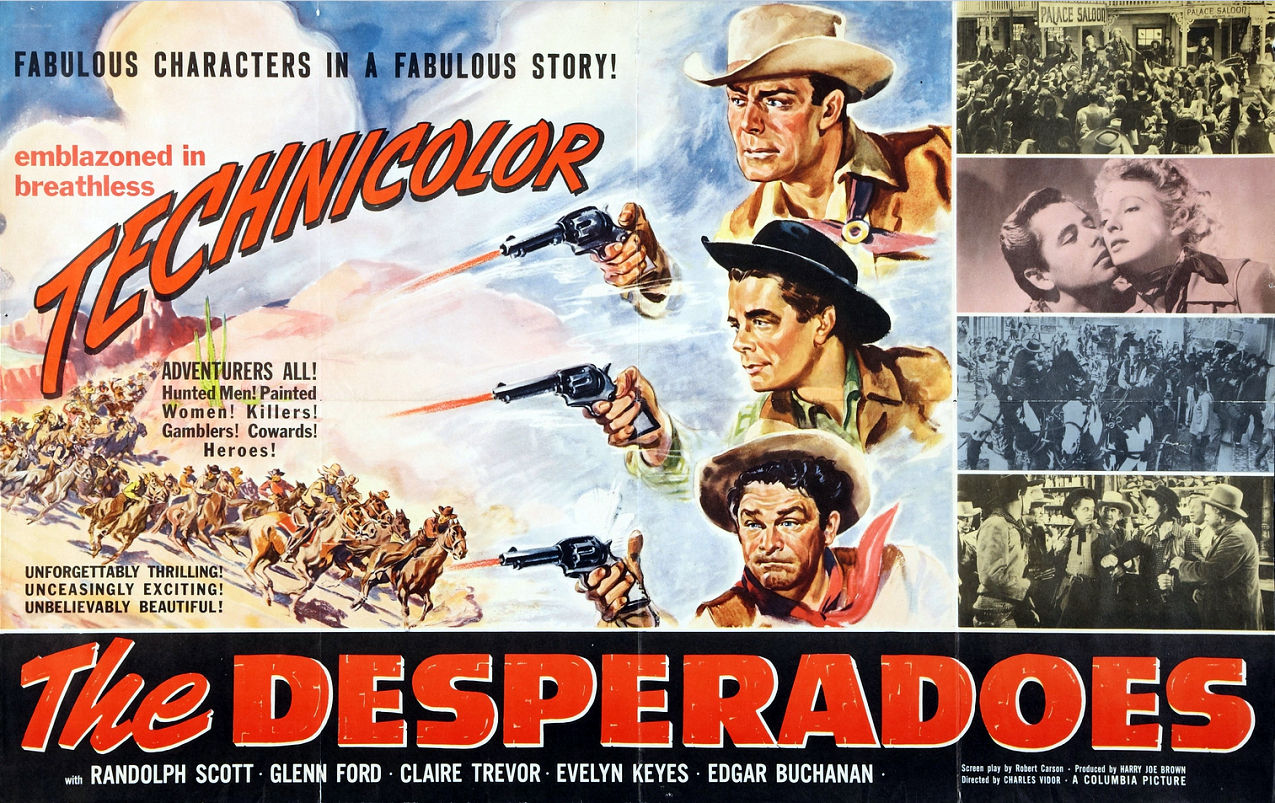
There’s a lot to like about THE DESPERADOES. Not that it’s anything groundbreaking; it’s your standard Western outing with all the standard clichés. you’ve got your two pals, one the sheriff (Randolph Scott ), the other an outlaw (Glenn Ford ). You’ve got your gambling hall dame (Claire Trevor ) and sweet young thing (Evelyn Keyes) vying for the good/bad guy’s attention. You’ve got your goofy comical sidekick (Guinn ‘Big Boy’ Williams). You’ve got your supposedly respectable heavy (Porter Hall ), a mean heavy (Bernard Nedell), and a heavy who has a change of heart (Edgar Buchanan). What makes this one different is the movie seems to know it’s clichéd, giving a nod and a wink to its audience as it merrily makes its way down that familiar dusty trail.
Based on a novel by pulp writer Max Brand (who also created the Dr. Kildare series), this was one of Columbia’s big releases of the year, and…
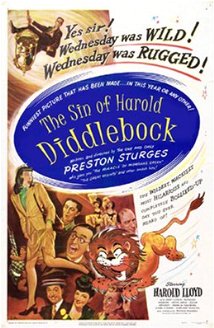
The 42nd film in Mill Creek’s Fabulous Forties box set was a 1947 comedy called The Sin of Harold Diddlebock.
As a classic film lover, I really wish that The Sin of Harold Diddlebock was better than it actually is. The film was a collaboration between two of the biggest names in cinematic comedy history: director/writer Preston Sturges and legendary actor Harold Lloyd. In fact, this was the first film that Sturges directed after leaving the studio system so that he could make bring his unique brand of satire to life without having to deal with interference. He managed to convince Harold Lloyd to come out of retirement to star in the movie and the film even works as a quasi-sequel to one of Lloyd’s most beloved silent comedies, The Freshman. In a perfect world, The Sin of Harold Diddlebock would have been a comedy masterpiece that would have perfectly shown off the talents of both men.
Unfortunately, that’s really not the case. The Sin of Harold Diddlebock is consistently amusing but it’s never quite as funny as you want it to be. This is one of those films that sounds like it should be hilarious but, when you actually watch it, you see that the film is oddly paced and Lloyd never seems to be fully invested in his role. I suppose the natural inclination would be to blame this on interference from the notoriously eccentric Howard Hughes, who co-produced the film with Sturges. After Harold Diddlebock failed at the box office, Hughes withdrew it and spent three years personally reediting the film before re-releasing it under the title Mad Wednesday. However, by most reports, Hughes wasn’t really the problem. If Wikipedia is to be believed (and God do I hate starting any sentence with that phrase), Lloyd and Sturges did not have a good working relationship. As sad as that is, it’s also understandable. Geniuses rarely work well together.
The Sin of Harold Diddlebock does get off to a good start, seamlessly incorporating the last reel of The Freshmen with footage shot for Harold Diddlebock. (Somewhat sweetly, the film starts with a title card informing us that the what we are about to see was taken from The Freshman.) After college freshman Harold Diddlebock scores the winning touchdown in a football game, impressed advertising executive J.E. Waggleberry (Raymond Walburn) offers Harold a job. However, Harold wants to finish college so Waggleberry tells Harold to look him up in four years.
Four years later, recently graduated Harold goes to Waggleberry for a job and discovers that J.E. Waggleberry has totally forgotten him. Harold ends up working in the mailroom but is told that, as long as he is ambitious and smart, he will easily move up in the company. 22 years later, Harold is still working in the mailroom. He is secretly in love with Miss Otis (Frances Ramsden). Of course, he was also in love with each of Miss Otis’s six older sisters, all of whom worked at the company before the current Miss Otis. Harold bought an engagement ring when the oldest Otis sister was with company. Years later, he’s still carrying it with him and dreams of giving it to the current Miss Otis.
However, that might be difficult because Harold has just been fired. J.E. Waggleberry feels that Harold’s unambitious attitude is setting a bad example. As severance, Harold is given a watch and $2,946.12.
The normally quiet and reserved Harold reacts to losing his job by doing something very unusual for him. He goes to a bar and, with the help of a con man (Jimmy Conlin) and a bartender (Edgar Kennedy), he gets drunk. The bartender even creates a special drink called the Diddlebock. Harold drinks it and wakes up two days later, wearing a huge cowboy hat and owning a bankrupt circus…
And it only gets stranger from there….
While The Sin of Harold Diddlebock doesn’t quite work, I appreciated the fact that it not only created its own surreal world but that it just kept getting stranger and stranger as the film progressed. It was Harold Lloyd’s final film and there’s even a scene where he and a lion end up on the edge of a skyscraper that’s almost as good as the famous comedic set pieces from his silent classics. It’s a pity that the film doesn’t really come together but I’d still recommend seeing it just for history’s sake.
(For those following at home, Lisa is attempting to clean out her DVR by watching and reviewing 38 films by the end of this Friday. Will she make it? Keep following the site to find out!)
Do you know who Florence Ziegfeld was?
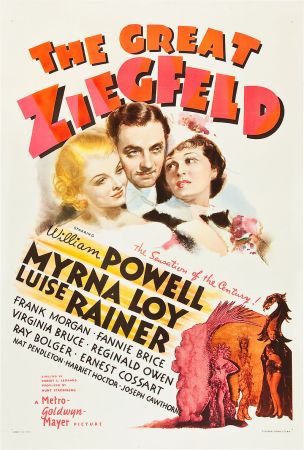
Don’t feel bad if you don’t because, until I saw the 1936 film The Great Ziegfeld, I had no idea and history is my number one obsession. Florence Ziegfeld was a theatrical producer who, in the early days of the 20th Century, produced huge spectacles. He was a showman who understood the importance of celebrity and gossip. He produced a show called The Ziegfeld Follies, which was considered quite risqué at the time but which looks remarkably tame today. Florence Ziegfeld was so famous that he even got his own Oscar-winning biopic.
The Great Ziegfeld features the always smooth William Powell as Ziegfeld. When we first meet him, he’s promoting a strongman and a belly dancer and nobody takes him seriously. But through hard work, good luck, and his own instinct for showmanship, he becomes famous and his shows gets bigger and bigger. The film follows Ziegfeld as he gets married, both times to someone he is grooming to be a star. His first wife is Anna (Luise Rainer), who loves him but divorces him when it becomes obvious that Ziegfeld’s life will always revolve around his work. His second wife is Billie Burke and we know that she is Ziegfeld’s true love because she’s played by Myrna Loy. Whenever you see William Powell and Myrna Loy in the same film, you know that they belong together.
The majority of The Great Ziegfeld is taken up with recreations of Ziegfeld’s stage shows. In fact, the film almost feels more like a musical variety show than a real biopic. (Judging from the credits, quite a few of Ziegfeld’s stars played themselves and recreated their acts on the big screen.) I can understand why this was attractive to audiences in the 1930s. With no end in sight to The Great Depression and Ziegfeld himself recently deceased, this movie was their only opportunity to see one of his spectacles. The film made sure that they got their money’s worth.
However, for modern audiences, all of the acts just add to what is already an oppressive running time. My main impression of The Great Ziegfeld was that it was really, really long. The movie itself is well-produced and William Powell and Myrna Loy are always fun to watch but the movie just goes on and on. As well, this biopic is so worshipful of Ziegfeld — the title is meant to be taken literally — that, as a result, he comes across as being one-dimensional. I did appreciate the film as a historical artifact but otherwise, it didn’t do much for me.
However, it did something for the Academy. The Great Ziegfeld was named the best picture of 1936! Luise Rainer won best actress despite only being on-screen for a handful of scenes. So many people were critical of Rainer’s award that, the very next year, the Academy introduced the award for best supporting actress.
As for why Ziegfeld won that Oscar — well, if you look at its competition and some of the other 1936 films that received nominations, you’re struck by the lack of truly memorable films. It would appear that, in a weak year, the Academy decided to give the award to the biggest production they could find.
And that was The Great Ziegfeld.
(Incidentally, if Flo Ziegfeld were alive today, he would probably be a reality TV producer.)
“Politicians have remained professionals only because the voters have remained amateurs!” — State of the Union (1948)
Does anyone remember the Americans Elect fiasco of 2012?
Americans Elect was an organization set up by a bunch of businesspeople, attorneys, and out-of-office politicians. Their stated goal was to challenge the political establishment, shake up the two-party system, and elect a president. The idea was that the party would hold a nationwide primary. Any registered U.S. voter could go online and cast their vote on what they thought should be in the party’s platform and who they thought should be the Americans Elect presidential candidate. Whoever won this nationwide primary would be required to 1) run on the platform and 2) pick a vice presidential candidate from the opposite party.
And all would be right with the world, right?
Right.
Anyway, I did register as an American Elect delegate, just because I was curious to see who was getting votes in the nationwide primary and who wasn’t. (And yes, I did cast a vote. I voted for Dallas County Commissioner Elba Garcia.) Looking over the site, I saw that all of the usual suspects were getting votes — Ron Paul, Hillary Clinton, Michael Bloomberg, Donald Trump, and even Barack Obama. None of the big vote getters were exactly nonpartisan or independent figures. With the possible exception of Ron Paul, all of them were members of the very establishment that Americans Elect was claiming to challenge.
Anyway, Americans Elect ended up nominating no one for President and, as we all know, the 2012 election came down to choosing between two candidates who both received money from the same millionaires and, in the end, the status quo was upheld.
To be honest, everyone should have realized that Americans Elect was a sham as soon as the New York Times printed a column praising the effort. Any truly independent political organization would never be praised by the New York Times. Instead, like most so-called independent political organizations, Americans Elect was just a case of certain members of the establishment slumming.
So, the lesson of American Elect would seem to be that any attempt to run outside of the mainstream will, in the end, simply lead you back to the mainstream. That was an expensive lesson for all of the volunteers who devoted their time to getting Americans Elect on the ballot in 28 states. It was a lesson that they could have learned much more easily by watching the 1948 film, State of the Union.
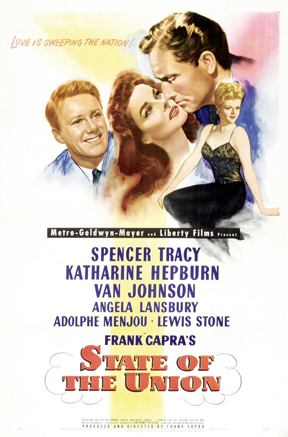
In State of the Union, newspaper publisher Kay Thorndyke (Angela Lansbury) wants to make her lover, Grant Matthews (Spencer Tracy), President of the United States. Grant is a no-nonsense, plain-spoken businessman who is quick to explain that he loves and cares about his country but that he hates partisan politics. (In many ways, it’s impossible not to compare Grant to … well, to just about every single wealthy businessman who has ever run for public office while claiming to essentially be nonpolitical. The big difference is that Grant actually means it.) However, by subtly appealing to both his ego and his patriotism, Kay convinces Grant to run. With the help of sleazy Jim Conover (Adolphe Menjou) and the sardonic Spike McManus (Van Johnson), Kay uses her money and her newspapers to turn Grant into a viable candidate.
The only problem is that Grant is separated from his wife Mary (Katharine Hepburn) and, since this movie was made in the 1940s, everyone knows that Grant has to be seen as being a family man if he’s going to be elected. For the election, Mary and Grant pretend to be happily married.
As the primary season continues, Grant finds himself being more and more manipulated by Kay and Jim. Eventually, Grant is forced to make a decision between his campaign and his integrity…
Following Mr. Smith Goes To Washington and Meet John Doe, State of the Union was the third part of director Frank Capra’s political trilogy. Based on a play (which, itself, was supposedly inspired by the 1940 Republican presidential candidate, Wendell Willkie), State of the Union never quite escapes its stage-bound origins. Add to that, the film was probably a bit more shocking when it was first released in 1948. In 2015, we’re used to idea of politicians being controlled by money. But, in 1948, audiences were perhaps a little bit more innocent.
But, that said, State of the Union is still an entertaining film. Needless to say, Spencer Tracy and Katharine Hepburn have a wonderful chemistry together and Hepburn gets a great drunk scene. (Hepburn had such an aristocratic presence that it’s always fun to watch her do comedy.) Angela Lansbury also does well, playing a character who could very well grow up to be the role she played in The Manchurian Candidate.
67 years after it was first released, State of the Union remains an entertaining film that makes some good and still relevant points. In 2016, when you’re tempted to get involved with the latest version of Americans Elect, watch State of the Union instead.

 Through the Shattered Lens