Dan Stanton (Edmund Cobb) and Condon (Tom Quinn) are planning to run a bunch of ranchers off their land by cutting off their water supply. Once the ranchers leave, Stanton and Condon will be able to sell their land to the railroads. After the bad guys murder a rancher named Jennings (George Morell), the rancher’s daughter (Lynne Carver) sends a message to U.S. Marshals Nevada Jack McKenzie (Johnny Mack Brown) and Sandy Hopkins (Raymond Hatton). Old friends of the murdered rancher, Sandy and Nevada come to town to rally the ranchers against Stanton and his men and to free up the water that’s been dammed up.
This was a pretty standard Johnny Mack Brown western. Johnny Mack Brown and Raymond Hatton always made for a good team but the story here is pretty predictable. After you watch enough B-westerns, you start to wonder if there were any made that weren’t about outlaws trying to run ranchers off their land. It’s interesting that these movies almost always center, in some way, around the coming of the railroad. The railroad is opening up the frontier and bringing America together but it also brings out the worst in the local miscreants.
As with a lot of B-westerns, the main pleasure comes from spotting the familiar faces in the cast. Charles King and Herman Hack play bad guys. Tex Driscoll plays a rancher. Horace B. Carpenter has a small role. These movies were made and remade with the same cast so often that that watching them feels like watching a repertory company trying out their greatest hits.
In 1959, the Clutter Family was murdered in Holcomb, Kansas.
Herbert Clutter was a farmer and was considered to be prosperous by the standards of small-town Holcomb. Neither he nor his wife nor his teenage son and daughter were known to have any enemies. The brutality of their deaths took not just the town but the entire state by surprise. People like the Clutters were not supposed to be brutally murdered. They certainly weren’t supposed to be brutally murdered in a tight-knit community like Holcomb or in a state like Kansas.
The Clutters
The author Truman Capote traveled to Holcomb with his friend Harper Lee, looking to write a story about how the heartland was dealing with such a brutal crime. Six weeks after the murders, while Capote and Lee were still conducting their interviews, two small-time criminals named Dick Hickock and Perry Smith were arrested for the crime. Capote’s proposed article about Holcomb instead became the basis for his best-known book, In Cold Blood. Capote followed the case from the initial investigation to the eventual execution of both Hickok and Smith. He examined the backgrounds of the two criminals, especially Perry Smith’s. (Indeed, there were some who felt that Capote saw something of himself in the mentally-fragile Smith.) In Cold Blood was Capote’s most successful book and it also launched the entire “true crime” genre. It also may have been Capote’s downfall as Capote reportedly spent the rest of his life haunted by the feeling that he would never top the book and that he had potentially exploited Perry Smith while writing it. In Cold Blood may be critical of the death penalty but, if Smith and Hickok hadn’t gone to the gallows, Capote would never have had an ending for the book.
(The writing of In Cold Blood and Capote’s subsequent struggles are dramatized in the excellent Capote.)
When it was published in 1965, In Cold Blood shot up the best seller lists. A film version was an inevitability. Otto Preminger — who had already made films out of Anatomy of a Murder, Exodus, Advice and Consent, and The Cardinal — was eager to turn the book into a film and one can imagine him churning out some epic version with his usual all-star cast. (Sal Mineo as Perry Smith? Peter Lawford as Dick Hickok? With Preminger, anything was possible.) However, Capote sold the rights to Richard Brooks, an independent-minded director who was also an old friend. Brooks decided to duplicate Capote’s “non-fiction novel” approach by actually shooting his film in Holcomb and having several residents of the town play themselves. He also rejected Columbia’s suggestion that Smith and Hickok should be played by Paul Newman and Steve McQueen. Instead, he cast former child actor Robert Blake as Perry Smith and an up-and-coming character actor named Scott Wilson as Dick Hickok. The only “star” who appeared in the film was television actor John Forsythe, who played the Kansas detective who was placed in charge of the investigation.
The story plays out in deliberately harsh black-and-white. (Legendary cinematographer Conrad Hall made his debut with this film.) The opening contrasts scenes of Smith and Hickok, both recently released from prison, meeting up in Kansas with scenes of the Clutter family innocently going about their day. Perry Smith is neurotic and quick to anger, a wannabe tough guy who wears a leather jacket and whose greasy hair makes him look less like a cunning criminal and more like an understudy in a regional production of West Side Story. Dick Hickok is friendly and slick, a compulsive shoplifter who claims that his smile can get him out of anything. In jail, Hickok heard a story that suggested that Mr. Clutter kept a lot of money hidden away in a safe on his farm. Hickok’s plan is to tie up and rob a family of strangers, with the assumption being that, by the time the Clutters get loose and call the police, he and Smith will already be far out of town. Neither he nor Smith seem like natural-born murderers. Smith seems to be too sensitive. Hickok seems like the epitome of someone who brags but doesn’t follow through. And yet, the morning after the robbery, four of the Clutters are discovered murdered in their own home.
The film delves quite a bit into Perry Smith’s background. Throughout the film, he has flashbacks to his abusive father and his promiscuous mother. When Alvin Dewey (played by John Forsythe) investigates Smith’s family, the recurring theme is that Perry never really had much of a chance to become anything more than a criminal. We learn less about Dick Hickok’s background, beyond the fact that he was a popular high school jock who turned mean after a car accident. And yet, despite the fact that the film is clearly more interested in Perry Smith than Dick Hickok, it’s Scott Wilson who dominates the film. It’s not that Robert Blake gives a bad performance. It’s just that Perry is such a neurotic mess and Blake gives a performance that is so method-y that occasionally, you’re reminded that you’re just watching a movie. Scott Wilson, on the other hand, gives a very natural performance as Dick Hickok. There’s nothing particularly showy about his performance and that makes Hickok all the more disturbing as a criminal and a potential murderer. If you’ve spent any time in the country, you’ve met someone like Dick Hickok. He’s the friendly guy who always knows that right thing to say but there’s something just a little bit off about him. He’s likable without being trustworthy.
A few years ago, when I saw that In Cold Blood was going to be airing on TCM, I told my aunt that I was going to watch the film. She replied that I shouldn’t. She saw the film when it was originally released and she described it as being incredibly disturbing. Despite her warning, I watched the film and I have to admit that she was right. Even though it’s nearly 60 years old and not particularly explicit when compared to the true crime films of today, In Cold Blood is still a disturbing viewing experience. Towards the end of the film, we finally see the murders in flashback and the image of Smith and Hickok emerging from the darkness of the farmhouse will haunt you. There’s not a lot of blood. The camera often cuts away whenever the actual murders occur (we hear more gunshots than we see) but the Clutters themselves are sympathetic and innocent victims and their deaths definitely hurt. Indeed, considering that the film falls on the more liberal side of the question of root causes, In Cold Blood deserves a lot of credit for not shying away from the brutality of the crimes. After spending 90 minutes emphasizing Perry Smith’s terrible childhood, it was important to remind the audiences of what he and Dick Hickok actually did.
The murder scene is so nightmarish that it actually makes it a bit difficult to buy into the film’s anti-death penalty argument. The film may end with Smith remorseful and a reporter (Paul Stewart) talking about how revenge is never the answer but the film’s liberal talking points feel hollow after witnessing the murder of four innocent people. (Ironically, it turned out there was no safe so those four people died so Smith and Hickok could steal about forty dollars.) A few years ago, I probably would have been very moved by the film’s anti-death penalty message. While I’m still opposed to the death penalty because I think there’s too much of a risk of a wrongly convicted person being executed, I’m long past having much personal sympathy for the Perry Smiths of the world.
Overall, In Cold Blood remains a powerful and disturbing movie. It was a film that was nominated for several Oscars, though it missed out on Best Picture due to 20th Century Fox’s huge campaign for Dr. Dolittle. Neither Blake nor Wilson were nominated, which is evidence that they were perhaps too convincing as Smith and Hickok for the Academy’s taste. While Robert Blake would go on to have the more storied career, Scott Wilson was a dependable character actor up until his death in 2018. A whole new generation of fans knew him not as Dick Hickok but instead as The Walking Dead‘s beloved Herschel Greene.
One final note: Both the book and the film present the murders as being an aberration, something that neither Smith nor Hickok originally planned. In 2013, new evidence was released that revealed the Smith and Hickok were the number one suspects in the murder of Christine and Cliff Walker and their two children, a crime that occurred in Florida shortly after they fled Kansas. The two of them were questioned at the time and given a polygraph test, which they both passed. The bodies of Smith and Hickok were exhumed for DNA testing, The tests came back inconclusive.
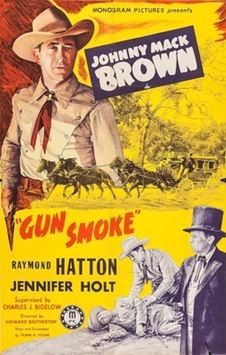
On the frontier, a stagecoach has been overturned and both the passenger and the driver have been killed by outlaws. The passenger was Hinkley, an archeologist. Who would want to kill a harmless archeologist? That’s what Marshals Nevada Jack McKenzie (Johnny Mack Brown) and Sandy Hopkins (Raymond Hatton) set out to discover. While Nevada Jack asks questions in the nearby town, Sandy disguises himself as a medicine man.
It all links back to an old Indian site that is said to be full of gold relics. Jane (Jennifer Holt), the daughter of Hinkley’s partner, reveals that the only other person who knows the location of the site is an old Indian named Shag (Dimas Sotello). Jack and Sandy have to try to track down Shag before he’s found the gang that killed Hinkley.
Yes, it’s another Johnny Mack Brown western. Despite the title, this has nothing to do with the television series that featured James Arness and Amanda Blake. GunSmoke is still a solid western, featuring a determined performance from Johnny Mack Brown and some memorable villains from the usual poverty row western stock company. Once again, Frank Ellis shows up as a henchman, though the identity of the main villain is actually a little more interesting than was typical for these films. Johnny Mack Brown is a little more serious than usual, throwing punches with authority. For fans of B-westerns, GunSmoke is an above average entry in Johnny Mack Brown’s seemingly endless filmography.
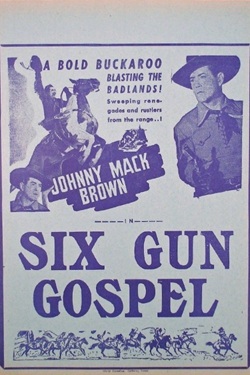
Marshals Nevada Jack McKenzie (Johnny Mack Brown) and Sandy Hopkins (Raymond Hatton) are sent to the frontier mining community of Goldville to determine who is responsible for hijacking all of the gold that should be coming out of the town. Not surprisingly, it’s all the work of another dastardly saloon owner (Kenneth MacDonald) who is planning on stealing all the gold, chasing off all the settlers, and then selling their land to the railroad company. While Sandy goes undercover as the town’s new preacher, Jack agrees to ride shotgun on a gold shipment, along with with Dan Baxter (Eddie Drew). Dan is in love with Jane Simms (Inna Gest), the daughter of honest miner Bill Simms (Kernan Cripps).
Johnny Mack Brown made a countless number of westerns for several different production companies but it seems like they always featured a crooked saloon owner and a plan to sell the land to a railroad company. Luckily, nobody watches these movies for the plots and that was probably true even when they were first released. People watch these movies for the nostalgia value of watching a movie where it’s good vs evil and good always triumphs without leaving any sort of lingering doubt about whether or not the heroes did the right thing. Johnny Mack Brown is as authentic on a horse and carrying a gun as he ever was and there’s a scene where he manages to get a gun despite being tied up that’s pretty cool. The appeal of Johnny Mack Brown was that he always seemed like he could do the things that he did in the movies in real life as well. Raymond Hatton provides comic relief, pretending to know the hymns being sung by his congregation and providing some songs of his own. There’s enough gun fights and horse chases to provide nostalgic happiness for fans of the genre and that’s the important thing.
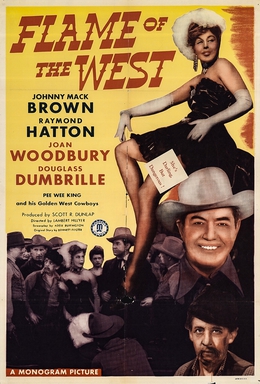
Marshal Tom Nightlander (Douglass Dumbrille) shows up in a lawless frontier town, tasked with bringing peace. He could sure use the help of Dr. John Poole (Johnny Mack Brown), a former gunslinger who has set his weapons aside and now works as the town doctor. Dr. Poole has sworn off guns but with corrupt businessman Wilson (Harry Woods) and his gang determined to keep their town lawless, Poole is soon forced to reconsider.
This B-western from Monogram is better than many of the other low-budget, poverty row westerns of the era. While the plot is another example of a corrupt businessman and his gang making life difficult for peaceful settlers, the characters in Flame of the West are a little more complex than usual. Brown stands out playing a character who, for once, doesn’t want to fight and believes that it’s better to talk than to shoot. Of course, this being a B-western, he soon sees the error of his ways. Dumbrille was usually cast as a villain so this film is a chance to see him in a likable and heroic role and he’s very convincing as a Wyatt Earp-style marshal.
Of course, even a serious B-western is still a B-western so songs and entertainment are provided by the gorgeous Joan Woodbury and Pee Wee King and his Golden West Cowboys. (Don’t worry, I had never heard of them before, either.) Joan Woodbury plays a saloon owner who wants to bring a higher class of entertainment to the frontier and she provides the film with enough sex appeal that 1945 audiences probably didn’t mind having to sit through the musical numbers before getting to the inevitable showdown between Johnny Mack Brown and Harry Woods.
Flame of the West is a good B-western that shows what dependable actors like Johnny Mack Brown and Douglass Dumbrille were capable of when given the opportunity.
“You finally did it! You blew it up! …. Goddamn you to Hell!”
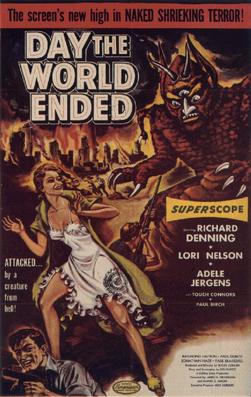
That’s right. Just as how the original Planet of the Apes showed us what the world would look like centuries after a nuclear war, 1957’s Day The World Ended shows us what things would be like in the weeks afterwards. And guess what? It wouldn’t be a lot of fun.
Day The World Ended starts with the bombs dropping and mushroom clouds forming in all of their fearsome glory. (Oppenheimer may have hated his greatest achievement but aesthetically, the atomic bomb is still an impressive invention.) Jim Maddison (Paul Birch) and his daughter, Louise (Lori Nelson), manage to survive by camping out in a steel bunker that Maddison built especially for the moment. As a former Navy commander, Maddison understood that the world was on the verge of nuclear war and he also understood that only those with discipline would survive. He’s filled with bomb shelter with supplies and he’s told Louise that only the two of them can use the shelter. Anyone else is out of luck.
Unfortunately, people keep showing up at the shelter and asking to come in. And while Maddison is prepared to leave them outside with the fallout and the mutants that have started to roam the desert, Louise just can’t stand the thought of leaving anyone to die. Reluctantly, Maddison starts to allow people to join him and his daughter. Some of them, like geologist Rick (Richard Denning), are a good addition to the group, Rick is actually an expert in uranium mining and a potential husband for Louise. (Louise has a fiancé but he’s missing. She keeps his picture by her bed. The picture, of course, is actually a photo of director Roger Corman.) Unfortunately, not everyone is as likable and well-intentioned as Rick. Lowlife hood Tony (Mike Connors) and his girlfriend, Ruby (Adele Jergens) show up and continue to act as if they’ve got the police after them even though the police were probably atomized with the rest of civilization. And finally, there’s a man (Jonathan Haze) who is transforming into a mutant and who develops a strange mental connection to Louise.
No one said the end of the world would be easy!
Day The World Ended was Corman’s fourth film as a director and it was also his first film in the horror genre. (It’s actually a mix of science fiction and horror but whatever.) The film was enough of a box office success that it inspired Corman to do more films in the genre. Seen today, it’s obviously an early directorial effort. It lacks the humor that distinguished Corman’s later films. In fact, the film is actually a little bit boring. Watching a film like this really drives home just how important Vincent Price and his energy were to Corman’s later films. This film doesn’t have an actor like Vincent Price or Boris Karloff or even Dick Miller, someone who could energize a film just through the power of their own eccentricities. Instead, Mike Connors, Paul Birch, and Richard Denning all give dull performances as the survivors. This is a historically important film because, without its box office success, Corman probably would have stuck with doing B-westerns and gangster films. Filmgoers should be happy that audiences in the 50s were drawn in by the film’s title and their own paranoia about nuclear war. It’s a film that one appreciates as a piece of history, even if it doesn’t quite stand up to the test of time.
Heldorado, Arizona is a frontier town with a problem. The Tullivers, led by Mike (Tom Tyler), keep robbing the bank and running off anyone who agrees to be the town’s marshal.
The Colonel (Raymond Hatton) and the Mayor (Fuzzy Knight) are at their wits end until a bison hunter named Lucky (Russell Hayden) comes riding into town in search of work. They hire Lucky to be their new marshal, paying him $200 a week and allowing him three free drinks a day.
They also give Lucky a cabin to stay in but when Shamrock Ellison (James Ellison), a dandy from up north, rides into town on a donkey, Lucky decides to rent him the cabin. When Ellison arrives at the cabin, he finds two Tulliver brothers looking for the stolen money that they hid in the fireplace. The brothers try to shoot Ellison but accidentally end up shooting themselves instead.
When Ellison says that he wants to keep a low profile, Lucky takes credit for killing the two Tullivers. When Mike shows up looking for revenge, Lucky has a change of heart and gives all the credit for Ellison. Lucky makes Ellison his deputy but what he doesn’t know is that Ellison is actually a government agent who has been sent to Heldorado to clean the town up.
This B-western does a good job of mixing comedy with action. It was one of many films that Ellison and Hayden made together and Hayden’s bluster plays off well against Ellison’s more serious performance. Much of the humor comes from Ellison having to keep the other townspeople from realizing that he’s a crack shot who knows how ride a horse as well as anyone in town. As well, Fuzzy Knight has his moments as the always drinking mayor. The action scenes are well-choreographed and there’s even a suspenseful scene where Ellison gets a shave from a barber who is actually a relative of the Tullivers. As always, the beautiful Julia Adams is a welcome addition to the cast as the Colonel’s daughter, who falls for Ellison. For fans of the genre, there’s plenty of entertainment to be found in this brisk, 50-minute western.
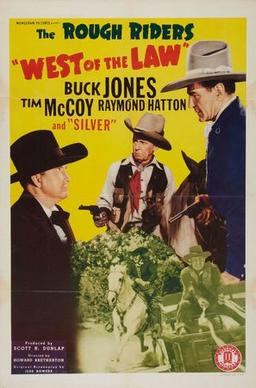
In the mining town of Gold Creek, an outlaw gang has been hijacking shipments of gold. Newspaper publisher Rufus Todd (Milburn Morante) has learned that the head of the gang is saloon owner Jim Rand (Harry Woods). Todd is planning on publishing a story identifying Rand as the outlaw leader on the front page of his newspaper so Rand’s secret partner, businessman John Corbett (Jack Daley) arranges for Rufus’s printing press to be blown up.
Rufus calls in his old friend, Marshal Buck Roberts (Buck Jones). Buck arrives in town with his fellow Rough Riders, Tim McCall (Tim McCoy) and Sandy Hopkins (Raymond Hatton). As usual, everyone is working undercover. Buck pretends to be an outlaw named Rocky Sanders. Tim claims to be a preacher who is not afraid to draw his gun and force everyone in the saloon to put down their drinks and listen while Rufus identifies Rand as being an outlaw. Sandy is the new undertaker and his coffins prove useful for smuggling in some much needed equipment.
The eighth Rough Riders film trods familiar ground. Once again, Buck is framed for a crime he didn’t commit and, as always, the villains are a businessman and a saloon owner. Still, I enjoyed seeing Tim to pretend to be a preacher and Sandy had some funny moments are the town’s garrulous undertaker. As always, McCoy, Roberts, and Hatton possessed an authentic western toughness that made them compelling heroes even in B-westerns like this one.
Since Tim McCoy reenlisted in the U.S. Army following Japan’s attack on Pearl Harbor, this was the last Rough Riders film to feature the original three riders and their chemistry and friendship are as strong as when the series first began. The movie ends with the promise that the Rough Riders would ride again but sadly, it was not to be. Though West of the Law doesn’t break any new ground, it’s still a decent finale for the original team.
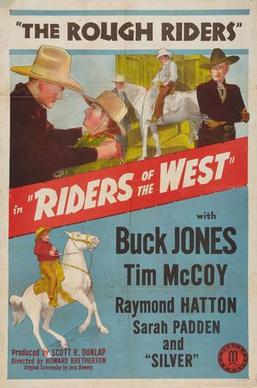
In a frontier town, a gang of rustlers are stealing cattle as a part of a plot to force cash-strapped ranchers to take out exorbitant mortgages on their ranches. Ma Turner (Sarah Padden) summons her old friend, Marshal Buck Roberts (Buck Jones), to come to town and take on the rustlers. When the town’s corrupt banker is murdered and Ma Turner’s son, Steve (Dennis Moore), is framed for the crime, Roberts calls in his fellow Rough Riders, Tim McCall (Tim McCoy) and Sandy Hopkins (Raymond Hatton), to help him take down the gang.
In many ways, this is a familiar Rough Riders film, right down to the main bad guy being the owner of the town’s saloon and Charles King showing up as a member of the gang. What sets it apart from the film that came before it is that, this time, Tim pretends to be an outlaw while Buck sets himself up as the new law in town. Tim takes on the identity of Tim Steele, a sarsaparilla-drinking ne’er do well who has just gotten out of prison. Jones and McCoy both seem to enjoy getting to switch their typical roles. As for Sandy Hopkins, he goes undercover as a peddler of snake oil and provides the comic relief. Riders of the West is a typical B-western but the chemistry between the three leads continues to shine through.
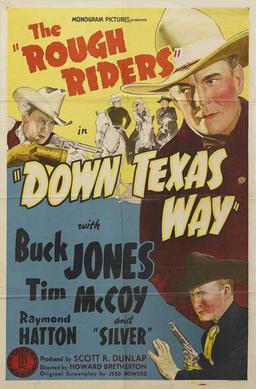
The sixth entry in the Rough Riders series finds Marshal Tim McCall (Tim McCoy) traveling from Wyoming to Texas so that he can help Sandy Hopkins (Raymond Hatton) celebrate his birthday. When he arrives, he discovers that the birthday celebration is on hold because Sandy has been accused of murdering his best friend, John Dodge (Jack Daley). Dodge was the richest man in town and the townspeople think that Sandy murdered him as a result of a disagreement over a card game. What they don’t know is that Sandy and Dodge were only pretending to be mad at each other as a practical joke.
Dodge was really murdered by Bert Logan (Harry Woods), an outlaw who has hired an actress named Stella (Lois Austin) to pretend to be Dodge’s long-lost wife. When all of Dodge’s property is given to Stella, Stella will then give it all to Dodge. While Tim tries to keep the sheriff (Glenn Strange) from prosecuting Sandy, Marshal Buck Roberts (Buck Jones) goes undercover and infiltrates Logan’s gang.
After five previous films that just featured the Rough Riders talking about what their lives were like when they weren’t chasing outlaws, Down Texas Way shows us Sandy Hopkins’s life in Texas. It’s about what you would expect. Sandy likes to spend his time playing cards and hanging out in the lobby of his hotel. It seems like an nice life, at least until Bert Logan tries to frame him for murder. Luckily, the other Rough Riders are always there to have his back. Down Texas Way is not one of the better Rough Riders films because Bert’s scheme never makes much sense but Hatton is relaxed and engaging and McCoy and Jones are their usual tough selves. As with the previous film, the appeal of this Rough Riders film is the Rough Riders themselves and the way that they always stick together and have each other’s back. That’s especially true in Down Texas Way, in which both Tim and Buck show that they’ll travel across several states if it means helping out a friend in a jam.
One final note, the town’s sheriff is named Trump, though I assume he’s no relation. Glenn Strange, who played Sheriff Trump, would later play Frankenstein’s Monster in the last of the Universal horror movies.
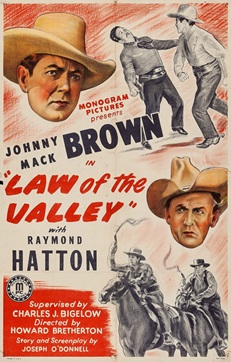 Dan Stanton (Edmund Cobb) and Condon (Tom Quinn) are planning to run a bunch of ranchers off their land by cutting off their water supply. Once the ranchers leave, Stanton and Condon will be able to sell their land to the railroads. After the bad guys murder a rancher named Jennings (George Morell), the rancher’s daughter (Lynne Carver) sends a message to U.S. Marshals Nevada Jack McKenzie (Johnny Mack Brown) and Sandy Hopkins (Raymond Hatton). Old friends of the murdered rancher, Sandy and Nevada come to town to rally the ranchers against Stanton and his men and to free up the water that’s been dammed up.



 Through the Shattered Lens