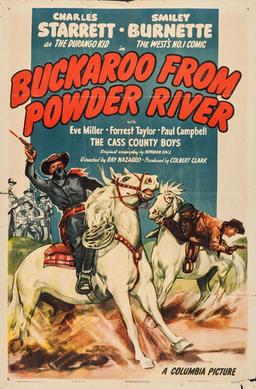
Buckaroo From Powder River (1947, directed by Ray Nazarro)


Pop Ryland (Forrest Taylor) is a frontier outlaw who makes law-breaking a family business.  With his two sons, Pop is planning on flooding the territory with counterfeit bonds.  His stepson, Tommy (Paul Campbell), doesn’t want anything to do with any criminal activity so Pop sends for McCall (Frank McCarroll), an assassin.  In a letter, Pop explains that he wants his stepson murdered.  When federal agent Steve Lacey (Charles Starrett) captures McCall, he finds the letter.  Steve heads into town and goes undercover, pretending to be McCall.  He also uses his other identity, the Durango Kid, to thwart Pop’s plans.

More than usual, this Durango Kid film leans more into the undercover aspect of Steve’s work.  What’s interesting is that, after Tommy fakes his own death, Tommy also disguises himself as the Durano Kid and keeps his stepfather from suspecting that Steve is actually a member of law enforcement.  It’s actually pretty clever, as far as these movies go, and it answers the question of why no one ever wonders why Steve and Durango are never in the same place at the same time.

Smiley Burnette shows up as Steve’s sidekick and he sings a few songs with the The Cass County Boys.  Along with Smiley’s antics, this film has all of the horse chases and gunfights that we expect from a Durango Kid movie.  Most of the usual stock company is present, including Ted Adams and Kermit Maynard.  As always, Charles Starrett looks authentic riding horse and handling a gun.  If you’re not into westerns, this film won’t convert you.  But, for fans of the genre, this is another entertaining outing for the Durango Kid,
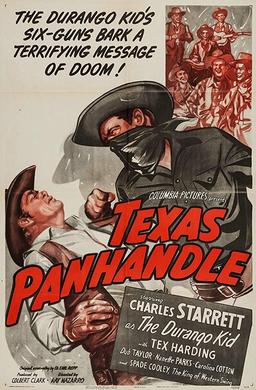
Texas Panhandle (1945, directed by Ray Nazarro)


Secret Service agent Steve Buckner (Charles Starrett) is told by his boss that his activities as the Durango Kid have led some in the Agency to suspect that Steve is himself an outlaw.  Even after Steve explains that he only takes on the Durango Kid identity when he needs to step outside of the law to protect innocent people, Steve is still suspended pending an investigation.

With nothing better to do, Steve rides off to the Texas panhandle, where he learns that outlaws have been robbing settlers and stealing government gold.  Working as the Durango Kid, Steve discovers that it’s not just outlaws that are targeting the new arrivals but it’s also the corrupt head of the local land office, Ace Gatlin (Forest Taylor).  Helping out Steve are settler Tex Harding and Cannonball (Dub Taylor), who works at the saloon and sings a few songs.

This is a standard Durango Kid film.  It has all the usual gunfights and horse chases but it doesn’t have Smiley Burnette.  Dub Taylor takes Smiley’s place as the comedic sidekick and, while Taylor isn’t bad, he’s still no Smiley Burnette.  Dub Taylor’s characters were usually more buffoonish than the clever helpers played by Smiley Burnette and, as a result, the Durango Kid movies with Taylor feel more juvenile than the ones with Smiley.  That’s the case here.

This installment is interesting because it reveals that Steve’s superiors knew about his Durango Kid side hustle and were as a confused about why he needed it as everyone else was.  Steve reveals he would rather lose his job than give up being Durango.  Luckily, at the end of the movie, he gets a telegram telling him that the investigation is over and he’s been reinstated with the Secret Service.  All’s well that ends well.

Challenge of the Range (1949, directed by Ray Nazarro)


On the frontier, someone is raiding the homes of ranchers like Jim (Henry Hall) and Judy Barton (Paula Raymond).  The Homeowners Association summons Steve Roper (Charles Starrett) to bring a stop to the raids.  Everyone suspects that Cal Matson (Steve Darrell) and his son, Rob (Billy Halop), are behind  the raids but Steve, as the Durango Kid, discovers that a third party is trying to set everyone at war with each other for his own benefit.

The entry in the Durango Kid series was Charles Starrett’s 103rd western.  It’s not a particularly distinguished entry, relying heavily on stock footage.  I did find the idea of the film’s bad guy trying to manipulate the Bartons and the Matsons into destroying each other to be interesting but the movie doesn’t do much with it and the identity of main villain will be obvious to anyone who watches the film.  There is one good scene where Steve disarms three bad guys and then makes them walk all the way back to town without their boots on.  Steve doesn’t mess around.

Smiley Burnette provides the comic relief and a few songs.  This time, Smiley’s a dime store writer researching his next book.  Musically, he is accompanied by The Sunshine Boys.  103 movies in and Smiley still hasn’t figure out that Steve and Durango are one of a kind.

Roaring Rangers (1946, directed by Ray Nazarro)


Another frontier town is in trouble.

Sherriff Jeff Conner (Jack Rockwell) is having trouble ridding his town of outlaws so his son, Larry, (Mickey Kuhn) writes a letter to his hero to ask for help.  He addresses the letter to “Durango Kid, Texas.”  That’s all it takes for Steve Randall (Charles Starrett) and his sidekick, Smiley Burnette, to show up in town.

Steve and Smiley apply to be deputies but Sheriff Conner explains that someone is circulating a petition to get him fired.  Steve dresses up as the Durango Kid and pressures the citizens to give the Sheriff another chance.  Realizing that the Durango Kid is making them look bad, the outlaws decide to dress up one of their own as Durango and make the Kid look bad.  With the town turning on Durango, will Durango and Smiley be able to save Sheriff Conner from an assassination attempt?

This Durango Kid film is different from the rest of the series in that, for once, Steve is hired to be a deputy instead of a sheriff.  This really is Sheriff Conner’s story, as he tries to win the respect of the town and keep its citizens safe, even while his own brother (Ed Cassidy) is working with the outlaws.  There are all the usual horse chase and shootouts but this time, Durango and Smiley are mostly around to provide support to a man who is trying to do the right thing.  B-western fans will enjoy it.

Smiley sings a few songs, as always.  This time, musical accompaniment is provided by Merle Travis and his Bronco Busters.

Six-Gun Law (1948, directed by Ray Nazarro)


Steve Norris (Charles Starrett) has moved to a new frontier town and is making a good living as a cattle rancher.  The sheriff (Ethan Laidlaw) takes a dislike to Steve and even accuses him of being a cattle rustler.  Steve is so angered that he plays right into the hands of Decker (Hugh Prosser), a corrupt businessman who secretly puts blanks into Steve’s gun and then tricks Steve into thinking that he has shot and killed the sheriff.

Decker appoints Steve as the new sheriff but demands that Steve do exactly what Decker orders him to do.  If Steve actually enforced the law, Decker will turn him in as the first sheriff’s murderer.  Steve may not be able to do anything about Decker’s crimes but his alter ego, The Durango Kid, can!  As always, working with Steve is his loyal sidekick, Smiley Burnette.

The stand-out set piece of this Durango Kid film is an exciting stagecoach chase, which features the Durango Kid (in the form of legendary stuntman Jock Mahoney) making some thrilling moves.  The scene was so exciting and popular that it was used in a dozen other Durango Kid films.  These movies were never shy about reusing good scenes, effective stunts, and plot twists.  (It’s easy to lose track of how many times Steve has been appointed as sheriff of a town.)  This was also neither the first nor the last time that Hugh Prosser and Robert Wilke would play bad guys in a Durango Kid movie.  However, this is the only Durango Kid film to feature the Rodeo Rangers providing musical accompaniment  to Smiley Burnette’s songs.

Six-Gun Law will be best appreciated by fans of the western genre.  Charles Starrett is as tough and authentic a cowboy as always and the storyline has some nice twists and turns.  For once, with Steve being blackmailed by Decker, it makes sense that Steve would put on his disguise and solve his problems as the Durango Kid.

Gunning For Vengeance (1946, directed by Ray Nazarro)


Steve Landry (Charles Starrett) rides into another town and is once again named the new sheriff.  Luckily, Steve’s old friend Smiley Burnette is working as the town’s blacksmith.  Steve makes Smiley his deputy and then sets about trying to break up a gang of cattle rustlers.  When Steve learns that his jurisdiction does not extend beyond the city limits, he dons the disguise of his alter ego, The Durango Kid, to go after the outlaws.

Has Steve met his match in Belle (Phyllis Adair), the saloon owner who is the secret leader of the outlaws?  She notices that The Durango Kid’s boot tracks are the same as Steve’s boot tracks.  I’m surprised that no one has ever noticed that before.  Steve went through a lot of trouble to disguise himself as Durango but he never bothered to change his boots.

This entry in the Durango Kid series features a lot of Smiley Burnette so your enjoyment on the film will depend on how much tolerance you have for Smiley’s songs and his style of humor.  Each film featured Smiley being followed around by a different group of musicians.  In this one, Smiley is accompanied by The Trailsman.  When Smiley accidentally locks himself in a jail cell, the Trailsman stand on the other side of the bars and sing a song about how Smiley can’t get out of the cell.  Smiley does eventually get out but, later on, he’s knocked out cold during an attempted jail break.  Smiley’s not much of a help in this one.

This has all of the typical Durango Kid elements, including the stock footage of the stampeding cattle that appeared in nearly all of his films.  There’s another saloon fight and a gunfight towards the end.  Durango rides out of town alone, leaving Smiley behind, but we know they’ll soon be reunited in another adventure.

The Desert Horseman (1946, directed by Ray Nazarro)


Steve Godfrey (Charles Starrett) is in trouble again.  He has been accused of stealing another payroll and the only man who can clear his name has just been murdered.  Steve thinks that he is being set up by outlaws who want to take control of the dead man’s ranch, which is now owned by Mary Ann Jarvis (Adele Roberts).

Luckily, Steve’s old friend, Smiley Burnette, is working as a cook at the Jarvis Ranch.  When Smiley isn’t singing songs with the Colorado Hillbillies, he tries to help Steve clear his name.  He explains that Mary Ann Jarvis won’t listen to Steve but maybe she’ll listen to Steve’s alter ego, The Durango Kid!

Durango rides again in this movie, though, the majority of the hour runtime is made up of Smiley Burnette singing songs and making jokes.  Smiley Burnette is not for everyone.  I enjoy the broad humor he brought to these films but I can understand why others might not.  Whenever Smiley sings a song, it does bring the action to a halt but that’s true of every Durango Kid film.  If you’re a fan of the series, you either like Smiley or you can at least tolerate him.  Smiley does do more than just sing in this movie.  He also throws black pepper in the eyes of one of the bad guys.

Even with all of the attention paid to Smiley, The Desert Horseman delivers all of the expected horse chases and gunfights.  The story is a little more interesting than usual.  Steve has been framed for not one but two crimes that he didn’t commit and that adds some urgency to the proceedings.  Charles Starrett, as always, is a believable western hero and he takes the role seriously.


The Rough Tough West (1952, directed by Ray Nazarro)


Steve Holden (Charles Starrett) is hired by an old friend, Jack Mahoney (played by Jock Mahoney), to serve as the sheriff of a frontier town.  Steve soon discovers that his old friend has been corrupted by power and is plotting to cheat the locals out of their land and the gold that the land holds.  Despite their friendship, Steve knows that Jack has to be stopped and made to see the errors of his way.  It’s a good thing that Steve is secretly the Durango Kid and that his old sidekick, Smiley Burnette, is the town’s police chief.  But even if Jack Mahoney does eventually see the error of his ways, will it be soon enough to stop his out-of-control henchmen?

This was one of the last of the Durango Kid films and it’s heavy on stock footage and Smiley Burnette musical numbers.  It has all of the usual horse chases and gunfights but making the villain an old friend of the Durango Kid adds a little more emotional weight to this entry than some of the other Durango Kid films.  As always, Charles Starrett is a strong western hero and Smiley Burnette’s antics are nowhere nearly as annoying as the antics of some of the other western sidekicks who were populating matinee movie screens in 1952.  Western fans should enjoy this fast-paced and undemanding film.

This is not the first time that Jock Mahoney played a friend of the Durango Kid who is named Jack Mahoney, though I think the Jack Mahoney who appeared in Pecos River, Junction City, Smokey Canyon, The Hawk of Wild River, and The Kid From Broken Gun was meant to be a different character than the one who appeared in The Rough, Tough West.  If Smiley Burnette could have a rotating cast of musicians who followed him from town-to-town, then the Durango Kid could very well have known multiple Jack Mahoneys.


The Lone Hand Texan (1947, directed by Ray Nazarro)


Oil’s been discovered on the Texas frontier and Sam Jason (Fred Sears) has got the rights to several wells.  Someone in town keeps sabotaging his operations and blowing up his oil wells.  Sam sends a telegram to his old friend, Steve Driscoll (Charles Starrett).  Steve shows up in town to help Sam set up his business.  Meanwhile, Steve’s alter ego, the masked Durango Kid, works to discover who has been targeting Sam.

This is actually more of a Smiley Burnette movie than a Durango Kid film.  As always, Smiley is the Kid’s sidekick in the movie.  Smiley owns a general store and he’s the towns postmaster.  Everywhere Smiley goes, he is followed by two musicians, Mustard and Gravy.  Smiley sings even more songs than usual in this movie and he even has a brief romance with the local widow (Mary Newton), who unfortunately is also behind the efforts to drive Sam out of business.  Smiley may be the sidekick but he gets more screentime than the Durango Kid in The Lone Hand Texan and he does a mighty fine job with it.

One of the curious things about The Lone Hand Texan is that one of the bad guys also decides to wear a mask and claim to be The Durango Kid.  I wish the movie has done more with that because I have never really understood why Steve feels like he has to pretend to be Durango in the first place.  It’s not as if it’s difficult to recognize Steve, even when he’s wearing a mask.  I have never understood why no one in his movies ever notices that you never see Steve and the Durango Kid in the same place at the same time.  Even Lois Lane should have been able to figure out Durango’s secret identity.

The Lone Hand Texas is a standard Durango Kid outing, albeit not as dependent on stock footage as some of Durango’s other films.  Smiley gets to do more than usual, which is the only thing that really sets it apart.  As with most of the Durango Kid films, it will be best appreciated by those who are already fans.

Cyclone Fury (1951, directed by Ray Nazarro)


Brock Masters (Mark Roberts) has been awarded a contract to supply the army with horses.  Corrupt businessman Grat Hanlon (Clayton Moore) wants that contract for himself so he sends his henchmen to kill Brock.  Because Brock has no known relatives, Grat believes that both the horses and the contract will soon be his.

However, Brock does have an heir!  He adopted an Indian child named Johnny (Louis Lettieri).  Johnny inherits the contract and both the Durango Kid (Charles Starrett) and Smiley Burnett are going to make sure that Johnny is able to deliver the horses.  Smiley is also going to find some time to sing some songs that have even less to do with the story than usual.

Cyclone Fury was one of the later entries in the Durango Kid series.  By the time it was made, Colombia was no longer willing to spend much money on the series so that majority of the film’s action scenes are lifted from other Durango Kid movies.  If you’ve never seen another Durango Kid movie, the action scenes are exciting and feature some impressive stunts.  If you have seen another Durango Kid movie, this one is going to seem really familiar.

For western fans, the main appeal here will be seeing Clayton Moore playing a bad guy.  Moore had already played The Lone Ranger when he appeared in this movie.  At the time Cyclone Fury was made, Moore had been unceremoniously fired from his most famous role and The Lone Ranger was being played by John Hart.  Hart would only last a season and Moore would subsequently be invited back to play the role that defined his career.  As for Cyclone Fury, Moore is convincing as Grat, though the character himself is just a typical Durango Kid bad guy.  The Durango Kid was always going up against seemingly respectable businessmen who were actually outlaws.

One final note: Moore’s Lone Ranger co-star, Jay Silverheels, appears in this film but only in archival footage from an early adventure of The Durango Kid.