In 1964, the state of Wyoming executed Charles Forsythe (Viggo Mortensen) for killing another inmate at Creedmore State Prison. Forsythe was innocent of the crime but the only other two people who knew, a prisoner named Cresus (Lincoln Kilpatrick) and a guard named Eaton Sharpe (Lane Smith), kept silent. Twenty-three years later, Cresus is still an inmate and Sharpe has been named the new warden of Creedmore. When a group of prisoner open up the old execution chamber, Forsythe’s electrified spirit escapes into the prison and starts to kill the prisoners and the guards, one-by-one. A convict named Burke (also played by Mortensen) understands what is going on but can he get anyone to believe him?
If the idea of an executed murderer turning into an electrified spirit sounds familiar, that’s because the exact same idea was used in Destroyer, The Horror Show, and Wes Craven’s Shocker, all of which went into production and were released at roughly the same time. Why did the late 80s see so many director making movies about convicts coming back to life after being sent to the electric chair? We may never know.
Of the four electric ghosts movies, Prison is the best. Lane Smith is a great villain and Prison makes good use of its claustrophobic setting. Since Charlie is stalking inmates instead of horny teenagers, there literally is no way for anyone to escape him. (It never makes sense, though, why Charlie is killing “innocent” prisoners when Sharpe, who hates all of this prisoners, is the one that Charlie is targeting for revenge.) The best scenes are the ones where the warden desperately tries to force the inmates to confess to the murders so he won’t have to confront the truth about Charlie’s revenge. Lane Smith, who would later be best known for playing Richard Nixon in The Final Days, acts the hell out of those scenes.
Prison was the first American film to be directed by Finnish director Renny Harlin and it is a hundred times better than many of the overproduced action films that Harlin would later be best known for. Of course, it’s no Die Hard 2 but I would gladly watch Prison over Cutthroat Island.
I’ve always felt that a truly good movie should inspire the viewer to seek to confess something about themselves. So here’s my confession. When I was a toddler, I was mauled by a stray dog. I don’t remember it, of course but I still have the small scars on my left arm as proof. As a result, I’m scared of dogs and I always have been. I jump when I hear one barking and the sound of one growling can easily set off a panic attack. Whenever I see one nearby, regardless of whether it’s on a leash or not, my heart starts to race.
For that reason, I suppose it was inevitable that a movie like the 1976 Spanish production A Dog Called Vengeancewould get to me.
The film opens in an unnamed South American country. Political prisoner Jason Miller escapes from a jungle prison. As he flees, Miller runs into a tracker and the tracker’s dog, a German Shepard named King. Miller kills the tracker and then continues to run. King, after a few rather sad scenes in which he tries to revive his dead master, gives chase.
And that, in short, is pretty much the entire 108-minute film. Miller runs and King chases. Whenever Miller thinks that he’s safe (whether he’s taking a bath in a river or making love to a woman who has agreed to hide him), that relentless dog shows up and tries to kill him. I have to admit that this movie did little to alleviate my fear of dogs because King is truly viscous. The scenes were attacks both Miller and other assorted humans left me cringing and I don’t think it’s just a coincidence that Miller looks to be truly scared during some of the attack scenes. King easily dominates the 1st half of this movie.
The 2nd half of the movie feels like a totally different movie from the first. Jason Miller, having reached the city, is reunited with his comrades in the revolution. Whereas the first half of the movie was almost wordless, the movie suddenly become a lot more talky as Miller and his associated debate the merits and morality of revolution. Personally, I prefer the second half if just because a nice element of moral ambiguity is introduced here as it becomes pretty obvious that the “revolutionaries” are just as corrupt as the country’s dictator. In the city, Miller finds himself still being pursued by his enemies but now his friends want him dead as well. And, of course, that dog shows up again as well…
Anatonio Isasi’s direction is, for the most part, strong and Jason Miller (best known as Father Karras in the Exorcist) gives a good, low-key performance as the film’s lead. But, of course, the real star of the movie is that damn dog and, despite not being a doglover, I have to admit that it did a pretty good job. Not only did I believe that dog wanted to kill Miller but I believed that he easily could as well. However, at the same time, it hard not to feel a little bit of admiration for King. He was just so compellingly relentless in his pursuit. It’s probably one of best unacknowledged canine performances in film history.
A Dog Called Vengeance is the epitome of the type of flawed yet oddly compelling film that could only have been made outside of the Hollywood system. By refusing to shy away from showing either the full savagery of the dog’s attacks or in man’s response to those attacks, director Isasi manages to craft a political allegory that also works as a simple thriller. By refusing to paint either Miller or the dog in purely black-and-white terms, he introduces a moral ambiguity that most Hollywood studios would never have the guts to even attempt. Tellingly, the most shocking and disturbing scene in the film is not one of King’s many attacks on Miller. Instead, it’s a scene in which our paranoid “hero” guns down an innocent dog while its 10 year-old owner watches in horror.
Unfortunately, A Dog Called Vengeance isn’t an easy film to find. I saw it as part of the Grindhouse 2 DVD compilation and the transfer — taken straight from a VHS release — was terrible with frequently blurry images and terrible sound. To a certain extent, this did give an authentic “grindhouse” feel to the experience of watching the movie but it doesn’t change the fact that it took a while to get used to just how bad the movie looked. Luckily, the transfer seemed to improve as the film went on and, by the end of the movie, was no longer an issue.
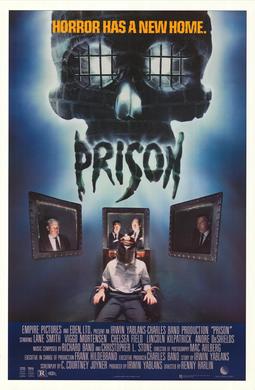 In 1964, the state of Wyoming executed Charles Forsythe (Viggo Mortensen) for killing another inmate at Creedmore State Prison. Forsythe was innocent of the crime but the only other two people who knew, a prisoner named Cresus (Lincoln Kilpatrick) and a guard named Eaton Sharpe (Lane Smith), kept silent. Twenty-three years later, Cresus is still an inmate and Sharpe has been named the new warden of Creedmore. When a group of prisoner open up the old execution chamber, Forsythe’s electrified spirit escapes into the prison and starts to kill the prisoners and the guards, one-by-one. A convict named Burke (also played by Mortensen) understands what is going on but can he get anyone to believe him?
 Through the Shattered Lens