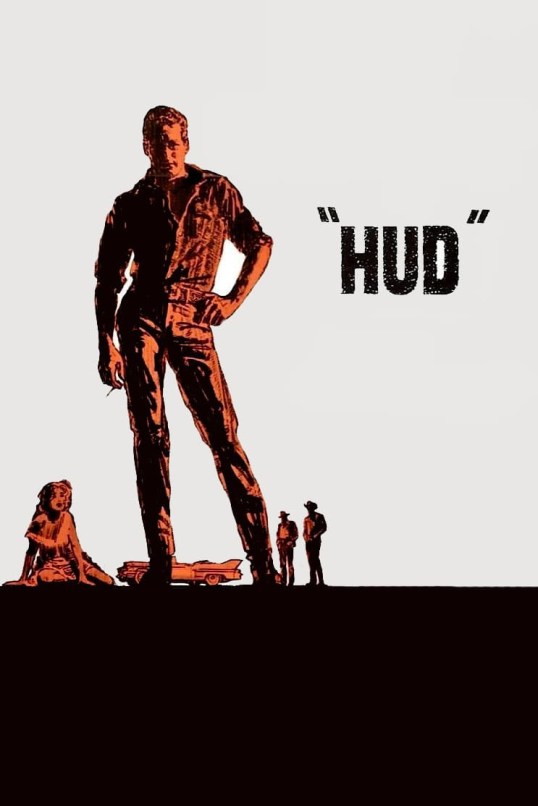
Film Review: Hud (dir by Martin Ritt)


In 1963’s Hud, Paul Newman plays a monster named Hud.

Hud Bannon is the son of rancher Homer Bannon (Melvyn Douglas).  Hud lives in a small Texas town, where he’s known for his pink Cadillac, his heavy-drinking, and his womanizing.  When we first meet him, he’s leaving the home of a married woman and narrowly escaping the rage of her husband.  Throughout the film, he mentions that he’s heading into town to meet “Mrs.” So-and-So.  Hud’s father fears that Hud might be incapable of caring about anyone but himself.  Hud’s nephew, Lonnie (Brandon deWilde), at first looks up to Hud but, over the course of the film, he comes to see his uncle for who he truly is.  Though Hud is quick to defend Homer from others, he himself views Homer with contempt and even plots to have the old man declared incompetent so that he can take over the ranch.  His flirtation with the family housekeeper, Alma (Patricia Neal), soon crosses the line into something much more dangerous.  Hud is charming and handsome in the way that only a 30-something Paul Newman could be.  But he’s also a complete monster.

In Hud, Newman gave one of his best performances and director Martin Ritt and cinematographer James Wong Howe captured some haunting images of the most barren parts of the Texas panhandle.  Howe’s black-and-white imagery not only captures the harsh landscape but also the harsh outlook of the people who live there.  Hud’s ruthless personality as is much a product of the demands of the land as his own narcissism.  The characters in Hud live in a land that doesn’t allow sentimentality.  It’s a land that’s allowed Hud to become the monster that he is.

At least, that’s the way that Paul Newman saw Hud.  That was also the way that the film’s director, Martin Ritt, viewed Hud.  They viewed him as being about as villainous and unlikable as a character could be but, to Newman’s surprise, audiences actually walked out of the film embracing the character and making excuses for him.  Newman was shocked to learn that teenagers were putting posters of him as Hud on their walls.

Why did viewers embrace Hud?

Some of it is due to the fact that Brandon deWilde gives a remarkably bland performance as Lonny.  We first see Hud through Lonny’s eyes and we are meant to share Lonny’s growing disillusionment with his uncle.  But Lonny comes across as being such an empty-headed character that it’s hard to really get emotionally invested in his coming-of-age.  When Hud eventually dismisses Lonny and his concerns, Lonny really can’t defend himself because there’s not much going on inside of Lonny.  On the other hand, Paul Newman gives such a charismatic performance as Hud that we find ourselves continually making excuses for his bad behavior.  When he talks about how he was raised and his difficult relationship with his father, we have sympathy for him even though we know we shouldn’t.  The viewer makes excuses for Hud because that’s what we tend to do when it comes to charismatic bad boys who don’t follow the rules.

Indeed, Hud is proof of the power of charisma and screen presence.  As a character, Hud does some truly terrible things and yet, because he’s Paul Newman, we want to forgive him.  We want to try to figure out why someone who is so handsome and so charismatic would also be so angry.  Lonny may be the “good” character but Hud is the one who we want to get to know.  When Lonny flips through a paperback to read the sex scenes, he comes across as being creepy.  When a drunk Hud flirts with a woman who he has just met, we ask ourselves what we would do if Hud ever tried that with us.  The truth is that we all know what we would do.  That’s what makes Hud both a dangerous and an intriguing character.

In the end, Hud is an excellent film that features Paul Newman at his best and which uses the downfall of Homer’s ranch as a metaphor for a changing American society.  Though Hud was  not nominated for Best Picture, it was nominated for almost everything else.  Melvyn Douglas and Patricia Neal won acting Oscars.  James Wong Howe’s cinematography was also honored.  Paul Newman was nominated and perhaps would have won if not for the fact that Sidney Poitier was nominated for playing the exact opposite of Hud in Lilies of the FieldHud was meant to be a picture about Lonny discovering his uncle was a monster.  Instead, the film became about Hud’s refusal to compromise.  It turns out that people like good-looking rebels who do what they want.

Even if viewers missed the point, Hud was one of the best films of the early 60s and Paul Newman’s powerful performance continues to intrigue.


Horror on TV: The Veil 1.2 “Girl on the Road” (dir by George Waggner)


From 1958, it’s The Veil!

The Veil was a horror anthology series that, because of financial difficulties at Hal Roach Studios, were never actually aired on television.  10 episodes were filmed before production was abruptly canceled.  Each episode was hosted by (and often starred) Boris Karloff.  Karloff later stated that he was never actually paid for his work on the show but his work as the host did eventually lead to him being hired to host Thriller, a horror anthology series that eventually did air.

As for The Veil, the ten episodes that were produced were never actually sold to a network but, in the 60s, several episodes were edited together to create films that aired on late night television.  It wasn’t until the 90s that the episodes were actually released on video.  For that, we largely have Something Weird Video to thank.

Each episode of The Veil opened with Karloff promising the lift the veil on a strange, perhaps supernatural, event.  (Most of the stories were supposedly based on true stories.)  Karloff would also play a role in each episode.  For instance, in tonight’s episode, he plays Morgan Debs.

Tonight’s episode is called Girl on the Road.  It’s a nicely atmospheric tale about a man (Tod Andrews) who picks up a mysterious woman (Eve Brent) who is stranded on the side of the road.  What is the woman’s secret and why is she terrified of Morgan Debs?  Why does everyone in the town refuse to talk about her?  Watch to find out!

This episode was directed by George Waggner, who is perhaps best known for directing the original Wolf Man.

Enjoy!

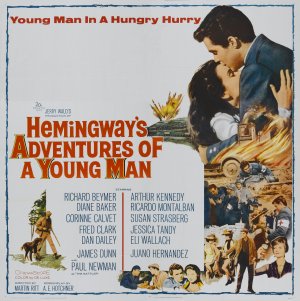
Lisa Cleans Out Her DVR: Hemingway’s Adventures Of A Young Man (dir by Martin Ritt)


(Lisa is currently in the process of cleaning out her DVR!  It’s going to take a while.  She recorded this 1962 literary adaptation off of FXM on January 30th!)

Hemingway’s Adventures Of A Young Man is one of those films that you just know was made specifically to win Oscars.  It’s a big prestige production, complete with a historical setting, an epic scope and big, all-star cast.  That most of those stars appear in relatively small roles was undoubtedly meant to evidence of the film’s importance.

“Look!” the film seems to shout at times, “This is such an important film that even Paul Newman was willing to stop by for a day’s work!”

The film is based on ten short stories by Ernest Hemingway and, loosely, A Farewell to Arms.  The stories all dealt with the early life of Nick Adams, who was a literary stand-in for Hemingway.  Since the Nick Adams stories were autobiographical (and, for that matter, so was A Farewell to Arms), the film can also be viewed as biopic.  Richard Beymer (who, a year earlier, had starred in West Side Story and who is currently playing Ben Horne on Twin Peaks) may be playing Nick Adams but the film leaves little doubt that he was actually meant to be playing Ernest Hemingway.

The film opens with Nick hunting with his father, Dr. Harold Adams (Arthur Kennedy).  He is present when his father travels to an Indian camp and helps to deliver a baby.  He respects his father but Nick wants to see the world and the film follows him as he explores America, working odd jobs and meeting colorful characters along the way.  Paul Newman shows up as a punch-drunk boxer and proceeds to overact to such an extent that he reminded me of Eric Roberts appearing in a Lifetime film.  Nick meets rich men, poor men, and everything in between.  He works as a journalist.  He works as a porter.  Eventually, when World War I breaks out, Nick enlists in the Italian army and the film turns into the 100th adaptation of A Farewell to Arms.

And really, I think it would have been an enjoyable film if it had been directed by someone like Otto Preminger, George Stevens, or maybe even Elia Kazan.  These are directors who would have embraced both the pulpy potential of the Nick Adams stories and the soapy melodrama of the war scenes.  A showman like Preminger would have had no fear of going totally and completely over the top and that’s the approach that this material needed.  Instead, Hemingway’s Adventures Of A Young Man was directed, in a painfully earnest style, by Martin Ritt.  Ritt tries to imitate Hemingway’s famously understated style with his understated direction but, cinematically, it’s just not very interesting.  Ritt portrays everything very seriously and very literally and, in the end, his direction is more than a little dull.

Sadly, the same can be said for Richard Beymer’s performance in the lead role.  Beymer comes across as being the nice guy who everyone says you should marry because he’ll be able to get a good and stable job and he’ll probably never go to jail.  Two months ago, when I watched and reviewed Twin Peaks, I really loved Beymer’s performance as Ben Horne.  He just seemed to be having so much fun being bad.  Unfortunately, in Hemingway’s Adventures Of A Young Man, he never seemed to be having any fun at all.  No wonder he temporarily put his film career on hold so that he could fully devote himself to working as a civil rights activist.

In the end, this is a movie that’s a lot more fun to look at than to actually watch.  Visually, the film is frequently quite pretty in an early 1960s prestige movie so sort of way.  And there are some good performances.  Eli Wallach, Ricardo Montalban, Susan Strasberg, Arthur Kennedy — there’s a whole host of performers doing memorable supporting work.  Unfortunately, even with all that in mind, this well-intentioned film largely falls flat.