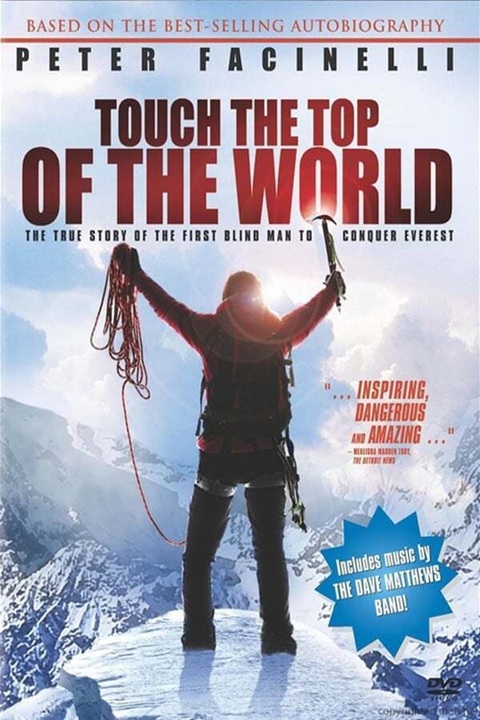
In 2001, Erik Weihenmayer became the first blind man to reach the summit of Mount Everest. Touch The Top Of The World is the story of how and why he did it.
Starting out with Erik (played by Peter Facinelli) and his friends already climbing Mount Everest, Touch The Top Of The World sets the stakes early with a scene of Erik trying to cross a rickety ladder that’s been laid across a mountain chasm. With every step, the ladder shakes and, of course, Erik can’t see where to place his feet. He’s having to do it on instinct and also by listening to the instructions shouted by his friends. Later, someone say that, of those who have tried to climb Mount Everest, one in six died in the attempt. Now imagine trying to do it without being able to see where you’re going. I wouldn’t have the courage but Erik is determined to show what can be accomplished through determination and teamwork. Erik isn’t just climbing for himself. He’s climbing for disabled people everywhere.
Flashbacks show how Erik was born with a degenerative eye disease that caused him to go blind when he was a child. His mother (Kate Greenhouse) and father (Bruce Campbell) never stop believing in him and, after his mother is killed in a car accident, Erik becomes determined to live up to her faith in him. He becomes a high school wrestler and then a teacher and eventually a climber.
Peter Facinelli gives a good performance as Erik but I know most people will probably be watching because Bruce Campbell plays his father. Bruce Campbell is great in the role, always supporting Erik and encouraging him to never give up. He’s the perfect father figure. He may not be able to climb Mt. Everest with his son but he’s still with Erik every step of the way.
Touch The Top Of The World was made for television and it has its moment when the sentiment is poured on pretty thick. I was worried when I saw that “Includes Music By The Dave Matthews Band!” on the cover of the DVD. Ultimately, it didn’t matter. It’s such a wholesome and heartfelt movie that it’s impossible not to get caught up in Erik’s mission to touch the top of the world.
I have to admit that cults have always fascinated me, largely because I can never really comprehend what would lead to someone joining one.
Seriously, how is it that otherwise intelligent people end up in a position where they not only become brainwashed but they also voluntarily give up their own individual personality, all so that they can belong to something that doesn’t make much sense. Myself, I’ve always been fortunate in that not only am I very confident in my talents and my beliefs but I’ve also never felt the need to have a mentor or any other type of life guide. Fortunately, I value my independence above all else. I’m also lucky enough to have ADD so severe that there’s no way I could actually spend more than 5 minutes listening to a lecture designed to brainwash me. I did go to one self-help seminar in college that seemed to be kind of a cultish but I was so bored that I left about halfway through. (Add to that, I was also annoyed by how much everyone else seemed to be enjoying it.) I’m immune to brainwashing, or at least I would like to think that I am.
Unfortunately, that’s not true for everyone. We tend to think of a cult as being a group of weird people living in a compound but the truth of the matter is that there are cults all around us. Basically, any organization that demands that its members sacrifice their own individual thoughts in order to “serve a greater cause” or please a certain being is a cult. Go on Twitter right now and you’ll undoubtedly be able to find several different cults fighting with each other. Cults appeal to people who, otherwise, feel empty. They provide a home and a group of ready-made friends but, of course, they also demand complete obedience and punish any hint of individuality. There’s no room for dissent. You see that a lot today and it’s a shame. People no longer think for themselves and instead, they believe whatever they’re told to believe. People have lost their damn minds over the past few years, both figuratively and literally. Sadly, it seems that once someone loses the ability to think for themselves, it’s gone forever.
I found myself thinking about this last night and this morning as I watched the latest “ripped from the headlines” Lifetime film, Escape From The NXIVM Cult: A Mother’s Fight To Save Her Daughter. NXIVM, which was founded and controlled by Keith Raniere (played, in a wonderfully creepy performance, by Peter Facinelli), presented itself as being a “personal development company” but, as everyone now knows, all of the self-help seminars and corporate doublespeak was actually a cover for a pyramid scheme that also served as a recruiting tool to supply Raniere with sex slaves. Among those who worked with Raniere was former Smallville actress, Allison Mack (played by Sara Fletcher in the film).
The film focuses on the true story of actress and minor royal Catherine Oxenberg (Andrea Roth), who spent a year helplessly watching as the NXIVM cult brainwashed her daughter, India (Jasper Polish). The film shows how the cult (and, more specifically, Allison Mack) preyed on and manipulated India’s own insecurities and used them to take her away from her family and her friends. In perhaps the film’s most disturbing scene, India returns home on her birthday and spends the majority of her own birthday party trying to recruit people to join NXIVM. It’s disturbing because we all know someone like India, someone who has become so obsessed with politics or religion or fandom that they view every occasion as just being another recruiting opportunity.
The film follows Catherine as she uncovers the truth about NXIVM, which is that it’s essentially a large-scale criminal racket that, because it’s targeted the children of the rich and famous, has also become immune to prosecution. When Keith is informed that Catherine has been publicly denouncing NXIVM and threatening to expose them, Keith smugly just says that they’ll sue her until she’s silent, just “like the others.” All of the sordid details are presented here — from the branding of Keith’s and Allison’s initials on their slaves to NXIVM’s casual and infuriating misogyny to the way that Keith used blackmail to manipulate both his followers and those who he considered to be a threat. But what makes the film ultimately memorable is not just the portrait of how NXIVM operated but also the film’s celebration of Catherine Oxenberg’s refusal to give up when it came to rescuing her daughter.
All in all, it’s a well-done movie and certainly one that has an important message. Be vigilant and beware any organization that claims that the key to happiness is sacrificing your own individual spirit.
Chicago in the 1920s. Booze may be illegal but that’s not keeping people from drinking and gangsters from making a killing. When an amateur boxer named Jack McGurn (Sean Faris) joins the mob, he befriend an up-and-coming criminal named Al Capone (Milo Gibson). While Capone rises through the ranks, McGurn is always by his side, usually firing a tommy gun. When Capone finally becomes the boss of Chicago, McGurn becomes his second-in-command and a leading strategist in the war against Capone’s rival, George “Bugs” Moran (Peter Facinelli).
If you’re looking for a historically accurate film about 1920s Chicago, look elsewhere. Today, “Machine Gun” McGurn is best known for being the mastermind behind the St. Valentine’s Day Massacre (which, of course, is recreated in Gangster Land) but it’s doubtful that he was ever Capone’s second-in-command. Famed Capone associates like Frank Nitti, Gus Alex, and Murray Humphreys are nowhere to be found in Gangster Land, nor is Eliot Ness. Instead Jason Patric plays the righteous and fictional Detective Reed.
What the film lacks in historical accuracy, it makes up for in gangster action. There’s enough tommy gun action, car chases, and showgirls to keep most gangster film aficionados happy. All of the usual Capone stuff is recreated: Johnny Torrio is assassinated, Dion O’Bannon is killed in his flower shop, and the St. Valentine’s Day Massacre scandalizes the nation. Though the film never displays anything more than a Wikipedia-level understanding of the prohibition era and there’s not a single gangster cliché that isn’t used, Gangster Land is briskly paced and makes good use of its low-budget. Sean Faris is stiff as McGurn but Milo Gibson (son of Mel) is better than you might expect as Al Capone and the underrated Jason Patric makes the most of his limited screen time. Fans of The Sopranos may want to watch for the chance to see Meadow herself, Jamie-Lynn Sigler, as McGurn’s showgirl wife.
Oddly enough, the late 90s and early 2000s saw a lot of movies about teenagers that all had strangely generic names. She’s All That, Down To You, Drive Me Crazy, Head Over Heels, Get Over It, Bring It On … the list is endless.
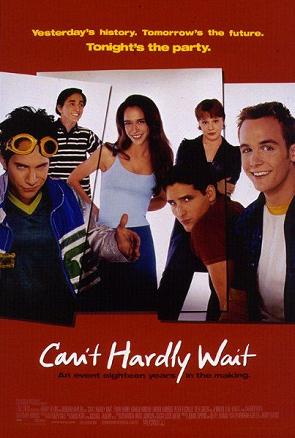
And then you have the 1998 graduation party-themed Can’t Hardly Wait. Can’t Hardly Wait has such a generic name that, when you first hear it, you could be forgiven for naturally assuming that it stars Freddie Prinze, Jr. Of course, if you’ve actually seen the film, you know that it features almost everyone but Freddie Prinze, Jr. This is one of those films where even the smallest roles are played by a recognizable face. In fact, there’s so many familiar actors in this film that a good deal of them go uncredited. Jenna Elfman, Breckin Meyer, Melissa Joan Hart, Jerry O’Connell, and Amber Benson may not show up in the credits but they’re all in the film. In fact, you could argue that Melissa John Hart, playing an impossibly excited girl who is obsessed with getting everyone to sign her yearbook, and Breckin Meyer, playing an overly sensitive lead singer, provide the film with some of its comedic highlights.
(That said, perhaps the most credible cameo comes from Jerry O’Connell. He plays a former high school jock who ruefully talks about how he can’t get laid in high school. He’s so convincingly sleazy and full of self-pity that you find yourself wondering if maybe O’Connell was just playing himself. Maybe he just stumbled drunkenly onto the set one day and started talking to anyone who would listen…)
Can’t Hardly Wait takes place at one huge high school graduation party, which is actually a pretty smart idea. The best part of every teen movie is the party scene so why not make just make the entire movie about the party? Almost every member of the graduating class is at this party and we get to see all of the usual types. There’s the stoners, the jocks, the nerds, and the sarcastic kids who go to parties specifically so they can tell everyone how much they hate going to parties. Eric Balfour shows up as a hippie. Jason Segel eats a watermelon in the corner. Sara Rue’s in the kitchen, complaining about how everyone’s a sheep. Jamie Pressly drinks and assures her best friend that she’s at least as pretty as Gwynneth Paltrow. (“And you’ve got way bigger boobs!” she adds, encouragingly.) Outside, Selma Blair frowns as someone hits on her with bad line.
Of course, Mike Dexter (Peter Facinelli) and Amanda Beckett (Jennifer Love Hewitt) are the main topic of conversation at the party. For four years, Mike and Amanda were the school’s power couple but Mike decides to dump Amanda right before they graduate. Mike feels that he’s going to have a great time in college and he doesn’t need any old high school commitments holding him down. His best friends all agree to dump their girlfriends too. Mike spends the party watching, in horror, as all of his friends go back on their promise. Amanda, meanwhile, wanders around and wonders who she is now that she’s no longer Mike Dexter’s girlfriend.
Preston Meyers (Ethan Embry) struggles to work up the courage to tell Amanda that he’s had a crush on her ever since the first day he saw her. Meanwhile, Preston’s best friend — the reliably sarcastic Denise (Lauren Ambrose) — finds herself locked in an upstairs bathroom with Kenny “Special K” Fisher (Seth Green). (Needless to say, Kenny is the only person who actually calls himself “Special K.”) Kenny is obsessed with losing his virginity. Denise, meanwhile, won’t stop talking about the sweet and dorky Kenny that she knew way back in elementary school.
And then there’s William Lichtner (Charlie Korsmo). He’s spent his entire life being tormented by Mike and he specifically goes to the party looking for revenge. However, he has a few beers and quickly becomes the most popular senior at the party. He even gets a chance to bond with Mike…
Can’t Hardly Wait is a favorite of mine. It’s one of those films that doesn’t add up too much but it’s so so damn likable that it doesn’t matter. It’s full of smart and funny scenes and all the actors are incredibly likable. If you’re not rooting for Preston and Amanda by the end of the movie then you have no heart. In fact, Can’t Hardly Wait is a lot like Empire Records. They may not be much depth to it but it’s so sincere and earnest that you can forgive it.
Dancer, Texas Pop. 81 is a 1998 film about a small town in West Texas that only has a population of 81 citizens. Just from my own experience of telling people about how much I happen to like this movie, I get the feeling that only 81 people may have actually seen it. But no matter! Regardless of how many people have actually seen it, Dancer, Texas is one of my favorite films about my home state.
Dancer starts out with a scene that is so quintessentially Texan that it might as well appear next to Texas in the dictionary. Four teenagers — all of whom are scheduled to soon graduate from high school — sit out in the middle of the highway. The road seems to stretch on forever. The land around them is empty. If you’ve ever been to West Texas, you know what type of land I’m talking about. It’s the type of land where you feel like you can see forever. In the far distance, we see a pair of headlights.
“Car’s comin'” one of them drawls, knowing that they’ve got at least another 15 minutes before that car ever gets anywhere near the tiny town of Dancer, Texas.
These four teenage boys make up 80% of the graduating class of Dancer’s high school and all four of them are planning on leaving town and heading for Los Angeles. Keller (Breckin Meyer) is their leader, the big dreamer who can’t wait to get out of the state. Terrell Lee (Peter Facinelli) is the son of the only rich man in town and he’s being pressured by his mother to stay in Dancer and to learn the oil business. John (Eddie Mills) is the simplest of the four and also the most reluctant about leaving. He simply wants to be a farmer and he can’t understand why his taciturn father refuses to say anything to keep him from leaving town. And finally, there’s Squirrel (Ethan Embry), who is the weird one. Every group needs a weird one and Squirrel is weird even by the usual standards of small town oddness.
Not much happens in Dancer, Texas. That goes for both the film and the town. Over the course of two days, all four of the boys are forced to decide whether they really want to leave or if they actually want to stay. Adding an extra poignancy to their decision is the fact that there literally is no chance that life in Dancer is ever going to change. Dancer is as it has always been and always will be. Deciding to stay means staying forever. And, as the film shows, that’s okay for some people and terrible for others.
I really like Dancer, Texas. Yes, it does move at its own deliberate pace and yes, a few scenes do tend to get a bit too obvious in their sentimentality (just to name two of the complaints that I saw from some commenters over at the imdb). Meyer, Facinelli, and Mills all give such wonderfully natural performances that it makes you all the more aware that Embry seems a bit out-of-place. But, ultimately, none of that matters. Dancer, Texas is one of the most honest and sincere films that I’ve ever seen and it’s a film that does my home state proud.
“Harry Potter is about confronting fears, finding inner strength and doing what is right in the face of adversity. Twilight is about how important it is to have a boyfriend.” – Stephen King
I have a problem with the notion that says you have to have someone in your life in order for your life to be considered perfect or grand. I’m of the mind that you step into the world alone and leave it the same same way. Even if you are surrounded by your nearest and dearest friends when you pass, you’re still the only one making that trip. And while I love the notion of Romance, I don’t believe it needs to translate to “Omigod, if you’re not near me, I’m going to jump off this building, I swear it because I can’t talk about you without stammering.” or the other obsessive notions that Twilight seems to bring up. This doesn’t mean I outright hate everything that Twilight is, but I’m not totally fond of the overall message it conveys. Perhaps I’m just emotionally cold that way.
And yet, I may know more about Twilight than any other guy in the known universe. It’s an enigma, I know.
A little background on why I, a guy, am writing a review for The Twilight Saga: Breaking Dawn, which is pretty much geared for girls. Note that I’ll refer to the film just as Breaking Dawn, because I really don’t see Twilight as a Saga by any means.
In the early 90’s, I hit a “Vampire Phase”. Between playing games of Vampire: The Masquerade and reading every Vampire Chronicle novel that Anne Rice wrote up until Tale of the Body Thief, I was pretty involved. I grew up with Vampires that were monsters to be feared (and sometimes admired), and dodged the sun more or less. I even owned two vampire encyclopedias. Somewhere between Mark Danielewski’s “House of Leaves” (a book I still haven’t finished) and Andrew Davidson’s “The Gargoyle”, I picked up a hardcover copy of Stephenie Meyer’s “Twilight” from Barnes & Noble. I didn’t think much of the books, save that they were quick reads. Meyer and her vampires were far from Rice and her universe lacked the erotic flair of Laurell K. Hamilton’s earlier books in the Anita Blake series. They were more or less books for teens, but they had vampires in them, so I pretty much inhaled all four books (Twilight, New Moon, Eclipse, and Breaking Dawn) twice in Hardcover. I even went so far to read Meyer’s “The Host” and have seen all of the other Twilight films in the theatre. While they all seem to be really close to the source material, there’s something strange in the translation. What made sense on paper really didn’t on screen (Sparkling Vampires jump to mind), but I guess that’s for an Editorial.
So, when it came to reviewing Breaking Dawn, we at the Shattered Lens drew straws. While we hold to the tenet that any movie can be reviewed by anyone even if the movie was previously reviewed by anyone else (for alternate viewpoints), this was a film that was pretty much off our collective radars. I think we all secretly wanted Lisa or Erin to take it, but both Lisa and my cousin gave the argument that I could probably give a different perspective on the film than all of the girls who planned to see it, most of whom would sprout something like the following:
“I love Edward so much, and that he took his time with Bella was just so heartfelt that I wanted to cry. I felt so bad for Jacob that he could haven’t have her. He deserves better than that!! If anyone doesn’t like what I’m saying, then I will come to their houses and stab them with rusty blades in their beds because no one – I mean no one – gets in the way of my Twilight Love!! You haters could suck it! Team Edward/Jacob Forever!!!!”
So, here I am, writing this. Let’s see what becomes of it, shall we?
For those of you who managed to avoid the Twilight books and movies like they were Sutter Cane novels, here’s everything you’ll ever need to know.
Twilight is the story of Isabella Swan (Kristen Stewart) who moves from Arizona (where Meyer lives) to Forks, Washington to live with her Sheriff father, Charlie (Billy Burke). While in school, she meets an interesting but strange fellow in Edward Cullen (Robert Pattinson). After being saved from a near fatal car crash in an impossible fashion by Edward, Bella becomes intrigued with who and what he may be. A little big of Googling and book buying leads her to discover that Edward is in fact, a Vampire. He explains he’s dangerous. She doesn’t care. He states he’s a killing machine. She loves the danger. He steps into the sunlight to show he doesn’t burn, he just sparkles. She’s just mesmerized.
The original Twilight was Bella’s introduction to The Cullens (who are more or less Vegetarians in that they don’t go after humans, but animals instead):
Carlyle (Peter Facinelli) – Father figure and Doctor. He recruited the rest of the family.
Esmee (Elizabeth Reaser) – Carlyle’s Wife and Mother Figure.
Emmett (Kellan Lutz) – The Muscle of the Family and companion to Rosalie.
Rosalie (Nikki Reed) – Emmett’s Companion and is pretty much opposed to Bella up until Breaking Dawn, for reasons she explains in Eclipse.
Alice (Ashley Greene) – Companion to Jasper and has the ability to see the decisions that others make before they make them.
Jasper (Jackson Rathbone) -The newest vampire of the group and companion to Alice. Has the ability to manipulate the emotional tides of others.
In Twilight, Bella and the Family run into a trio of vampires, one of which decides he has to hunt down and kill Bella (because she’s food). The family is able to kill the vampire and get on with their undead lives, not before a final parting shot showing the vampire’s girlfriend and her desire to kill Bella in return. Bella decides it’s in her best interests to become a vampire and tries to persuade Edward to change her, but he refuses, citing she has many years ahead of her worth living.
In New Moon, Edward decides to celebrate Bella’s birthday at his place. After an accident occurs that leaves her bleeding, Jasper loses it and attacks her. The family is able to save her, but this convinces Edward that it just won’t work out and the entire family leaves town. Left on her own, Bella spends the next four months crying and screaming in her sleep over Edward until her father convinces her to hang out with her friends. She ends up spending more time with Jacob Black (Taylor Lautner), a friend who lives on a nearby reservation that clued her into what the Cullens really were. They get closer as friends and eventually, she discovers that Jacob and his family are actually Werewolves. While cool, she also learns that the Werewolves don’t get along with Vampires and despise the Cullens. They haven’t killed the vampires because of a Treaty that was enacted long ago. Werewolves stay on their side, Cullens on the other and no humans get hurt. Victoria (the girlfriend of that dead vampire in Twilight) returns to town to kill Bella, but she’s protected by the Wolves. She ends up doing a little cliff diving, which catches Alice’s attention and she manages to reunite with the family, though learns that Edward plans to kill himself. Edward believes she died when she jumped off the cliff, volunteering himself to death by the Vampire Congress known as the Volturri.
Alice and Bella fly to Italy and intercede, rescuing Edward from his fate and meeting the Volturri. As Bella knows too much, the Volturri leader demands that within a year she has to becomes a vampire. This of course, excites Bella and annoys Edward, who throws in a “Let’s get Married First” clause into the works. The idea of this is to help give closure to all the humans in Bella’s life. She reluctantly agrees to it. Jacob catches wind of this and spends the next book & film, Eclipse, trying to convince Bella that she should live and that he’s the better choice of a love interest.
Okay, Eclipse. Victoria knows that she can’t get to Bella on her own without dealing with both the Werewolves and the Vampires. She finds a resident of Forks in Seattle named Riley Biers and changes him to a Vampire, convincing him that the Cullens are bad and killed her friend. He builds an army and they attack the Cullens en masse, but somewhere along the line, Victoria forgot to mention there may be giant dogs in the area. The Cullens and Werewolves join forces and defeat the newborns with ease. In the process, Bella learns more about the Wolves and their ability to “Imprint”, meaning they basically obsess over one person for the rest of their lives (much like whales, I suppose). Luckily, Jacob hasn’t Imprinted on Bella yet. Edward eventually dispatches Riley and Victoria, leaving the romance to continue. In Eclipse, the Cullens explain to Bella how they came to be, partially to help her what she has to look forward to, positive or negative.
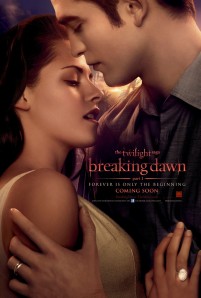
And all that brings us to Breaking Dawn, Part I.
Of the Twilight movies, I still feel Eclipse was the strongest one. Breaking Dawn covers everything the 1st half of the book does and manages to do it without stepping past the PG-13 bounds it created. The film starts off with Edward and Bella’s Wedding, with different reactions from everyone. Jacob hates it, wolfs out and runs to Canada. The Cullens are ecstatic. Charlie manages to deal with it. The wedding ceremony is done well, and gives some screen time to all of the high school friends (who we won’t be seeing after the wedding). Stephenie Meyer herself even has a cameo here (and eerily looks like my mother). Even the honeymoon is done better than I thought it would. Anyone expecting Bella and Edward’s honeymoon to look like something out of a late night Cinemax series may be disappointed, but the romance is nice to see and there were some laughs in the audience. Again, it’s Twilight. I’m not expecting Jane Eyre or Sense & Sensibility romance levels. At least, that’s what the snoring mother sitting next to me who brought her kids felt, I think.
After the married couple’s wild honeymoon, Bella discovers she’s miraculously pregnant and even worse, the unborn child is sucking the very life from her. The wolves find out about this and feel that she needs to be eliminated, along with the rest of the Cullens, as it breaks the Treaty. Bella is rushed home while the Cullens try to find a way to save both the baby and the mother. Will Bella make it? Will the Wolves pounce on the vampires? Those are some of the questions brought to the table.
Jacob finds himself taking sides with the Cullens, which causes him to recall his Alpha Status in his wolf pack and stand alone (or nearly alone) against his family. In the book, this was done pretty well, but translated to the screen the scene with wolves telepathically yelling at one another seemed a little cartoonish. Just change back to people and talk it over. I guess it was done that way to show how animals have the whole Alpha / Omega relationship, and remains one embarrassing moment in a sea of scenes that were okay.
Visually, Eclipse was a serious step up from both Twilight and New Moon. Breaking Dawn seemingly returns to the look and feel of the original Twilight, right down to Carter Burwell’s score. With the exception of the Bella’s Lullaby theme (which worked incredibly well, especially at the last two minutes of the film), the music felt a little weak to me. I actually preferred Howard Shore’s score to Eclipse. Don’t get me wrong, the movie goes where it’s supposed to, but you’d expect things to look a little better as it goes along. It would be nice if they improved on that.
One other thing I’ll give this (and that’s all of the Twilight mess) is the audience. I live for seeing audiences react to what they’re seeing on the screen, and I can’t remember a more reactive audience set since Captain America. Some of the girls who go to see this really go wild over it, and some of the guys grumble loudly. My theatre was packed, right down to the front seats where you have to crane your neck up to see everything. It’s the closest to a Midnight Movie experience you could have at a Matinee.
The big problem Breaking Dawn Part II will have will be trying to be exciting, because there isn’t a lot that occurs in the second half of the story that’s worthy of stretching it out to nearly two hours. It’ll be interesting to see what they do with that.
Overall, Breaking Dawn doesn’t really break any new ground in Vampire myths or anything like that. For anyone unfamiliar with the Twilight movies or books, it may feel slow and even a little boring at times. For it’s target audience (readers of the book), it gives them just about everything they wanted.



 Through the Shattered Lens