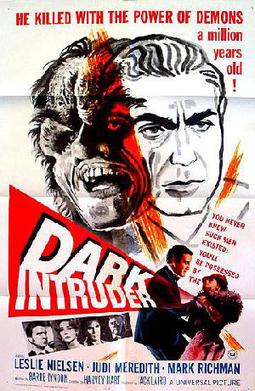
Horror Film Review: Dark Intruder (dir by Harvey Hart)


The 1965 film, Dark Intruder, takes place in San Francisco in 1890.

Murders are being committed on the foggy streets of the city that was once known as Yerba Buena.  Women are being stalked through allies and attacked by a caped figure who seems to thrive on the darkness.  At each murder, a hideous statuette is left behind.  The statuette seems to depict a winged demon emerging from the back of a man’s head.  With each murder, the demon appears to be growing closer and closer to fully escaping from the man.

The police are baffled and the press is suggesting that London’s infamous Jack the Ripper has come to California.  (Well, where else would he go?  I kid, California, I kid!  I love you, California.  Well, I love some parts of California, at least.)  As the police often due when they have a case with supernatural overtones, they turn to local socialite and bon vivant, Brett Kingsford (Leslie Nielsen).

Brett lives in a mansion, where he wakes up nearly every morning with a hangover.  He enjoys life but he’s also found time to become an expert on the occult.  He even has a giant plant in his library that perks up whenever there’s a paranormal presence nearby.  Brett is engaged to Evelyn Lang (Judi Meredith), who speaks in an annoyingly high voice.  When the police bring the statuettes to Brett, he takes them to a psychic named Chi Zeng for advice.  Chi Zeng (played by Peter Brocco, who you may have guessed was not Chinese) reveals that the statuette represent a Sumerian demon that is inhabiting the body of a human.  The demon has to commit seven murders so that it can freed from its host and then allowed to commit as many terrible acts as it wants.

Who is the demon possessing?  Brett’s friend, Robert Vandenburg (Peter Mark Richman), fears that it could be him.  Brett tries to assure Vandenburg that he has nothing to worry about but as Brett continues his investigation, he comes to realize that Vandenburg actually may have a lot to worry about….

Dark Intruder is a short film, clocking in at a little under an hour.  It was originally developed as a pilot for a television series that would have featured Leslie Nielsen solving occult crimes on a weekly basis.  Unfortunately, the series wasn’t picked up (it sounds like it would have been fun!) and Dark Intruder was given a theatrical release as part of a double feature with William Castle’s I Saw What You Did.  It’s an effective little film, full of gothic atmosphere, misty streets, and a frightening (and clawed) villain.  The murder that opens the scene seems as if it would have been quite graphic by the standards of 1966 television.  Perhaps that’s why the pilot didn’t lead to a series.

Of course, for a lot of people, the main appeal here is Leslie Nielsen, playing one of his “serious” roles.  Usually, it’s difficult to watch Nielsen’s dramatic work because it’s impossible not to be amused at his signature deadpan line delivery.  But he’s actually very good in Dark Intruder.  It helps that Brett Kingsford was written as being someone who had a sense of humor, as opposed to the stiff characters that Nielsen usually played in his dramatic roles.  Nielsen appears to be having fun in the role, which is not something you can say about most of Nielsen’s dramatic work.  Again, it’s a shame that Dark Intruder was apparently too ahead of its time for 1965.
Retro Television Review: Fantasy Island 5.10 “A Very Strange Affair/The Sailor”


Welcome to Retro Television Reviews, a feature where we review some of our favorite and least favorite shows of the past!  On Tuesdays, I will be reviewing the original Fantasy Island, which ran on ABC from 1977 to 1984.  Unfortunately, the show has been removed from most streaming sites.  Fortunately, I’ve got nearly every episode on my DVR.

This week’s episode is about angels and Flying Dutchmen.

Episode 5.10 “A Very Strange Affair/The Sailor”

(Dir by Cliff Bole, originally aired on January 2nd, 1982)

This episode begins not with Mr. Roarke meeting the plane but instead with him heading out alone to the beach, where he meets a ghost ship that is being steered by Captain Hendrik Van Horton.  Captain Van Horton is the legendry Flying Dutchman, the sailor who cursed God when he failed to defeat the Spanish fleet and who is now cursed to sail the ocean until he finds a woman who not only loves him but who is “willing to sacrifice her life” for him.  Every seven years, Captain Van Horton is allowed to spend two days on dry land and he almost always comes to Fantasy Island.

And yes, this all sounds very intriguing and it is an interesting way to open this episode.  I’m so used to the stock footage of Roarke driving down to the docks that it’s always a bit jarring to see something different.  However, Captain Van Horton is also played by the reliably stiff (if likable) Peter Graves.  Graves’s deadpan and straight-forward acting style made him the ideal actor for certain roles, usually as a professional of some sort.  However, Graves’s rather stoic persona did not make him the best choice to play a tortured sea captain, cursed to sail on the ocean for an eternity.

As for his fantasy, the captain is lucky enough to be on the Island at the same time as Laura Myles (Florence Henderson), whose fantasy is to fall in love with an old-fashioned man’s man.  She falls for the Captain, despite the attempts of her ex-boyfriend, Bill (Brett Halsey), to win her back.  Unfortunately, the Captain loses his temper and punches the well-meaning Bill.  Bill is willing to forgive the Captain but Mr. Roarke explains that the Island police are not as forgiving.  (Doesn’t Mr. Roarke control the police?  It’s his Island!)  Captain Van Horton needs to marry Laura and then leave.

Captain Van Horton explains that he’s fallen in love with Laura but he can’t ask her to die for him.  Laura says that she would be willing to die for a man who she has known for a day and half.  Roarke then reveals that Laura doesn’t have to die.  She just has to be “willing to die.”  (Wow, what a silly curse!)  The Captain and Laura sail off together but you have to wonder how the Captain feels about discovering, after hundreds of years of wandering, that there was an easily exploitable loophole to the curse.

As for the other fantasy, Ron (Dick Smothers) needs some confidence so he’ll be able to talk notorious tightwad, J.D. Stoneman (Hans Conried) i,nto investing in an orphanage.  Roarke rings a bell and summons an angel, Miss Harbringer (Shelley Smith).  Miss Harbringer gives Ron a pep talk and even goes to talk to Stoneman herself.  Of course, Miss Harbringer’s real purpose is to make Ron’s wife, Elaine (Arlene Golonka), so jealous that Elaine will take over and encourage Ron to talk Stoneman into giving him the money.

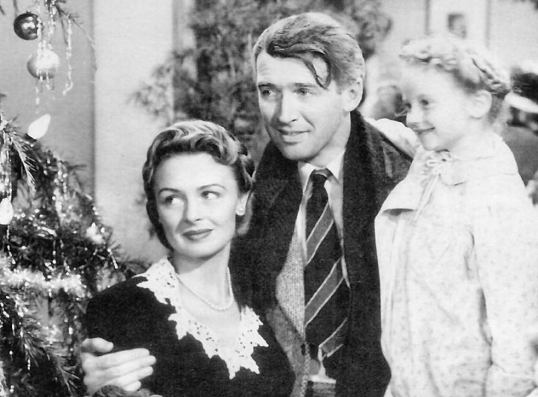
Anyway, Miss Harbringer flirts with Stoneman and convinces him to invest in a good cause.  But she allows Ron and Elaine to believe that it was Ron’s powers of persuasion that convinced Stoneman to invest.  It’s kind of sad that Ron and Elaine forget about Miss Harbringer as soon as they get their money but Roarke says that’s the way it is for angels.  I don’t think that’s true, though.  I bet George Bailey never forgot Clarence.

(Atta boy, Clarence!)

Tattoo is not in this episode so it’s Julie’s turn to assist Mr. Roarke.  What’s odd is that the episode doesn’t even offer up any explanation as to where Tattoo has disappeared.  This episode was a bit on the blah side so it definitely could have used Tattoo.  A random llama shows up at the end of the show and I liked that.  Llamas are cute.  But otherwise, this was a forgettable trip to the Island.

Horror Film Review: Twilight Zone: The Movie (dir by John Landis, Steven Spielberg, Joe Dante, and George Miller)


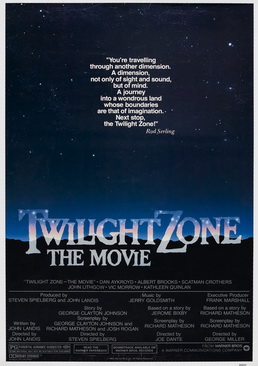
1983’s Twilight Zone: The Movie is meant to be a tribute to the classic original anthology series.  It features four “episodes” and two wrap-around segments, with Burgess Meredith providing opening and closing narration.  Each segment is directed by a different director, which probably seemed like a good idea at the time.

Unfortunately, Twilight Zone: The Movie is a bit of a mess.  One of the episodes is brilliant.  Another one is good up until the final few minutes.  Another one is forgettable.  And then finally, one of them is next too impossible to objectively watch because of a real-life tragedy.

With a film that varies as wildly in tone and quality as Twilight Zone: The Movie, the only way to really review it is to take a segment at a time:

Something Scary (dir by John Landis)

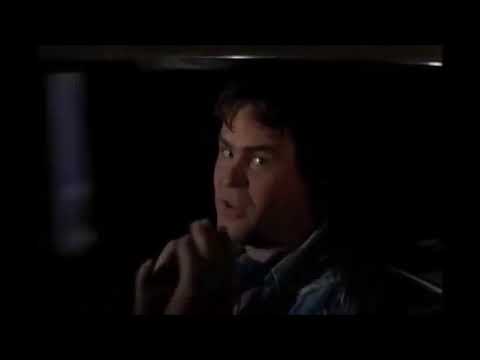
Albert Brooks and Dan Aykroyd drive through the desert and discuss the old Twilight Zone TV series.  Brooks claims that the show was scary.  Aykoyd asks if Brooks wants to see something really scary.  This is short but fun.  It’s tone doesn’t really go along with the rest of the movie but …. oh well.  It made me jump.

Time Out (dir by John Landis)

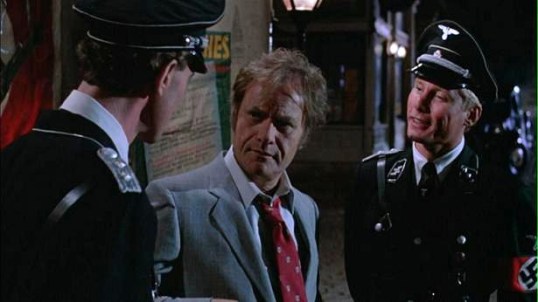
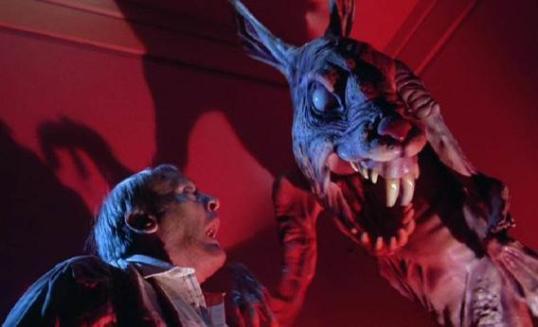
Vic Morrow plays a racist named Bill Connor who, upon leaving his local bar, finds himself transported to Nazi-occupied France, the deep South, and eventually Vietnam.

How you react to this story will probably depend on how much you know about its backstory.  If you don’t know anything about the filming of this sequence, you’ll probably just think it’s a bit heavy-handed and, at times, unintentionally offensive.  Twilight Zone often explored themes of prejudice but Time Out just seems to be using racism as a gimmick.

If you do know the story of what happened while this segment was being filmed, it’s difficult to watch.  Actor Vic Morrow was killed during filming.  His death was the result of a preventable accident that occurred during a scene that was to involve Morrow saving two Vietnamese children from a helicopter attack.  The helicopter crashed, killing not only Morrow but the children as well.  It was later determined that not only were safety protocols ignored but that Landis had hired the children illegally and was paying them under the table so that he could get around the regulations governing how many hours child actors could work.  It’s a tragic story and one that will not leave you as a fan of John Landis’s, regardless of how much you like An American Werewolf in London and Animal House.

Nothing about the segment feels as if it was worth anyone dying for and, to be honest, I’m kind of amazed that it was even included in the finished film.

Kick The Can (dir by Steven Spielberg)

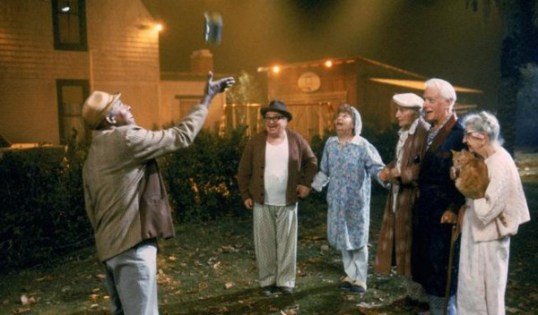
An old man named Mr. Bloom (Scatman Crothers) shows up at Sunnyvale Retirement Home and encourages the residents to play a game of kick the can.  Everyone except for Mr. Conroy (Bill Quinn) eventually agrees to take part and, just as in the episode of the Twilight Zone that this segment is based on, everyone becomes young.

However, while the television show ended with the newly young residents all running off and leaving behind the one person who refused to play the game, the movie ends with everyone, with the exception of one man who apparently became a teenager istead of a kid, deciding that they would rather be old and just think young.  That really doesn’t make any damn sense but okay.

This segment is unabashedly sentimental and clearly calculated to brings tears to the eyes to the viewers.  The problem is that it’s so calculated that you end up resenting both Mr. Bloom and all the old people.  One gets the feeling that this segment is more about how we wish old people than how they actually are.  It’s very earnest and very Spielbergian but it doesn’t feel much like an episode of The Twilight Zone.

It’s A Good Life (dir by Joe Dante)

A teacher (Kathleen Quinlan) meets a young boy (Jeremy Licht) who has tremendous and frightening powers.

This is a remake of the classic Twilight Zone episode, It’s A Good Life, with the difference being that young Anthony is not holding an entire town hostage but instead just his family.  This segment was directed by Joe Dante, who turns the segment into a cartoon, both figuratively and, at one point, literally.  That’s not necessarily a complaint.  It’s certainly improvement over Spielberg’s sentimental approach to the material.  Dante also finds roles for genre vets like Kevin McCarthy, William Schallert, and Dick Miller and he provides some memorably over-the-top visuals.

The main problem with this segment is the ending, in which Anthony suddenly reveals that he’s not really that bad and just wants to be treated normally, which doesn’t make much sense.  I mean, if you want to be treated normally, maybe don’t zap your sister in a cartoon.  The teacher agrees to teach Anthony how to be a normal boy and again, what the Hell?  The original It’s A Good Life worked because, like any child, Anthony had no conception of how adults felt about him.  In the movie version, he’s suddenly wracked with guilt and it’s far less effective.  It feels like a cop out.

Still, up until that ending, It’s A Good Life worked well as a satire of the perfect American family.

Nightmare at 20,000 Feet (dir by George Miller)

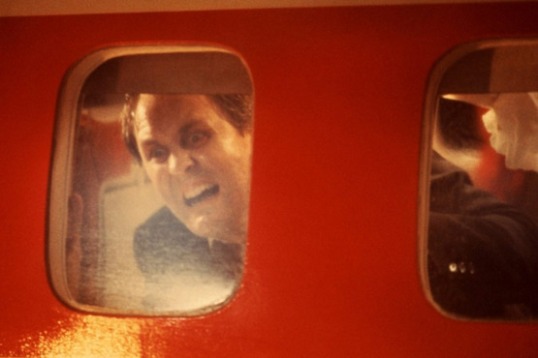
In this remake of Nightmare at 20,000 Feet, John Lithgow steps into the role that was originally played by William Shatner.  He plays a man who, while attempting to conquer his fear of flying, sees a gremlin on the wing of his airplane.  Unfortunately, he can’t get anyone else on the plane to believe him.

Nightmare at 20,000 Feet is the best of the four main segments.  It’s also the one that sticks closest to its source material.  Director George Miller (yes, of Mad Max fame) doesn’t try to improve on the material because he seems to understand that it works perfectly the way it is.  John Lithgow is also perfectly cast in the lead role, perfectly capturing his increasing desperation.  The one change that Miller does make is that, as opposed in the TV show, the gremlin actually seems to be taunting John Lithgow at time and it works wonderfully.  Not only is Lithgow trying to save the plane, he’s also trying to defeat a bully.

Something Scarier (dir by John Landis)

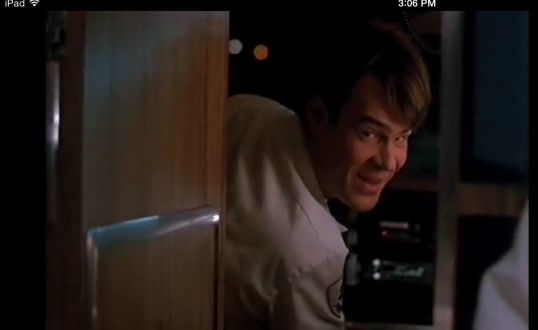
Dan Aykroyd’s back as an ambulance driver, still asking his passenger if he wants to see something really scary.  It’s an okay ending but it does kind of lessen the impact of Nightmare at 20,000 Feet.


Film Review: Tobor The Great (dir by Lee Sholem)


Last week, along with my friends and fellow members of the Late Night Movie Gang, I watched the 1954 sci-fi film, Tobor The Great.

As you can probably tell by looking at the top of this review, Tobor came with a really great poster.  It’s a poster that promises all sorts of sci-fi thrills and chills.  It screams, “B-movie masterpiece!”  You look at that poster and you think to yourself, This film is probably extremely silly but I absolutely have to watch it!

Of course, if you know anything about the B-movie aesthetic of the 50s and 60s, you won’t be shocked to learn that the poster has next to nothing to do with the actual film.  True, there is a robot is featured in the film.  The poster is honest about that.  And Tobor actually looks just as good in the movie as he does on the poster.  And there is a subplot about space travel but, at no point, do we see Tobor walking across the surface of Neptune or Jupiter or wherever it is that Tobor is supposed to be in this poster.  Maybe he’s on one of the moons of Saturn.  Who knows?

Also, at no point, does Tobor carry around a woman.  In fact, Tobor is pretty much a film for kids.  The main character, other than Tobor, is an 11 year-old boy named Gadge (Billy Chapin).  I can only imagine how audiences reacted when they went into the film expecting to see the scene in the poster and instead, they were confronted with a movie about a little boy and his robot.

Tobor is one of those films that opens with several minutes of stock footage.  Rockets take off.  The stars shine in the sky.  Scientists and engineers do stuff.  It all looks pretty impressive but, of course, none of it was actually shot for this film.  In fact, the use of all that stock footage mostly serves to highlight how cheap the rest of the movie looks.

As for the film’s plot, it has apparently been determined that it’s too dangerous to send humans into space.  So, Professor Nordstrom (Taylor Holmes) and Dr. Harrison (Charles Drake) build a robot that is specifically designed to fly an interstellar craft.  They name their creation Tobor, because that’s robot spelled backwards.  (Tobor even points out that his name is robot spelled backwards.)  In order to help Tobor explore the universe, they design him to be able to simulate human emotions.  In fact, they’re so successful at it that Tobor ends up befriending Nordstrom’s grandson, the aforementioned Gadge.

The press and the military are all very impressed with Tobor.  Unfortunately, it’s the 1950s and that means that the communists are impressed by Tobor as well!  Can the scientists and their families keep Tobor from getting abducted by a bunch of Russian agents!?  Let’s hope so because there’s a lot of space that needs to be explored….

Anyway, Tobor The Great is silly but kind of fun.  It has its slow spots but it also has a really cool robot and it’s always fun to watch the commies get thwarted.  It’s a real time capsule film, one that not only reflects the decade in which it was made but which also has a somewhat charming innocence to it.  If nothing else, it’s nice to think that, in the days before CGI, the filmmakers actually had to make a Tobor of their own.  Apparently, Tobor is currently in a private collection and I hope whoever has him is treating him well.

Horror on TV: The Twilight Zone 1.13 — “The Four of Us Are Dying”


TheTwilightZoneLogo

In this episode of the Twilight Zone, a con man (Harry Townes) has the ability to change his face to make himself appear like anyone he wants to be. Needless to say, this ability doesn’t quite work out as well for him as he might have hoped.

This episode originally aired on January 1st, 1960.

(If the video is not showing up below — some browsers apparently have problems showing embedded videos from Hulu — you can watch the episode at http://www.hulu.com/watch/440771.)

The Daily Grindhouse: Homebodies (dir by Larry Yust)


Can we just be honest about something?

Most of us are a little bit scared of the elderly.

Oh, we try to deny it.  We talk about how they’re “real characters” or we attempts to convince ourselves that their eccentricities are actually signs of an incurable zest of life.  We tell ourselves that old people remind us of the value of carpe diem but, ultimately, they creep most of us out because, when we look at them, we see our own future.  Regardless of what we do today or tomorrow, we’re all going to eventually become old.  Perhaps that’s why there’s a whole industry devoted to keeping old people out of sight and out of mind.

Today’s entry in the Daily Grindhouse, the obscure 1974 film Homebodies, is effective precisely because it understands that unpleasant truth.

Directed by Larry Yust, Homebodies tells the story of Mattie (Paula Trueman).  Mattie is one of seven elderly retirees who are the sole residents of a condemned apartment building.  All around them, buildings are being torn down and replaced with new apartments.  When an uncaring social worker (Linda Marsh) shows up and informs them that they’re going to be forcefully relocated to an assisted living facility, Mattie take matters into her own hands.  She realizes that every time there’s an accident on a construction site, work stops for a few days.  Hence, if there are enough accidents, work will be stopped indefinitely.  Mattie and her fellow residents (some reluctantly and some not) are soon murdering anyone they view as a threat.  While this is effective initially, things get complicated once Mattie starts to view some of her fellow residents with the same contempt that she previously reserved for construction workers.

Homebodies is one of those odd and dark films that could have only been made in the 70s.  When the film begins, one would be excused for expecting to see a heart-warming comedy about a bunch of plucky seniors outsmarting the forces of progress and real estate.  After all, the elderly residents of the condemned building are all appropriately quirky and, as played by Paula Trueman, Mattie doesn’t seem like she’d be out-of-place as one of the prankers on Betty White’s Off Their Rockers.  Linda Marsh’s social worker and Kenneth Tobey’s construction foreman both seem like the type of authority figures who one would expect to see humiliated in a mawkish 1970s comedy film.

Instead, Homebodies turns out to be an effectively creepy and dark little film.  When the elderly residents of the apartment building fight back, they do so with a surprising brutality that’s all the more effective because of the harmless exteriors of Mattie and her fellow residents.  Paula Trueman makes Mattie into a truly fascinating and frightening monster.  When a few of her fellow residents start to question Mattie’s methods, you truly do fear for them because Mattie has truly proven herself to be capable of just about anything.  While Trueman dominates the film, the entire cast is excellent.  As a classic film lover, I was happy to see that one of the residents was played by Ian Wolfe, a character actor who will be recognizable to anyone who has ever watched TCM.

(Remember the old man who gave the lecture at the observatory in Rebel Without A Cause?  Him.)

I first saw Homebodies on YouTube and I was going to share it below but, apparently, the video has been pulled from the site.  That’s a shame because it’s a film that definitely deserves to be seen, if for no other reason than to appreciate the performances from a cast of underrated character actors who, sadly, are no longer with us.   Unfortunately, the best I can offer is this Spanish-language trailer for the film.