Embracing the Melodrama Part II #49: Hustle (dir by Robert Aldrich)


HustleContinuing our journey into the dark Hell of the 1970s, we now take a quick look at the 1975 cop film, Hustle.

Taking place in Los Angeles, Hustle tells the story of several different people who find their lives intertwined in the desperate dance of existence.  (Does that sound overdramatic?  Well, that’s the type of film that this is.)

There’s Leo Sellers (Eddie Albert), a lawyer with bright rosy cheeks and a friendly manner.  You look at Leo and you automatically assume that he must be a nice guy, the type of guy who puts on a fake beard and plays Santa Claus down at the local orphanage.  But actually, Leo is a lawyer for the mob.  He’s gotten rich through crime and his mansion hides all sorts of secrets.  He also has a weakness for violently abusing prostitutes.

Speaking of prostitutes, one of Leo’s favorite is Nicole (Catherine Deneuve), an icy French beauty who survives by holding the world at a distance.  Though Nicole doesn’t like Leo, she has to keep him happy because Leo could easily arrange for her to be deported back to France.

Nicole is also the girlfriend of Phil Gaines (Burt Reynolds), a cynical homicide detective who, like her, tries to keep the world at a distance.  Phil is obsessed with old films and frequently speaks of how much he wishes the real world could be like a movie.  Throughout the film, he talks about eventually moving to Rome.

Phil’s partner is Louis Belgrave (Paul Winfield), who is not quite as cynical as Phil but who is definitely getting there.  Whereas Phil is always talking about how much the world has disappointed him, Louis mostly accepts things without complaint.  He just wants to do his job and go home at the end of the day.

Phil and Louis’s boss is Santoro (Ernest Borgnine, giving a typical Ernest Borgnine performance).  Santoro is not a bad guy but, in order to hold onto his job, he has to keep powerful men like Leo Sellers happy.

Santoro also has to deal with the complaints of people like the Hollingers.  Marty Hollinger (Ben Johnson) is a veteran of the Korean War and handles the world in a gruff and suspicious manner.  Paula (Eileen Brennan) is Marty’s wife and, as a result of his emotional distance, has recently started having an affair.

And then there’s Gloria (Colleen Brennan), Marty and Paula’s daughter.  Gloria ran away from home a while ago and soon found herself working as a stripper, a porn actress, and eventually as a prostitute.  When Gloria is found dead, Phil and Louis get the case.  It’s obvious to them that Gloria committed suicide.  It’s not so obvious to Marty, who is convinced that his daughter was murdered and, disgusted by Phil’s cynical attitude, sets out to investigate the case on his own.

One of the more interesting things about Hustle is that really is no murder mystery.  Despite what Marty believes, Gloria really did commit suicide.  Marty’s insistence that she was murdered has more to do with his guilt over being a bad father than it does with any real evidence.  As Marty investigates his daughter’s life, he is exposed to a sordid world of strip clubs and prostitution.  He discovers that Gloria’s clients included many powerful men and he decides that the last client she saw must have murdered Gloria.

That client is Leo Sellers.  And while Leo may not have murdered Gloria, he is willing to kill Marty to keep his secret life from being exposed.  Phil and Louis are forced to choose between remaining detached or protecting Marty from himself.

And, since this film was made in the 70s, it all ends on a really dark note!

Hustle shows up on Encore occasionally.  It’s a strange film to watch, as it alternates between being a fairly predictable cop film and being a portrait of existential dread.  The movie doesn’t really work; it’s too long, it features some amazingly pretentious dialogue, and Reynolds, Winfield, and Deneuve all seem to be bored with their characters.  Probably the film’s best performance comes from Ben Johnson.  I imagine that has to do with the fact that Johnson is playing the only character who behaves in a fairly consistent way.

And yet, if you’re like me and you’re fascinated with the nonstop fatalism of 70s cinema, Hustle does have some historical value.  It’s one of those films that you watch and you wonder how anyone survived the 1970s!
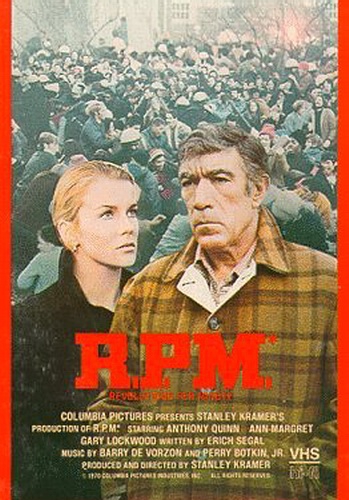
Lisa Goes Back To College: R.P.M. (dir by Stanley Kramer)


RPM

For my next return-to-college film, I ended up watching R.P.M.  Like both Getting Straight and Zabriskie Point, R.P.M. was released in 1970 and deals with political unrest on campus.

Directed by Stanley Kramer (who also gave us such respectable and middlebrow liberal films as Guess Who’s Coming To Dinner and Judgment at Nuremberg), R.P.M. takes place at prestigious college.  Students radicals led by Rossiter (Gary Lockwood) and Dempsey (Paul Winfield) have taken over a building on campus.  When the university’s president goes to confront the students, one of them yells out, “Buzz off!”  Well, you know how sensitive college presidents are.  He quickly resigns his post and the students demand that he be replaced either by Che Guevara, Eldridge Cleaver, or Paco Perez.

Unfortunately, Guevara is dead and Cleaver is in Algeria.  Fortunately, left-wing sociology professor Paco Perez (Anthony Quinn) is available and he just happens to teach on campus!  Perez is named interim president of the college.  Now, Perez has to bring peace to the campus, despite the fact that the protestors now see him as a sell-out because he accepted the position. Perez also has to deal with nonstop snarky comments from his girlfriend, a grad student named Rhoda (played by Ann-Margaret).

Especially when compared to Getting Straight and Zabriskie Point, R.P.M. is something of a forgotten film.  I haven’t found many reviews online and the majority of them mostly seem to focus on the fact that the film is dated and that director Stanley Kramer’s portrayal of the student protestors is incredibly negative.  And, in many ways, those criticisms are perfectly valid.  And yet, with all that in mind, I still loved R.P.M.  Of the three 1970 campus protest films that I watched last weekend, R.P.M. was my personal favorite.

Why do I so love R.P.M?

Well, let’s check out some of the dialogue.

When Paco first comes to see the protestors, one girl literally sings, “Look what the revolution dragged in!”

Later, another demonstrator is heard to philosophically ask, “Why is the good ass never radical and the radical ass never good?”  (And that’s certainly a question that was asked by everyone who drove by Occupy Dallas back in 2011.)

About the college administration, one girl announces, “They’ve got empty scrotes!”

When Paco tells Dempsey that the college is finally going to hire a black admissions offer, Dempsey replies, “How black?  Is this cat an oreo cookie?  Is he related to my uncle Tom?”

When Paco asks how long it will take for the protestors to peacefully leave the building, one of them loudly announces, “It would take to the 12th of never!”  Of course, everyone applauds.

And that’s not counting all of the times that random protestors say, “Right on!”

But even better than listening to the protestors is listening to Paco and Rhoda discuss their relationship.

When Rhoda tells Paco that she knows the real him because she sees him without his pajamas, Paco replies, “That’s not reality.  That’s flab.”  With a world-weary sigh, Rhoda replies, “Flab is reality.”

When Paco complains about Rhoda’s cooking, she sensibly tells him, “Next semester, hump a home economics major.”  Paco replies, “I did.  The food is great but the talk is lousy.”

After being taunted by a student, Paco asks Rhoda, “Did you tell the kids I was a lousy lay?”  Rhoda laughs and replies, “I may have thought it but I never said it!”

Finally, in one heart-warming scene, Paco informs Rhoda that, “The whole campus calls you Paco’s Pillow.”

Seriously, how can you not love a movie with dialogue this overwritten and over-the-top?  It’s obvious the Kramer and screenwriter Erich Segal were desperate to sound hip and contemporary and, as a result, nobody speaks like a normal person.  Instead, listening to R.P.M. is a bit like listening to a party to which every 60s stereotype has been invited.

And yet, it’s not just the dated dialogue that causes me to love R.P.M.  As opposed to the histrionic Getting Straight and the artistically detached Zabriskie Point, R.P.M. is an attempt to seriously deal with the issue of student protest.  For every three moments that ring false, there’s one that works and that’s a lot more than most films about campus unrest can say.  Anthony Quinn gives a good performance as a man who doesn’t realize quite how complacent he has become.  He and Gary Lockwood have a wonderfully tense scene together where they sincerely and intelligent debate their different worldviews.  It’s the best scene in the film and one that is so well-done that it excuses any previous missteps.

R.P.M. occasionally shows up on TCM.  Keep an eye out for it.

Antony Quinn and Ann-Margaret


Horror Review: The Serpent and The Rainbow (dir. by Wes Craven)


The word zombies conjures up the flesh-eating variety popularized by George Romero’s horror films and the legion of films from others soon after. Prior to 1968’s Night of the Living Dead the word zombies was synonymous more with the gothic-like horror films which took the Haitian voodoo folklore about the recently dead being brought back to life by voodoo priests to act as mindless slaves. It’s this version of the word zombie which Wes Craven decided to explore with his 1988 film adaptation of the Wade Davis non-fiction book The Serpent and The Rainbow. Wes Craven’s film fictionalizes the ideas and treatises put forward in Davis’ book and creates a film which tries to put to light the true horror which lay behind the voodoo folklore regarding zombies.

The film introduces us to the ethnobotanist character of Dennis Alan (played by Bill Pullman) who’s approached by a major pharma-corporation about researching the scientific origins and cause of the voodoo “zombie”. He heads off to Haiti at a time when it’s going through a political upheaval that would lead to the subsequent revolution that topples the dictatorship of that country’s leader, Francois “Baby Doc” Duvalier. During his time in Haiti he investigates story of a patient named Christophe who was reported dead 8 years past but seen recently walking about in a dazed manner. It’s while trying to get a handle on how Christophe was declared dead by authorities but then “resurrected” years later which brings Alan in contact with the local witch doctors who question Alan’s motives but also ridicule him for his narrow viewpoint regarding things which science cannot answer. But through persistence he finally gets one local to assist him in procuring the so-called “zombie powder” used to bring the dead back to life.

The Serpent and The Rainbow shows the real horror about zombification when Alan’s investigations and persistence to acquire the “zombie powder” brings the attention of the country’s secret police (the Tonton Macoutes) and one of it’s leaders and reported voodoo priest in Captain Dargent Peytraud (played by Zakes Mokae in a chilling performance) who warns him repeatedly not to continue. Repeated verbal warning and threats soon become more direct and physical as Alan finds out first-hand why no one in the country dares to speak of “zombies” to an outsider and why Captain Peytraud and his Tonton Macoutes were feared as if they were agents of the evil spirits of their voodoo faith.

Craven does a very good job in taking Wade Davis’ non-fiction book and creating a thrilling and suspenseful piece of horror which suggests that the lead character of Dennis Alan has stepped into a world that was steeped not just in the realm of science but also in the supernatural. The film includes some great scenes which shows Alan experiencing some very horrific nightmares which seems indistinguishable from his waking moments and vice versa. Unlike Craven’s previous work in horror which were imbued with some dark humor but always brutal in it’s depiction of everyday horror, this film rarely goes the gory route though the scenes of torture should make even the most hardened and jaded horror aficionado to squirm in their seat.

The true horror revealed by Craven’s film is the very human figure of Captain Peytraud and his Tonton Macoutes who use the local populace’s fear of “zombification” and how Peytraud has taken advantage of these people’s voodoo beliefs to control the public and keep themselves in power. It’s horror that many recognize and understand yet heightened even more with the addition of a local religious practice that’s relatively unknown and misunderstood by outsiders (especially by those in the West). The film never truly answers the question raised in the beginning of the film of whether the practice of “zombification” is wholly scientific and pharmacological in origins and cause or does religion and the supernatural has a hand in making the process occur. Even after the climactic encounter between Alan and Captain Peytraud in the end of the film only brings more questions which Craven seems to relish in not letting his film answer on either side of the discussion.

The Serpent and The Rainbow is one of those films during the 1980’s which never really got a fair shake from critics and the audience but has since gained quite a following in the years since it’s release. It’s actually one of Craven’s more subtle works during that period of time where violence in the film was the exception instead of the rule as in his past films. It’s a film which continues to gain fans as more and more younger film fans discover the film. Sometimes the word zombies doesn’t conjure up the typical flesh-eating variety but instead one even more horrific since it’s one based on real-life. Sometimes reality can be scarier than what we can conjure up in our minds. The Serpent and The Rainbow is one film which does a great job in supporting that.