I review BLOOD WORK (2002) – starring Clint Eastwood and Jeff Daniels!


Here at The Shattered Lens, we’re celebrating Clint Eastwood’s 95th birthday on May 31st. As part of that celebration, I decided to revisit his 2002 film, BLOOD WORK. 

BLOOD WORK finds Clint Eastwood as retired FBI profiler, Terry McCaleb (Clint Eastwood), a man who has recently had a heart transplant. Despite the wishes of his doctor Bonnie Fox (Angelica Huston), the beautiful Graciella Rivers (Wanda De Jesus) is able to guilt McCaleb into investigating the death of her sister, Gloria, when she reveals to him that it’s her sister’s heart that is now beating in his chest. Unable to drive due to his heart condition, McCaleb hires his goofy next-boat neighbor Buddy (Jeff Daniels) as his driver. The two set out to find any clue or follow any lead they come across. Eventually McCaleb is able to uncover that Gloria’s killer may be the “Code Killer,” the very same killer that he was after when his heart gave out on him, forcing his retirement. He’s going to do everything he can to catch the killer this time, even if it kills him in the process! 

BLOOD WORK puts Clint Eastwood smack dab in the middle of one of my favorite genres, the serial killer film, and the result is somewhat of a mixed bag. On the positive side, it contains a really good performance from a 72 year old Clint Eastwood as the retired FBI guy and recent heart transplant recipient. This character trait strips away Eastwood’s ability to be a Superman as he has been so many times before in his career. As a matter of fact, we feel his pain when a big Russian throws him down, or when he has to dive out of the way of a car trying to run him over. We worry for him when he gets a fever, which could actually kill him. But even in his fragile state, every so often he’ll grab a shotgun and start blasting away at the inhabitant of a car he sees watching him. His character has to rely on his intellect more than his strength and Eastwood is fun to watch in the role, with his performance the highlight of the movie. Of the other performances, I really like Angelica Huston in the relatively small role of his doctor. You believe that she really wants him to get better, and she’s pissed off that he’s gotten himself involved in this murder investigation. I’m not that impressed with Jeff Daniels here. I normally like his work, so I think the problem is that his character isn’t written that well. Wanda De Jesus is a lovely woman, and she has some good moments, but there are a couple of times that she’s way over dramatic, and I couldn’t help but roll my eyes. 

As I mentioned earlier, I usually enjoy serial killer movies, and I did enjoy BLOOD WORK. It hits most of the expected notes of the genre… the serial killer taunting the lawman, the visits to the family members of the victims, the sudden discovery of clues / evidence, the eleventh hour reveal of the killer, etc. With Eastwood at the center of it all as both actor and director, you can’t really go wrong even if the movie does drag some during its middle portion. And even though it’s presented as a whodunit, there’s not a lot of mystery to the identity of the killer. I suspect most filmgoers will figure it out before the final reveal. But at the end of the day, BLOOD WORK is definitely worth a viewing for fans of Clint Eastwood and fans of serial killer movies. Not his best work, but still better than most! 

I’ve included the trailer for BLOOD WORK below:
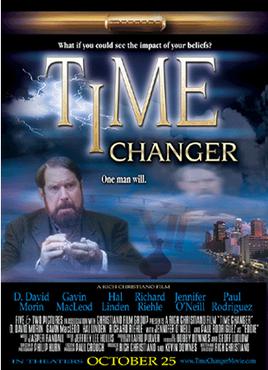
October Positivity: Time Changer (dir by Rich Christiano)


The 2002 movie, Time Changer, tells the story of Russell Carlisle (D. David Morin).  Russell is a bible professor who has written a book called The Changing Times.  The Changing Times encourages everyone to live a good, moral life but it doesn’t specifically state that they should live a good, moral life because Jesus says so.  Dr. Norris Anderson (Gavin MacLeod) argues that the book will actually not lead people to become better but will instead lead them away from Christianity by convincing them that all they have to do is be nice.  Carlisle disagrees.

Luckily, Anderson just happens to have a time machine in his basement!  When Russell comes over to discuss the book, Anderson suggests that Russell go into the future and see just how changed the world has become.  Mostly to humor Anderson, Russell agrees and steps into the machine.

And suddenly, Russell Calirlise is in the year 2002!

What does Russell discover?  He learns that even movies about good people still feature things that he finds objectionable.  He discovers that even people who go to church don’t always live a perfect life.  In 1890, Russell was shocked to learn that the divorce rate was 5% so you can only imagine how he reacts when he goes to 2002 and continually runs into people who talk about their ex-wives.  Russell also gets upset when he hears some teenage girls talking about sneaking out of the house and going on an unchaperoned date.  The horrors!

To be honest, there’s been a lot of movies that have told similar stories to Time Changer.  Someone from the past comes to the “present,” and is shocked to discover how much the world has changed.  Time Changer is unique that it’s totally on Russell’s side and essentially argues that we would all be better off if we still embraced the culture of the 1890s.  If that sounds a bit preachy, that’s because it is a bit preachy.  Interestingly enough, the film has no trouble having Russell explain how he, as someone from 1890, feels about dating, entertainment, and honesty but it leaves out how an 1890 man like Russell would have viewed women or people of color.  Russell is shocked by the casual use of bad language but, conveniently for the film’s efforts to make him a sympathetic character, he doesn’t raise an eyebrow at suddenly finding himself in a multiracial society.  It’s easy to argue for a return to 1890 morality when you ignore everything that was bad about the 1890s.

That said, the film has a few intentionally amusing moments, even if they’re exactly the type of moments that you would expect to see in a film about time travel.  (For example, Russell finds himself fascinated by a light switch.)  D. David Morin gives a likable performance Russell and the scene where Anderson hurriedly explains how time travel works as a nice little satire of the genre.  It’s far too preachy to really be effective but Time Changer is not a total waste of time.  That said, I would far rather live in 2022 than 1890.

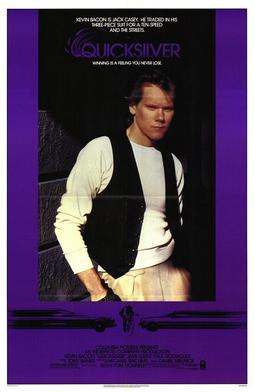
Embracing the Melodrama Part II #77: Quicksilver (dir by Thomas Michael Donnelly)


QuicksilverWho doesn’t love Kevin Bacon?

Seriously, I have yet to meet anyone who doesn’t have a positive reaction to seeing Kevin Bacon on screen.  He may not be a star in the way that Bradley Cooper or Bollywood sensation Shah Rukh Kahn are stars but still, he is one of those actors that everyone just seems to instinctively like.

I think, to a large extent, that is because, despite the fact that he’s been around and acting forever, Kevin Bacon himself still comes across as being a normal, blue-collar sorta guy.  Whenever you see him being interviewed, you get the feeling that Kevin Bacon basically shows up, does his job to the best of his ability, and, as opposed to many other actors, he doesn’t take himself or his movies too seriously.  He’s justifiably proud of the good films that he’s appeared in and he’s never had any problem admitting that he’s been in a lot of bad films as well.

In fact, it was Kevin Bacon’s openness about his bad films that led to me discovering 1986’s Quicksilver.  This is the film that, in a 2008 interview, Kevin Bacon referred to as being “the absolute lowest point of my career.”  (Consider, for a minute, that this is being said by the same Kevin Bacon who had an arrow shoved through his throat in the original Friday the 13th and that will give you some clue of how much disdain Kevin seems to have for Quicksilver.)

Naturally, having read that, I knew that I simply had to see Quicksilver.  I’ll admit right now that I was hoping to discover that it was some sort of loss and unappreciated classic.  I wanted this to be the review where I defended the unacknowledged brilliance of Quicksilver.  I wanted to say, “Don’t be so hard on yourself, Kevin!  Give Quicksilver another chance!”

But no.

Quicksilver doesn’t quite suck but it definitely comes close.

At the same time, it is interesting as a classic example of what happens when a filmmaker tries to assign some sort of deeper meaning to or find inherent nobility in an activity or job that really isn’t that interesting.  Often times, this will happen with sports movies.  A director or producer will make the mistake of thinking that just because he’s obsessed with beach volleyball that means that there’s a huge audience out there just waiting for someone to make the ultimate beach volleyball film.  Or, you’ll get a film like 1999’s Just The Ticket, where Andy Garcia is described as being the “world’s greatest ticket scalper” and the audience is supposed to be impressed.

In the case of Quicksilver, it’s all about being a bicycle messenger.  I’m assuming that, one day, director Thomas Michael Donnelly was stuck in traffic and he happened to see a bike messenger rushing down the street, whizzing past all of the stalled commuters.  And Donnelly probably thought, “I wish I was that guy right now!”  Every day after that, whenever Donnelly was stuck in traffic, he thought back to that bike messenger and slowly he grew obsessed.  All of his friends and his family got sick of listening to him talk about how much he envied the freedom of that bike messenger.  Finally, a little light bulb turned on over Donnelly’s head and he said, “I’ve got to make a movie out of this!”

And then the bulb burned out but nobody noticed.

Quicksilver-photo_625px_8col

Kevin Bacon plays Jack Casey.  When we first meet Jack, he’s a successful stock broker and he’s got a really bad, porn-appropriate mustache.  One day, he’s sitting in the back of a cab and he goads his driver into getting into a race with a bike messenger.  The messenger beats the cab.  Jack is amazed!

And then, perhaps the very same day (the film is so poorly edited that it’s hard to tell), Jack not only loses all of his money but all of his parents’ money as well.  Since poor men couldn’t afford facial hair in the 1980s, he shaves off his mustache.  Desperately needing work, Jack applies to be a  — you guessed it! — bicycle messenger.

The rest of the film is basically Jack delivering messages and talking about how he’s free now to live the life that he’s always wanted to live.  And the thing is, you like Jack because he’s being played by Kevin Bacon.  I mean, Kevin Bacon is so inherently likable that audiences even liked him when he was trying to kill Professor X and Magneto in X-Men: First Class.  But, at the same time, you listen to Jack go on and on about how much better his life is now and you just want to say, “Who are you kidding?”

Needless to say, Jack has a group of quirky coworkers.  Of course, by quirky, I mean that they are all quirky in a very predictable Hollywood sort of way.  For instance, there’s the crusty old veteran and the goofy fat guy and the hard-working Mexican guy who wants to start his own business in America and the cocky black guy who is mostly notable for being played by Laurence Fisburne.  One thing they all have in common is that they all love and damn near worship Jack, who has quite the common touch despite having formerly been a super rich stock broker with a bad mustache.

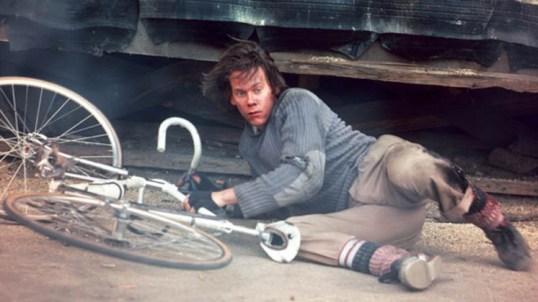
Anyway, Terri (Jami Gertz) also wants to become a bicycle messenger but she’s being used to deliver drugs by Gypsy (Rudy Ramos).  She and Jack fall in love and, along with helping out his quirky coworkers and finding a way to make back his fortune, Jack also has to deal with Gypsy.  It’s all very dramatic (though the drug dealer subplot feels as if it was awkwardly inserted into the film at the last moment) but mostly, the plot is just an excuse for scenes like the one below:

Quicksilver is … well, it’s not particularly good.  It has a few good bike weaving in and out of traffic scenes but it’s definitely no Premium Rush.  But it is kinda fun, in a “Oh my God, look at the 1980s” sorta way.  And, for what it’s worth, it’s a film that proves that Kevin Bacon can be likable in almost anything.