Brad reviews HOUSE OF WAX (1953), starring Vincent Price and a very young Charles Bronson!


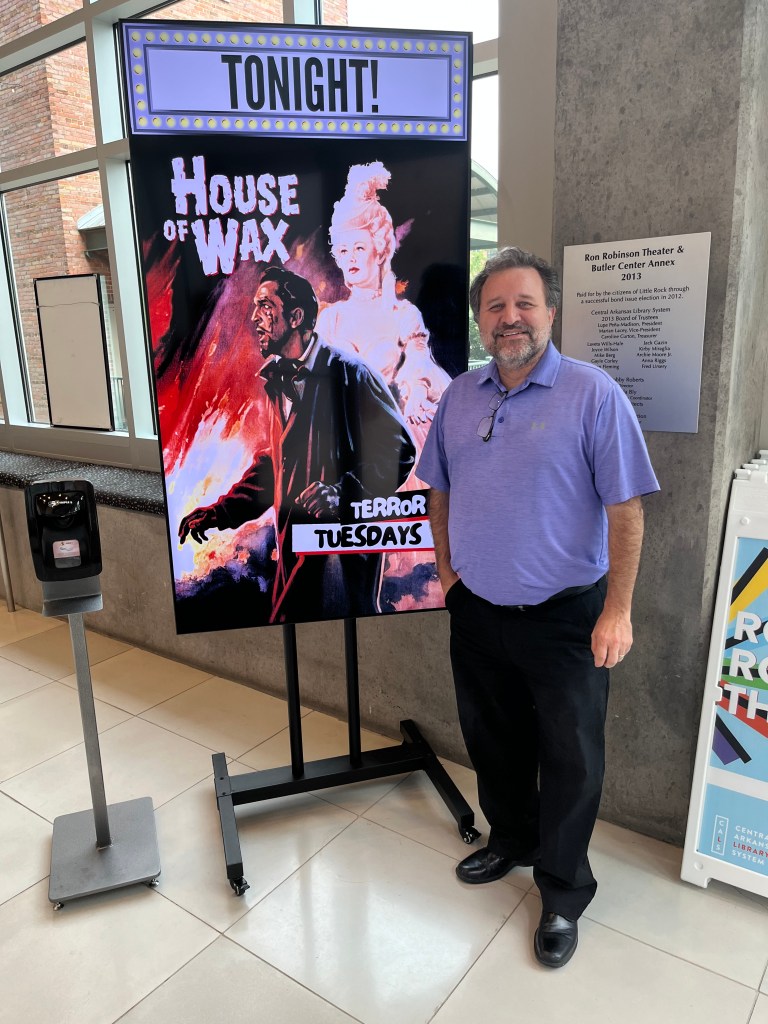
As my readers probably know, I’m one of actor Charles Bronson’s biggest fans, and I’m always on the lookout for venues showing his films on the big screen. In the summer of 2024, the Ron Robinson theatre in downtown Little Rock screened the 1953 Vincent Price classic, HOUSE OF WAX, which features Bronson in one of his earliest on-screen roles. It was so early, he was still being billed as Charles Buchinsky! Of course I wasn’t going to miss it! 
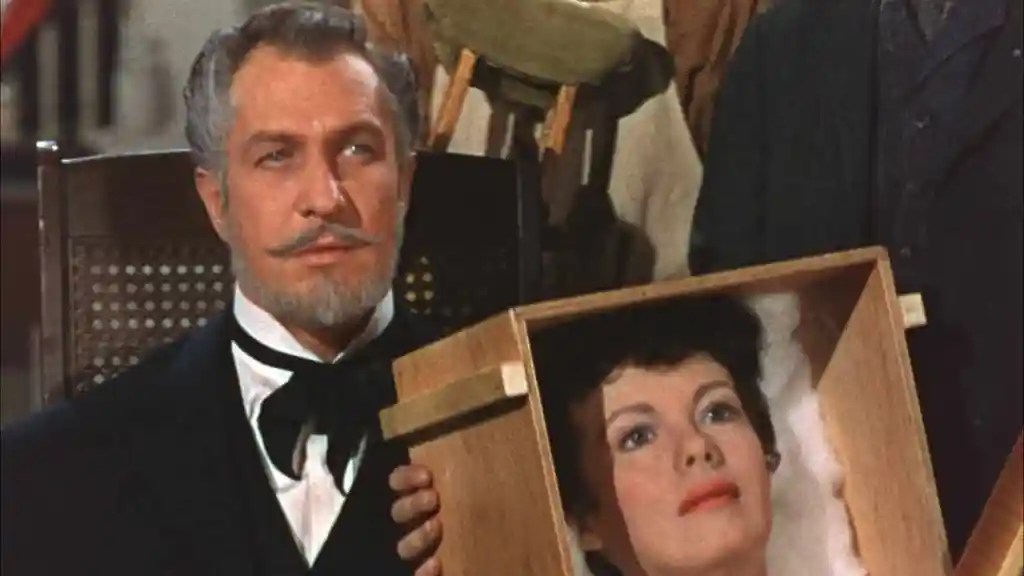
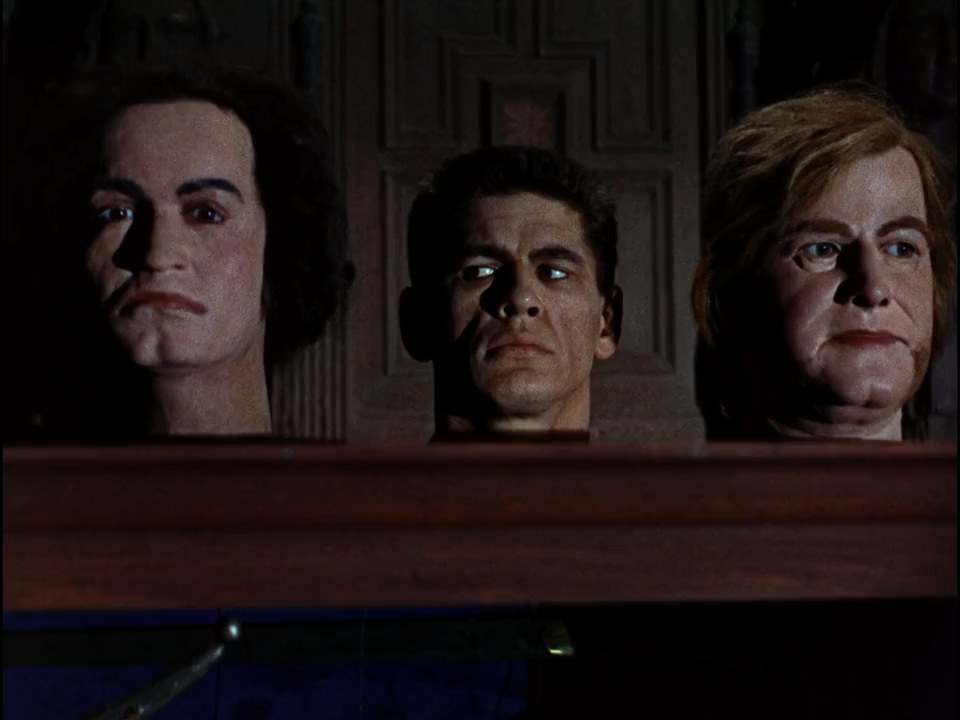
HOUSE OF WAX stars Vincent Price as Professor Henry Jarrod, a talented wax sculptor in early 20th-century New York City. Jarrod’s museum, which features historical figures that look amazingly lifelike, is his pride and joy. However, his business partner, Matthew Burke (Roy Roberts), has grown impatient with his investment and decides he wants to burn down the wax museum for the insurance money. When Jarrod refuses to take part in the fraudulent scheme, Burke sets the museum on fire, leaving Jarrod presumed dead in the process. But Jarrod survives, and with the help of his mute henchman Igor (Charles Bronson), returns to open a new wax museum with a dark and dangerous twist… his exhibits are eerily lifelike because they are real bodies coated in wax. As his former friend Sue Allen (Phyllis Kirk) and her boyfriend Scott Andrews (Paul Picerni) snoop around the house of wax, they begin to suspect that Jarrod has lost his mind and has descended into the mad depths of murder. Will they be able to expose Jarrod’s gruesome secret, or will they become his next exhibit?!!

Directed by André de Toth, HOUSE OF WAX is a landmark horror film, notable for its early use of 3D and Vincent Price’s excellent performance. The film’s strength lies in its undeniably creepy premise, that of turning human beings into wax sculptures, as well as Price’s ability to blend sophistication with menace. Jarrod is quite the sympathetic character at first, but he’s gradually revealed to be certifiably insane as a result of his near-death experience, and that transformation is quite scary. Young Charles Bronson’s portrayal of Igor is also quite freaky. His cold, blank, murderous stare says, “I’ll kill you and not even think twice about it.” His stalking of the heroine, played by Phyllis Kirk, in the dark, spooky house of wax near the end, is one of the true highlights of the movie. It’s also fun seeing Carolyn Jones (AKA Morticia Addams) show up as a spirited victim of the madman! Of course, you can’t help but notice the moments set up for the 3D effects, which come off as quite gimmicky at this point. I specifically took note of the movie’s use of paddleballs and leg kicks! I must admit, however, that these dated elements add to the overall charm of HOUSE OF WAX as a reminder of the olden days of 50’s Hollywood! 

Overall, in my humble opinion, HOUSE OF WAX is a classic scary movie. It’s a perfect treat for fans of vintage horror as well as a testament to the magnetic screen presence of Vincent Price!
Lisa Marie’s First Review of 2025: Beyond the Poseidon Adventure (dir by Irwin Allen)


On New Year’s Eve in 1972, a tragedy struck in the Aegean Sea.  Just as the clock hit midnight and its passengers wished each other a happy new year, the cruise ship Poseidon was capsized by a tidal wave.  The majority of the ship’s crew and passengers were killed in the disaster but a small group managed to climb up through the wreckage and make their way to the ship’s hull, where they were rescued.  Gene Hackman sacrificed his life so that Ernest Borgnine, Red Buttons, Jack Albertson, Carol Lynley, and Pamela Sue Martin could all survive.

We all know the story of The Poseidon Adventure and some of us have even been goaded by our sisters into singing There’s Got To Be A Morning After for karaoke night at Grandpa Tony’s.  (Grandpa Tony’s has since shut down but, for a while, it was the best place in Dallas for nachos and karaoke.)  But do you know the story of what happened after that initial group of survivors was rescued from the ship?  Have you gone Beyond The Poseidon Adventure?

First released in 1979, Beyond The Poseidon Adventure picks up directly from where the first film ended.  Mere minutes after the rescue helicopter flies off, a tugboat pulls up alongside the still capsized wreck of the Poseidon.  Needing money to pay off his debts, Captain Mike Turner (Michael Caine) has decided to declare salvage rights and claim all of the cash and jewelry that he can find in the wreckage.  Accompanying him is his mentor Dead Meat (Karl Malden) and his protegee, Annoying and Cutesy (Sally Field).  Actually, Dead Meat is named Wilbur but, as soon as Karl Malden starts to dramatically grab at his chest, viewers will know that he’s destined to heroically sacrifice himself.  Annoying and Cutesy’s real name is Celeste.  Sally Field gives perhaps the worst performance of her career as the almost always perky Celeste.  This movie came out the same year that Sally Field appeared in the film for which she won her first Oscar, Norma Rae.  I have to imagine that Field was happy to win that Oscar because it meant she would never have to do another film like Beyond The Poseidon Adventure.

Before the tugboat crew can begin to explore the Poseidon, another boat shows up.  This boat is captained by Stefan Svevo (Telly Savalas), who claims to be a doctor who is responding to an S.O.S. from the capsized ship.  Svevo and his crew insist on accompanying the tugboat crew into the Poseidon.  It’s obvious from the start that Svevo is not actually a benevolent doctor.  For one thing, the men accompanying him are armed.  For another thing, he’s played by veteran screen villain Telly Savalas.

The two crews finally enter the ship and …. hey, there’s even more people on the boat!  At the end of The Poseidon Adventure, we were told that only six people had survived the disaster but apparently, that was just a damn lie.  The ship is literally crawling with people who still haven’t gotten out.  (Why didn’t the people who rescued the first batch of survivors check to make sure that they had gotten everyone?)  There’s Tex (Slim Pickens), who says he’s from “Big D” and talks about how he owns an oil well (as we all do in Big D).  There’s Frank Mazzetti (Peter Boyle, basically playing the same loudmouth that Ernest Borgnine played in the first film) and his daughter Theresa (Angela Cartwright) and Theresa’s new boyfriend, Larry (Mark Harmon).  There’s a nurse (Shirley Jones) and a blind man (Jack Warden) and his wife (Shirley Knight).  There’s Susanne (Veronica Hamel), the cool femme fatale who has a connection to Svevo.

While Svevo searches for a crate of plutonium (what the Hell was that doing on the Poseidon?), Mike tries to get the survivors to safety.  That means once again climbing up to the hull while the ship shakes and the engines continue to explode.  Both the first film and the sequel feature the exact same footage of the engines exploding.  At this rate, I guess the Poseidon might finally sink sometime this year.

Directed by Irwin Allen (who produced the first film), Beyond The Poseidon Adventure is about as bad as a film could be.  The first film had plenty of silly moments but it also had the entertaining spectacle of Gene Hackman and Ernest Borgnine competing to see who could yell the loudest.  Beyond the Poseidon Adventure has Michael Caine and Telly Savalas both looking bored while Peter Boyle complains, “That was the worst New Year’s Party I’ve ever been to!” and Sally Field says stuff like, “I’ve been to Anzio!  It’s the pits!”  At one point, Slim Pickens says that he’s as phony as a three dollar bill.  The same could be said of this film.  Beyond The Poseidon Adventure looks and feels cheap and generates none of the suspense of the first film.

As Beyond The Poseidon Adventure ended, I found myself worrying that there might be other passengers still stuck on the ship.  I mean, apparently, it’s very easy to not only survive on a capsized cruise ship but also to be overlooked by professional rescue crews.  Unfortunately, there was not another sequel so those folks were just out of luck.

30 Days of Noir #16: I Was A Communist For The FBI (dir by Gordon Douglas)


The 1951 noir, I Was A Communist For The FBI, tells the story of Matt Cvetic (Frank Lovejoy).  The film could just as easily be called I Hate Matt.

Seriously, from the minute we first see Matt, he’s got people hating on him.  When he goes to visit his mother, his three brothers all make it clear that he’s not welcome in their house.  When he goes to the local high school to find out why his son has been getting into fights, the principal is cold and rude to him.  Even worse, his son announces that it’s all Matt’s fault!  When Matt goes to his job at a Pittsburgh steel mill, the other members of his union view him with a mix of suspicion and resentment.  When Matt attempts to give his neighbor’s son some batting tips, the boy’s father tells Matt to get away from his child and adds, “Baseball is an American game!”

As you may have guessed from the film’s title, Matt is a communist.  He’s been a member of the Communist Party for nine years and, during that time, he’s seen a lot of bad things.  He’s met wth the shady spies who secretly deliver Russian orders to their comrades in the U.S.  He’s watched as communist leader Jim Blandon (James Millican) has plotted to sow discord among otherwise loyal Americans.  He’s watched as unions have been taken over and money has been raised on the backs of the workers.  If there’s anything that Matt understands about communism, it’s that the majority of its leaders care little about the people that they claim to represent.

Because Matt’s a communist, he basically can’t go anywhere without someone calling him “a dirty red” or a traitor to his country.  However, it quickly becomes apparent that not even his fellow communists trust him.  When Matt leaves one clandestine meeting, he’s followed until he reaches home.  In order to test Matt’s ideological purity, Jim Blandon orders a school teacher named Eve Merrick (Dorothy Hart) to get to know him.  We’re told that Eve is one of many communists who have managed to land a job teaching the children of America.

As you’ve probably once again guessed just by looking at the film’s title, the communists have good reason to be suspicious of Matt.  For 9 years, Matt has been working undercover.  As much as it tears him up that he can’t even tell his family the truth, Matt is determined to do what he has to do to keep America safe.  Sadly, that means that Matt has to be a pariah.  He has to deal with his “comrades” showing up at his own mother’s funeral and sarcastically mocking her religious faith.  When his own brother punches him, he has to accept it and lie about  being “a communist and proud of it!”  As he explains it, the fact that his son hates his “communist” father just makes Matt love his son all the more….

I Was A Communist For The FBI is an interesting film.  On the one hand, it’s a very easy film to criticize.  Yes, it’s totally heavy-handed, to the extent that the film even ends with the Battle Hymn of the Republic playing in the background.  Yes, Frank Lovejoy is a bit on the bland side in the lead role.  Yes, the film does seem to be making the argument that some people are more deserving of civil liberties than others.  As someone who believes in individual freedom above all else, it’s hard for me not to take issue with the way the film glorifies not only the FBI but also government overreach in general.

And yet, it’s a very well-made film.  Director Gordon Douglas hits all the right noir notes, from the shadowy streets to the pervasive sense of unease and paranoia.  James Millican is wonderfully villainous as Jim Blandon and Dorothy Hart also gives a good performance as Eve.  The film itself portrays the communist leadership as being more concerned with profit than ideology.  At one meeting, they brag about how much money they’ve made by infiltrating the unions.  In another meeting, Blandon orders one of his stooges to start promoting fascism, the idea being to divide Americans into two extremist camps and then wait for them destroy themselves.  When the communists start a riot during a labor strike, they attempt to blame it on a Jewish newspaper.  When they’re not fanning the flames of antisemitism, they’re causally using the “n-word.”  Again, it’s all very heavy-handed but, at the same time, it’s also a reminder that there will always be grifters who will attach themselves to any ideological movement, hoping to enrich themselves off of the idealism of others.  In our current hyperpolitical climate, that’s an important lesson to remember.

Finally, if nothing else, I Was A Communist For The FBI is very much a document of its time.  It was based on a true story, though how close it sticks to the actual facts of the case I won’t venture to guess.  Oddly enough, it received an Oscar nomination for Best Documentary, even though it’s clearly not a documentary.  Don’t ask me how to explain that one.  It’s a strange world.

http://www.youtube.com/watch?v=R8zhmCjV71w

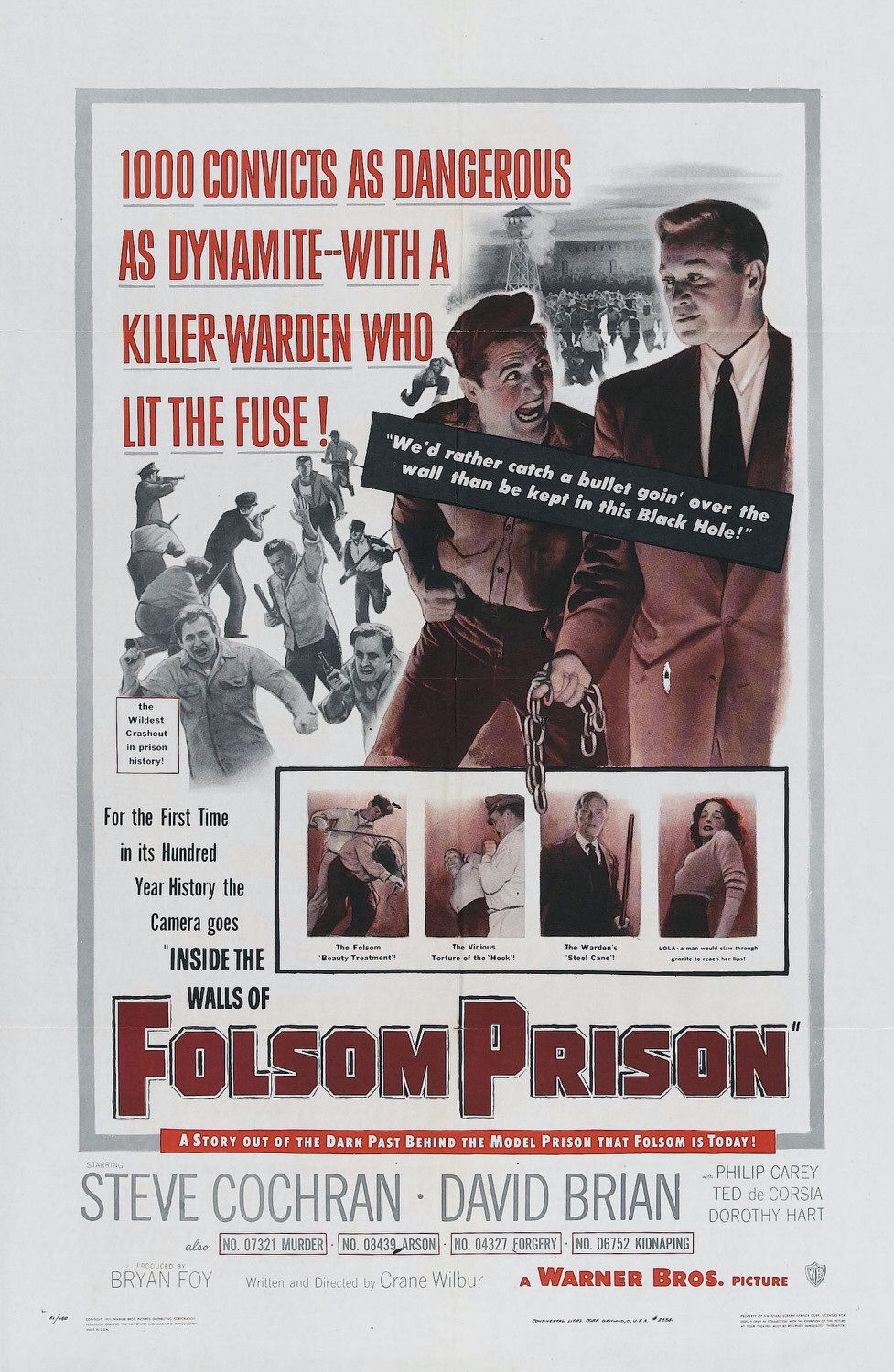
Folsom Prison Blahs: INSIDE THE WALLS OF FOLSOM PRISON (Warner Brothers 1951)


gary loggins's avatarcracked rear viewer

folsom1

Filmed on location inside the infamous prison, and with a testosterone-loaded cast led by Steve Cochran  , David Brian, Ted de Corsia, and Philip Carey  , I expected INSIDE THE WALLS OF FOLSOM PRISON to be slam-bang entertainment along the lines of BRUTE FORCE . Well, not so much. The trouble’s not with the cast, nor the atmospheric direction of Crane Wilbur. It’s Wilbur’s script that commits the cardinal sin of any action film: too much talk!

Even the prison itself talks, narrating the opening credits: “I am Folsom Prison. At one time they called me Bloody Folsom. And I earned it…”, intones the prison, voiced by Charles Lung (an appropriate name for someone who talks to much!). The movie begins with an attempted jailbreak, put down by sadistic Warden Rickey (de Corsia) and his thugs. He then ratchets up the punishment, making life even more miserable for the cons, until…

View original post 441 more words

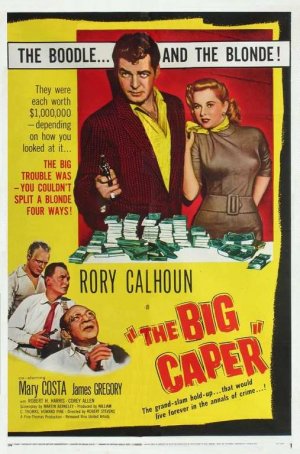
Netflix Noir #2: The Big Caper (dir by Robert Stevens)


The Big Caper Poster

For our next Netflix Noir, we take a look at a heist film from 1957, The Big Caper.

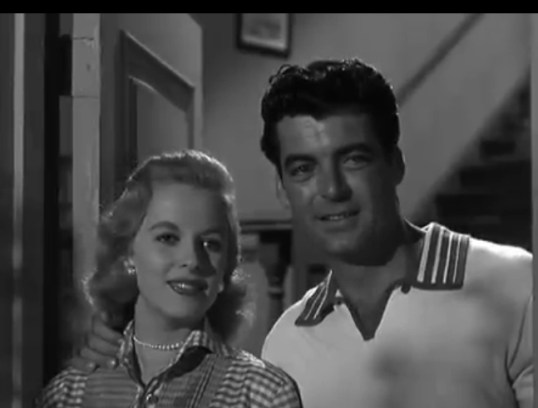
Frank (Rory Calhoun) is a small time criminal with a plan.  He knows that there’s a Marine base near the small town of San Felipe, California and he also knows that, during the weekend before payday, the San Felipe bank will be holding a million dollar payroll for those Marines.  He proposes  to Flood (James Gregory), a wealthy crime boss whom Frank idolizes, that they should find a way rob that bank over the weekend.  Flood agrees to the plan.

While Flood recruits some help for the robbery, Frank and Flood’s girlfriend, Kay (Mary Costa), move into the town and set themselves up as a part of the community.  Using Flood’s money, Frank buys a gas station and he and Kay move into a nice suburban house.  At first, Frank resents being forced to live like a “square.”  He bitterly complains that the local San Felipe newspaper doesn’t even tell him “how the horses did.”

But then something odd happens.  Frank starts to enjoy being a member of the community.  Soon, the gas station is making a profit and Frank is even thinking about buying a second one.  Oddly enough, his becomes best friends with the local cop.

As for Kay, she transitions to respectability even before Frank does.  As she eventually confesses to Frank, she’s tired of being treated like Flood’s property.  She wants to stay in San Felipe and make a life for herself.  Wearily, Frank tells her that she better hope that Flood doesn’t find out…

Meanwhile, Flood has recruited together his gang and they’re not exactly the most impressive bunch of criminal masterminds.  There’s Roy (Corey Allen), a physical fitness fanatic who is almost childlike in his devotion to Flood.  There’s Harry (Paul Picerni), who demands that his girlfriend Doll (Roxanne Arlen) be a part of the scheme.

And then there’s Zimmer (Robert H. Harris), a bald, sweating pyromaniac who spends most of his time begging for alcohol and lighting matches.  Zimmer arrives at Frank’s house unannounced and Frank is forced to pretend that Zimmer is his uncle.

Once Flood and the rest of the gang arrive, Frank starts to prepare for the robbery but he soon discovers that he’d rather be barbecuing with the neighbors.

The Big Caper is a clever little film, one that features excellent performances (especially from Gregory, Calhoun, Allen, and Harris) and tons of hard-boiled dialogue.  What makes this film especially memorable is the way that it contrasts the fake respectability of the wealthy Flood with the newfound, but genuine, respectability of Frank and Kay.

If The Big Caper was made today, it would probably be directed by the Coen Brothers and Ben Affleck and Ray Liotta would play Frank and Flood respectively.  However, the film works just as well with Rory Calhoun and James Gregory and is totally worth seeing.

The Big Caper