High atop Mt. Olympus, Zeus (Laurence Olivier) and his fellow Gods look down on Earth and jealously manipulate its citizens. When Zeus impregnates Danae (Vida Taylor), the daughter of the King of Argos, she and her son Perseus (Harry Hamlin) are banished to sea. Zeus responds by ordering Poseidon (Jack Gwillim) to release the Kraken.
Years later, when Callibos (Neil McCarthy), the son of the Goddess Thetis (Maggie Smith), destroys all but one of Zeus’s flying horses, Zeus transformer Callibos into a tailed monster. Thetis tries to get her revenge by having Callibos kill Perseus but instead, Perseus chops off Callibos’s hand, comes to possess Pegasus, the last of the flying horses, and also wins the right to marry Andromeda (Judi Bowker).
At the wedding, Cassiopeia (Sian Phillips) declares Andromeda to be even more beautiful than Aphrodite (Ursula Andress). Big mistake. Aphrodite demands that Andromeda by sacrificed to the Kraken. Along with Pegasus, Ammon (Burgess Meredith), Thallo (Tom Pigott-Smith), and robot owl, Perseus goes on a quest to get the snake-haired head of Medusa so he can turn the Kraken into stone.
There’s a lot that I love about Clash of the Titans, from the Ray Harryhausen’s stop-motion special effects to the blind witches who pass one eyepiece among them to Burgess Meredith’s performance as Ammon. I even like the robot owl. But the thing that has always made the biggest impression on me is that Mt. Olympus is portrayed as having a shelf that holds a figurine for every human in the world. The Gods casually move the pieces around and transform them on whims. Of all the films that have been based on Greek mythology, ClashoftheTitans is one of the few that really captures the idea of the Gods essentially being a bunch of petty and jealous libertines who view humans are just being their playthings.
Let’s not overthink Clash of the Titans, though. The main appeal of Clash of the Titans is that it’s just a good, old-fashioned adventure movie. In this age of CGI and humorless heroes, it’s hard not love the film’s mix of old-fashion stop-motion animation, strong characters, and occasional moments of humor. (I like the owl and I won’t apologize for it.) Also, Medusa has appeared in a lot of movie but she’s never been scarier than in this movie. Who can forget the yellow glow of her eyes, followed by men turning to stone? Who can forget the hiss of her tail or the moment when Perseus waits to strike while trying not to look into her eyes? Beyond Medusa, who can forget the Kraken rising from the sea or the blood of Callibos giving birth to giant scorpions? Without CGI, Clash of the Titans still captures the feel of living in a different time and a different land. Clash of the Titans brings mythology to life in a way that few other films have been able to,
I loved the original Clash of Titans when I was a kid. I rewatched it last month and I happy to say that I love it still.
As you can probably tell just from looking at everything that’s been posted on the site today, I love the Oscars. That said, I realize that the Oscars aren’t for everyone. Some people find Oscar-nominated movies to be boring. Some people find the ceremony to be unbearably pompous. Every year, there’s the lament of “The truly entertaining films always get snubbed!”
Well, fear not! If you’re not into the Oscars, there are alternatives! For instance, you can go over to Prime right now and rent the 1984 film, Conan the Destroyer!
Conan The Destroyer is the sequel to the original Conan the Barbarian, with Arnold Schwarzenegger returning as Conan and Mako returning as the sorcerer who narrates the events of Conan’s life. This film is a continuation of the adventures of the barbarian who would become king, a trip to a world much different from our own, and a study of savagery vs civilization. Of course, to most viewers, Conan The Destroyer is just the film where a weird lizard monster picks up Arnold Schwarzenegger by his feet and spins him around in circles. Have you seen that meme where it’s made to appear as if Kate Winslet is spinning around a helpless Schwarzenegger? Along with Titanic, this is the film that you have to thank for it.
Conan The Destroyer picks up from where Conan the Barbarian ended. Conan is still wandering around the desert, working as a thief and a mercenary. He’s still praying to Crom and missing Valeria. He’s picked up a companion, a cowardly thief named Malak (Tracey Walter). When Conan and Malk are captured by Queen Taramis (Sarah Douglas), Taramis offers to bring Valeria back to life if Conan will escort the Queen’s niece, Jehna (Olivia D’Abo), to a temple so that she can retrieve a gem that will be used to …. you know what? I’m just going to be honest here. I have absolutely no idea what the quest is about. It’s just one of those things where Conan and his crew have to break into a castle or a temple and steal something so that a god can either be awakened or defeated. The film, to be honest, is a bit vague about how it all works but then again, the mission is less important than the journey.
It turns out that, with the exception of her insanely tall bodyguard Bombaata (Wilt Chamberlain), Jehna has never seen an actual man before and, needless to say, she is quickly fascinated by Conan. (She asks Bombaata if Conan is as handsome as he appears to be, Bombaata reluctantly agrees that he is.) However, Conan only cares for the deceased Valeria. As he leads Jehna, Malak, and Bombaata to the castle where they’ll find the gem, he picks up some other traveling companions. The wizard Akiro (Mako) joins them as does the fierce warrior Zula (Grace Jones). Of course, it turns out that Taramis has an agenda of her own and it all ends in a lot of shouting, swordplay, and muscle flexing.
If Conan the Barbarian was distinguished by the grim and girtty approach that it took to material that others would have played for camp, Conan the Destroyer takes the opposite approach. Of course, a lot of that is because director/screenwriter John Milius did not return to oversee Conan the Destroyer. Instead, Conan the Destroyer was directed by Richard Fleischer, who was one of those veteran directors who made a countless number of films in all sorts of genres but who never really developed a signature style of his own. Fleischer takes a semi-comedic approach to Conan and his quest. As opposed to the brutal warrior and conqueror who appeared in Milius’s film, the Conan in this film is a well-meaning rogue who punches out a camel and who also gets tongue-tied whenever he has too much to drink or when Jehna flirts with him. There’s little of the first film’s violence in this sequel and none of the emotional stakes.
That said, Conan the Destroyer is definitely entertaining. It’s just such a silly movie that you can’t help but enjoy it. Schwarzenegger, apparently understanding that the film is never going to make any sense, cheerfully goes through the motions and he actually does a pretty good job with some of his more comedic lines. The allies and the villains who he collects through the film are all memorably flamboyant. Sarah Douglas is especially entertaining as the over-the-top villainous. If you’re going to be evil in a film like this, you might as well go all out.
Conan The Destroyer was not nominated for an Oscars but it’s still a fun movie.
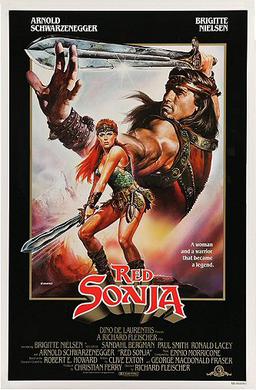
The 1985 film, Red Sonja, invites us to take a journey to a forgotten age, a time of a mythical kingdoms, evil sorcery, epic sword fights, and annoying little child kings who spent a lot of time shouting. It’s a time of wonder, danger, heroism, and, of course, Arnold Schwarzenegger.
Reportedly, the once and future governor of California has frequently named Red Sonja as being the worst film in which he ever appeared. When you consider some of the other films that have featured Gov. Schwarzenegger, that’s indeed a bold statement. In Red Sonja, Schwarzenegger plays Lord Kalidor. Interestingly enough, Lord Kalidor is absent for the majority of the film. He shows up briefly at the beginning of the film and then he vanishes for quite a bit of Red Sonja‘s 89-minute running time. Whenever Schwarzenegger does show up, he wears the smirk of a man who knows that he’s going to get paid a lot of money for doing very little actual work.
The majority of the film focuses on Sonja (Brigitte Nielsen), a warrior who lives in one of those vanished ages, perhaps after the War of the Rings but before the sinking of Atlantis. When we first see her, she’s being spoken to by what appears to be a puff of smoke, which is apparently meant to be some sort of warrior goddess. The puff of smoke fills tells Sonja about everything that happened to her before the start of the movie, though we never do learn why Sonja needs to be told her own backstory. After rejecting the sexual advances of the evil Queen Gedren (Sandahl Begman), Sonja was forced to watch as her parents and brother were murdered and then she was raped and left for the dead by the Gedren’s soldiers. The Goddess promises to make Sonja into a superior warrior, on the condition that Sonja agree to never have sex with a man unless that man can first beat her in fair combat. Sonja agrees and is sent off to get trained by the Grand Master. It’s kinda like Kill Bill, if Bill was a puff of smoke.
Jump forward to …. well, I’m not sure how many years pass. To be honest, it’s next to impossible to really discern any sort of coherent logic to the film’s narrative progression so let’s just give up on that. What’s important is that there’s this temple and, inside the temple, there’s a glowing green talisman. Apparently, the talisman created the world but now it needs to be carefully watched over before being destroyed. Only women are allowed to handle the talisman (Yay!) but they’re not allowed to destroy it unless directed by a man. (Booooo!) The temple priestesses are waiting for Lord Kalidor to arrive so that they can get rid of the talisman. However, Queen Gedren shows up first. Not only does she steal the talisman but she kills the priestesses as well.
One of the priestesses was Varna (Janet Agren, who you might recognize from Lucio Fulci’s City of the Living Dead). Varna just happens to be the sister of Sonja. (Sonja is now known as Red Sonja, because she had red hair. From now on, I want to be known as Red Lisa.) Now, Sonja has yet another reason to want to kill Gedren! Rejecting Kalidor’s help, Sonja heads off for revenge. Along the way, she meets an annoying child king named Tarn (Ernie Reyes, Jr.), who is upset that Gedren previously destroyed his kingdom. Despite hating him, Sonja allows Tarn and his guardian, Falkon (Paul L. Smith), to tag along with her. Despite not being an official member of the revenge party, Kalidor decides to follow after them because he wants to beat Red Sonja in fair combat, if you get what I mean.
Red Sonja is a spectacularly silly film. The dialogue is stilted. Even by the standards of the 1980s ,the special effects are poorly executed. This the type of film where the evil Queen nearly destroys the world not because she has any sort of grand scheme but instead, just because she’s evil and that’s what evil people do. Brigitte Nielsen delivers her lines with a forced solemnity while Schwarzenegger, Bergman, and the great Paul L. Smith seem to be struggling not to start laughing.
And yet, there’s a sneaky charm to be found in all of the silliness. For instance, when Sonja does finally reach the queen’s castle, she has to cross a bridge that appears to basically be the skeleton of giant rhinoceros. No none in the film seems to be surprised to come across a skeleton a giant rhinoceros and, to be honest, there’s no reason for it to be there. It’s just there and it’s so wonderfully out-of-place that it becomes rather fascinating. Add to that, while the portrayal of the evil lesbian queen is problematic in all sorts of ways, this is a film about a strong female warrior who doesn’t need a man to rescue her and that was probably even more rare in 1985 than it is today!
Watching Red Sonja, you get the feeling that nobody involved in the film took it all that seriously and that perhaps the best way to handle the movie is to just sit back and have a laugh. It’s dumb, it’s campy, it often makes no sense but, at the same time, it’s still a lot easier to follow than Game of Thrones. Like many bad films, it’s only bad if you watch it alone. Watch it with a group of your snarkiest friends and you’ll have a totally different experience.
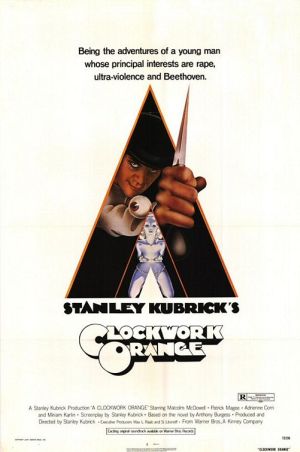
It may seem strange, at first, that I am including the 1971 best picture nominee, A Clockwork Orange, in a series of Back to School reviews. Certainly, Stanley Kubrick’s iconic adaptation of Anthony Burgess’s novel is not usually described as being a film about juvenile delinquency but that’s exactly what it is.
Many viewers tend to forget that Alex (played by Malcolm McDowell, who was nearly 30 at the time) and his three droogs are all meant to be teenagers. (Only Michael Tarn, who played Pete, was actually a teenager at the time the film was shot. Warren “Dim” Clarke and James “Georgie” Marcus were both in their late 20s.) There’s even a lengthy scene in which Alex is interrogated by a social worker, P.R. Deltoid (Aubrey Morris). Viewers are usually so surprised when Deltoid suddenly grabs Alex’s crotch that they forget that the whole reason Deltoid even came to the flat was to find out why Alex had been skipping school. (“Pain in my gulliver,” was Alex’s oft-quoted excuse.)
So, make no mistake about it. Among other things, A Clockwork Orange is a film about both the problem of juvenile delinquency and the continuing debate concerning what the authorities should do about it. Stylistic and philosophical differences aside, A Clockwork Orange comes from the same cinematic family tree that’s given us everything from Rebel Without A Cause to Bully to Spring Breakers.
Of course, that’s not all that A Clockwork Orange is about. It’s a Kubrick film, which means that there’s several different layers to work through and multiple interpretations for what we see on-screen. For those who may not be familiar with the film, it takes place in a recognizable but futuristic England. (One of my favorite theories is that A Clockwork Orange was about what was happening on Earth while David Bowman was becoming the starchild in 2001: A Space Odyssey.) It’s a violent world, one where there appears to be significantly fewer people around than in the past. The streets are deserted and bombed out. Occasionally, when Alex returns to his home, he passes a mural of idealized working men creating a new world. This rather banal work of Socialist realism has been defaced by obscene drawings and mocking graffiti.
Teenage Alex spends his nights hanging out with his friends (or, as he calls them, droogs), Pete, Georgie, and Dim. They drink at the Korova Milk Bar and wear obscenely oversized codpieces, signifying this society’s obsession with outsized masculinity. When they speak (and when Alex narrates the film), they do so in a rhyming slang called Nadsat. Under Alex’s sociopathic leadership, they spend their nights raping women, beating the homeless, and fighting with other gangs. When Alex is not with his droogs, he enjoys lying around the house and listening to Beethoven (or “Ludwig Van” as he calls him).
After being betrayed by his droogs (who have tired of Alex’s cockiness), Alex ends up imprisoned for murder. However, Alex is offered an early release if he’s willing to take part in the Ludovico Treatment. For two weeks, Alex is drugged and forced to watch violent and sexual films while the music of Beethoven plays in the background. As a result of the treatment, Alex grows physically ill at the thought of both violence and sex but he can also no longer listen to Beethoven. Arguably, as a result of being cursed of his anti-social tendencies, he has lost the only non-destructive thing that he enjoyed.
Over the objections of the prison chaplain (who argues that robbing Alex of his free will is not the same as rehabilitating him), Alex is sent back into the real world and he quickly discovers that he now has no place in it. His parents have rented his room out to a boarder who is now more of a son to them than Alex ever was. The streets are full of men who were previously tormented by Alex and who now wants revenge. In perhaps the film’s most brilliant moment, Alex discovers that his former droogs are now members of the police force. Though they may now be wearing uniforms, Dim and Georgie are still as destructive and dangerous as Alex once was. The difference is that Alex was caught and cured whereas Dim and Georgie discovered they could do just as much damage as authority figures as they did as juvenile delinquents.
In fact, the only people who now care about Alex are the political dissidents who hope to use Alex to discredit the government. However, the dissidents aren’t particularly worried about Alex’s well-being either. He’s just a prop to be used for their own ambitions. Even worse, for Alex, is the fact that one of the dissidents is Mr. Alexander (Patrick Magee), a writer who lost both his ability to walk and his wife to an earlier assault committed by Alex…
(Interestingly enough, Mr. Alexander’s boyguard is played by David Prowse, who later become the ultimate symbol of government oppression when he was cast as Darth Vader in Star Wars.)
A Clockwork Orange is a brilliant film but it’s one about which I have very mixed feelings. On the one hand, you can’t deny the power of the film’s imagery. How many times has just the opening shot — of McDowell staring at us while wearing one fake eyelash — been imitated on TV and in other movies? How much of the film’s dialogue — from “pain in my gulliver” to “the old in-out” — has lived on long past the movie? Regardless of how many times I’ve seen A Clockwork Orange, the film’s electronic score (from Wendy Carlos) never ceases to amaze me. Finally, it’s a film that argues that free will is so important that even a sociopath like Alex must be allowed to have it and that, as the chaplain argues, true goodness comes from within and cannot be manufactured or regulated by a government agency. (It’s also a film that suggests that the government would be just as quick to use the Ludovico Treatment not just on the evil Alexes on the world but on anyone who dared to dissent from the party line.) As I’m something of a “Freedom of Choice” absolutist, that’s a message to which I responded.
(At the same time, A Clockwork Orange does not argue that Alex’s actions should be free of consequences. If anything, the film’s message seems to be that things would have been better for literally everyone if the government had just left Alex in jail, as opposed to trying to “fix” what was wrong with him.)
And yet, I have mixed feelings about A Clockwork Orange. I guess my main issue is that the film doesn’t always play fair. Malcolm McDowell is allowed to give a charismatic and well-rounded performance as Alex but nearly everyone else in the film is directed and written as a one-dimensional caricature. Whereas Anthony Burgess’s novel emphasized the very real damage that Alex did to his victims, the film tends to surround Alex with comedic grotesqueries. By both making Alex the only fully developed character in the entire film and then casting the energetic and charismatic Malcolm McDowell in the role, the film seems, at times, to come dangerously close to letting Alex off the hook for his worst crimes. It also leaves the film open to the oft-repeated charge of glamorizing sex and violence. (According to Roger Lewis’s biography of the author, that was Anthony Burgess’s opinion of the film.) For the record, I don’t think A Clockwork Orange is an immoral film but I understand why some people disagree.
For that reason, A Clockwork Orange remains a controversial film. In fact, I’m somewhat surprised that this subversive and deliberately confrontational film was nominated for best picture. It was only the 2nd (and last) X-rated film to receive a best picture nomination. Though it lost to The French Connection, A Clockwork Orange continues to be a powerful and controversial film to this day. Perhaps the biggest indication of A Clockwork Orange‘s success is that it’s still being debated 45 years after it was first released.
 High atop Mt. Olympus, Zeus (Laurence Olivier) and his fellow Gods look down on Earth and jealously manipulate its citizens. When Zeus impregnates Danae (Vida Taylor), the daughter of the King of Argos, she and her son Perseus (Harry Hamlin) are banished to sea. Zeus responds by ordering Poseidon (Jack Gwillim) to release the Kraken.
 Through the Shattered Lens