Everyone remembers the “Mad as Hell Speech” from Sidney Lumet’s 1976 satire, Network.
Personally, I think this scene below is just as good. Replace “tube” with TikTok and AI and you’ll have a pretty good explanation for why the world today is full of so many ignorant people who think they know more than they do.
(Usually, heavy-handed scenes annoy me. Fortunately, much like David Fincher with Aaron Sorkin’s script for The Social Network, Sidney Lumet knew the right directorial tone to take when translating Paddy Chayefsky’s script to the screen. One shudders to think of what Network would have been like with a less skilled director behind the camera.)
You gotta watch out when it comes to those sensory deprivation tanks. They may look like fun and it might seem like a pleasant idea to spend a while floating in and out of a state of consciousness but those tanks will mess you up. Especially if you’ve got unresolved issues with your family and religion.
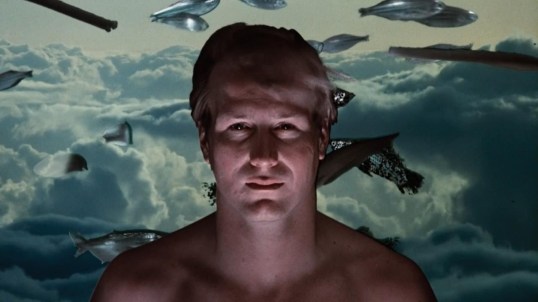
Also, if you’re going to go to Mexico to try a powerful hallucinogenic, make sure you’re not appearing in a Ken Russell film because again, those drugs will mess you up. It’s like you’ll close your eyes and, when you reopen them, you’ll be in an 80s music video or something.
Now, to be honest, Altered States came out in 1980 so it’s a bit unfair to complain that it looks like a music video from the 80s or, for that matter, the 90s. Instead, it’s more fair to say that a lot of the music videos from those two decades looked like Altered States. That shouldn’t be particularly surprising since this film was directed by Ken Russell and Russell was a director who specialized in combining music with wild imagery.
Altered States may have been directed by Ken Russell but it was written by Paddy Chayefsky. Chayefsky, of course, is best known for writing the script for Network. (He also wrote the script for the Oscar-winning film, Marty.) Chayefsky is one of those writers who is always cited as an inspiration by writers who are trying justify being heavy-handed. For instance, when Aaron Sorkin was criticized for both Studio 60 On The Sunset Strip and The Newsroom, his supporters started talking about how he was just carrying on the proud tradition of Paddy Chayefsky. In his autobiography, A British Picture, Ken Russell portrays Chayefsky as being a pompous control freak who refused to allow any changes to his dialogue-heavy script. Russell responded by directing his actors to speak the dialogue as quickly as possible, rendering much of it incoherent. In a few scenes, he even specifically had the actors eating so that their mouths would be full as they spoke. Chayefsky was not amused and eventually demanded to be credited under his real name, Sidney Aaron.
As for the film itself, it tells the story of Dr. Eddie Jessup (William Hurt, in his film debut), who is convinced that he can cure schizophrenia by exploring states of altered consciousness. As mentioned above, this leads to him floating in a tank and taking hallucinogenics in Mexico. Somehow, this leads to him turning briefly into a caveman and then into some sort of primordial energy creature. His wife (Blair Brown) is not happy that Eddie appears to be determined to reverse evolution and return to mankind’s original form. For that matter, Eddie’s bearded colleagues (Charles Haid and Bob Balaban) all think that he’s playing a dangerous game as well. Eddie’s daughter (Drew Barrymore, making her film debut) isn’t particularly concerned but that’s just because she’s like five and probably thinks it would be fun to have a primordial energy monster to play with. Anyway, it all becomes a question of whether or not all questions need to be answered and whether love can defeat science.
Anyway, this is a deeply silly movie but it’s also kind of compelling, mostly because the uneasy mix of Chayefsky’s pompous, serious-as-Hell script and Ken Russell’s aggressive and semi-satiric directorial style. Chayefsky obviously meant for the story to be taken very seriously whereas Russell takes it not seriously at all. Though Chayesfky and Russell ended up hating each other, Russell keeps the film from becoming the cinematic equivalent of Neil DeGrasse Tyson’s twitter account. Chayefsky’s greatest objection was that Russell directed the actors to not only speak quickly but to also speak over each other but this actually works to the film’s advantage. Eddie and his colleagues are young, arrogant, and determined to make their mark. Of course, they’re going to speak quickly. They’re excited and there’s no time to lose. The film’s best moments are the early ones, where it’s hard not to get swept up in Eddie’s enthusiasm. Of course, once Eddie turns into a caveman, it pretty much becomes impossible to take anything that follows seriously.
For all the talk about the origins of mankind and whether or not love can save the day, the main appeal of this film is to watch William Hurt totally freak out. Jessup’s hallucinations allow Russell to do what he did best and they’re the highlight of the film. Despite Chayefsky’s ambitions, you don’t watch this film for the science. You watch it for the seven-eyed ram and the scenes of Eddie walking into a mushroom cloud. Ken Russell was smart enough to know that audiences would take one look at William Hurt, with his WASP bearing, and totally want to see just how fucked up Eddie Jessup actually was. On that front, Russell totally delivers.
This film is a mess but at least it’s a Ken Russell mess.
With the recent passing of director, Sidney Lumet, I decided to watch one of Lumet’s best-known films, the 1976 best picture nomineeNetwork.
Network tells the story of Howard Beale (played by Peter Finch). Howard is a veteran news anchor at a fictional television network. Because his ratings are in decline, Howard is fired. Howard reacts to this by announcing that he will commit suicide at the end of the next broadcast. Ironically, so many people tune in to see Howard kill himself that his ratings improve and Howard gets to keep his job under the watchful eyes of news director Max Shumacher (William Holden) and network executive Dianne Christiensen (Fay Dunaway).
At the same time, Max and Dianne are adulterous lovers. The course of the film’s narrative finds Max abandoning his wife (Beatrice Straight) and Dianne, who is described as a “child of the tube,” enthusiastically trying to produce an early reality television show starring a group of Marxist revolutionaries. They do this under the paranoid eyes of network president Frank Hackett (Robert Duvall) and Frank’s boss, the corrupt Arthur Jenson (Ned Beatty).
However, Howard Beale isn’t just an over-the-hill news anchor. He’s actually a seriously mentally ill man who hears voices and who starts to see himself as some sort of messiah. Eventually, this leads to a disheveled Howard giving a crazed speech in which he encourages viewers to yell, “I’m as mad as Hell and I’m not going to take it anymore!” Yes, this is the famous scene that is always used whenever some pompous media jackass wants to criticize the current state of television. Even though I think it’s one of the most overrated scenes in history, here it is:
Anyway, after this scene, Dianne starts to promote Howard as the “Mad Prophet of the Airwaves” and Max gets all outraged over how the news no longer has any integrity (bleh, Max is kinda full of himself) and eventually, Howard’s mad rantings get the attention of Arthur Jenson who has plans of his own for Howard. The whole thing eventually ends on one of those rather dark notes that’s impressive the first time you watch it but just seems more heavy-handed and clumsy with subsequent viewings.
As you might be able to tell from my review, I almost felt as if I was watching two different movies when I watched Network. For the first hour, the movie is a sharp and clever satire on the media. The characters are sharply drawn, the performance are full of nuance, and even the villainous Dianne is allowed a bit of humanity. And then, Howard gives his famous “mad as Hell” speech and the entire freaking film pretty much just falls apart as suddenly, all the characters start to act like cartoons. The film’s satire becomes so heavy-handed that you actually find yourself wanting to watch something mindless and brainless just because you know it would piss off self-righteous old Max. The actors stop acting and instead concentrate on shouting. Whatever humanity Dianne had been allowed suddenly vanishes and she just becomes yet another stereotypical “castrating bitch.” Max gets to spend a lot of time telling her why she’s worthless and it pretty much all comes down to the fact that 1) she’s under 40 and 2) she has a vagina. (Never mind the fact that Max has abandoned his wife, apparently men are allowed to be assholes.) By the time the 2nd half of the film ends, you don’t care about whatever the film’s message may have been. You’re just happy that everyone has finally shut up.
As I sat through the second half of this film, it soon became apparent to me why Aaron Sorkin has continually cited Network‘s screenwriter Paddy Chayefsky as a major influence. Chayefsky won an Oscar for writing Network and he’s constantly cited as one of the greatest screenwriters of all time but, quite frankly, his script isn’t that good. Much like Sorkin’s work, you’re aware of the screenplay not because of what the characters say but because they say so much. This is the type of film that is often wrongly called prophetic by bitter old men. This is largely because the script itself was written by a bitter old man. The only true insight one gets from this movie is the insight that the old will always view the young and the new as a threat.
And yet, even as the second half of the film collapses around us, Network still holds our attention. We’re still willing to stick around to see how all of this ends (and keep an eye out for a 17 year-old Tim Robbins who made his uncredited film debut at the end of Network). This has nothing to do with anything written by Paddy Chayefsky and everything to do with the direction of Sidney Lumet. I once read somewhere that you can’t make a good film out of a bad script. I’m not sure who said that though it has a definite William Goldman sound to it. Well, if nothing else, Network proves that this is not always the case.
To me, there is no more fitting tribute to Sidney Lumet than to say that he somehow managed to create something worthwhile out of Network.

 Through the Shattered Lens