October True Crime: Deadly Vows (dir by Alan Metzger)


The 1994 made-for-TV movie Deadly Vows opens with a football game.

It’s just a friendly football game in the park.  The majority of the players appear to be frat boys.  They’re muscular and athletic and they play hard but they’re not professional athletes.  However, there is one player that sticks out.  Tom Weston (Gerald McRaney) is taking the game very seriously and he is determined to win.  He continually begs his team’s quarterback to throw him the ball.  When he’s tackled, he staggers back up and run back to the huddle, even though he’s limping and out-of-breath.  Again, Tom is taking the game very seriously.  Tom is also nearly twenty years older than the other players.

Tom is desperate to prove that he can still keep up with the young guys around him, even though it’s obvious that he can’t.  Tom also drives a truck for a living and spends his time on his CB radio, bragging about how good he is at his job and trying to pick fights with anyone who he feels doesn’t treat him with enough respect.  Incidentally, Tom is not driving a big truck.  He’s driving a small truck.  It’s actually more of a van than a truck…..

In other words, Tom is having a midlife crisis.

I think everyone either knows or has, at least, come across someone like Tom Weston.  He’s the balding, forty-something guy who brags about how he’s in the best shape of his life and who shamelessly flirts with every young woman that he sees, despite the fact that he’s married to a woman his own age, Nancy (Peggy Lipton).  Nancy, for her part, tries to be understanding.  Like a lot of insecure men, Tom is a very active gaslighter.  Indeed, when Nancy first meets Bobbi (Josie Bisset), she believes Tom when he says that Bobbi is just a friend.  Of course, the truth of the matter is that Tom is having an affair and he even married Bobbi a few weeks earlier.  Tom’s not just a guy having a mid-life crisis.  He’s also a bigamist.  And eventually, he’s a murderer.

Deadly Vows is based on the true story of Robert Harnois, a man who is currently in prison for murdering one wife and trying to kill the other.  When this film was made, Harnois had not yet been convicted of the murder which is why the character’s name was changed to Tom Weston.  The film itself is slightly ambiguous as to the circumstances that led to the murder.  While we see Tom reading about it in prison and smirking, we don’t actually see him taking the contract out on the victim’s life.  But, in a safely made-for-TV style, it’s pretty clearly implied that Tom hired someone to carry out the murder.  (And, in real life, that’s exactly what happened.)

Deadly Vows is, in many ways, a typical made-for-TV true crime film.  What sets it apart from other entries in the genre is Gerald McRaney’s chilling performance as Tom Weston.  McRaney plays Weston as the type of sociopath who thinks that he can charm his way out of any situation.  Instead, most people can see right through him and his manipulative bluster.  Indeed, the film portrays Tom as being a very stupid and pathetic man.  Unfortunately, one doesn’t have to be smart to hurt other people.  Peggy Lipton and especially Josie Bisset both give good performance as well but this film is ultimately dominated by McRaney’s performance as a murderous loser who simply cannot accept that he’s not 22 anymore.
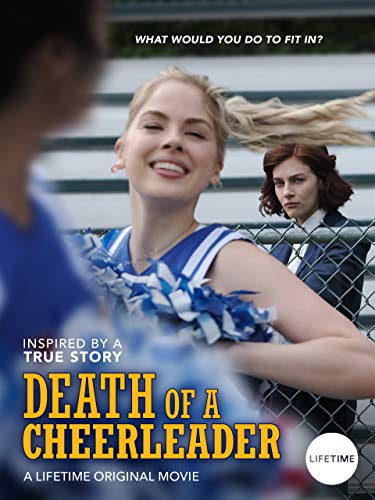
Lifetime Film Review: Death of a Cheerleader (dir by Paul Shapiro)


Kelly Locke (Sarah Dugdale) appears to have it all.  Even though everyone agrees that she can occasionally be a little bit mean with some of the things that she says, Kelly is still one of the most popular students at Hollybrook High.  She’s a cheerleader.  She’s the leader of the Bobbettes, the school’s most prestigious social group.  She gets good grades, she lives in a big house, and her family has a lot of money.

Bridget Moretti (Aubrey Peeples), on the other hand, wants to have everything.  She’s shy and desperate to fit in.  She wants to be a member of the Bobbettes.  She wants to be a cheerleader.  Even more importantly, she wants Kelly to be her best friend.  Kelly, however, thinks that Bridget’s a little bit strange.  In fact, when Bridget lies to Kelly about there being a party as an excuse to get Kelly to spend time with her, Kelly accuses Bridget of “wanting to be me.”  Kelly then says that she’s going to tell everyone at school about what a weirdo Bridget is so Bridget stabs her to death.

Now, you would think that Bridget would be the number one suspect.  After all, Bridget’s not that smart and it’s not easy to get away with murdering someone, especially when it’s an impulsive act.  However, no one suspects Bridget.  Bridget’s just too shy and nice for anyone to believe that she could possibly be a murderer.  Instead, everyone assumes that another student, Nina Miller (Morgan Taylor Campbell), is the killer.  After all, Nina used to be popular until she dyed her hair and started hanging out with the stoners.  Nina even threatened to kill Kelly once.  Nina says she was just mad and that she wasn’t being serious but that doesn’t stop strangers from calling her house and demanding that she confess….

Now, if this story sounds familiar, that’s because it’s a true story and it’s one that has been recreated on countless true crime shows, including Deadly Women, 1980s: The Deadliest Decade, and Killer Kids.  It was also turned into a made-for-TV movie in 1994, A Friend to Die For, starring Kellie Martin as the murderer and Tori Spelling as her victim.

Death of a Cheerleader is a remake of A Friend to Die For, telling the same basic story but attempting to give it a more modern spin, which in this case amounts to a lot of hand-held camerawork and a far less judgmental attitude towards casual drug use.  The remake also slightly differs in the way that it views its main characters.  If the first film was sympathetic to Bridget, the remake is a bit more ambiguous.  Bridget is portrayed as being slightly off from the beginning and far more openly bitter over Kelly’s success than in the original film.  At the same time, Kelly is portrayed a bit more sympathetically in the remake than in the original.  Tori Spelling played the role as being a straight-up bitch, whereas Sarah Dugdale instead plays her as someone who puts a lot of pressure on herself and who often doesn’t understand how cruel her comments can sometimes be.  The biggest difference between the two films is that the remake focuses for more on the wrongly accused Nina, even allowing her to narrate the story.  If anything, the film’s main message seems to be about how messed up it is that brave nonconformists like Nina are always going to be unfairly blamed for the mistakes of mousy conformists like Bridget.  That’s a good message and one that I certainly appreciated.

The remake of Death of a Cheerleader works well enough.  The hand-held camera work gets to be a bit much but Sara Dugdale, Morgan Taylor Campbell, and Aubrey Peeples all give great performances and the film actually does a better job than the original of capturing the strange culture of high school popularity.  While it may not feature any scenes as iconic as Tori Spelling melodramatically lighting up a joint, Death of a Cheerleader is still an effective Lifetime film.