Embracing the Melodrama Part II #55: The Tenth Level (dir by Charles S. Dubin)


10thlevelI first found out about the 1976 made-for-tv movie The Tenth Level while I was doing some research on the Milgram experiment.  The Milgram experiment was a psychological experiment that was conducted, under the direction of Prof. Stanley Milgram, in 1961.  Two test subjects were placed in two separate room.  One test subject was known as the “Learner” and he was hooked up to a machine that could deliver electric shocks.  The other subject was the “Teacher.”  His job was to ask the Lerner questions and, whenever the Learner gave an incorrect answer, the Teacher was supposed to correct the error by pushing a button and delivering the electric shock.  With each incorrect answer, the shock would get worse.

Of course, what the Teacher did not know was that the Lerner was an associate of Prof. Milgram’s and that pushing the button did not actually deliver a shock.  The Lerner would intentionally give wrong answers and, after the Teacher pushed each subsequent button, the Lerner would groan in pain and eventually beg the Teacher to stop.  The test was to see how long the Teacher would continue to push the buttons.

The study found that 65% of the Teachers, even when the Lerner stopped responding, continued to push the buttons until delivering the experiment’s final 450-volt shock.  It was a surprising result, one that is often cited as proof that ordinary people will do terrible things if they’re ordered to do so by an authority figure.

The Tenth Level is loosely based on the Milgram experiment.  Prof. Stephen Turner (William Shatner) is a psychology professor who conducts a similar experiment.  Turner claims that he’s looking for insight into the nature of blind obedience but some of his colleagues are skeptical.  His best friend (Ossie Davis) thinks that Turner is mostly trying to deal with the guilt of being a WASP who has never had to deal with discrimination.  His ex-wife, Barbara (Lynn Carlin), thinks that the experiment is cruel and could potentially traumatize anyone who takes part in it.  Turner, meanwhile, is fascinated by how random people react to being ordered to essentially murder someone.

Eventually, a good-natured carpenter/grad student, Dahlquist (Stephen Macht), volunteers.  At first, Turner refuses to allow Dahlquist to take part because he’s previously met Dahlquist and Dahlquist is a friend of one of Tuner’s assistants.  However, Dahlquist literally begs to be allowed to take part in the experiment and Turner relents.

Unfortunately, the pressure of administering shocks proves to be too much for Dahlquist and he has a 70s style freak-out, which essentially means that the screen changes colors and everything moves in slow motion as he smashes up the room.  As a result of Dalquist’s violent reaction, Turner is called before a disciplinary committee and basically put on trial.

The Tenth Level is an interesting film.  On the one hand, the subject matter is fascinating and, if nothing else, the film deserves some credit for trying to seriously explore the ethics of psychological experimentation.  On the other hand, this is a film from 1976 that features William Shatner giving numerous monologues about the nature of man.  And, let us not forget, this is William Shatner before he apparently developed a sense of humor about himself.  That means that, in this film, we get the Shatner that inspired a thousand impersonations.  We get the Shatner who speaks precisely and who enunciates every single syllable.  And let’s not forget that Shatner is paired up with Ossie Davis, an actor who was never exactly subtle himself.

The end result is a film that is both thought-provoking and undeniably silly.  This is a film that will make you think even while it inspires you to be totally snarky.

(Also of note, John Travolta supposedly makes his film debut in the Tenth Level.  Apparently, he plays a student.  I have yet to spot him.)

You can watch it below!
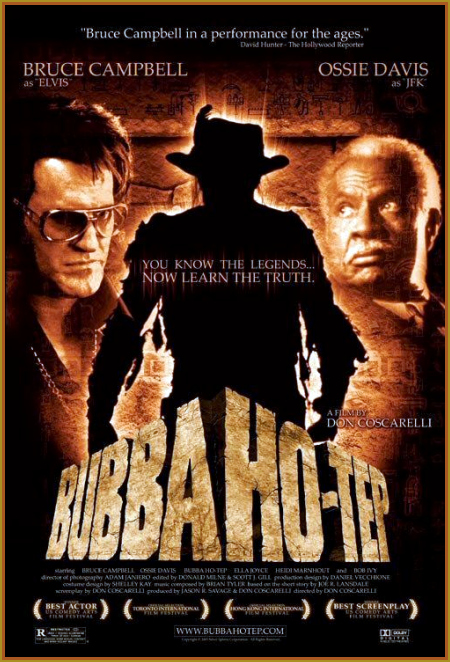
Review: Bubba Ho-Tep (dir. by Don Coscarelli)


Bubba Ho-Tep was one of those film projects which just screamed out “can’t lose” the moment it the people who were going to be attached to it were announced. I mean for people who grew up watching horror movies and other such fun things during the 80’s would know of the name Don Coscarelli. His Phantasm franchise scared and creeped out a large number of young kids and teenagers as they grew up during the 1980’s. Author Joe R. Landale is not as well-known for the unread but he also brings big smiles to people who also like their stories to be full of quirky humor, dry sarcastic wit in addition to pulp-style horror and thrills. But the major coup this film had which made all genre fans suddenly smile and grin like fools has to be hearing that genre-veteran and B-movie extraordinaire Bruce Campbell taking on the role of an aging Elvis Presley.

The movie was released in very limited screens in the summer of 2002. In fact, the movie really only got shown during the summer genre film festivals which dealt with genre movies like horror, sci-fi and other so-called low-brow genre projects which the more elitist film goers tend to shun. Luckily I wasn’t too elitist enough to be able to find Bubba Ho-Tep playing in the San Francisco Film Festival. To say that what I saw was pure cheesy fun would do the film a disservice. While it’s true that the film had it’s moment of horror, I mean it is a movie about a soul-sucking Egyptian Mummy let-loose in a Texas retirement home. What I was surprised to see as I watched through Bubba Ho-Tep was just how much more than a cheesy B-movie horror flick it turned out to be.

The film pretty much brings up the scenario of how it would be if the real Elvis Presley was still alive, in his 70’s and wasting away in a Texas retirement home. That the Elvis Presley who passed away sitting on a toilet at Graceland was actually an impostor who switched places with the real Elvis after the genuine article decided all the fame, groupies and excessiveness of being The King was just too much and wanted a break from it all. So, the real Elvis lost his chance to switch back with his double and thus ended up forgotten in a Texas retirement home where the employees and caregiver treat him like a child and don’t believe him when he tells them he is the real deal. To make matters worse he now has to deal with a cowboy hat and boots wearing Egyptian mummy whose sole source of nourishment are the souls of the old retirees who inhabit the retirement home. The way the mummy sucks the souls from its victims become a running joke within the film. Let’s just say it doesn’t try sucking the souls out through the old folks’ mouth or nose.

Bruce Campbell has always been a mainstay of the B-movie scene. His popularity as being “The Man” who has inhabited such iconic cult characters such as Ashley “Ash” Williams of Evil Dead fame has made him a well-known actor to genre fans everywhere. Campbell could’ve easily hammed it up in the role of the aging Elvis Presley in Bubba Ho-Tep. No one would’ve faulted him for such an over-the-top performance, but instead of going that route he instead plays the role with such an understated and subtle style which made the character more human and sympathetic. Campbell’s nuanced performance also turned a horror-comedy into something more sentimental and sad. Bubba Ho-Tep had turned into a horror-comedy which had a unique and sympathetic look at how the elderly have been treated and seen more as nuisances and less than human. It doesn’t help that their cries for help once the mummy targets them for feeding fall on deaf ears as those hired to help them consider their pleas as the senile ramblings of someone whose mental facilities have long left them.

Campbell’s performance as “The King” was supported quite well by the great, late Ossie Davis whose role as an elderly black man who thinks he’s John F. Kennedy brings new meaning to the film cliche: buddy movie. Davis’ character truly believes that he was and is President Kennedy who was turned black through some conspiracy by Lyndon B. Johnson to save his life. At first, we the audience are in on the joke but due to Davis’ wonderful performance we begin to believe that he may be right. If cowboy-attired Egyptian mummies and an aging Elvis look real why not him. The interplay between Campbell and Davis makes for some great acting and comedy. Without these two men the film would’ve been relegated to the direct-to-video level of filmmaking. Instead what we get is a wonderfully crafted film which despite its pedigree still became one of the better films of 2002.

Don Coscarelli does a fine job of balancing the scenes of comedy and horror with poignancy without ending up with a film that’s too maudlin for its own good. It’s a good sign that one of the 80’s master genre directors has found a nice project to show that he hasn’t lost the edge and skill when it comes to making genre movies. He has also shown with Bubba Ho-Tep that one can have a horror-comedy without drowning it in gore (which this movie had a surprisingly little of) and juvenile slapstick. Even joke sequences involving aging Elvis’ penis with it’s unidentifiable growth made for genuine laughs instead of laugh for laughs sake. The same goes for the double entendre from JFK involving his Ding Dong snack. I think with anyone else at the helm of this picture the movie would’ve fallen either too much into gorehound territory on one side or inane slapstick comedy on the other end.

In the end, Bubba Ho-Tep was one of those rare little genre gems which transcends its genre pedigree and beginnings without meaning to. Like I said with the convergence of Coscarelli, Lansdale, and Campbell making the project happen this was one little movie that was bound to not fail. I highly recommend this movie to anyone who hasn’t seen it. Despite it’s silly sounding title the movie is more than just the sum of its cover.