Film Review: The Shoes of The Fisherman (dir by Michael Anderson)


The 1968 film, The Shoes of The Fisherman, opens in a snowy Siberian labor camp.  For the past twenty years, this camp has been the home of Kiril Pavlovich Lakota (Anthony Quinn), the Ukrainian archbishop of Liviv.  Kiril is unexpectedly released by Russia’s new leader, Piotr Ilyich Kamenev (a very British Laurence Olivier).  After explaining to Kiril that Russia and China are on the verge of nuclear war due to a famine that has been instigated by U.S. sanctions, Kamenev tells Kiril that he is being released on the condition that he tell no one about the conditions at the Russian labor camp.  Kiril starts to protest just for Father Telemond (Oskar Werner), the Vatican’s representative, to say that the conditions have already been agreed to.

In Rome, Kiril meets the Pope (John Gielgud), who makes the humble Kiril a cardinal, over Kiril’s objections that he just a “simple man.”  Later, when the aged Pope suddenly dies, Kiril is unexpectedly elected, as a compromise candidate, to succeed him.  Still humble and considering himself to be a simple man with a simple mission, Kiril suddenly finds himself as one of the most revered and powerful men on the planet.  With Father Telemond as his secretary, Kiril tries to make the Vatican responsive to the needs of the people and sets out to bring peace between the Russians and the Chinese. That turns out to be easier said than done, especially when Telemond himself is eventually accused of heresy for his progressive views.

(And yes, Telemond is a Jesuit….)

The Shoes of the Fisherman is a type of film that should be familiar to anyone who has any knowledge of the Hollywood studios in the 60s.  It’s the type of big and self-serious film that was meant to tell audiences, “You won’t find anything this opulent and important on television!”  The cast is designed to appeal to everyone.  Anthony Quinn and Laurence Olivier are there for the older viewers (especially the older viewers who made up the majority of the Oscar voters in 1968) while, for the younger voters, there’s handsome Oskar Werner as a Jesuit who interpretation of the Gospels is so radical that even Pope Francis would probably tell him to step back a little.  For the older, anti-communist viewers, there are scenes that portray the harsh conditions at a Siberian labor camp.  The commies put Kiril in prison so he must be one of the good guys.  And for the younger, more liberal viewers, there was the suggestion that the threat of World War III was largely due to the actions of the American government.  And, just in case there was still anyone who thought that television was preferable to a prestige picture, TV star David Janssen shows up as a cynical reporter whose wife (played by Barbara Jefford) is a doctor who Kiril helps to get some medicine for one of her dying patients.  Director Michael Anderson includes enough sudden zoom shots to let younger viewers know that he’s with them while still directing in a stately enough manner to appeal to the older viewers.

The end result is a film that is big and grand but also rather slow.  The film gets bogged down in subplots that don’t really add much to the overall story.  We spend way too much time with the reporter and his wife.  Anthony Quinn does a good enough job as Kiril, giving a rather subdued performance by Quinn standards.  (A scene where Kiril recites a Jewish prayer for a dying man is wonderfully acted by Quinn, who seems to truly be emotionally invested in the film’s message of togetherness.)  Laurence Olivier is not at all convincing as a Russian but still, he has the stately bearing of a man used to being in power.  Like many of the studio productions of the late 60s, The Shoes of The Fisherman tries a bit too hard to strike a balance between old school Hollywood and the counterculture and the film ultimately feels rather wishy-washy as a result.  It’s a noble film with good intentions but it’s not particularly memorable.

Film Review: Voyage of the Damned (dir by Stuart Rosenberg)


In 1939, an ocean liner named the MS St. Louis set sail from Hamburg.  Along with the crew, the ship carried 937 passengers, all of whom were Jewish and leaving Germany to escape Nazi persecution.  The ship was meant to go to Havana, where the passengers had been told that they would be given asylum.  Many were hoping to reunite with family members who had already taken the voyage.

What neither the passengers nor Captain Gustav Schroeder knew was that the entire voyage was merely a propaganda operation.  No sooner had the St. Louis left Hamburg than German agents and Nazi sympathizers started to rile up anti-Semitic feelings in Cuba.  The plan was to prevent the passengers from disembarking in Cuba and to force the St. Louis to then return to Germany.  The Nazis would be able to claim that they had given the Jews a chance to leave but that the rest of the world would not take them in.  Not only would the Jews be cast as pariahs but the Germans would be able to use the world’s actions as a way to defend their own crimes.

Captain Schroeder, however, refused to play along.  After he was refused permission to dock in Cuba, he then attempted to take the ship to both America and Canada.  When both of those countries refused to allow him to dock, Schroeder turned the St. Louis toward England, where he planned to stage a shipwreck so that the passengers could be rescued at sea.  Before that happened, Belgium, France, the Netherlands, and the United Kingdom jointly announced that they would accept the refugees.

Tragically, just a few days after the passengers disembarked, World War II officially began and Belgium, France, and the Netherlands all fell to the Nazi war machine.  It is estimated that, of the 937 passengers on the St. Louis, more than 600 of them subsequently died in the Nazi concentration camps.

The journey of the St. Louis was recreated in the 1976 film, Voyage of the Damned, with Max von Sydow as Captain Schroeder and a collection of familiar faces playing not only the ship’s passengers and crew but also the men and women in Cuba who all played a role in the fate of the ship.  In fact, one could argue that there’s a few too many familiar faces in Voyage of the Damned.  One cannot fault the performances of Max von Sydow, Malcolm McDowell, and Helmut Griem as members of the crew.  And, amongst the passengers, Lee Grant, Jonathan Pryce, Paul Koslo, Sam Wanamaker, and Julie Harris all make a good impression.  Even the glamorous Faye Dunaway doesn’t seem to be too out-of-place on the ship.  But then, in Havana, actors like Orson Welles and James Mason are awkwardly cast as Cubans and the fact that they are very obviously not Cuban serves to take the viewer out of the story.  It reminds the viewer that, as heart-breaking as the story of the St. Louis may be, they’re still just watching a movie.

That said, Voyage of the Damned still tells an important true story, one that deserves to be better-known.  In its best moments, the film captures the helplessness of having nowhere to go.  With Cuba corrupt and the rest of the world more interested in maintaining the illusion of peace than seriously confronting what was happening in Germany, the Jewish passengers of the St. Louis truly find themselves as a people without a home.  They also discover that they cannot depend on leaders the other nations of the world to defend them.

Defending the passengers falls to a few people who are willing to defy the leaders of their own country.  At the start of the film, Nazi Intelligence Chief Wilhelm Canaris (Denholm Elliott) explains that Captain Schroeder was selected specifically because he wasn’t a member of the Nazi Party and could not be accused of having ulterior motives for ultimately returning the passengers to Germany.  Canaris and his fellow Nazis assume that anti-Semitism is so natural that even a non-Nazi will not care what happens to the Jewish passengers.  Instead, Schroeder and his crew take it upon themselves to save the lives of the passengers.  It is not Franklin Roosevelt who tries to save the passengers of St. Louis.  Instead, it’s just a handful of people who, despite unrelenting pressure to do otherwise, step up to do the right thing.  Max von Sydow, who was so often cast in villainous roles, gives a strong performance as the captain who is willing to sacrifice his ship to save his passengers.

Flaws and all, Voyage of the Damned is a powerful film about a moment in history that must never be forgotten.

Film Review: Fahrenheit 451 (dir by Francois Truffaut)


Tonight, HBO will be premiering a film version of Ray Bradbury’s Fahrenheit 451.  This version will star Michael B. Jordan as “fireman” Guy Montag and Michael Shannon as Montag’s boss, Captain Beatty.  It’s one of the more eagerly anticipated films of the current television season but it’s not the first version of Fahrenheit 451 to be filmed.

The first version was released, by Universal Pictures, in 1966.  It was the first (as well as only) English langauge film to be directed by the great French filmmaker, Francois Truffaut.  (It was also Traffaut’s first color film, allowing the flames to burn in bright yellow and red.)  Unfortunately, Truffaut would later describe the film as being his “saddest and most difficult” film making experience.

Though there are a few noticeable differences, the film sticks closely to the plot of Bradbury’s novel.  Guy Montag (Oskar Werner) is a “fireman” in the near future.  Montag lives in a society where books have been banned and the populace is kept to docile through a combination of pharmaceuticals and mindless television programming.  Montag’s wife, Linda (Julie Christie), is content to live life without questioning anything.  However, when Montag meets a school teacher named Clarisse (also played by Christie), all of his previous assumptions are challenged.  What if the government isn’t always right?  What if ignorance isn’t bliss?  What would happen if, instead of burning books, Montag actually read one?  After witnessing a woman choosing to self-immolate herself so that she can die with all of her books, Montag is finally ready to quit being a fireman.  But his captain (Cyril Cusack) tells Montag that he needs to go on one more call, this one to Montag’s own house.

Truffaut’s film leaves out most of the overly sci-fi elements of Bradbury’s original novel.  For instance, in the novel, Montag is terrified of the robots dogs that the firemen use but the dogs never appear in Truffaut’s film.  As well, Traffaut totally eliminates the character of Faber, the former English professor who uses a portable communicator to keep in contact with Montag.  (Today, of course, that hardly seems like science fiction.)  In Truffaut’s film, the setting is designed to appear as contemporary and familiar as possible, a reminder that the story may have been sent in the future but that the issues it dealt with were relevant to the present.  With this film, Truffaut asked the audience, “How different is the world today from the world of Bradbury’s novel?”

Truffaut’s other big departure from Bradbury’s text was to cast Julie Christie as both Clarisse and Linda.  In the book, Montag’s wife was named Mildred and Bradbury went of out of his way to establish her as being the exact opposite of Clarisse.  In Truffaut’s film, the double casting of Christie seems to suggest that Clarisse and Linda are two sides of the same character.  Montag loves them both, though each appeals to a different part of Montag’s psyche.  Linda appeals to the side of Montag that wants to just accept things the were they are and be happy.  Clarisse, meanwhile, represents the part of Montag that wants to be free to feel everything, even if it means occasionally being unhappy or uncertain.  When Montag finally meets the Book People, he discovers that they are just as fanatical about memorizing and reciting books as Linda was about watching her television shows.  Was this intentional on Truffaut’s part, a suggestion that both the government and the rebels are, like Clarisse and Linda, two sides of the same coin?

It’s an intriguing but uneven movie.  Truffaut apparently didn’t have a great working relationship with Oskar Werner and, at times, Werner doesn’t seem to be particularly invested in the role of Montag.  (Interestingly enough, it’s also been suggested that Jacqueline Bisset’s character in Day For Night was inspired by Truffaut’s experiences working with Julie Christie in this film.)  When the characters interact, the dialogue sometimes feel stiff and dull, as if Truffaut never got over his discomfort with having to direct a film in something other than his native French.  At the same time, the film is full of hauntingly beautiful images, from the defiant woman standing in the middle of her burning books to the Book People walking through the snow.  Truffaut makes brilliant use of color and the visuals are often strong enough to overcome even Oskar Werner at his most sullen.

Fahrenheit 451 is an imperfect movie but one worth seeing.  Will the new HBO version be able to match it?  We’ll find out soon enough.

http://www.youtube.com/watch?v=w0PwQOr53SA

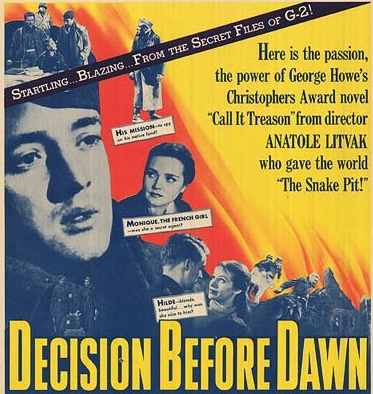
Cleaning Out The DVR, Again #14: Decision Before Dawn (dir by Anatole Litvak)


MPW-55716

So, I’m currently in the process of cleaning out my DVR by watching the 40 films that I recorded from March to June of this year.  Yesterday, I watched the 14th film on my DVR, the 1951 film Decision Before Dawn.  

Decision Before Dawn aired on April 9th on FXM and I specifically recorded it because it was nominated for best picture.  It only received one other nomination (for editing) and it’s one of those nominees that often seems to be dismissed by Oscar historians.  Whenever Decision Before Dawn is mentioned, it’s usually because it’s being unfavorably compared to the other nominees: A Place In The Sun, A Streetcar Named Desire, and An American In Paris.  I went into Decision Before Dawn with very low expectations but you know what?

Decision Before Dawn is not a bad film.  In fact, I would even go as far as to say that it’s actually a damn good film.  If you’re into war films — and, admittedly, I am not — you will love Decision Before Dawn.  If, like me, you’re a history nerd, you’ll be fascinated by the fact that, since this film was shot on location, Decision Before Dawn offers a chance to see what Europe looked like in the years immediately following the destruction of World War II.

As I mentioned, I’m not really into war movies but fortunately, Decision Before Dawn takes place during World War II.  World War II is one of the few wars where there’s no real ambiguity about whether or not the war needed to be fought.  When it comes to picking a villain that everyone can hate, Adolf Hitler and his followers are petty much the perfect villains to go with.

In Decision Before Dawn, Oskar Werner plays Karl Maurer, a German soldier who deserts after his best friend is executed for insubordination.  Though Karl loves his home country, he hates the Nazis who have taken it over.  Karl surrenders to the Americans and volunteers to return to Germany to act as a spy.  Karl finds himself in a strange situation.  Though he’s fighting against the Nazis, he is also mistrusted by the Allies.  He is literally a man without a country.

When word comes down that a German general is willing to surrender, Karl and another German soldier-turned-spy, the greedy and cowardly Sgt. Barth (Hans Christian Bleth), are sent into Germany to both find out if the information is true and to find out where another division of German soldiers is located.  Accompanying the two Germans is a bitter American, Lt. Dick Rennick (Richard Basehart).  Rennick doesn’t trust either of the Germans.

While Rennick and Barth track down the surrendering General, Karl is sent to track down the other division.  Along the way, Karl visits many bombed out German towns and meets Germans of every political persuasion.  Some of them still vainly cling to hope for victory over the Allies but the majority of them are like Hilde (Hildegard Knef), a young war widow who just desperately wants the fighting to end.  Thanks to the deeply empathetic performances of Werner and Knef, the scenes between Hilde and Karl elevate the entire film.  In those scenes, Decision Before Dawn becomes more than just a war film.  It becomes a portrait of men and women trapped by circumstances that they cannot control.

Decision Before Dawn is an exciting and well-acted thriller, one that starts slow but then builds up to a truly thrilling conclusion.  Anatole Litvak directs the film almost as if it were a film noir, filling the entire screen with menacing shadows and moody set pieces.  Decision Before Dawn is a war film that does not celebrate war but instead mourns the evil that men do and argues that sometimes the most patriotic thing that one can do is defy his or her government.  It may be one of the more obscure best picture nominees but it’s still one that deserves to be rediscovered.

By the way, if you do watch Decision Before Dawn, be sure to keep an eye out for Klaus Kinski.  He only appears for a minute or two and he’s not even credited but you’ll recognize him as soon as you see him.  The eyes give him away as soon as he shows up.

DBD_Kinski

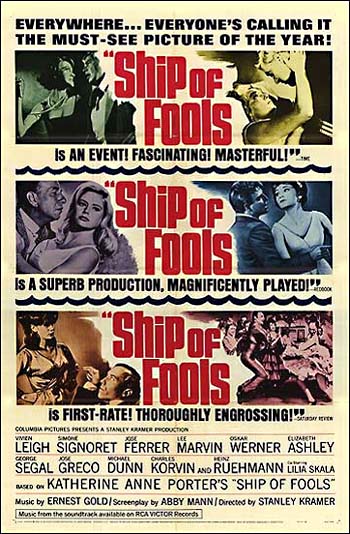
Embracing the Melodrama #20: Ship of Fools (dir by Stanley Kramer)


ship-of-fools-poster

The 1965 best picture nominee Ship of Fools follows a group of passengers as they take a cruise.  The year is 1933 and the luxury liner, which has just left Mexico, is heading for Nazi Germany.  Both the passengers and the crew represent a microcosm of a world that doesn’t realize it’s on the verge of war.

There’s Carl Glocken (played by Michael Dunn), a dwarf who has the ability to break the fourth wall and talk directly to the audience about all of the fools that have found themselves on this ship.  He alone seems to understand what the future holds.

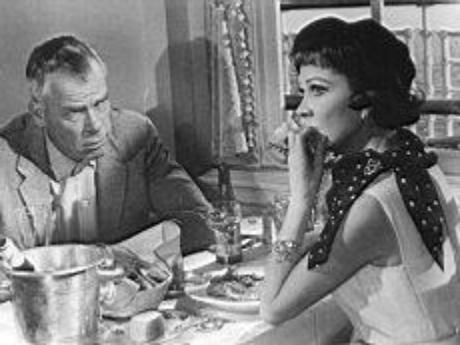
There’s Mary Treadwell (Vivien Leigh), an aging Southern belle who spends almost the entire cruise flirting with the crew and other passengers, desperate to recapture her fading youth.  That also seems to be the main goal of Bill Tenney (Lee Marvin), an unsophisticated former baseball player who spends most of the cruise brooding about his failed career.

There’s the Countess (Simone Signoret), a political prisoner who is being transported to an island prison.  She falls in love with the ship’s doctor (Oskar Werner).  The doctor’s dueling scar suggests that he is a member of the old aristocracy and he is literally the film’s only good German.  Perhaps not surprisingly, he is also in the process of dying from a heart condition.

And then there’s David (George Segal) and his girlfriend Jenny (Elizabeth Ashley).  David is a frustrated and depressed painter while Jenny is far more determined to enjoy life, which should be pretty easy because the boat is also full of performers and dancers.

Finally, there’s the buffoonish Rieber (Jose Ferrer), a German industrialist whose dinner table talk hints at the horrors that are soon to come.

Ship of Fools is a big, long film in which a large cast of stars deal with big issues in the safest way possible.  In short, it’s a Stanley Kramer film.  As one can tell from watching some of the other films that he directed (Judgment at Nuremberg, Guess Who’s Coming To Dinner, and R.P.M.), Stanley Kramer made films that were often easier to admire than to actually enjoy.  As the critic Mark Harris points out in his book Pictures At A Revolution, Kramer started out as a producer and he retained the sensibility of a producer even after he stared directing.  As such, his films would address issues that were certain to generate a lot of free publicity but, at the same time, he would never run the risk of alienating his audience by digging too deeply into those issues.  His films would have the type of all-star casts that would, again, bring in an audience but Kramer rarely seemed to give thought as to whether or not an all-star cast would distract from the film’s message.  Finally, unlike the truly great directors, Kramer never really figured out how to tell a story with images.  As a result, his movies were often full of characters whose sole purpose was to explain the film’s themes.

Does that mean that Stanley Kramer never made a good film?  No, not at all.  Judgment at Nuremberg remains powerful and R.P.M. is a guilty pleasure of mine.  Kramer was usually smart enough to work with talented professionals and, as a result, his films were rarely truly bad.  Some of them even have isolated moments of greatness.  It’s just that his films were rarely memorable and truly innovative and, therefore, they are easy for us to dismiss, especially when compared to some of the other films that were being made at the same time.

With all that in mind and for reasons both good and bad, Ship of Fools is perhaps the most Stanley-Kramerish of all the Stanley Kramer films that I’ve seen.  The film was apparently quite acclaimed and popular when it was originally released in 1965 but watched today, it’s an occasionally watchable relic of a bygone age.  How you react to Ship of Fools today will probably depend on whether or not you’re an admirer of any of the actors in large cast.  For the most part, all of them do a good job though you can tell that, as a director, Kramer struggled with how to make their multiple storylines flow naturally into an overall theme.  Not surprisingly, Vivien Leigh and Lee Marvin give the two most entertaining performances and Jose Ferrer makes for a wonderfully hissable villain.  Oddly enough, I find myself most responding to the characters played by George Segal and Elizabeth Ashley.  I’m not sure why — their storyline is rather predictable.  Maybe it was just because Elizabeth Ashley’s character goes wild and starts dancing at one point.  That’s what I would do if I found myself stuck on a boat with a tortured painted.

(What is especially interesting is that neither Oskar Werner or Simone Signoret are particularly memorable and yet they both received Oscar nominations.  Perhaps 1965 was a weak year for acting.)

In the end, Ship of Fools is a movie that will be best appreciated by those of us who enjoy watching old movies on TCM and take a special delight in spotting all of the wonderful actors that, though they may no longer be with us, have at least had their talent preserved on film.  Ship of Fools may not be a great film but it does feature Vivien Leigh doing an impromptu and joyful solo dance in a hallway and how can you not appreciate that?

ship-of-fools-1-1