It can be argued that 1987’s Opera is one of Dario Argento’s most personal films.
In the mid-80s, Argento was hired to direct an opera, in this case a production Giuseppe Verdi’s Macbeth. Argento described the opportunity to direct an opera as being a case of one of his childhood dreams coming true. Unfortunately, certain people were scandalized with the idea of hiring a director of violent horror films to direct the opera, even though Macbeth is one of the most horrific of Shakespeare’s plays. I mean, if any story seems to be custom-made for a director who is known for his complex set pieces and his willingness to indulge in graphic imagery, it would seem to be Macbeth. Despite this, the production was canceled and Argento was left feeling like an outsider in his own industry.
Along with his disappointment over the canceled production of Macbeth, Argento was also suffering on a personal level when he directed Opera because he had just separated from his long time partner and collaborator, Daria Nicolodi. The two of them had a notoriously volitale relationship, one that led to some of Argento’s best films and reportedly some of his biggest on-set fights. Despite the fact that they had split up, Argento still wrote a role for her in his latest film. At first, Nicolodi refused the role but she changed her mind when Argento promised her the most spectacular death scene in the movie. However, when it came time to shoot the scene, Nicolodi apparently grew paranoid that Argento was planning to kill her for real. Fortunately, Nicolodi was incorrect about that and Argento was totally correct about her scene being one of the best in the film.
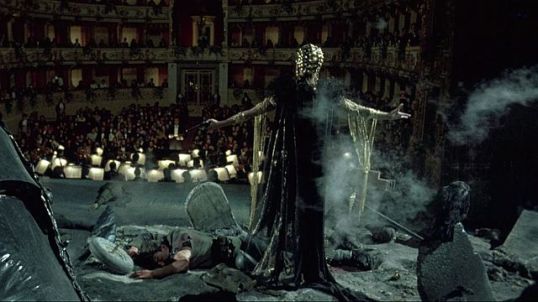
Opera takes place during a production of Macbeth, one that is directed by a controversial horror director named Marco (played by Ian Charleson, the star of the Oscar-winning Chariots of Fire). When his star is injured in an auto accident, Marco is forced to cast the young understudy, Beth (Cristina Marsillach), as Lady Macbeth. Despite the doubts of many, Betty gives a strong performance in the role. She stuns the audience. Perhaps the power of her performance is due to her own traumatic memories of her mother being murdered by a never captured assailant.
Speaking of murder, people around Betty start dying as well, often while Betty is forced to watch. The black-gloved killer often come out of nowhere, gags Betty, and ties her to whatever is nearby. The killer always tapes a row of needles under Betty’s eyes, keeping her from being able to close them or to look away as the killer then proceeds to murder her friends. The first victim is Betty’s handsome boyfriend, Stefano (William McNamara). The second murder is a costumer (Barbara Cupisti). Three of the opera’s ravens are killed, leaving the remaining ravens determined to get revenge.
Betty, it should be noted, refuses to go the police about what she has witnesses because she thinks that the killer is the same person who murdered her mother. You have to wonder at her logic or the fact that director Marco agrees with her decision. Personally, if I witnessed a murder as brutal as the murder of Stefano, I would go to the police. It’s hard to really sympathize with Betty’s decision, as much as the film seems to think that I should.

Opera has a lot of fans and it does feature some of Argento’s strongest visuals. Towards the end of the film, there’s an extended raven attack in the opera house that is one of Argento’s greatest set pieces. And, for all of her fears that she was about to be killed for real, Daria Nicolodi’s shocking death scene is Argento at his best. Both Ian Charleson and Urbano Barberini give excellent performance and, even if the genesis of the film was found in Argento’s anger over his canceled version of Macbeth, there’s a lot of affection to be found in the film’s portrayal of what goes into putting on a massive production. One gets the feeling that, for once, Argento actually likes the majority of the characters in the film.
That said, I have to admit that there are a few things that I don’t particularly care for in Opera. If I liked Phenomena more than most viewers, I like Opera a bit less. After each murder, Argento attacks our ears with heavy metal and I assume the point is to contrast the stateliness of the opera with the chaos of the killer’s actions. But, while I can respect Argento’s logic (assuming that was his logic), the music itself tends to be repetitive and, after the second time that we hear it, it gets kind of boring. And Betty is not a particularly sympathetic protagonist, both due to the way she’s written and also Cristina Marsillach’s less than convincing performance in the role. Reportedly, Argento and Marsillach did not get along during filming and perhaps that explains why her performance never really seems to come alive. Everyone in the film insists the Betty is a revelation of Lady Macbeth but there’s nothing about Marsillach’s performance that makes us believe that. It’s hard not to feel that the film would have been improved if Cristina Marsillach and Barbara Cupisti had switched roles.
(Director Michele Soavi, who has a small role in this film, did later cast Cupisti as the lead in his film Stage Fright and watching Cupisti in that film, it’s even easier to imagine her as the lead in Argento’s film.)
The film ends on a strange note, one that seems to serve as a call-back to Phenomena. What I find interesting is that critics who like the film overall tend to be critical of the ending and the idea of Marsillach talking to a lizard. Whereas I, someone who does not like the film quite as much as some others, absolutely loves the ending because it’s just so weird and it comes to use from out-of-nowhere. It’s as if Argento is saying, “You might have kept me from directing an opera but it’s my movie and I’m in control here.”

Opera did well in Italy and the rest of Europe but, as was so often the case, Argento was screwed by his American distributors. Opera was originally supposed to get an American theatrical release but, when the distributor went bankrupt, the film was only given a video release, with much of the gore edited out to ensure that the film received an R-rating and could be carried by Blockbuster. (That’s right. Blockbuster wouldn’t carry anything above an R. Where’s your God now, video nerds?) Fortunately, all that was edited out was put back in when Opera was released on DVD in 2002.

The (Reviewed) Films of Dario Argento:


 Through the Shattered Lens