Icarus File No. 17: Che! (dir by Richard Fleischer)


Che Guevara!

By most accounts, Che Guevara epitomized the excesses and the hypocrisies of the extreme Left.  He spoke of the class struggle while remaining an elitist himself.  He oversaw thousands of executions and advocated for authoritarian rule.  In his writings, he frequently revealed himself to be a racist and a misogynist.  By arguing that the Russians should be allowed to bring nuclear missiles to Cuba, he brought the world to the brink of destruction.  However, he also died relatively young and he looked good on a t-shirt.  Decades after he was executed by the Bolivian Army in 1967 (or was it the CIA?), he remains an icon for college students and champagne socialists everywhere.

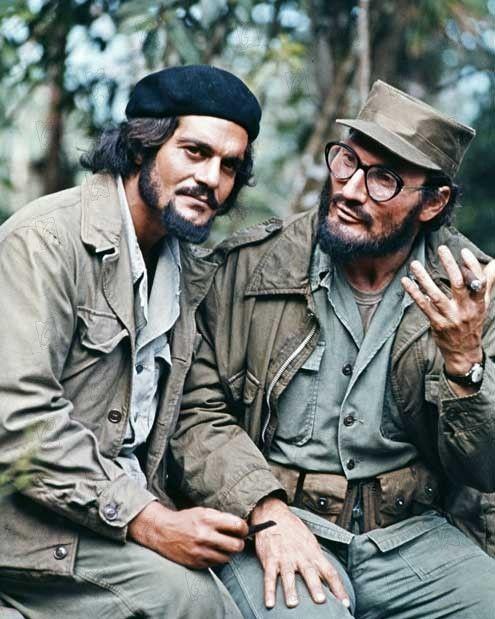
The film about Che! was released in 1969, two years after his death.  Starring the Egyptian actor Omar Sharif as Che Guevara, Che! opens with Guevara already a martyr and then quickly gives way to flashbacks.  Various actors pretending to be Cuban appear and speak directly to the audience, debating Che Guevara’s legacy.  Some describe him as being a violent thug who killed anyone who displeased him.  Others describe him as a visionary doctor who sacrificed his comfortable existence for the people.  It’s a rather conventional opening and one that hints that Che! is going to try to have it both ways as far as Che’s legacy is concerned.  But it’s still effective enough.  A montage of soldiers and rebels creates the proper feeling of a society on the verge of collapse.

And then Jack Palance shows up.

Palance first appears creeping his way through the Cuban jungle with a group of soldiers behind him.  Palance is chomping on a cigar and he wears the intense look of a man on a mission.  My initial reaction was that Palance was playing one of the CIA agents who sent to Cuba to try to assassinate Fidel Castro or to set up the Bay of Pigs invasion.  I kept waiting for him to look at the camera and launch into a monologue about why, for the safety of America, he had been dispatched the topple Cuba’s communist government.  Imagine my shock when Omar Sharif called Palance, “Fidel.”

Yes, that’s right.  Jack Palance plays Fidel Castro!  As miscast as the suave Omar Sharif is as Che Guevara, nothing can prepare one for seeing Jack Palance playing Fidel Castro.  Needless to say, there is nothing remotely Cuban or even Spanish about Jack Palance.  He delivers his lines in his trademark terse Jack Palance voice, without even bothering to try any sort of accent.  (And, needless to say, both he and Sharif speak English through the entire film.)  Anyone who has ever seen a picture of a young Fidel Castro knows that, while he shared a family resemblance with Justin Trudeau, he looked nothing like Jack Palance.  Eventually, Palance puts on a fake beard that makes him look even less like Castro.  When one of our narrators mentions that Castro was a great speaker, the film cuts to a scene of Palance spitting out communist slogans with a noted lack of enthusiasm.  When Castro takes control of Cuba, Palance looks slightly amused with himself.  When Che accused Castro of selling out the revolution, Palance looks bored.  It’s a remarkably bad piece of casting.  Seeing Palance as Castro feels like seeing John Wayne as Genghis Khan.  Thank goodness Hollywood never tried anything that silly, right?  Anyway….

As for the rest of the film, it hits all the expected notes.  The film was made in the very political year of 1969, a time when the New Left was ascendant and many considered Che Guevara to be a hero.  However, since this was a studio production, Che! tries to appeal to both college radicals and their parents by taking a “both sides” approach to Che Guevara.  Here’s Che teaching an illiterate farmer how to read.  Here’s Che overseeing a bunch of dissidents being executed.  Here’s Che getting angry at Castro for not being properly enthusiastic about housing Russian nuclear missiles.  Here’s Che talking about a moral revolution.  Here’s Che trying to start an unwanted war in Bolivia.  Here’s Che talking to Sid Haig — hey, Sid Haig’s in this film!

Like so many mainstream political films of the 60s and today, Che! tries to be political without actually taking any firm positions.  One is tempted to say that is the film’s downfall.  Of course, the film’s real downfall is casting Jack Palance as Fidel Castro.

There’s no way to recover from that.
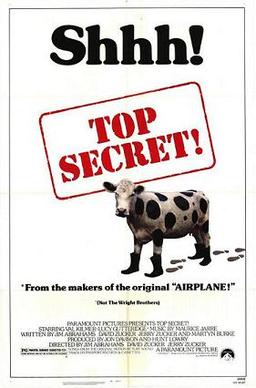
Spring Breakdown: Top Secret! (dir by Jim Abrahams, David Zucker, and Jerry Zucker)


“How silly can you get?” Val Kilmer sings in the 1984 film Top Secret! and the answer would appear to be very silly.  Extremely silly.  Nonsensically silly.  Unbelievable silly.  So silly that it transcends all formerly known types of silliness.  In other words, this is a very silly film but that’s okay because it’s meant to be silly.

Some people, I know, would probably argue that Top Secret! doesn’t really qualify as a Spring Break film but I have to disagree.  Like any good Spring Break film, a good deal of Top Secret! takes place on the beach and Val Kilmer plays Nick Rivers, a singer who is obviously meant to be a parody of the type of singers who used to regularly appear in the beach party movies of the 60s.  Nick’s number one hit song is Skeet Surfin, which celebrates the sport of skeet shooting while on a surf board.  The movie opens with hundreds of handsome young men jumping on surf boards while holding rifles.  I honestly don’t know whether skeet surfing was every an actual sport but I certainly hope that it was because it looks like it would have been a lot of fun.  Certainly, it would perk up the Olympics.

Of course, Nick is not the only person in the film whose life is connected to the beach.  Hillary Flammond (Lucy Gutteridge) spent much of her youth shipwrecked on a beach with Nigel (Christopher Villiers).  Unfortunately, one day, Nigel went out to sea to search for help and he never returned.  Hillary was eventually rescued.  That’s certainly a sadder trip to the beach than Nick’s but still, a beach is a beach.

Hillary and Nick’s paths cross when Nick is invited to perform at a cultural festival in what, in 1984, was known was East Germany.  Hillary is a member of the Resistance while her father, Dr. Paul Flammond (Michael Gough), is being held prisoner by the government and is being forced to design the type of secret weapons that are always at the heart of espionage adventures like this one.  When Nick and Hillary meet, it’s love at first sight.  Nick gets involved in the plan to save Hillary’s father and to thwart the insidious plans of the East German government.  He also finds the time to sing a lot of songs.

The plot of Top Secret! isn’t really easy to describe.  That’s largely because there really isn’t a plot in a conventional sense.  Instead, there’s just one joke after another.  The dialogue is purposefully nonsensical.  The visuals are full of odd details.  The jokes are frequently hilarious and, because they’re so fast and relentless, they’re also next to impossible to adequately describe.  Much of the visual humor simply has to be seen to be understood and appreciated.  For instance, it may sound slightly humorous to say that a scene features a stern-looking army officer answering a giant phone but you have to actually see the film to truly understand just how brilliantly Top Secret! pulls off the gag.

Of course, what really makes the film is work is Val Kilmer, who is young, handsome, and incredibly likable in the role of Nick.  Kilmer delivers every bizarre line with a straight face and an enthusiastic earnestness that makes him the perfect center for all the craziness raging around him.

How silly can you get?  Watch Top Secret! and find out!

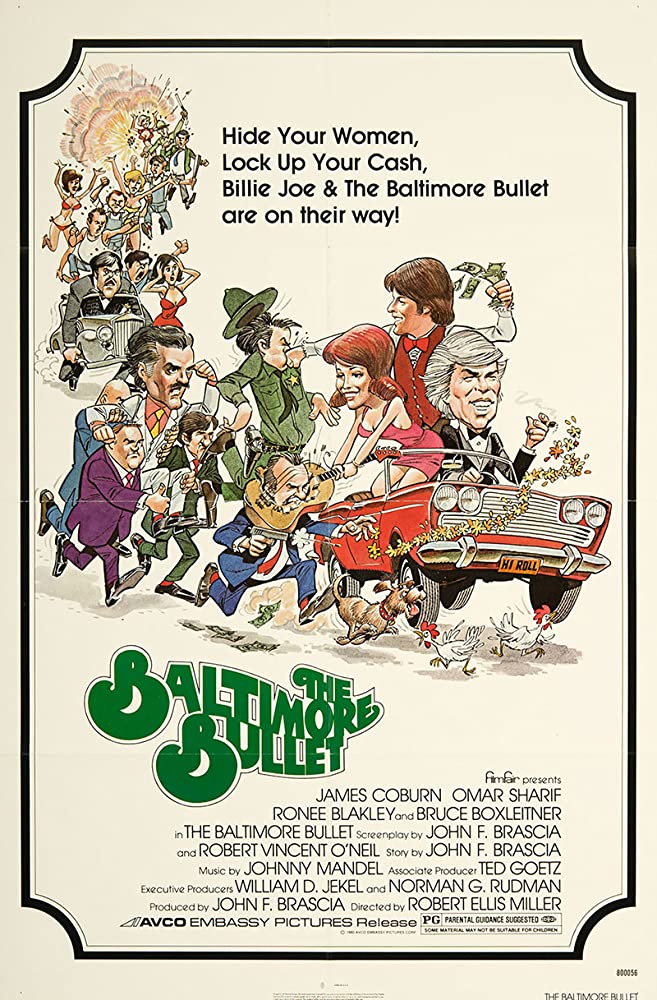
The Baltimore Bullet (1980, directed by Robert Ellis Miller)


James Coburn was one of those actors who improved any film in which he appeared in.  Take The Baltimore Bullet, for example.  Without Coburn, The Baltimore Bullet is basically The Hustler without any of that film’s grit or edginess.  With Coburn, it’s still a bad remake of The Hustler but at least it’s got James Coburn.

Coburn plays Nick Casey, who was once known as The Baltimore Bullet.  He was the top pool player in the country but now, he makes a meager but enjoyable living traveling the country with his protegee, Billie Joe Robbins (Bruce Boxleitner), and hustling people out of their money.  Nick’s plan is to raise enough money so that he and Billie Joe can go down to New Orleans, enter the national pool championship, and defeat the reigning champion, a man known only as the Deacon (Omar Sharif).  The episodic film follows Nick and Billie Joe as they travel across the country, having comedic adventures and trying to stay one step ahead of all of the people that they’ve cheated.   Along the way, they pick up an aspiring country singer named Carolina Red (Ronee Blakley, who somehow went from her Oscar-nominated debut in Nashville to this).

The Baltimore Bullet doesn’t work for any number of reasons.  A big problem is that Nick and Billie Joe’s friendship never really makes sense.  There’s no real reason for Nick to need a protegee and Billie Joe often seems to be more interested in playing poker than playing pool.  We never understand why Nick would take someone as erratic as Billie Joe under his wing.  Another problem is that The Deacon never seems like a formidable opponent.  He’s just Omar Sharif, looking bored and carrying a pool cue.  Because we don’t like Billie Joe and don’t care about the Deacon, we don’t really care who wins the tournament.  Probably the most interesting thing about The Baltimore Bullet is that, while it was obviously meant to be a rip-off of The Hustler, its plot, with a veteran hustler teaming up with a callow protegee, actually has more in common with The Hustler‘s sequel, The Color of Money (which would be released 6 years after The Baltimore Bullet).

All of that almost doesn’t matter, though, just because James Coburn’s in the movie.  James Coburn always came across like the coolest human being on the planet, even in something like The Baltimore Bullet.  There’s not much depth to Nick as a character but Coburn plays the role with a gleam in his eyes and a leer that looks like it belongs on the face of a cartoon wolf and it’s impossible not to like him.  While everyone else is struggling with the bad dialogue and their inconsistent characters, Coburn looks like he’s having the time of his life.  Coburn was an actor who was incapable of giving a bad performance and he’s the main reason to see The Baltimore Bullet.

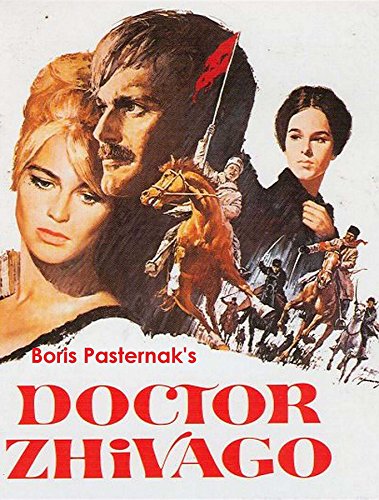
Lisa Reviews An Oscar Nominee: Doctor Zhivago (dir by David Lean)


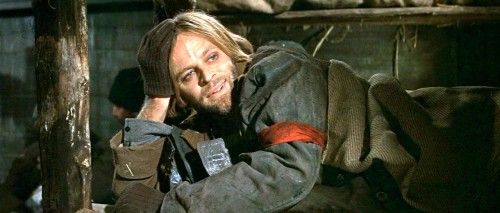
Klaus Kinski is the main reason to watch the 1965 film, Doctor Zhivago.

The legendarily difficult and erratic Mr. Kinski shows up about halfway through this 3-and-a-half hour film.  He plays a cynical and unstable prisoner on a train.  The train is full of passengers who are escaping from Moscow and heading for what they hope will be a better and more stable life in the Ural Mountains.  (The film takes place during the Communist revolution and the subsequent purges.)  That Kinski taunts everyone on the train is not a surprise.  Both Werner Herzog and David Schmoeller (who directed Kinski in Crawlspace) have made documentaries in which they both talked about how difficult it was to work with Kinski and how several film crews apparently came close to murdering Klaus Kinski several times throughout his career.

Instead, what’s surprising about Kinski’s performance is that he’s even there to begin with.  Doctor Zhivago is an extremely long and extremely stately film.  It’s one of those films where almost every actor gives a somewhat restrained performance.  It’s a film where almost every shot is tastefully composed and where the action often slows down to a crawl so that we can better appreciate the scenery.  It’s a film that stops for an intermission and which opens with a lengthy musical overture.  In short, this is a film of old school craftsmanship and it’s the last place you would expect to find Klaus Kinski luring about.

When he does show up, you’re happy to see him.  Even though he’s only onscreen for about five minute, Kinski gives the film a jolt of much-needed energy.  After hours of watching indecisive characters talk and talk and talk, Kinski pops up and basically, “Screw this, I hate everything.”  And it’s exciting because it’s one of the few time that Doctor Zhivago feels unpredictable.  It’s one of the few times that it feels like a living work of art instead of just a very pretty but slightly stuffy composition.

Just from reading all that, you may think that I don’t like Doctor Zhivago but that’s actually not the case. It’s a heavily flawed film and you have to be willing to make a joke or two if you’re going to try to watch the whole thing in just one sitting but it’s still an interesting throwback to a very specific time in film history.  Doctor Zhivago was designed to not only be a spectacle but to also convince audiences that 1) TV was worthless and that 2) Hollywood craftsmanship was still preferable to the art films that were coming out of Europe.  At a time when television and independent European cinema was viewed as being a real threat to the future of the film industry, Doctor Zhivago was a film that was meant to say, “You can’t get this on your black-and-white TV!  You can only get this from Hollywood where, dammit, people still appreciate a good establishing shot and treat the production code with respect!”  Even today, some of the spectacle is still impressive.  The beautiful shots of the countryside are still often breath-taking.  The scenes of two lovers living in an ice filled house are still incredibly lovely to look at.  The musical score is still sweepingly romantic and impressive.

It’s the story where the film gets in trouble.  Omar Sharif plays Yuri Zhivago, a doctor and a poet who falls in love with Lara (Julie Christie) while Russia descends into chaos.  The Czar is overthown.  The communists come to power and prove themselves to be just as hypocritical as the Romanovs.  The revolutionary Pasha (Tom Courtenay, bearing a distracting resemblance to Roddy McDowall) is in love with Lara and helps to bring about the revolution but is then declared an enemy of the people during the subsequent purges.  The craven Komarovsky (Rod Steiger) also wants to possess Lara and he’s so corrupt that he manages to thrive under both the Czar and the communists.  Alec Guinness plays Yuri’s half-brother and is the most British Russian imaginable.  Doctor Zhivago is based on a Russian novel so there’s a lot of characters running around and they’re all played by a distinguished cast of international thespians.  However, none of them are as interesting as the scenery.

As for the two main actors, Omar Sharif and Julie Christie convince you that they’re in love but not much else.  Sharif is never convincing as a poet and he feels miscast as a man who spends most of his time thinking.  Reportedly, Lean’s first choice for the role was Peter O’Toole and it’s easy to imagine O’Toole in the part.  But O’Toole had already done Lawrence of Arabia with Lean and didn’t feel like subjecting himself to another year of Lean’s notoriously prickly direction.  So, the role went to O’Toole co-star, Sharif.   Julie Christie turned down Thunderball to do both this film and Darling, for which she would subsequently win an Oscar.

(Speaking of the Oscars, Doctor Zhivago was nominated for Best Picture and, though it won five other Oscars, it lost the big prize to The Sound of Music, of all things.  1965 really wasn’t a great year for the Oscars.  The only 1965 Best Picture nominee that still feels like it really deserved to be nominated is Darling.  Of the other nominees, Ship of Fools is ponderous and A Thousand Clowns is almost unbearably annoying.  And The Sound of Music …. well, I prefer the Carrie Underwood version.)

Doctor Zhivago is a big, long, epic film.  It’s lovely to look at and it has a few nice scenes mixed in with a bunch of scenes that seem to go on forever.  In the conflict between the state and the individual, it comes down firmly on the side of the individual and that’s a good thing.  (The communist government attempts to suppress Yuri’s love poems because they celebrate the individual instead of society.  And though the government might be able to destroy Yuri’s life, they can’t destroy his spirit.  Again, it’s a message that would have worked better with a more thoughtful lead actor but still, it’s a good message.)  It’s a flawed film but watch it for the spectacle.  Watch it for Klaus Kinski.

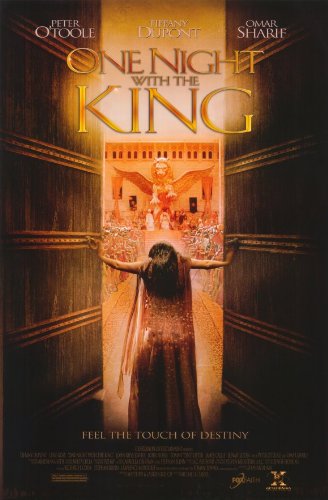
Film Review: One Night With The King (dir by Michael O. Sajbel)


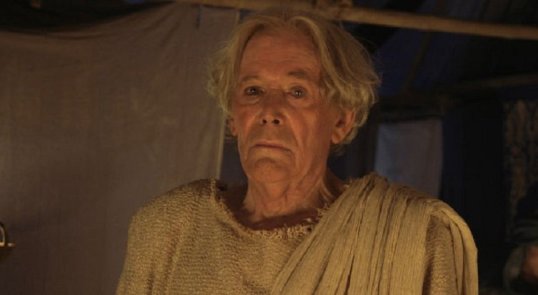
The 2006 Biblical film, One Night With The King, opens with God ordering King Saul to conquer and execute all of the Amalekites and their livestock.  However, as so often happened whenever God ordered him to do something, Saul manages to screw everything up.  He does conquer the Amalekites but he decides to keep their best livestock for himself and he also declines to execute the Amalekite king or his pregnant wife.  The prophet Samuel (played by an uncomfortably frail-looking Peter O’Toole) shows up and tells Saul that he’s screwed up for the last time.  Samuel goes off to execute the Amalekite king.  However, the queen escapes into the desert.

And that’s the last we see of her.  It’s also the last we see of O’Toole who, despite being top billed, has about a minute of screen time.

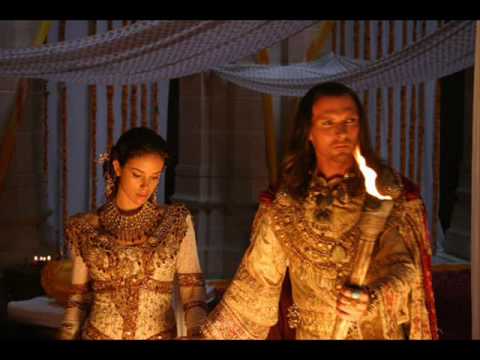
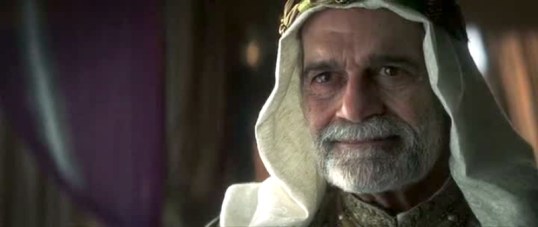
Jump forward several hundred years.  We are now in the city of Susa, Persia.  It’s the center of the known world.  We know this because characters tend to say stuff like, “We are living in the center of the known world.”  Xerxes (Luke Goss) is the king of Persia, a somewhat uncouth man who is obviously used to getting everything that he wants.  Xerxes is plotting on marching off to war.  However, his current wife is opposed to the war and refuses to attend Xerxes’s pre-war banquet.  Scandal!  Xerxes’s advisor, Prince Memucan (Omar Sharif, who co-starred with Peter O’Toole in Lawrence of Arabia), suggests that perhaps Xerxes should get a new wife.

Every female virgin in the city is brought to Xerxes’s palace so that, under the watchful eye of the king’s eunuch, Hegai (Tommy Lister, Jr.), they can compete for the chance to become queen.  Among the women is the beautiful Hadassah (Tiffany Dupont), who is the niece of one of the king’s scribes, Mordecai (John Rhys-Davies).  Hadassah does not tell the king that she’s related to Mordecai and instead says that her name is Esther.  With the help of Hegai, Hadassah soon emerges as the favorite to become the new queen.

Meanwhile, an evil man named Haman (Boo!  Haman!  Boo!) has shown up on the scene.  Haman (played by James Callas) is a descendant of the Amalekites that Saul failed to destroy.  (Dammit, Saul!)  A greedy astrologer, Haman (Boo!) has been appointed to the position of vizier by Xerxes.  Haman (hiss!) demands that all of the king’s servants bow before him.  However, because he has a pagan symbol sewn onto his clothes, Mordecai refuses to do so.  Driven by hate (Boo!), Haman makes plans to execute not only Mordecai but every other Jew in Persia.  With the king unaware of Haman’s intentions, only Hadassah can stop his plans but to do so, she’ll have to risk seeing the king unsummoned….


The story of Esther, Mordecai, the king, and the moment that Haman (Boo!) discovers that karma is a bitch has always been one of my favorites so I’ve always enjoyed One Night With The King whenever I’ve watched it.  Don’t get me wrong.  It has its flaws.  Though the film does a pretty good job of recreating the past on a low budget, it’s still one of those films that’s full of awkward exposition, cringe-worthy dialogue, and more than a few inconsistent performances.  (Sharif and O’Toole, for instance, both go through the motions, doing just enough to pick up a paycheck.)  At the same time, Luke Goss is properly rough-around-the-edges as the king and Tiffany DuPont is well-cast as Hadassah.  Tommy Lister, Jr. appears to be having a lot of fun in the role of the world’s most unlikely eunuch and, as a result, he’s entertaining to watch.  Visually, it’s a pretty film and the costumes are to die for, as they should be in any film about a royal romance.  And, even if the story is at times awkwardly told, it still reaches a deeply satisfying conclusion.

James Callas is convincingly evil and properly detestable as Haman (Boo!  Haman!  Boo!).  Haman is an archetype of evil, the ant-Semite whose evil legacy has continued to haunt the world in the centuries since he met his own fate.  Though the film at times spends too much time playing up the romance between the king and Hadassah (which, while nice to watch, is not the point of the source material), One Night With The King does include enough scenes of Haman (hiss!) ranting to make clear the link between Haman and the anti-Semitism of the Nazis and those modern day hate mongers who try to hide their bigotry behind claims that they are “only criticizing Israel.”  Haman’s evil makes his final fate all the more satisfying but the film leaves no doubt that, unless the world remains vigilant, there will always be new Hamans threatening to come to power.  That’s an important enough message to make up for many of the film’s missteps.

One Night With The King is a flawed, low-budget film.  But I like it.


Film Review: The Fall of the Roman Empire (dir by Anthony Mann)


Why did the Roman Empire fall?

Well, historically, there were several reasons but they can all basically be boiled down to the fact that the Empire got too big to manage and that having two separate capitols certainly didn’t help matters.  The Empire got so large and overextended that the once fabled Roman army was no match for the barbarians.

Of course, if you’ve ever watched a movie about the Roman period, you know exactly why the Empire fell.  It all had to do with decadence, gladiators, human sacrifices, and crazed emperors with unfortunate names like Caligula and Commodus.  The Roman Empire fell because the imperial government descended into soap opera, complete with love triangles, betrayals, and whispered plotting inside the Senate.

Another thing that we’ve learned from the movies is that the fall of the Roman Empire was damn entertaining.  Between the orgies and the men wearing those weird helmets with the brushes on top of them, there’s nothing more fun that watching the Roman Empire fall.

Case in point: the 1964 film, The Fall of the Roman Empire.

This three and a half hour epic begins with the last of the good Roman emperors, Marcus Aurelius (Alec Guiness), battling to keep the Germanic barbarians from invading the empire.  Marcus is a wise man and a great leader but he knows that his time is coming to an end and he needs to name a successor.  His daughter, Lucilla (Sophia Loren), is an intelligent and compassionate philosopher but, on the basis of her sex, is not eligible to succeed him.  His son, Commodus (Christopher Plummer), may be a great and charismatic warrior but he’s also immature and given to instability.  Marcus’s most trusted adviser, Timonides (James Mason), would never be accepted as a successor because of his Greek birth and background as a former slave.  (Add to that, Timonides is secretly a Christian.)

That leaves Livius (Stephen Boyd).  Livius is one of Marcus’s generals, a man who is not only renowned for his honesty and integrity but one who is also close to the royal family.  Not only is he a former lover of Lucilla’s but he’s also been a longtime friend to Commodus.  Unfortunately, before Marcus can officially name Livius as his heir, the emperor is poisoned.  Commodus is named emperor and things quickly go downhill.  Whereas Marcus ruled with wisdom and compassion, Commodus is a tyrant who crushes anyone who he views as being a potential threat.  Lucilla is married off to a distant king (Omar Sharif).  Timonides is declared an enemy after he suggests that the conquered Germans should be allowed to peacefully farm on Italian land.  Rebellion starts to ferment in every corner of the Empire and Livius finds himself trapped in the middle.  Which side will he join?

Despite all the drama, Commodus is not necessarily an unpopular emperor.  One of the more interesting things about The Fall of the Roman Empire is that Commodus’s popularity grows with his insanity.  The crueler that he is, the more the people seem to love him.  Soon, Commodus is fighting as a gladiator and having people burned at the stake.  While some Romans are horrified, many more love their emperor no matter what.  People love power, regardless of what it’s used for.  Perhaps that’s the main lesson and the main warning that the final centuries of the Roman Empire have to give us.

The Fall of the Roman Empire is surprisingly intimate historical epic.  While there’s all the grandeur that one would normally expect to see in a film about the Roman Empire, the film works best when it concentrates on the characters.  While Boyd and Loren do their best with their thinly drawn roles, the film is stolen by great character actors like Alec Guinness, James Mason, and Christopher Plummer.  Plummer, in particular, seems to be having a blast playing the flamboyantly evil yet undeniably charismatic Commodus.  Even with the Empire collapsing around then, both Plummer as an actor and Commodus as a character seems to be having a blast.  Add to that, there’s all of the usual battles and ancient decadence that you would expect to find in a film about the Roman Empire and the end result is a truly enjoyable epic.

As I watched The Fall of the Roman Empire, it was hard for me not to compare the film to Ridley Scott’s Gladiator.  That’s because they’re both basically the same damn movie.  The main difference is that The Fall of the Roman Empire is far more entertaining.  The Fall of the Roman Empire, made in the days before CGI and featuring real people in the streets of Rome as opposed to animated cells, feels real in a way that Gladiator never does.  If Gladiator felt like a big-budget video game, The Fall of the Roman Empire feels like a trip in a time machine.  If I ever do go back to 180 A.D., I fully expect to discover James Mason giving a speech to the Roman Senate while Christopher Plummer struts his way through the gladiatorial arena.

Finally, to answer the question that started this review, why did the Roman Empire fall?

It was all Christopher Plummer’s fault, but at least he had a good time.

4 Shots From 4 Films: Omar Sharif Edition


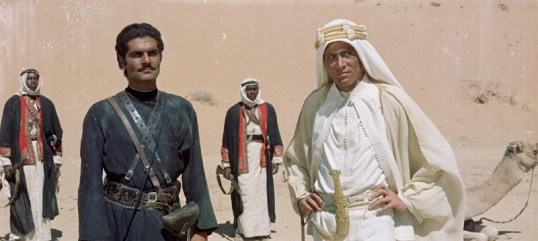
Today the film world received news that legendary actor Omar Sharif passed away at the age of 83. The acclaimed Egyptian actor would make quite an entrance with his very first English-language film: David Lean’s epic Lawrence of Arabia.

Omar Sharif would go on to star in such film as Dr. Zhivago, MacKenna’s Gold, Funny Girl and Behold a Pale Horse to name a few. He might be recognized by the younger generation in such films as The 13th Warrior and Hidalgo. He would be the vision of the noble romantic whether it was as a warrior, a poet or a leader. He would bring a bearing on-screen that exuded steadfast nobility yet still with a streak of roguish charm.

With each passing year we lose more and more of our classic performers. Now Omar Sharif joins the others who have gone before him but will always live on in our memories of him up on the screen.

4 SHOTS FROM 4 FILMS

Lawrence of Arabia (dir. by David Lean)

Lawrence of Arabia (dir. by David Lean)

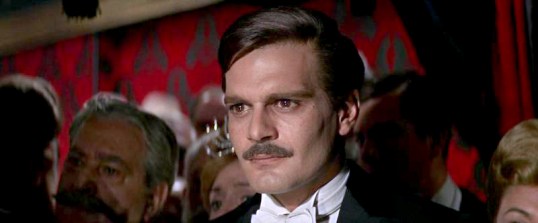
Dr. Zhivago (dir. by David Lean)

Dr. Zhivago (dir. by David Lean)

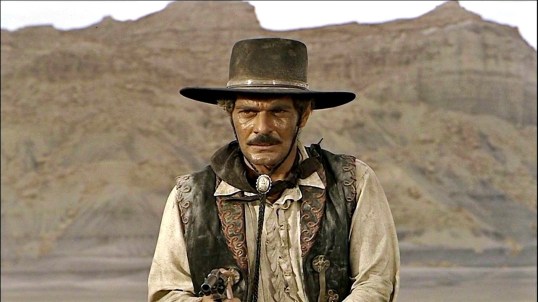
MacKenna'sGold

MacKenna’s Gold (dir. by J. Lee Thompson)

Hidalgo (dir. by Joe Johnston)

Hidalgo (dir. by Joe Johnston)