Welcome to Retro Television Reviews, a feature where we review some of our favorite and least favorite shows of the past! On Saturdays, Lisa will be reviewing The American Short Story, which ran semi-regularly on PBS in 1974 to 1981. The entire show can be purchased on Prime and found on YouTube and Tubi.
This week, we have an adaptation of a 1963 short story.
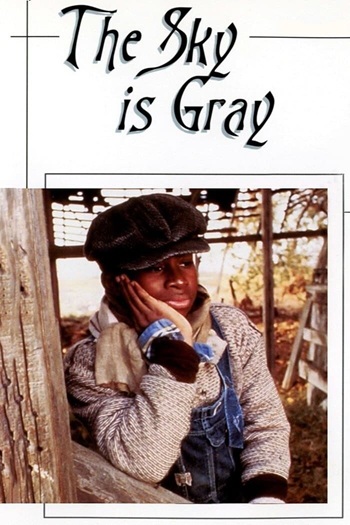
Episode #15: The Sky Is Gray
(Dir by Stan Lathan, originally aired in 1980)
This adaptation of an Ernest Gaines short story takes place in Louisiana during the 1940s. James (James Bond III) is a young black child who lives on a farm. His father is overseas, serving in the Army during World War II. His mother (Olivia Cole) is a stern but loving woman who is trying to raise the sensitive James in a world where one often has to depend on their inner strength to survive. When James comes down with a toothache, he and his mother travel to a nearby town so he can see the dentist. From having to stand in the back of the bus to listening to a debate between a priest and a militant in the dentist’s office, it’s an eye-opening journey for James. When the white receptionist at the dentist’s office arbitrarily cancels James’s appointment and tells him and his mother to come back tomorrow, the two of them seek shelter. James discovers how strong his mother is when they’re harassed by a pimp (Reuben Collins). He also learns that there is unexpected kindness in the world when a white store owner invites him and his mother inside to give them shelter from the cold and windy day. During one trip to the dentist, James learns that the world is far more complicated than he originally knew.
This was an okay adaptation of Gaines’s acclaimed short story. Young James Bond III gave a good performance as James and the episode was full of scenes that visually captured the feel of being an outsider. That said, as was often the case with this series, the adaptation was so straight-forward that it didn’t really capture the nuance of Gaines’s writing. In the short story, Gaines put the reader right into James’s head. The adaptation doesn’t really do that. A heavy-handed musical score doesn’t help matters but, with all that in mind, this was still an effective coming-of-age tale.
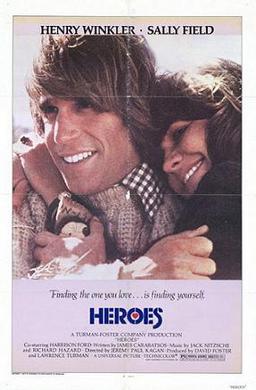
The 1977 film, Heroes, tells the story of Jack Dunne (a young Henry Winkler).
Jack spent four years fighting in Vietnam. Since returning to America, he has struggled to adjust to civilian life. Though he’s mentally blocked out much of what happened in Vietnam, he’s haunted by nightmares, When we first meet him, he’s a patient at a mental health facility in New York City. He has big plans, though. He wants to open up a worm farm in Eureka, California. He’s convinced that he can make a ton of money selling worms to fisherman and he wants all of the old members of his unit to join him in the venture. After Jack escapes from the hospital, he boards a bus heading for California.
He also meets Carol (Sally Field), who is supposed to be getting married in four days but who has decided to board a bus and take an impromptu vacation instead. When Carol is told that the bus is already full and she’ll have to wait for the next one, Jack bribes the ticket agent to get Carol on the bus. Once on the bus, Jack makes himself into a nuisance, continually bothering the driver (Val Avery) and embarrassing Carol. (In the film’s defense, it’s later established that Jack isn’t just being a jerk for fun. The driver’s uniform makes Jack nervous. That said, it’s hard not to feel bad for the driver, who is just doing his stressful job to the best of his ability.) Carol and Jack do eventually strike a tentative friendship. They’re linked by the fact that they’re both trying to escape from something.
At a diner, Jack tells her that he served in Vietnam.
“I protested the war,” Carol says.
“I fought it,” he replies.
Carol eventually joins with Jack in his quest to track down the three people who he expects to go into business with. One of them is missing. One of them never returned home from the war. And the third, Ken (Harrison Ford), is living in a trailer and raising rabbits for a living. Ken is also a stock car racer, though he eventually admits that he rarely wins. In fact, he seems to spend most of his time drinking and shooting off the M16 that he keeps in his car’s trunk. Meeting Ken sends Jack spiraling into depression but, with Carol’s help, Jack is finally starts to come to terms with the reality of what happened to him and his friends in Vietnam.
Heroes was one of the first films to sympathetically portray the plight of Vietnam veterans struggling to adjust to life back in the United States and it certainly deserves a lot of credit for its good intentions. (Indeed, it’s implied that a part of Carol’s concern from Jack comes from her own guilt over how the anti-war movement treated the returning soldiers.) That said, the film itself is an awkward mix of drama and comedy. The first half of the film, in which Henry Winkler comes across like he’s doing a manic Al Pacino impersonation, is especially uneven. Winkler and Field are both naturally likable enough that the film remains watchable but, during the first half of the film, most viewers will never buy their relationship for a second. It’s hard to believe that the driver wouldn’t have kicked Jack off the bus as soon as he started to cause trouble and the other passengers often seem to be unrealistically charmed by Jack’s behavior. If I’m on a crowded bus and some dude insists on walking up and down the aisle and taunting the driver, I’m probably going to get off at the first stop and refuse to get back on. Traveling with a bunch of strangers is already nerve-wracking enough without having to deal with all of that.
Not surprisingly, things improve once Harrison Ford shows up. This was one of Ford’s last character parts before he was cast as Han Solo in Star Wars. (Heroes, however, was released after Star Wars, which explains why Ford is mentioned prominently in the trailer despite having a relatively small role.) Ford gives a strong performance as the amiable but ultimately self-destructive Ken. Ford plays Ken as someone whose quick smile is a cover for the fact that his entire life is a mess. Whereas Jack wears his emotions on his sleeve (and Winkler never stops projecting those emotions), Ken is someone who has repressed his anger and his sadness and Ford gives an internalized and controlled performance. Perhaps not coincidentally, Winkler calms down a bit when he’s acting opposite Ford and, as a result, his own performance starts to improve.
After the meeting with Ken, Jack starts to realize that it’s not going to be as easy to start his business as he thought. Jack starts to come down from his manic high and, even more importantly, Henry Winkler stops overacting and instead, starts to dig into the sadness at the heart of Jack’s life. During its second half, the film finally settles on being a drama and Heroes becomes a much stronger story as a result. Even Jack and Carol’s relationship seems to make more sense during the second half of the film. Things end on a note of cautious optimism, which also acknowledging that life can never go back to what it was before the war.
Today, if anyone watches Heroes, it’s probably going to be for Harrison Ford. (I imagine the presence of Harrison Ford is the reason why it’s currently available on Netflix.) It’s a bit of an uneven film, one that feels as if it should have been stronger than it actually was. Still, it’s a worthwhile time capsule of 1977 and America’s struggle to come to terms with the Vietnam War. Today, we’re still struggling to come to terms with what happened in Iraq and with the botched withdrawal from Afghanistan and, again, it seems like the country is too busy trying to move on to take the time to take care of its veterans. It’s sad that so many people only seem to care about the soldiers who fight in popular wars. Heroes was a plea to America not to forget its veterans. It’s a plea that still needs to be heard.
Well, here we are! It’s January 1st. In just a few days, the Oscar nominations will be announced and then, on February 9th, the winners will be revealed! From now until the day of the ceremony, I will be taking a look at some of the films that were nominated for and won Oscars in the past. As of this writing, 556 films have been nominated for best picture. I hope that, some day, I will be able to say that I have seen and reviewed every single one of them.
Let’s start things off with the 1978 Best Picture nominee, Coming Home!
Coming Home takes place in California in 1968. While hippies stand on street corners and flash peace signs, teenagers are being drafted and career military men are leaving for Vietnam and people continue to tell themselves that America is doing the right thing in Indochina, even though no one’s really sure just what exactly it is that’s going on over there. At the local VA hospital, the wounded and the bitter try to recover from their wartime experiences while struggling with an often heartless bureaucracy and feelings of having been abandoned by their country.
When Marine Corps. Capt. Bob Hyde (Bruce Dern) is deployed to Vietnam, he leaves behind his wife, Sally (Jane Fonda). Told that she can no longer live on the base while her husband is overseas, Sally gets an apartment, a new car, and eventually a new hairdo. She also gets a new friend, Vi Munson (Penelope Milford). Vi smokes weed and is critical of the war in Vietnam. It doesn’t take long for Sally to start to enjoy the idea of being free and not having to cater to Bob’s every whim. Sally even ends up volunteering at the local VA hospital.
That’s where she meets Luke (Jon Voight, looking youngish and incredibly sexy), a bitter but sensitive vet who, having gone to Vietnam and returned to the U.S. as a paraplegic, is now outspoken in his opposition to the war. Luke is also friends with Billy (Robert Carradine), who is Vi’s shell-shocked brother. When Luke and Sally first meet, they collide in a hallway and Sally gets a bag full of urine spilled on her. It’s only later that Luke and Sally realize that they knew each other in high school and soon, they’re having an affair. Luke, who is as gentle a lover as Bob is brutish, brings Sally to her first orgasm in a sensitively-directed scene that should be studied by any and all aspiring filmmakers.
Unfortunately, the problem with having an affair while your husband is away is that, eventually, your husband’s going to come back. Bob returns from Vietnam and he’s no longer the confident and gung ho officer that he was at the start of the film. He now walks with a pronounced limp and, like Luke, he’s angry. However, whereas Luke has channeled his anger in to activism, Bob tries to keep his emotions bottled up. (He does take the time to give the finger to a few protesters and, considering how obnoxious most of the protesters in this film are, you can’t help but feel that Bob may have had a point.) When Bob discovers that Luke and Sally have been having an affair, he snaps….
Meanwhile, Billy is having a hard time readjusting to life, Vi is getting picked up by sleazy men in bars, and there’s a ventriloquist who shows up a few times. There’s a lot going on in Coming Home and, at times, it feels like the film’s trying to cram in too much. The film often seems a bit disjointed, with semi-documentary footage of Voight hanging out with real paraplegic vets awkwardly mixed in with didactic scenes of Sally turning against the war.
That the love story between Sally and Luke is so effective has far more to do with the performances of Jane Fonda and especially Jon Voight, than it does with anything in the film’s script. Indeed, the script itself doesn’t seem to be too concerned with who Luke and Sally were before they collided in that hallway and it also doesn’t seem to be all that interested in who they’ll be after the end credits role. As written, they’re just plot devices, specifically created and manipulated to express the film’s antiwar message. But then you see Jon Voight’s haunted eyes while he’s listening to a group of vets discuss their experience or you hear the pain in his voice while he talks to a bunch of high school students and it’s those little moments and details that tell you who Luke is. By that same token, Jane Fonda does a good job of showing each stage in Sally’s liberation, even if you can’t help but feel that the main reason Sally becomes an anti-war feminist is because she’s played by Jane Fonda.
Of course, in the end, the entire film is stolen by Bruce Dern. You actually end up feeling very sorry for Bob Hyde (and, to the film’s credit, you’re meant to). It would have been very easy to just portray Bob as being a close-minded pig but the film respects his pain just as much as it respects Luke’s anti-war activism and Sally’s need to be free. In the end, you actually feel worse for Bob than you do for either Luke or Sally. Bob is as much a victim of the war as anyone else in the film.
Coming Home was one of the first films about Vietnam to ever be nominated for best picture. Jane Fonda and Jon Voight both won Oscars but the film itself lost to a far different look at the war in Vietnam, The Deer Hunter.

 Through the Shattered Lens