Film Review: Custody (dir by James Lapine)


custody-2-620x345

Last night’s Lifetime movie premiere, Custody, didn’t really feel like a Lifetime film.

This was largely because it really wasn’t.  Custody was written and directed by the acclaimed theatrical director, James Lapine.  The cast features not only Emmy winner Tony Shalhoub and Oscar nominee Catalina Sandino Moreno but also two Oscar winners, Viola Davis and Ellen Burstyn.  Unlike most Lifetime films, Custody was not filmed in Canada.  There were no Toronto landmarks in the background.  (You never realize how much you miss Canada until it’s gone.)  Custody played at Tribeca last year.  Much like Stockholm, Pennsylvania, Custody was made for a theatrical release but it ended up premiering on television instead.  As a result, Custody did not follow the usual Lifetime 8 act pattern.  The commercial breaks felt awkward.  With a 150 minutes running time, this film tested my four-minute attention span.

The other thing that set Custody apart from most other Lifetime films was that it wasn’t much fun to watch.  The great thing about Lifetime movies is that they are almost always fun.  It doesn’t matter what serious subject is being examined.  It doesn’t matter how dramatic things may get.  Lifetime movies are always fun.  To use one of my favorite terms, Lifetime movies embrace the melodrama.  Lifetime films push the limits.  Lifetime films say, “You think we won’t introduce a crazy twin halfway through the movie?  JUST WATCH US!  You think we won’t toss in a sudden case of amnesia or a cheating husband or a psychotic au pair in lingerie?  YOU DON’T KNOW LIFETIME!”

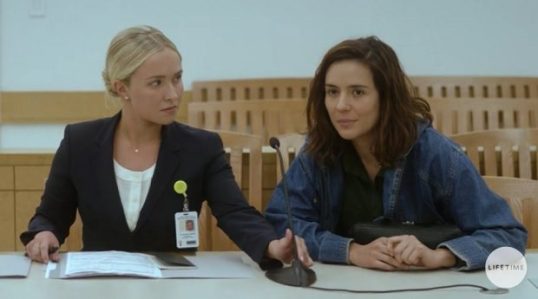
Custody, on the other hand, was a very serious movie about a very serious topic and therefore, it wasn’t much fun to watch.  In fact, Custody was a bit of a well-intentioned mess.  It followed one case as it worked its way through the family court system.  Sara Diaz (Moreno) has been wrongly accused of being an unfit mother.  Her attorney is Ally Fisher (Hayden Panettiere), who has just graduated from law school and who comes from a rich family.  Ally’s grandmother is played by Ellen Burstyn, largely because everyone’s rich grandmother is played by Ellen Burstyn.  Representing the state is Keith (Dan Fogler), who has absolutely horrid taste in ties.  The judge is played by Viola Davis and she’s going through a messy divorce from Tony Shalhoub.

I could see what Lapine was going for.  Custody juggles several plotlines, showing how everyone involved in the case has their own individual biases and problems to deal with.  Will the judge’s dissolving marriage make her more or less sympathetic to Sara?  Will the white and privileged Ally ever be able to truly understand Sara’s situation?  Will Keith ever learn how to properly select a tie?  These issues may seem petty when taken on their own but, when crammed together, they form one big human drama.

Or, at least, that seems to have been the plan.  Lapine gets some good performances from his cast but Custody never quite comes together.  This is one of those heavy-handed films where characterization is more likely to be advanced by a lengthy monologue than by action.  Add to that, Custody is ultimately far too enamored of the family court system.  Everyone means only the best and the bureaucracy is your friend.

I will say this.  Based on my own experience working as an administrative assistant in a law office, Custody does get one thing very right.  Male lawyers are always the worst dressed people at any courthouse.  On this count, Dan Fogler played one of the most realistic attorneys ever seen on TV.


Embracing the Melodrama #58: The Place Beyond The Pines (dir by Derek Cianfrance)


The-Place-Beyond-The-Pines

First released in 2013, the underrated (and, as far as end-of-the-year awards ago, underappreciated) The Place Beyond The Pines is actually three cinematic melodramas in one.  Much like a great novel, this movie is split into multiple pieces with each part telling a different part of a larger story.  It’s an interesting and ambitious concept, the type that we sometimes fear that audiences are no longer capable of appreciating.

The first third of the story centers on Luke Glanton (Ryan Gosling), a motorcycle stuntman who performs at state fairs.  During one such fair in upstate New York, he meets and has a brief affair with Romina (Eva Mendes, giving an excellent performance).  When he returns to New York a year later, Luke discovers that he is now a father.  Luke quits the fair and decides that he wants to be a part of his son’s life but Romina, who is now in a stable relationship with a good man named Kofi (Mahershala Ali), asks him to stay away.  Determined to be part of his son’s life and also looking to win back Romina, Luke stays in town and gets a job working with Robin (the always excellent Ben Mendelsohn).  Robin owns an auto garage and, as he explains to Luke, he also used to be a bank robber.  Soon, with Robin’s help, Luke is robbing banks and sending the money to Romina.

Place

Luke’s story is probably the strongest in the film.  Ryan Gosling is charismatic as the dangerous yet likable Luke and he and Eva Mendes have a lot of on-screen chemistry.  Ben Mendelsohn brings yet another one of his trademark burned out characters to life and Mahershala Ali is sympathetic as Kofi, a man, who despite being good and responsible, is simply no Ryan Gosling.

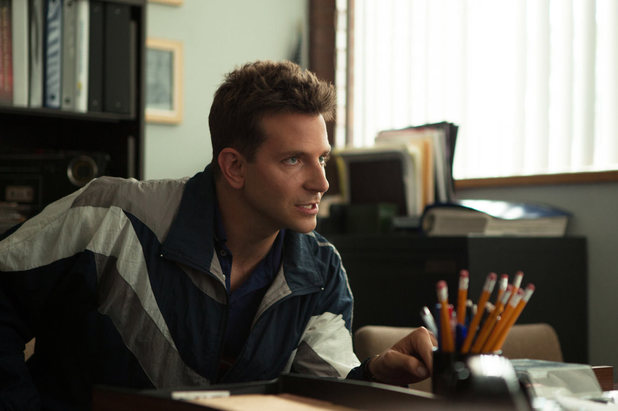
The second part of the story deals with Avery Cross (Bradley Cooper), the cop who chases Luke after one of his bank robberies.  Avery is the politically ambitious son of a former judge (Harris Yulin) and, much like Luke, he also has newborn son.  When Avery is originally hailed as hero for his pursuit of Luke, Avery’s feelings are far more ambivalent.  It gets even more difficult for him when he catches some of his fellow cops (led, of course, by Ray Liotta) stealing the money that Luke sent to Romina.  When Romina rejects Avery’s attempt to return the money to her, Avery is left with little choice but to try to take down the crooked cops himself.  It’s the only way for him to clear his conscience.

movies-the-place-beyond-the-pines-still-7

And, finally, in the third part of the story, teenager Jason Cankham (Dane DeHaan) meets and befriends Avery’s son, AJ (Emory Cohen).  What neither one of them realizes is that Jason is Luke’s son.  The interesting thing here is that the two sons have, on the surface at least, turned out to be the exact opposites of their father.  Jason is the good kid while AJ is probably one of the most despicable movie teenagers of all time.  When Jason learns the truth about both of their fathers, he has to decide whether he’s his father’s son or if he is his own human being.

the-place-beyond-the-pines03

As you might be able to guess from the above plot description, The Place Beyond the Pines is a big epic of a film and, perhaps not surprisingly, the end results are intriguing if occasionally uneven.  The film starts out so strongly with Ryan Gosling roaring down empty roads on his motorcycle that it’s hard for the rest of the movie to live up to that opening’s promise.  And yet somehow, the film manages to do just that.  Even the parts of the film that didn’t particularly intrigue me — like the whole subplot with the corrupt cops — were saved by the efforts of a perfectly chosen cast.  The third and final part of the film provides the perfect climax, helping us to both understand the legacy of Luke Glanton and Avery Cross but also to understand why both of their stories are important, both as individual tales and as parts of a greater whole.

The Place Beyond The Pines may not be perfect, not in the way that a film like Winter’s Bone is perfect.  However, we should still be glad that films like it are being made.

Place-Beyond-the-Pines