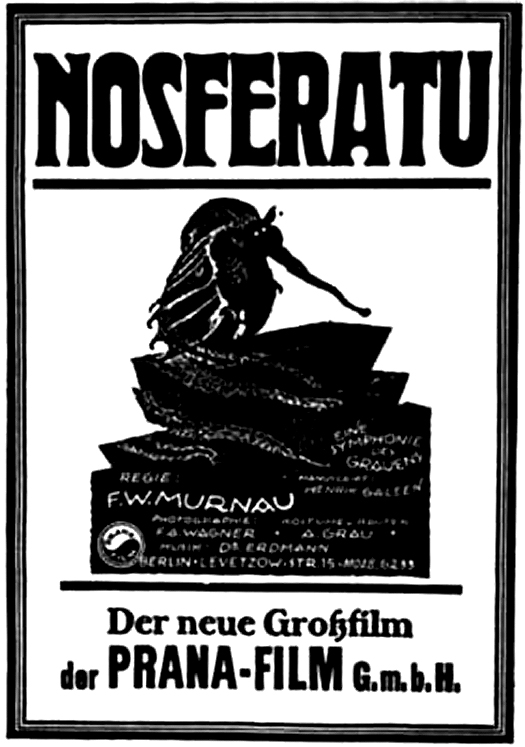
International Horror Film Review: Nosferatu, the Vampyre (dir by Werner Herzog)


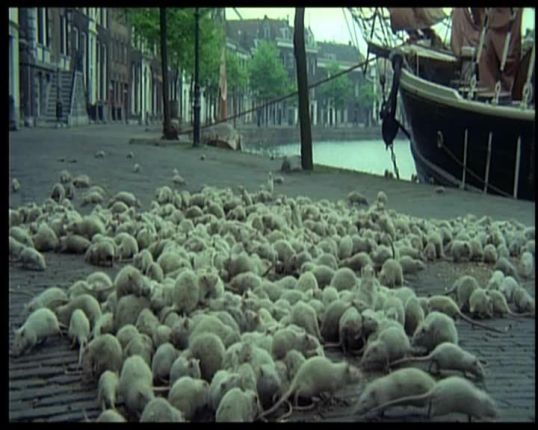
Agck!  The rats!

Nosferatu, Werner Herzog’s 1979 remake of the F.W. Murnau’s classic silent vampire film, may be best known for Klaus Kinski’s feral performance of Count Dracula but, for me, I’ll always remember the rats.

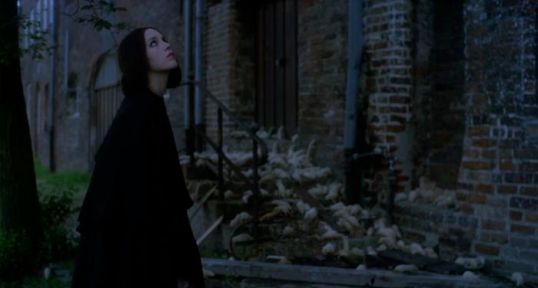
When Dracula first comes to the city of Wismar, he travels via a boat.  Spending the day in his coffin, he arises at night to kill the crew of the ship.  (Eventually, the captain’s dead body ends up tied to the wheel to ensure that the boat’s course is not altered.)  In order to keep the people of Wismar from realizing that they have a vampire in their midst, Dracula travels with thousands of rats and forges the ship’s log to make it seem as if the crew has fallen victim to the plague.  When the boat docks at Wismar, thousands of rats flood into the streets.  When Lucy (Isabelle Adjani) later walks through the streets of the Wismar, it becomes obvious that the rats have conquered the city.  The remaining people are too busy burying their dead and preparing for the end to do much about the rats.  One group cheerfully eats a lavish meal while thousands of rats wait behind them.  Later, the rodents have taken over the table.  The people are gone but the rats remain.
Werner Herzog has often cited the original Nosferatu as one of the films that most inspired him as a young filmmaker.  His remake is both a respectful homage to the original film and also a uniquely Herozgian work.  Much as the Spanish expedition at the center of Aguirre, The Wrath of God ended with the raft being conquered by monkeys, the city of Wismar is conquered by both rats and mythology.  Even towards the end of the film, when it becomes obvious that a vampire has come to town, the people refuse to believe it.  Some wait for God to save them.  Some just decide to celebrate the end.  But only Lucy, who we are told is pure of heart, is willing to sacrifice herself for the people of Wismar.  And yet, the film leaves us wondering if that sacrifice would really be worth it.  Are the people of Wismar worth saving?  This version of Nosferatu suggests that perhaps they’re not.
 

Lucy is the wife of estate agent Jonathan Harker (Bruno Ganz).  As with almost every version of Dracula, Nosferatu opens with Harker traveling to Dracula’s castle, dismissing the claims of local villagers are being mere superstition, and then eventually meeting the count himself.  Klaus Kinski may be made up to look like Max Schreck from the original film but he still turns Dracula into a uniquely Kinski-like creation.  Kinski’s Dracula has little of the old world charm of Bela Lugosi or even Christopher Lee.  Instead, he’s like a feral animal, hissing out his dialogue and almost always hiding in the shadows.  It’s been such a long time since this Dracula was human that he no longer knows how interact with them.  Instead, like an abused animal, he cringes when Harker attempts to speak to him.  There’s a loneliness to this Dracula and an unexpected sadness in his eyes.  Asking him to control his thirst for blood would be like asking a wild animal not to obey its natural instinct to kill.  The only time that this Dracula doesn’t seem to be full of self-loathing is when he’s actually hunting blood.  Then he moves like a calculating predator.

As one might expect from a Herzog film, Nosferatu moves at its somewhat odd but deliberate pace.  (Harker’s lengthy journey to reach Dracula’s remote castle will remind you of Klaus Kinski trying to conquer the Amazon in Aguirre and Fitzcarraldo.)  The imagery is surreal and dream-like.  I already mentioned the rats and the scene of Kinski stalking the captain of the boat feels like it was taken from a filmed nightmare.  It’s also impossible to forget the images of black-clad men, marching down the streets of Wismar and carrying coffins on their shoulders, all ignoring Lucy as she begs them to understand that there is something even deadlier than the plague at work in Wismar.

Both the original and the remake of Nosferatu are classic vampire films.  I suggest watching both.  Herzog shot two version of Nosferatu, one in German and one in English.  Though both versions are essentially the same, I recommend the German version just because, in the English version, it’s obvious the actors are occasionally having trouble performing in a foreign language.  The German version feels more authentic.  Since the film is basically a visual poem, it’s effective even if you’re watching it without subtitles.


Horror on the Lens: Nosferatu (dir by F.W. Murnau)


Today’s Horror on the Lens is a classic film that really needs no introduction!  Released in 1922, the German silent film Nosferatu remains one of the greatest vampire films ever made.  It’s a film that we share every October and I’m happy to do so again this year!

Enjoy!

Horror on the Lens: Nosferatu (dir by F.W. Murnau)


Today’s Horror on the Lens is a classic film that really needs no introduction!  Released in 1922, the German silent film Nosferatu remains one of the greatest vampire films ever made.  It’s a film that we share every October and I’m happy to do so again this year!

Enjoy!

Horror Scenes That I Love: A Scene From Nosferatu


Today’s horror scene that I love comes from the absolutely terrifying 1922 silent film, Nosferatu.

Directed by F. W. Murnau and featuring Max Schreck as Count Orlock, Nosferatu is often cited as being the first vampire film.  That’s actually not true.  There were apparently film adaptations of Dracula that were produced years before Murnau gave the world his “unauthorized” adaptation.

However, I do think it can be argued that Nosferatu is the most influential vampire film ever made.  Every vampire movie released over the past 95 years has been a direct descendant of Nosferatu and it remains a truly nightmarish work of horror art.  One need only compare it to Universal’s first Dracula film to see how well Nosferatu has aged.

Enjoy this terrifying scene!

Horror on the Lens: Nosferatu (dir by F.W. Murnau)


Today’s Horror on the Lens is a classic film that really needs no introduction!  Released in 1922, the German silent film Nosferatu remains one of the greatest vampire films ever made.  It’s a film that we share every October and I’m happy to do so again this year!

(As well, since I’m going to be reviewing Dracula later today, it seems especially appropriate to start things off with Nosferatu.)

Enjoy!

4 Shots From Horror History: The Cabinet of Dr. Caligari, Haxan, Nosferatu, The Hands of Orlac


This October, I’m going to be doing something a little bit different with my contribution to 4 Shots From 4 Films.  I’m going to be taking a little chronological tour of the history of horror cinema, moving from decade to decade.

Today, we take a look at the first half of the 1920s.

4 Shots From 4 Films

The Cabinet of Dr. Caligari (1920, dir by Robert Wiene)

The Cabinet of Dr. Caligari (1920, dir by Robert Wiene)

Haxan (1922, dir by Benjamin Christensen)

Haxan (1922, dir by Benjamin Christensen)

Nosferatu (1922, dir by F.W. Murnau)

Nosferatu (1922, dir by F.W. Murnau)

The Hands of Orlac (1924, dir by Robert Wiene)

The Hands of Orlac (1924, dir by Robert Wiene)

Horror on the Lens: Nosferatu (dir by F.W. Murnau)


Today’s Horror on the Lens is a classic film that really needs no introduction!  Released in 1922, the German silent film Nosferatu remains one of the greatest vampire films ever made.  It’s a film that we share every October and I’m happy to do so again this year!

Enjoy!


Horror on the Lens: Nosferatu (dir by F.W. Murnau)


Nosferatuposter

This isn’t the first time that we’ve shared the classic 1922 silent vampire film Nosferatu here on the Lens but who cares?  It’s not only one of the most influential films ever made but it’s also something of a Halloween tradition around these parts!  Directed by the great German expressionist F.W. Muranu and featuring an iconic performance from Max Schreck, Nosferatu is a film that everyone should see at least once.

And here’s your chance!


Happy Birthday, Werner Herzog!


2005_grizzly_man_018

Happy birthday, Werner Herzog!  That’s right — one of the greatest and most visionary directors of all time is 71 years old today.

Now, if you’ve followed this blog for a while, then you know that I love trailers.  In honor of Herzog’s birthday, here are 6 trailers from Werner Herzog:

Here is Herzog’s latest (and some would say, most powerful) documentary — an anti-texting PSA:

As a bonus, here’s Les Blank’s 1980 documentary, Werner Herzog Eats His Shoe.

Horror Film Review: Nosferatu (dir. by F.W. Murnau)


Since I previously “presented” our readers with The Cabinet of Dr. Caligari, it’s only appropriate to now present another early horror film — F.W. Murnau’s classic silent vampire film, Nosferatu.  Much like Dr. Caligari, Nosferatu requires a bit of patience from modern audiences that take intrusive sound and CGI as a given.  And much like Dr. Caligari, Nosferatu rewards the patience.  Everything from Murnau’s moody use of shadow to Max Schreck’s performance as Orlock adds up to create one of the most influential and iconic films of all time.  And while the film itself might not feature the “jump out your seat scares” that modern audiences expect (and demand) from horror films, the image of Schreck’s creeping shadow remains effectively creepy and nightmarish.  Like all great horror, this is a film full of images that stick with you after you view it.

I am also very aware of both Werner Herzog’s excellent 1980 remake and the Oscar-nominated Shadow of the Vampire.  However, I’m kinda typing all this up at work so those two films will have to wait for a later date.  For now, if you have 84 minutes to kill and seriously, who doesn’t?, please enjoy F.W. Murnau’s classic Nosferatu