Review: Ballerina (dir. by Len Wiseman)


“You don’t choose to be a killer, you are chosen.” — The Chancellor

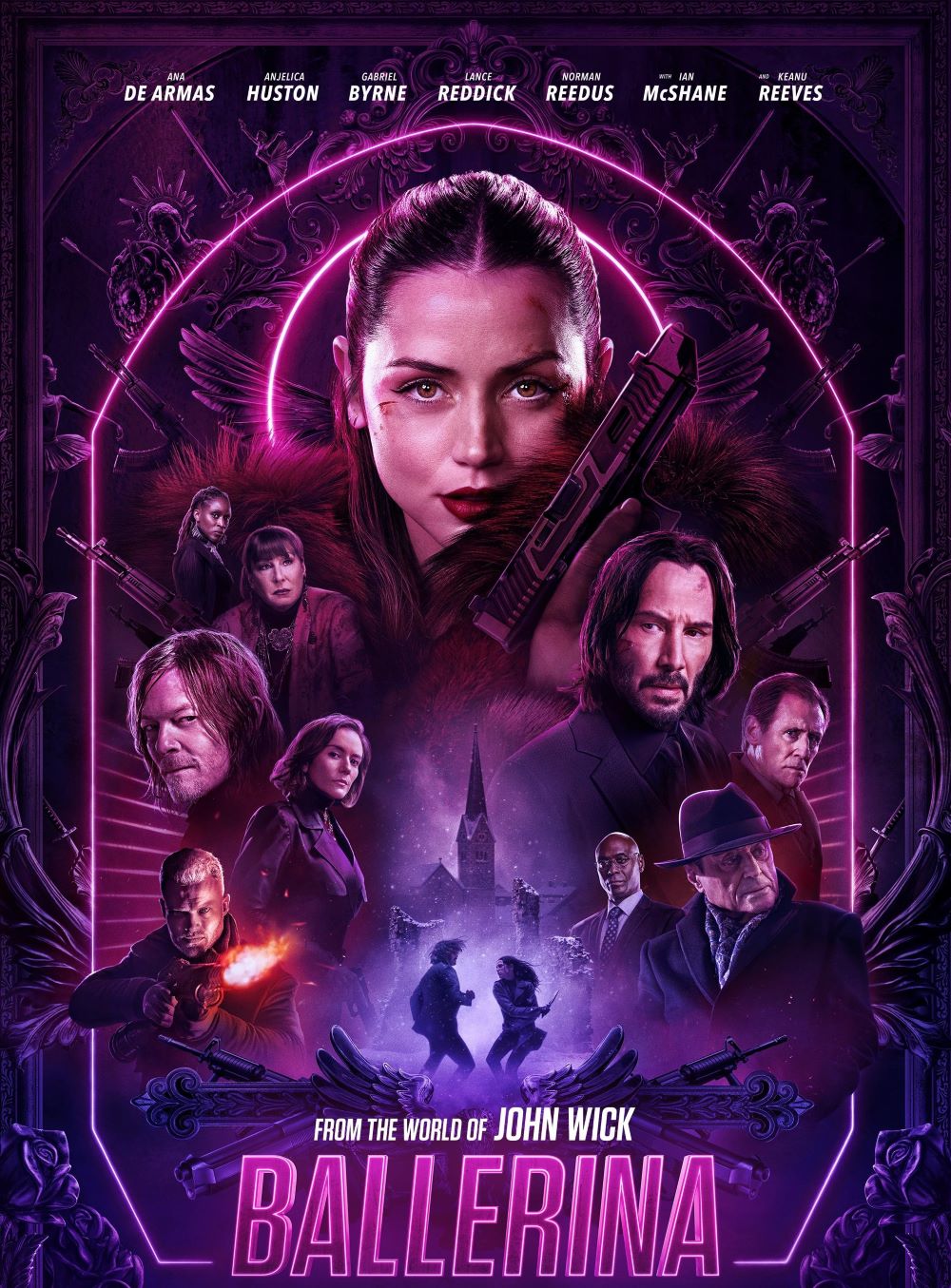
Ballerina lands in theaters feeling like someone finally turned the volume up on the quieter, more balletic side of the John Wick universe. Anchored by Ana de Armas’s poised, ferocious turn, the film doesn’t reinvent the neon‑lit, bullet‑cartoon rules of the franchise so much as rearrange them into a new rhythm. It’s still a very familiar kind of action movie—assassins, codes, bodies on the floor—but it carves out its own niche by centering a woman who’s not just another lethal accessory to John’s world, but someone the world has already trained into a weapon.

At the same time, Ballerina leans hard on the style and flourish of the later John Wick films, and that’s both its main selling point and its biggest limitation. The way shots linger on gun grips, the way the camera circles around bodies mid‑spin, the way every hallway fight feels like stage choreography—it’s all very familiar, very polished, and very much a continuation of the franchise’s visual language. That’s great if you’re here for the aesthetic, but it also means the film sometimes feels more like an extension of the Wick universe’s attitude than a story that confidently stands on its own two feet.

Ana de Armas plays Eve Macarro, a young assassin who grew up in the shadow of the Ruska Roma and the Continental, groomed to kill long before she fully understood what she was doing. The story unfolds in a loose “between films” slot in the Wick timeline, so fans who care about franchise continuity will get their little Easter eggs and cameos, but the film smartly never gets completely bogged down in explaining how this fits into every rulebook. Instead, it leans into the idea that the John Wick universe is big enough that other hunters can walk around in it, following their own grudges and grief. Eve’s motive is straightforward: she wants to track down the people she believes killed her father when she was a child, and along the way she has to square off against both the old guard of her upbringing and the cult‑like killers who seem to operate just outside the established order.

Like a lot of John Wick entries, though, Ballerina is ultimately more interested in expanding the world and reinforcing its rules than drilling deep into its own plot. Eve’s revenge‑driven quest gives the film its spine, but the mechanics of that revenge are often secondary to the chance to show off another assassin enclave, another weird code, or another showdown that feels like a set‑piece first and a character beat second. You can feel the priorities: where she travels, who she bumps into, and how this underworld operates often matter more than whether her arc is especially surprising or emotionally rich. The plotting starts to feel like connective tissue between bigger, more stylized sequences, and that’s where the reliance on franchise style starts to hurt more than help.

The film’s greatest strength is how it employs the language of ballet and violence in the same breath. The title Ballerina might make you expect a lot of literal tutus and pirouettes, and there’s a bit of that in the opening stretches, but the real choreography is in the fight scenes. Eve’s movement is light‑on‑her‑feet one moment—a few spins, a quick sidestep—and then suddenly brutal, close‑quarters savagery the next. The camera doesn’t just document her skills; it dances with them, letting wide‑angle shots show off the architecture of a fight before snapping into tight, impact‑heavy close‑ups. It’s unmistakably a Wick‑style approach, only dialed into a slightly more feminine, almost theatrical register.

De Armas deserves a lot of credit for making Eve feel like a real person, not just a killing machine with a pretty face. She’s cold, yes, but there’s weariness under the surface, the kind that comes from being raised in a world where emotions are a liability. The script doesn’t drown her in backstory; it just lets small moments—a hesitation, a glance at a photo, the way she holds a gun—do the work. When she finally loses her composure and starts to scream, grunt, and visibly struggle during later fights, the effect is more powerful than if she’d been effortlessly killing everyone from minute one. She sweats, she bleeds, she gets thrown around, and that makes her victories feel earned, not just cool.

Stylistically, Ballerina is very much in line with the rest of the franchise: glossy, slightly over‑the‑top, and hyper‑aware of its own aesthetic. The camera work is sleek, the color grading pops, and the score leans into synth textures that feel like a slightly more elegant cousin of the usual Wick pulse. There are also some deliberately playful musical choices—bits of Tchaikovsky and other classical motifs that echo in the background during key scenes—which tie the idea of ballet back to the film’s emotional core. The setting shifts from the familiar New York–style Continental spaces to a quieter, almost fairy‑tale European village that houses a different kind of assassins’ retirement community. It’s a neat trick: the filmmakers give us something that still feels like the same universe but just enough of a different flavor that it doesn’t feel like a rerun.

But that lush style also underlines how much the film is prioritizing world‑building over a tight narrative. Conversations about the Ruska Roma, the Continental, and the cult‑like assassins’ outpost are there less to advance Eve’s inner journey and more to remind us that the John Wick universe is vast, layered, and full of hierarchies. Fans who love the lore will probably eat that up, but if you’re hoping for a more self‑contained narrative, it can start to feel like you’re watching a very expensive lore compendium. The emotional core is there—it just has to fight for space amidst all the visual flexing and mythology maintenance.

Where Ballerina becomes a bit uneven is in its plotting. The basic “one girl, one very long night of revenge” template is solid, but the script doesn’t always give it enough depth or surprise. There are too many conversations where characters explain the rules of the world to each other, or recap what’s already been established, rather than using those moments to add nuance to the characters or relationships. The side figures—like various crime bosses, elders, and reluctant allies—do their jobs entertainingly enough, but they don’t all get the same level of interior life that Eve has. Some of the supporting performances are strong across the board, but the material doesn’t always push them to do anything more than punctuate the action beats.

Keanu Reeves drops in briefly as John Wick, and the cameo is handled with the kind of restraint that makes it feel like a favor rather than a stunt. He doesn’t hang around; he makes a sharp, efficient entrance, has a few quiet exchanges, and then exits, leaving the movie firmly in Eve’s hands. That’s crucial, because one of the criticisms of earlier spin‑off ideas was that they’d feel like vanity detours or glorified cameos. Here, John’s presence actually reinforces the idea that this is someone else’s story now, and that he’s just another player in a much larger ecosystem of killers.

The film’s worst moments are also some of its most visually striking: the bigger, more outlandish set‑pieces that lean fully into the franchise’s “go‑no‑go” action logic. The final third, in particular, is one long, almost goofy crescendo of fights, stunts, and absurdly lethal props. It’s a lot of fun in the moment, but it also underlines how thin the actual plotting can be. When the camera is spinning around a flamethrower‑wielding Eve or a hallway of assassins dropping in from the ceiling, the movie doesn’t always give us enough emotional context to care about who’s living or dying beyond the immediate spectacle. It’s the kind of sequence that will make fans cheer in the theater, but might look a bit clumsier on a second viewing.

One area where Ballerina arguably improves on the core series is its handling of gender dynamics. Eve isn’t fetishized; she’s allowed to be both emotionally grounded and physically dominant without being framed as some kind of fantasy object. The film nods to the idea of “girl power” in the assassin world, but it also lets the character operate within familiar constraints—tradition, hierarchy, and expectation—instead of pretending she’s a one‑woman revolution. She’s tough, but she’s also vulnerable, and that balance keeps the tone from tipping entirely into empty empowerment sloganeering. The way the movie treats her relationships—with her father’s memory, with her mentors, and with the people she’s ordered to kill—adds a layer of emotional sophistication that earlier entries in the franchise often glossed over for the sake of pure momentum.

If you’re coming into Ballerina expecting a radical reinvention of the series, you’ll probably leave a little underwhelmed. It doesn’t rip up the rulebook or deliver a huge thematic twist on what we already know about this universe. Instead, it refocuses the camera on a different kind of protagonist, lets the familiar style breathe a little differently, and proves that the world of John Wick is big enough to house more than just one lone wolf. It’s a stylish, violent, occasionally silly, definitely pulpy action film that knows exactly what it wants to be: a long, bloody ballet in which the lead is a woman who’s finally ready to dance on her own terms—even if the choreography sometimes matters more than the story it’s supposedly telling.

John Wick Franchise (spinoffs)
Film Review: From the World of John Wick: Ballerina (dir. by Len Wiseman)


It seems almost inevitable that Ana de Armas would make it into the John Wick franchise. Having worked with Keanu Reeves in multiple films since 2015’s Knock Knock, she has great chemistry with him on camera. De Armas has also proven she can handle action both with 2021’s No Time to Die and 2023’s Ghosted, with the latter also boasting a bit of comedy. From the World of John Wick: Ballerina (or just Ballerina for the sake of this writing) puts Ana in the mix of all the madness as Eve Maccaro. While it doesn’t have the tightest story in the world when compared to the rest of the John Wick saga, Ballerina does hold its own at least as a showcase for the stunt work. If you enjoyed Atomic Blonde or any of the Underworld films, you really won’t have any problems here.

The story for Ballerina takes place during the events of John Wick 3 – Parabellum. As a child, when Eve loses her father to a crew of armed men sporting a brand on their wrists, she is taken in by The Continental’s Winston (Ian McShane). Winston introduces her to the tribe of killers known as the Ruska Roma, lead by The Director (Anjelica Houston), who train her to become like them. Those familiar with the John Wick franchise will recall that the Ruska Roma was John’s tribe before some action caused a split between him and them.

In addition to her pointe practices (which look painful), she’s trained with knives, guns and other tactics. Unlike the assassins that normally frequent The Continental, the Ruska Roma aren’t fully ruthless and can be a force of good. After handling various tests, she discovers a clue leading to the people who killed her father and the man who leads them (ironically played by Point of No Return’s’ Gabriel Byrne, given the film moves in similar circles). Can Eve get her vengeance in the shadow of the legendary Baba Yaga?

While Eve’s story is a still a tale of vengeance as much as Wick’s, there are two distinct differences. As taught by her trainer Nogi (Sharon Duncan Brewster, Dune: Part One), being a girl has some merits and flaws. She might not have the strength to go toe to toe with some of her male opponents (and try telling Ana this, she throws herself deep into the stuntwork), she can move for weakpoints and cheat her way though to victory. “Fight like a girl” becomes the motto. The other difference is that Eve has to work within both the rules of the Ballerinas as well as those the High Table puts on their Hotels. I thought that was an interesting touch to things.

With those stunts, I really would like to know if Ana or any of the stunt team were hurt in any way making this film. Eve goes through a lot and doesn’t have that protective Armani suit of Wick’s. Into walls, over dressers, through glass and even fire, but she keeps getting up and giving that damage right back to her targets. I hope this becomes a contender for the Academy’s new award for stunts. It’s an easy lock for a Nomination.

Casting-wise, you’ll see some familiar faces. Winston and Charon (the late Lance Reddick) are both on hand, as well as stuntman/actor Daniel Bernhardt (The Matrix Reloaded, Nobody, that awesome “ronny/lily’ episode of HBO’s Barry). Some new faces include Norman Reedus (The Walking Dead) and Anne Parillaud (Innocent Blood, La Femme Nikita).

Len Wiseman hasn’t directed a feature film since 2012’s Total Recall, but watching Ballerina you really couldn’t tell. Some of the locales do look like they were borrowed from Wiseman’s Underworld films, but that actually works in Ballerina‘s favor. The film flows well from scene to scene and the action is visible enough that there’s little to miss. There are very few lulls in the action. Though the film was written by both Derek Kolstad and Shay Hatten, who both previously worked on pretty much the entire Wick Franchise along with Nobody, it’s a different flavor to things. You won’t any any major info on the High Table and how all that works, though. This more of a contained story that flutters through the rest of the universe.

I only had one major problem with Ballerina, which was the way in which they chose to cameo Keanu Reeves as John Wick. Unless I’m wrong, I think the story makes a mistake in the John Wick timeline at some point by bringing Wick and Eve face to face (and the trailers already alluded to this). Their meeting appears to occur after Wick’s branding and ex-communication from the Ruska Roma (“You can never come back.”, she told him in John Wick 3), so the events leading up to the meeting didn’t entirely make sense to me (though it was wonderful to watch). It doesn’t mar the film, it’s still enjoyable. It’s just that tiny question that digs in the back of your skull like “If Old Biff gave young Biff the Almanac, and Young Biff changed the future, how did Old Biff exist long enough to return the DeLorean back to a 2015 timeline that shouldn’t exist anymore?” – a question I still ask every now and then.

Overall, Ballerina is a pretty good addition to the John Wick franchise. Ana de Armas gives it her all and deserves all the kudos for that work she puts in. Here’s hoping that we get a bit more of her action (and of that universe) down the road.

The Films of 2024: The Bikeriders (dir by Jeff Nichols)


Taking place in the late 60s and the early 70s, The Bikeriders tells the story of The Vandals Motorcycle Club.

The Vandals were founded by Johnny (Tom Hardy), a truck driver who got the idea for starting his own motorcycle gang after catching a late night broadcast of The Wild One.  Under Johnny’s strong leadership, the Vandals quickly grow and soon, branches are opening up across the country.  Of the many members of the Vandals, the most charismatic is Benny (Austin Butler), a quiet and enigmatic man who loves his motorcycle and who seems to have the worst luck when it comes to crashing and getting caught by the police.  If Johnny epitomizes the leadership needed to successfully start a motorcycle club in the first place, Benny epitomizes the coolness of being a rebel and doing your own thing.  Everyone in the club wants to be like Benny, even if the majority of them have more in common with the simple-minded Cockroach (Emory Cohen) or the eccentric Zipco (Michael Shannon).  The fatalistic Johnny knows that he can’t remain in charge forever and he views Benny as his heir apparent.  However, Benny’s feelings about the whole thing are far more difficult to decipher.  As the Vandals themselves grow increasingly more violent and hostile and as lowbrow criminals like The Kid (Toby Wallace) step up to challenge Johnny’s power, both Benny and Johnny are forced to confront the reality of what The Vandals have become.

Watching The Bikeriders is a frustrating experience, especially for those of us who have enjoy director Jeff Nichols’s other films.  It’s a good movie but it never quite becomes the great movie that it so obviously wants to be.  On the plus side, both Austin Butler and Tom Hardy give excellent performance as Benny and Johnny.  Both characters serve as archetypes for a uniquely American style of masculinity and Hardy and Butler bring them to life as both symbols and as human beings.  Tom Hardy, especially, captures the tragic dignity of a man who knows that his fate has already been set.  Wisely, Butler and Hardy both underplay their characters.  Neither Johnny nor Benny are the types to normally show their emotions, which makes their rare moments of vulnerability all the more powerful. If nothing else, The Bikeriders serves as a reminder that both Butler and Hardy are legitimate movie stars, along with being excellent actors.

Unfortunately, the film suffers due to an awkward framing device, in which Benny’s wife, Kathy (Jodie Comer), is interviewed by photographer and writer Danny Lyon (Mike Faist).  Kathy serves as the audience surrogate.  We learn about the Vandals through her eyes and she’s the one explains to us all of the ins-and-outs of Vandal culture.  Unfortunately, Kathy is a bit of an underwritten character and her relationship with Benny never feels convincing.  Unlike Hardy and Butler, Jodie Comer never lets you forget that she’s a performer giving a performance.  Much like Meryl Streep in The Laundromat and Don’t Look Up, Comer gives the type of bad and mannered performance that could really only come from an otherwise good actress.  Whenever the viewer starts to get emotionally involved with the story, director Jeff Nichols cuts back to Lyon staring reverently at Kathy while Kathy prattles on in dialogue that tries so hard to sound authentic that it ultimately makes the whole thing feel artificial.

Just as he did in Take Shelter and Mud, Nichols attempts to capture the unique mythology of the Midwest in The Bikeriders.  Occasionally, he succeeds.  The scene where Benny outruns the cops, just to discover that his motorcycle has run out of gas, serves as evidence of just how good a director Jeff Nichols can be.  But, in the end, The Bikeriders is never quite as strong, moving, or insightful about outlaw culture as it wants to be.  It’s a good film but it’s hard not to feel that it could have been so much more.

Here’s The Trailer For The Bikeriders!


Here’s the latest trailer for a film that I am definitely looking forward to seeing in 2024, The Bikeriders!  Directed by Jeff Nichols of Mud and Take Shelter fame, The Bikeriders is a fictionalized look at the history of a notorious outlaw motorcycle gang.  Even if I didn’t have a weakness for bikers, the fact that the cast features Austin Butler, Norman Reedus, Jodie Comer, and Tom Hardy would be more than enough to pique my interest!

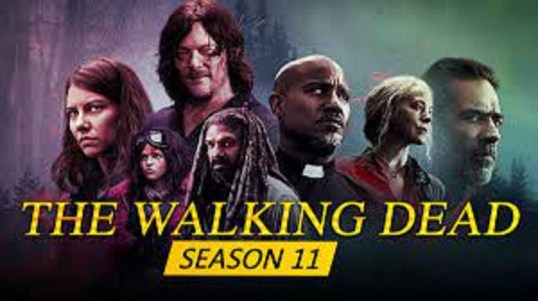
TV Review: The Walking Dead 11.14 “The Rotten Core” (dir by Marcus Stokes)


I’ve always wondered how little Herschel would react when he eventually met Negan and learned that Negan was responsible for killing Glenn.

I mean, we all knew that it would happen eventually because, let’s face it …. Maggie and Negan are totally in love!  It’s going to take them a while to admit it, of course.  Maggie’s busy ruling Hilltop like a dictator and Negan’s got a new wife.  Plus, there’s the whole thing where Negan savagely murdered Glenn and then spent a few seasons gloating about it.  I mean, it’s going to take a while to move on from all of that.  Taking all of that into consideration, Lauren Cohan and Jeffrey Dean Morgan still have more legitimate chemistry than anyone else on this show and Maggie and Negan are definitely in love.  Plus, they’re scheduled to get their own spin-off, where they both move to the most romantic city in America, New York!  Not only does that mean that Hilltop is probably screwed (because why else would Maggie leave) but it also means that Maggie and Negan are destined to fall in love while listening to Dean Martin sing That’s Amore.

And the question has always been, how would Herschel react?  Well, this week, we got our answer.  After discovering that bratty little Herschel had snuck into the Apartment Complex, Negan agreed to keep an eye on him while Maggie and the other Hilltoppers continued to fight off a combination of walkers and Commonwealth soldiers.  It didn’t take long for Herschel to figure out that Negan was the man who killed his father.  Herschel pointed a gun at Negan but was eventually talked out of shooting him, proving that Herschel is ready to forgive and it’s time to let the healing begin!

Just as Herschel was discovering that Negan killed Glenn, Darryl was discovering that the Commonwealth isn’t as much of a paradise as he perhaps originally thought.  He and Rosita was ordered by Sebastian to enter his old house and retrieve his cash.  The only problem was that the house was full of walkers!  In not very subtle terms, Sebastian threatened Darryl’s children.  Inside the house, Darryl and Rosita discovered that they were not the first people to be ordered into the House of Death.  There was also April, whose children were also threatened by Sebastian.  Apparently, threatening people’s children is Sebastian’s thing.  Fortunately, Carol and Mercer showed up to help.  Unfortunately, they still had to give the money to Sebastian because he’s Governor Milton’s son and, as a result, doesn’t have to face the consequences of his actions.

This was an okay episode, though it was hard not to feel that the whole thing with the Apartment Complex was a bit overextended.  The Complex invasion could have been wrapped up in one episode instead of stretching it out over two weeks.  That felt like a throwback to the days when almost every episode was Rick talking about something that he was going to do in a future episode as opposed to just going ahead and doing whatever needed to be done.  The Walking Dead has often had a bad habit of stretching things out a bit too far.  As far as the other subplot was concerned, we already know that Commonwealth is a bad place so devoting an entire episode to Darryl finally figuring it out felt a bit superfluous.

That said, the important thing is that this episode reminded us all that Negan and Maggie are totally in love, even if they won’t admit it.  Good for them.  The world may end but love never dies.

TV Review: The Walking Dead 11.12 “The Lucky Ones” (dir by Tawnia McKiernan)


It’s confession time!

As I’ve mentioned in the past, I was never a regular Walking Dead viewer in the past.  And, after Carl Grimes died, I actually stopped watching the show all together.  It was not until this current season started that I once started to regularly watch The Walking Dead.  So, I have to admit that I had actually forgotten that Hillside and Alexandria were separate locations, with separate leaders and separate governing philosophies.  I guess I just assumed that Hillside was a particularly trashy party of Alexandria.  But, no …. I was wrong!  It turns out that Alexandria, Hillside, and Oceanside are three separate communities.

Go ahead.  Take a moment to laugh at me and then we’ll move on.

Done?

Well, we’re moving on anyways!

This week’s episode found Governor Milton and Lance Hornsby visiting each of the three communities and trying to bring them into the Commonwealth.  Milton offered security and access to better goods.  Alexandria saw that this was a good idea and signed up.  Oceanside, on the other hand, said, “We’ll do whatever Hillside does.”  Well, why don’t you just become a part of Hillside then!?

Not surprisingly, Maggie didn’t want to join up with the Commonwealth.  Maggie was indeed tempted but, when she saw the difference between how the leaders of the Commonwealth lived as opposed to how the community’s workers and soldiers lived, Maggie said no deal.  Or, at least, that’s what Maggie claims happened.  Personally, I think it has more to do with Maggie not wanting to surrender any of her power.  For all of her concerns about the way the Commonwealth treats its citizens, it’s not exactly as if Maggie is running a democracy herself.  After Maggie refused to enter into an alliance with the Commonwealth, a few members of Hillside left the community and, quite frankly, I don’t blame them.  Hillside’s a dump!  Not even Negan is willing to live there.

Anyway, at the end of the episode, we learned that Gov. Milton isn’t as bad as everyone tends to assume.  She was okay with not being able to bring Hillside and Oceanside into the Commonwealth, even saying that she expected that Maggie would ultimately refuse.  Not okay with Maggie’s decision was Lance Hornsby, who not only takes a disturbingly sadistic glee in shooting walkers but who also is apparently obsessed with controlling everyone.  Honestly, I don’t think anyone was really shocked to discover that Lance was not to be trusted. Josh Hamilton hasn’t exactly been giving a subtle performance in the role.  Actually, just the fact that Lance was being played by Josh Hamilton should have been our first clue about not trusting him.

Meanwhile, Ezekiel was operated on and Eugene and Max got to know each other.  Needless to say, Eugene was not happy to discover that Stephanie didn’t actually exist and he was also a bit freaked out to to discover that Max is Mercer’s sister.  By the end of the episode, though, Eugene and Max seemed to be growing close.  Max offered Eugene some advice on his novel.  Eugene admitted that he had destroyed his only copy.  WHY DID YOU DO THAT, EUGENE!?  Eugene is never going to succeed as an author with that attitude.

This episode felt like the calm before the storm.  While I don’t know if we needed to spend as much time on Gov. Milton’s travel as we did, at least the show managed to get to all three communities in one episode as opposed to stretching it out over six episodes, like they used to do back in the Rick Grimes era.  It seems obvious that there’s an invasion coming, it’s just a question of who is going to strike the first blow.

Horror TV Review: The Walking Dead 11.6 “On the Inside” (dir by Greg Nicotero)


Who is Connie?

I have to admit that, when I started watching the latest episode of The Walking Dead a few days ago, I had absolutely no idea who Connie was.  As I’ve stated before, I actually stopped watching the show after Carl Grimes shot himself during season 8.  With Carl dead, it really didn’t seem like it was going to be worth following the show to whatever bleak destination it was heading towards.  So, I sat out two and a half seasons.  I missed the final appearance of characters like Rick Grimes and Michonne.  I missed the death of Jesus during season 9, which was unfortunate since that was one character who really got on my nerves.  And, most importantly, as far as this week’s show was concerned, I missed the introduction of Connie.

And yet, despite not really knowing who she was, I was enthralled by her storyline.  Connie (played by Lauren Ridloff) and Virgil (Kevin Carroll) spent the majority of this week’s episode trapped in a house.  On the outside of the house, there were Walkers.  On the inside was something even more frightening, a group of feral human beings who, though still living, had reverted to mindless cannibalism.  For the first time in a long time, The Walking Dead was genuinely scary.  The Walkers, who are far too often treated as an afterthought on this show, were a legitimate threat and the feral people made me jump every time they emerged from the shadows.  I was frightened for Connie and Virgil, despite not being totally sure who they were.  For once, I cared about whether or not the film’s human characters would survive and it’s been a while since I’ve been able to say that about The Walking Dead or, for that matter, any other zombie-themed show or movie.

Director Greg Nicotero deserves a lot of credit for this episode.  He did a wonderful job maintaining suspense and an atmosphere of impending doom.  The scenes of Connie and Virgil in the house felt a bit like an homage to the Dead films of George Romero.  Beyond the location, the twin threats of the Walkers and the Ferals brought to mind one of the main themes of Romero’s work — i.e., there’s not that big of a difference between the dead and the living.  One could argue that the Ferals are just getting an early start on their eventual fate.

The Connie/Virgil storyline was so intense that I was actually happy for the somewhat more subdued scenes involving Darryl and the Reapers.  They have me a chance to catch my breath, even if the Reapers themselves still haven’t really established themselves as anything more than just this season’s group of misdirected bad guys.  Naturally, I felt bad for Frost but, at this point, I can’t really say that I’m surprised by his fate.  There’s been many Frosts over the past few years of The Walking Dead.

On The Inside was definitely a triumph.  It reminded me of why, way back in 2010, people were so excited about this show in the first place.  Hopefully, this will bode well for the rest of season 11.

TV Review: The Walking Dead 11.4 “Rendition” (dir by Frederick E. O. Toye)


I was up at Lake Texoma this weekend so I missed the latest episode of The Walking Dead when it originally aired.  I did, however, set the DVR for it.  I came back from the lake on Tuesday of this week and while I was eager to watch most of the shows that I had recorded, I really couldn’t summon up much enthusiasm for The Walking Dead.  For the show’s first four or five seasons, The Walking Dead is what I would have immediately watched but, eleven seasons in, the show no longer holds the promise of the unexpected.  Instead, it has settled down into a comfortable pattern.

Earlier today, when I finally did get around to watching Rendition, it all felt very, very familiar.  Once again, Darryl ended up wandering off on his own  Once again, Darryl ended up getting captured and tortured by the latest group of evil humans, The Reapers.  We learned a little about Reaper culture but, despite the whole religion angle, it turns out that the Reapers are just like every other group of evil humans who have shown up in the show.  At this point, even Darryl should be wondering how the exact same thing can keep happing to the exact same guy.

(At first, I was going to say that this episode did change things up a bit by having one of Darryl’s ex-lovers turn out to be a Reaper.  But then I remembered that Darryl’s brother turned up at the Governor’s prison and that was actually a lot more impressive because Darryl’s brother actually had a definable personality of sorts.  He came across as being something more than just a plot point.)

The gimmick with The Reapers is that, before the zombie apocalypse, they served in Afghanistan and they’re now ultra-religious.  That does explain why the Reaper from last week was so happy to see Gabriel and so insistent that Gabriel pray for him.  It also explain why the leader of the Reapers is named Pope, even though that seems more than a bit heavy-handed on the part of the writers.  But who knows?  Maybe this story arc will actually give Gabriel something to do other than glare at everyone with his one good eye.  One can only hope.  Watching this episode, it was hard not to contrast Gabriel’s cry of, “There is no God here!” to Pope’s request (or was it a demand) that Daryl believe in the Reapers’ version of God.

That said, this episode felt way too familiar.  It was well-acted and competently directed and all of that but it still felt a bit too safe for an episode during the final season of a show that, regardless of what it may be now, was once a pop cultural juggernaut.  If you’re like me and you’re hoping things will go out with not just a bang but with a few hundred bangs, it’s impossible not to be disappointed with this season so far.  Let’s hope things pick up and we actually do get the type of finale that The Walking Dead deserves!

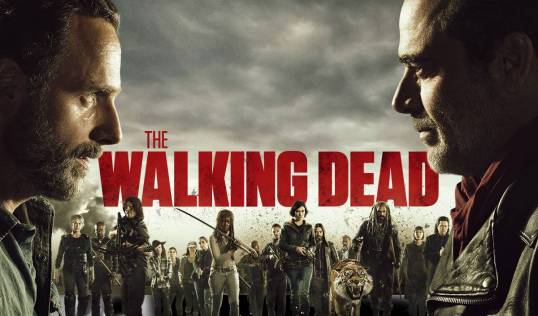
TV Review: The Walking Dead 8.9 “Honor” (dir by Greg Nicotero)


So, has everyone seen the latest episode of The Walking Dead?  If not, why are you reading this review?  I ask because, on another site that I write for, I’ve got two people bitching at me for revealing too many spoilers about the shows that I review and, as a result, I felt the need to post an apology to those people.  As far as apologies go, it was fairly passive-aggressive and I’d hate to have to be that insincere on this site.  So, in other words, if you haven’t watched the latest episode of The Walking Dead, don’t read this review.  Thanks!

(Okay, I think I’ve rambled on long enough that anyone who didn’t want spoilers should have left by now.)

On Sunday night, the eighth season of AMC’s The Walking Dead resumed and oh my God, I have got such mixed feelings about what I just watched.  Before I go any further, allow me to share something that I tweeted back in April of 2017:

In other words, I can’t say that I’m shocked that Carl’s dead.  In fact, to a certain extent, I kind of respect the show for following through as opposed to coming up with some last-minute contrivance to allow Carl to live.  At the same time, I do think that the death of Carl has robbed the show of some potentially intriguing future storylines.  In the comic, Carl is still alive and he’s even bonded a bit with Negan.  During Season 7, the show seemed to be laying the foundation for that storyline but apparently, Negan’s going to have to bond with some other kid now.  Maybe Henry.  Maybe Judith.

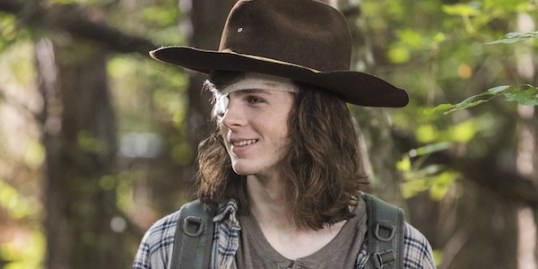
I guess the main thing that bothers me about Carl’s death is that I really do feel that it was mostly due to the fact that the show’s pace has slowed down to such an extent that Chandler Riggs was getting too old to play the role. The Walking Dead has been on the air for 8 seasons but how many years have actually passed in the show?  It’s hard to say but really, it doesn’t seem like Carl should be any older than 14 or maybe 15.  Meanwhile, Chandler Riggs is closing in on 19.  It’s hard not to feel that the show’s producers decided to kill Carl off rather than maybe just wrap up a few storylines and have season 9 open with a “Four years after the defeat of the Saviors” title card.

Myself, I’ve frequently gotten annoyed with Carl as a character, even though I’ve always appreciated Chandler Riggs’s performance.  That said, Carl was one of the few characters left on the show with room to grow.  Rick is never going to change.  If Negan does become the friendly gardener that we saw in Carl’s fantasy, it’s going to have more to do with expedience than anything else.  Carl, though, was still discovering who he was and what he believed.  The majority of the characters have spent the last three or four seasons in a rut.  By virtue of being young, Carl was one of the few characters who actually had a chance of breaking out of that rut.

I mean, to be absolutely honest, I always assumed that the show would end with Carl shooting Rick before he could reanimate.  If you go all the way back to season 1, that’s the ending that the show has appeared to be logically building up to.  Now, I guess Judith will have to do it.

As for the episode itself … again, my feelings were mixed.  This episode was determined to wring every last drop of emotion out of Carl’s passing.  When it worked, it was largely due to the performances of Riggs, Danai Gurira, and the always underrated Andrew Lincoln.  At the same time, there was a part of me that started to resent just how much the show dragged out Carl’s death.  I know that AMC likes to do “super-sized” episodes of The Walking Death but, in this case, I think this episode would have been more effective if it had just been an hour.  Yes, that single gunshot was heart-rendering but, up until I heard it, there was a part of me that feared the show was planning to drag Carl’s death out over the entire rest of the season.

While Carl was dying, Carol, Morgan, and a few other people went off to rescue Ezekiel.  Gavin, who was always one of the most obnoxious of the Saviors, is now dead and yay for that.  Morgan has apparently decided that he’s okay with killing people again.  Morgan also apparently now has Jason Voorhees-style super strength.

It wasn’t a bad episode, though it certainly didn’t carry the power that it would have carried if it had happened during the fourth or fifth season.  On the one hand, I’ve always appreciated the fact that anyone can die on The Walking Dead.  On the other hand, characters die so frequently (and then pop up on the Talking Dead to say goodbye) that it’s now easy to get cynical about the whole thing.

In fact, it may be too early to say whether The Walking Dead handled Carl’s death the right way.  It depends on how this all plays out.  Will the show use Carl’s death as an excuse to go off in an unexpected direction or will we promptly get back to Negan chuckling and Rick giving speeches?  I’m actually looking forward to next week, just because I’m interested in seeing which Rick we’re going to get.  Are we going to get the crazy Rick who appeared after Lori died or are we going to get the catatonic Rick who showed up after Negan executed Abraham and Glenn?  Or maybe it’ll be the return of the Stoic Rick who shot zombie Sophia because he knew he had no other choice.  Which Rick will it be?

We’ll find out next week … hopefully.


TV Review: The Walking Dead 8.8 “How It’s Gotta Be” (dir by Michael E. Satrazemis)


SPOILER ALERT!  DO NOT READ THIS REVIEW UNLESS YOU’VE WATCHED THE LATEST EPISODE OF THE WALKING DEAD!  SERIOUSLY, I’M NOT KIDDING!

Right now, I would say that 75% of The Walking Dead fandom is heartbroken.  The end of tonight’s episode has generated some very real angst among some people.

As for me, I’m actually feeling rather proud of myself because I predicted that all this would happen.  I predicted it way back on November 5th and I’ve even got the tweet to prove it.  But, before I go on, I think it might be good to consider the words of a song from 1965.  Here are the Poets with That’s Way It’s Got To Be:

See, it all gets back to what has always been the underlying theme of The Walking Dead.  Nobody is going to get out of this show alive.  It doesn’t matter how good you are.  It doesn’t matter how likable you are.  It doesn’t matter how much the audience loves you.  Everyone on this show is eventually going to die.  The only question is whether someone will be around to keep them from reanimating afterward.  Negan, Rick, Maggie, Carol, Daryl, Michonne, Eugene … none of them are going to get out of this alive.  Death will come for everyone eventually and tonight, it appears that it’s coming for Carl.

As I tweeted on November 5th…

Tonight’s episode featured a lot of Carl.  When Negan and the Saviors showed up at Alexandria and demanded that Rick be given to them, Carl is the one who offered to sacrifice his life so that the rest could live.  (And, of course, we now know why Carl was willing to do that.  He literally had nothing to lose.)  When the Saviors were blowing up Alexandria, we watched as Carl made his way through the flaming wreckage of his former home.  Throughout the show, we got flashbacks of Carl arguing with Rick about Rick’s harsh philosophy.  Tonight, we saw more of Carl then we’ve seen in a while and I spent the whole show assuming that meant that Carl was probably not going to come to a good end…

But still, it’s hard to overstate the emotional impact of seeing Carl there at the end, bitten by a walker and fighting to breathe.  As Chris Hardwick and Khary Payton stated at the start of Talking Dead, Chandler Riggs really did grow up over the past few seasons of The Walking Dead.  It’s always kind of been easy to make jokes at Carl’s expense.  Early on in the show, it always seemed inevitable that he would end up getting lost or picked up the by the wrong people.  Whenever I live tweeted those early seasons of The Walking Dead, I almost always suggested that the ideal solution to almost any problem would be to sacrifice Carl.  But tonight, Chandler Riggs showed why Carl has become a favorite of many fans of this show.  The episode ended with Carl still alive but fading.  Will he die?  I really don’t see how he can’t.  He’s been bitten on his side so it’s not like they can just chop off a limb, like they did with Herschel.  If the show is to have any integrity, Carl has to die and he will be missed.

Up until that final scene with Carl, tonight’s episode could have just as easily been called “Everyone Better Do What Rick Says.”  Darryl took it upon himself to crash that truck into wall of the Sanctuary, which is actually what Rick did not want him to do.  As a result, the Saviors escaped, were able to launch a counter attack, destroy Alexandria, and take over The Kingdom.  Carl, meanwhile, went off on his own, helped out Siddiq, and ended up getting bitten for his trouble.  From now on, everyone better listen to Rick.

Rick got the line of the night when he asked Negan, “Don’t you ever shut the Hell up?”  That’s something that I’ve been wondering for a season and a half now.  Tonight, Negan actually lived up to his fearsome reputation.  As for the other Saviors, Simon made me say, “Oh God, this fucking guy again…” as soon as he got out of that truck and Gavin came across like a teacher trying to control an unruly classroom.  I guess Dwight is officially a part of Rick’s group now.

This was sometimes a hard episode to watch, not because it was bad but because it literally took place in the dark.  All of the action played out at night and the show actually did good job of using the darkness to its advantage.  There was an eerie and horrible beauty to scenes of Alexandria burning to the ground.

But you know what?

In the end, all anyone is going to remember about this episode is that final scene with Carl.

That’s the way it’s got to be.

And with that, The Walking Dead is on hiatus.  Season 8 will resume in 2018 and so will our coverage!