Film Review: Free Fire (dir by Ben Wheatley)


Last night, I saw Free Fire, the latest film from the visionary British directing-and-screenwriting team of Ben Wheatley and Amy Jump.

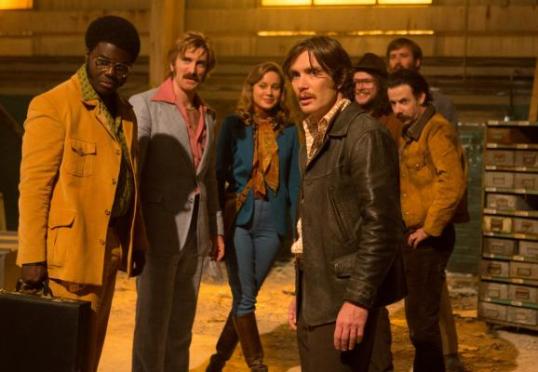
Free Fire takes place in Boston in the 1970s.  We know it’s the 70s because of all the wide lapels, the flared jeans, and the impressive facial hair.  In short, everyone looks like an extra from Thank God, It’s Friday.  Note that I said Thank God, It’s Friday and not Saturday Night Fever.  None of the characters in Free Fire could pull off John Travolta’s white suit.  As much as they try to pretend otherwise, everyone in this film is low rent.  No one is as clever or street smart as they believe themselves to be.  Even more importantly, no one is as good a shot as they think.

The film takes place in a decrepit warehouse, the type of place that is strewn with rats and hypodermic needles.  Chris (Cillian Murphy), Frank (Michael Smiley), Steve-O (Sam Riley), and Bernie (Enzo Cilenti) are members of the Irish Republican Army and they’ve come to the U.S. to purchases weapons.  Chris and Frank are no-nonsense professionals.  Bernie is a well-meaning moron.  Steve-O is a drug addict who, the previous night, got beaten up after he smashed a bottle across the face of a 17 year-old girl.

Working as intermediaries are Justine (Brie Larson) and Ord (Armie Hammer).  Justine specializes in keeping jumpy people calm.  She and Chris flirt as they wait for the guns to arrive.  As for Ord — well, let’s just say that Ord was my favorite character in the film.  He’s always calm.  He looks really good in a suit.  And, whenever things get intense, he’s always quick to light up a joint and make a sarcastic comment.  This is probably the best performance of Armie Hammer’s career so far.  (Or, at the very least, it’s the best performance of his that I’ve seen.  I hear that he gives an excellent performance in the upcoming Call Me By Your Name.)  Certainly, this is the first film that I’ve seen, since The Social Network, in which Hammer seemed to be truly worthy of the hype that has surrounded his career.

Finally, there’s the gun dealers themselves.  There’s Martin (Babou Ceesay), who seems to be fairly low-key professional.  There’s Gordon (Noah Taylor), who is a henchman who looks disconcertingly similar to Chris.  And then there’s Vernon, who is from South Africa and who is constantly talking and smiling.  Not surprisingly, Vernon is played by Sharlto Copley.  Finally, Harry (Jack Reynor) is a driver who desperately wants to impress Ord.  Harry loves John Denver and he also loves his cousin.  In fact, he loves his cousin so much that, when he recognizes Steve-O as the junkie who smashed a bottle across her face, Harry pulls a gun and starts firing.

The rest of the film deals with the resulting gun fight, which is complicated with two mysterious snipers (Patrick Bergin and Mark Monero) suddenly open fire on both of the groups.  Who hired them and why?  That’s a mystery that could be solved if everyone stops shooting and yelling at each other.  Of course, that’s not going to happen because 1) no one is a good enough shot to actually get the upper hand and 2) almost everyone in the warehouse is an idiot.

At it’s best, Free Fire mercilessly parodies the excessive violence of modern crime cinema.  When it comes to crime films, most people just remember the shoot outs so Free Fire takes things to their logical extreme by just being a 90-minute gun fight.  At its weakest, Free Fire occasionally becomes exactly what it’s parodying.  The film’s structure — one night in one location — proves to be limiting.  At times, you find yourself really wishing for a flashback or at least a little exposition to explain who everyone is outside of that warehouse.  The cast is full of good actors and they all give good performances but the characters are, at best, thinly drawn.  At times, it was difficult to keep track who was who.  I especially found myself mixing up Michel Smiley and Sharlto Copely.  It was all the facial hair.

About 30 minutes into Free Fire, I was already composing a bad review in my head but, by the final shot (and yes, the double meaning is totally intentional), Free Fire had won me over.  It’s an experiment that doesn’t really work but it’s so relentless and dedicated to seeing its story to its conclusion that I couldn’t help but appreciate the film’s efforts.  When the guns finally did stop firing and the end credits started, I was shocked to discover that, without even realizing it, I actually had gotten just a little caught up in the film’s story.

Ben Wheatley and Amy Jump previously gave us one of the most memorable films of the decade (so far), A Field in England.  Free Fire might not quite work but I’ll always make the time to see the latest from Wheatley and Jump.


Here’s The Red Band Trailer For Free Fire!


Hi, everyone!

When Jeff and I went to see Logan on Thursday night, one of the many trailers that played before the film was this red band one for Free Fire.  Free Fire is an action comedy, one that I think is meant to satirize the ultra violent heist films of the 90s and early aughts.  Seriously, there are parts of this trailer that should make Guy Ritchie cringe.

That said, this trailer is also about a minute too long.  At first, everyone in the theater thought it was kind of funny but then, around the two minute mark, the yawns started to kick in.  “Are they just going to shoot at each other for the entire trailer?” someone asked.

The answer is yes.  And you know what?  The trailer probably doesn’t do Free Fire justice because this movie was directed by Ben Wheatley and I’m still having dreams inspired by his oddly hypnotic A Field in England.  I’ll follow him anywhere!

Free Fire has a March 31st release date in the UK and an April 21st release date in the States.

Anyway, here’s the red band trailer for Free Fire!

Trailer: Predestination


predestination-review

The Spierig Brothers have been two filmmakers whose work has been coming in under the radar since their cult-favorite horror film Undead came out in 2003. They followed this up seven years later with the vampire dystopian film Daybreakers.

Both films have their moments but (IMO) failed to reach the level of the filmmakers’ ambitions for both films.

It’s now been four years since Daybreakers and the brothers have a new film out and it’s another ambitions project that tackles the themes of time paradox and predestination hence the title of the film.

Predestination made it’s premiere at this year’s SXSW festival is Austin, Texas. It has since made a limited run in the US since late August.

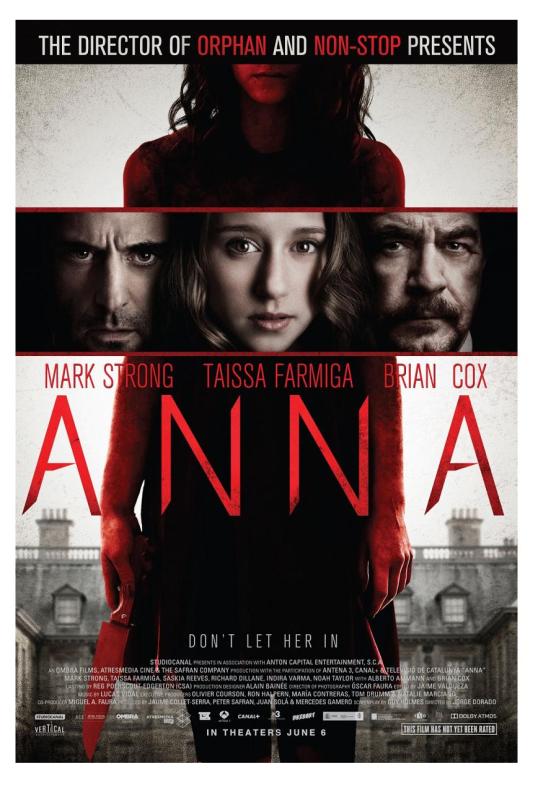
Film Review: Anna (dir by Jorge Dorado)


AnnaI just finished watching Anna, a Spanish thriller that was briefly given an American release way back in June.  Anna (which was produced under the title Mindscape) got fairly bad reviews, with many critics dismissing it as being a weak imitation of Inception.

Having now seen the film, I can say that, once again, the critics were wrong.

Oh, don’t get me wrong.  It’s obvious that without Inception, there never would have been an Anna.  But, as any fan of old school Italian horror can tell you, imitation is not necessarily a bad thing.  Anna may start out as a low-budget take on Inception but, by the end of the film, it has established its own unique identity.

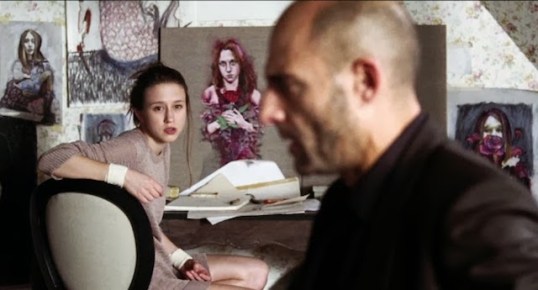
Anna tells the story of John (Mark Strong), a “memory detective.”  John has the power to enter into people’s memories, where he can search for clues to help people deal with psychological trauma and to occasionally help the police solve crimes.  At the start of the film, John is recovering from a trauma of his own.  After their son dies, his wife — who is also a memory detective — retreats so deeply into her memories that she can’t come back.  (Yes, I know.  It’s exactly like Inception.  Just be patient…)  While exploring the memories of an assault victim, John’s own memories start to intrude on the victim’s memories, leading to John having a stroke.

After John recovers from the stroke, he finds himself both financially destitute and emotionally unstable.  His boss (Brian Cox) takes sympathy on John and assigns him to what should be an easy case.  16 year-old Anna (Taissa Farmiga) is refusing to eat and her extremely wealthy parents want to know why.

John meets Anna and discovers that she’s a sarcastic, intelligent, and withdrawn teenager.  When John enters into her mind, he discovers memories of neglect and abuse.  The night after John first enters Anna’s memories, her nurse is pushed down a flight of stairs.  The nurse claims that Anna pushed her while Anna swears that she’s being framed.  Anna’s parents, meanwhile, have signed papers to have her committed, giving John just a few days to determine what’s behind Anna’s behavior.

Convinced that she’s innocent, John enters into Anna’s memories and searches for clues that will answer the question of whether Anna is a victim or a sociopath.  As he does so, he finds more and more evidence that Anna was abused.  However, he also starts to discover hints that there may be more to Anna’s memories than he originally realized.

Anna is a good and entertaining mystery of a film, one that takes its time telling its multi-layered story.  Jorge Dorado makes his directorial debut with Anna and he wisely emphasizes characterization and atmosphere above all else.  There’s a dream-like sense of menace that fills every frame of the film, casting a palpable feeling of unease over both John and the audience.  As a result of his work here, I’m definitely looking forward to seeing what Dorado does in the future.

Mark Strong is a talented and intelligent actor who has gotten typecast as a villain.  As such, it’s nice to see him actually get a chance to be the star for once.  Strong gives a sympathetic performance while adding just enough instability that the audience is never totally at ease with John.  The same can also be said of Taissa Farmiga, who gives a wonderfully ambiguous performance that makes Anna both innocent and destructive at the same time.  Anna keeps both John and the audience guessing until the very end of the film.

Anna is currently making the rounds on cable.  I would recommend keeping an eye out for it.

strong


Review: The Proposition (dir. by John Hillcoat)


When I first saw John Hillcoat’s film The Proposition I was literally shocked and dumbstruck with what I had just witnessed. As a long-time aficionado of the horror genre I could say that part of me has become desensitized to onscreen violence and nothing really shocks me. Even though I’ve seen films with more violence throughout its running time, The Proposition just had a heavy sense of despair, moral ambiguity, and a Miltonian feel throughout. The film felt like how it would be if one accepted an offer from one of the damned to stroll down to the Nine Circles of Hell. As much as I didn’t want to accept that offer the curiosity of what I might see won out. That’s how I was able to sit through the entirety of Hillcoat’s ultra-violent and nihilistic tale of lawless and amoral individuals in the untamed wilderness of 1880’s Australian Outback.

I must agree with several critics who have said The Proposition seemed to mirror another dark and violent tale. Hillcoat’s film shares so much the same themes and tone as Cormac McCarthy’s brutal novel, Blood Meridian, that one almost wondered if the film was adapted from McCarthy’s great novel. But similarities aside, Hillcoat and Nick Cave’s (director and writer respectively) film can clearly stand on its own two bloody legs.

The film begins with a bloody siege and shootout and we’re soon introduced to two of the three Burns’ brothers. We soon find out that both brothers, Charlie (played by Guy Pearce) and Mikey (played by Richard Wilson), are outlaws wanted for a multitude of heinous crimes with a recent one the senseless rape and murder of the Hopkins family. One Capt. Stanley (Ray Winstone) who acts as law in this particular area of the Outback also happens to be friends of the unfortunate Hopkins clan. When he finally apprehends the two brothers after the siege gives older brother Charlie a proposition. He’ll spare the younger brother’s life from the hangman’s noose if Charlie finds their older brother Arthur (played with Kurtz-like menace by Danny Huston) and kills the outlaw leader. The quest is set as Charlie accepts and sets out to find his elder brother. Whether Charlie will go through with killing his older brother Arthur is one thing the audience won’t find out until the final minutes of the film. Even though there’s no love-lost between Charlie and Arthur, there’s still the traditional bond of family that makes Charlie’s quest a complex one.

We realize early on that Charlie is very protective of his simpler, younger brother Mikey and would do anything to save his life. Guy Pearce does a great performance as the conflicted and brooding Charlie Burns. There’s a quiet intensity in Pearce’s performance. He’s pretty quiet through most of the film, but one could feel the palpable rage just roiling beneath his brooding countenance. Pearce’s Charlie is one who is only a trigger away from exploding into outright violence. Charlie is definitely a child and creation of the lawless Outback the film is set in.

Arthur Burns on the other hand comes in introduced as an almost warrior-poet (though in this story it would be more like a charismatic-sociopath) who would watch the sun set and spout poetry as easily as gun down an innocent or slice a man’s throat without missing beat. Danny Huston does a bravura performance as the charismatic and wholly amoral Arthur. His performance easily matches that of Pearce’s scene for scene. Another performance that I must point out as being very strong in the film is Ray Winstone as Capt. Stanley, the Ahab of the tale with his obsession to bring civilization to the lawless Outback and to bring Arthur Burns to ultimate justice even if it means dealing with the lesser evil that is Charlie Burns.

The Proposition will be talked about alot for its unflinching look at violence onscreen. Though there’s been films that have more violence per hour than Hillcoat’s film, but the extreme brutality of the killings, maimings and rape in The Proposition has such an air of realism to it that one cringes at every gunshot wound and knife slashing. Like Aronofsky’s Requiem for a Dream, this film’s scenes of violence makes one want to rush into the shower and cleanse off the dirt, grime and stink of the film. It’s in this unflinching and realistic portrayal of death and violence that the film shares alot with McCarthy’s Blood Meridian. The images are difficult to watch, but our curiosity makes us look through squinted eyes to see the full breadth of the violence. In time, just through the audiences acceptance of the oncreen violence do we soon become complicit in whats going on the screen.

It is a shame that The Proposition had such a limited release in the US. Even since it’s release on video it’s a film that still seems to be underappreciated. I think this film would’ve done as well as Eastwood’s Unforgiven in giving the audience a different, darker side of the Old West mythology (though its really the Australian Old West). John Hillcoat has crafted himself a brutal and nihilistic film that’s very hard to watch but also difficult to ignore. The Proposition is a film I highly recommend as it is the type of film that helps redefine a whole genre.