This week’s edition of Lisa Marie’s Favorite Grindhouse trailers is dedicated to Umberto Lenzi, who was born, on this date, in 1931. Lenzi was one of the most prolific of the Italian directors who came to prominence in the 60s, 70s, and 80s. A craftsman at heart, he directed films in every genre. Admittedly, he was never quite the critical favorite that Argento, Margheriti, Deodato, Bava, Fulci, and Soavi were. That’s a polite way of acknowledging that Umberto Lenzi was responsible for a few very bad films. But he directed some good ones, as well. Even if he’s not as acclaimed as some of his contemporaries, I think every Italian horror fan has at least one or two Lenzi films that they will happily defend to the grave.
Today, in honor of Lenzi’s life and work, here are 6 trailers for 6 Umberto Lenzi films! These trailers, by the way, could be considered NSFW so watch them at your own discretion.
Spasmo (1974)
I will be the first to admit that I have shared this trailer quite often on this site. What can I say? I just love the way everyone keeps going, “Spasmo! Spamso!” Spasmo is giallo, one with the a plot that will keep you guessing.
2. The Tough Ones (1976)
Though Lenzi is probably best-remembered for his horror films, he also directed his share of violent, French Connection-inspired crime films. The Tough Ones is a good example.
3. From Corleone to Brooklyn (1979)
From Corleone to Brooklyn is another one of Lenzi’s crime films. While Corleone is a town in Sicily, there’s little doubt that the main purpose of the title was to trick people into thinking that this film was somehow connected to The Godfather.
4. Eaten Alive (1980)
Eaten Alive was one of the many cannibal films that Lenzi directed. This is actually one of the better examples of that rather icky genre. It’s certainly superior to Lenzi’s own Cannibal Ferox. Ivan Rassimov as Jim Jones turns out to be perfect casting. The trailer below is actually an edited version of the original trailer.
5. Nightmare City (1980)
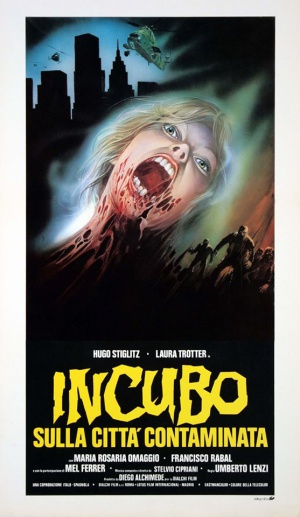
This was Lenzi’s best-known contribution to the zombie genre. Uniquely, for the time, Lenzi’s zombies were fast and clever. The film was not acclaimed when it was originally released but it has since been cited as an influence on many recent zombie films. This is probably Lenzi’s most effective film as a director, even if the ending will probably have you rolling your eyes.
6. Nightmare Beach (1989)
Finally, in one of his final films, Lenzi brought together the spring break genre with the slasher genre. There’s some debate over how much of this film was directed by Lenzi and how much by a mysterious figure known as Harry Kirkpatrick. When I reviewed this film and mentioned the controversy, the film’s star, Nicolas De Toth, replied that Lenzi was definitely the one who directed. As he would definitely be in the best position to know, that’s good enough for me!
Since Case just reviewed 28 Days Later, this seems like the perfect time to say a few words about the 1980 Italian horror film, Nightmare City! Though Nightmare City has never been as critically acclaimed or as popular with audiences, it is regularly cited as probably being one of the main inspirations for 28 Days Later.
Now, don’t get me wrong. I can’t say for sure whether it was an influence or not. I listened to the entire Danny Boyle/Alex Garland commentary track on my DVD of 28 Days Later and neither of them ever mentioned Nightmare City. As well, there are some pretty big differences between Nightmare City and 28 Days Later. For one thing, 28 Days Later is a hyperkinetic Danny Boyle film whereas Nightmare City is obviously an Umberto Lenzi film, filled with over the top gore, gratuitous nudity, and nonstop violence. For that matter, the Infected in 28 Days Later still look human whereas all of the infected humans in Nightmare City are covered with what appears to be burned oatmeal. (I’m going to guess that it’s meant to be radiation scarring.)
And yet, despite all of that, it’s impossible to watch Nightmare City without thinking about 28 Days Later and vice versa. Both Nightmare City and 28 Days Later are commonly mislabeled as being zombie films, despite the fact that both of them are about people who have been driven mad by a military accident/experiment. Where you really see the influence that Nightmare City had on 28 Days Later is in the scenes in which various “infected” humans run through the streets, savagely attacking and killing anyone that they come across. For all the attention that was given to 28 Days Later‘s “fast zombies,” Nightmare City got there first. Call them human, call them infected, or call them zombies, the monsters in Nightmare City are relentless, unstoppable, and blood thirsty. Whatever flaws the movie may have, Nightmare City‘s zombies truly do belong in a nightmare.
(Except for that one scene in which a zombie extra is seen to be kicking a soccer ball while a dog chases after him but you have to look closely to notice…)
But before I say too much more about Nightmare City, I’m going to ask you to watch this tribute to the hero of Nightmare City, journalist Dean Miller:
Dean Miller was played by Spanish actor Hugo Stiglitz. (If that name sounds familiar, it may be because Quentin Tarantino named a character after him in Inglourious Basterds.) To be honest, the first time I ever saw Nightmare City, I thought that Stiglitz’s performance was one of the worst in the history of horror cinema. No matter how violent or bloody the film gets, Stiglitz rarely seems to react. He might occasionally arch an eyebrow. But, for the most part, he doesn’t seem to care. But, after subsequent viewings, I’ve come to respect the fact that, while everyone else in the film was overacting, Siglitz distinguished himself by refusing to act at all.
Nightmare City is a relentless and nonstop film. It starts out with Dean Miller being sent down to the local airport. His job is to cover the arrival of a scientist who has been assigned to investigate a recent nuclear accident. From the minute that the plane lands and a horde of hatchet-wielding zombies stream out onto the tarmac, Nightmare City is nonstop mayhem.
And, quite frankly, a lot of it doesn’t make much sense. At one point, the zombies enter a television studio and attack what appears to be the most boring dance show in the world and, as bloody and borderline disgusting as the action got, I still couldn’t get over how boring the dance show was before the zombies showed up. The other thing that struck me about that scene was that nobody at the television studio seemed to be that upset about a bunch of radiation-scarred zombies literally massacring hundreds of people on camera. Dean may have arched an eyebrow but even he didn’t seem that concerned.
(Fortunately, Dean manages to escape by grabbing a TV and throwing it at the zombies. Apparently, televisions explode if you throw them, even if they’re not plugged in at the time.)
Then the zombies attack a hospital and it’s the hospital attack that always disturbs me. There’s a scene where a nurse comes across a zombie raiding a blood bank and he shakes his head almost apologetically. Oddly, almost all of the doctors turn out to be self-defense experts. One elderly doctor even throws a scalpel at a zombie with all the skill of an Agent of SHIELD (or perhaps even …. HYDRA!)
Meanwhile, the military is supposed to be doing something but I’m not sure what. We get a lot of scenes of a general (played by Lenzi regular Mel Ferrer) staring down at a model of the city but he doesn’t ever actually seem to do anything. His assistant, meanwhile, is worried about his sculptor girlfriend being at home alone. He should be since there are two zombies in the basement, though we’re never quite sure how they got there without anyone else in the house noticing.
And the mayhem continues. There’s a zombie priest. There’s a zombie attack at an amusement park. There’s many scenes of Hugh Stiglitz staring off in the distance. At one point, his girlfriend falls off a roller coaster and we are briefly amazed at the sight of an obviously fake dummy crashing to the pavement below. But fear not because … it’s all a dream!
That’s right, Dean Miller wakes up in bed!
OH MY GOD, LISA, YOU JUST SPOILED THE MOVIE!
No, I didn’t. Believe it or not, the movie’s nowhere close to being over yet…..
Nightmare City is a hard film to review because, while it might not be good in any traditional sense, it’s also very much a one-of-a-kind movie. This is one of those relentless and shameless exploitation films that works despite itself. It’s preposterous, it’s silly, it’s often offensive, and yet it’s never less than watchable. If you’re into Italian horror, you have to see this film. If you’re into zombie cinema, you have to see this film. (If you’re not into either, you probably stopped reading this review a while ago.)
And, while you watch it, I dare you not think about 28 Days Later…
So, last week at this time, I asked you which movie I should watch on March 20th. I gave you twelve possible movies and I asked you to vote. 678 votes were cast and, despite strong showings by An Education, Crazy/Beautiful, and Nightmare City, the winner is Valley of the Dolls!
And for that, I thank you. As some of you may know, my dream is to someday play Neely O’Hara in a remake directed by our own Arleigh Sandoc.
I will be watching Valley of the Dolls tonight. Look for my review of it either on Wednesday or Thursday.
Well, here’s your chance to, once again, tell me what to do. I’ve randomly selected 12 films from my film collection. Whichever film gets the most votes will be watched and reviewed by me next Tuesday, March 20th.
Here are the films up for consideration:
1) Black Jesus (1968) — This Italian film stars Woody Strode as an African rebel leader who is captured by his country’s right-wing, American-backed dictatorship.
2) Capote (2005) — Philip Seymour Hoffman was an Oscar for best actor for playing writer Truman Capote in this film that details how Capote came to write his true crime classic, In Cold Blood. This film was also nominated for best picture.
3) Chappaqua (1966) — In this underground cult classic, drug addict Conrad Rooks seeks treatment in Switzerland while being haunted by a scornful William S. Burroughs. This film features cameo from Allen Ginsberg, The Fugs, and just about every other cult figure from 1966.
4) Crazy/Beautiful (2001) — Jay Fernandez and Kirsten Dunst have lots and lots of sex. This was like one of my favorite movies to catch on cable back when I was in high school. 🙂
5) An Education (2008) — In my favorite movie from 2008, Carey Mulligan is a schoolgirl in 1960s England who has a secret affair with an older man (played by Peter Sarsgaard), who has plenty of secrets of his own. Co-starring Rosamund Pike, Emma Thompson, Alfred Molina, and Dominic Cooper (who is to die for, seriously).
6) Female Vampire (1973) — In this atmospheric and ennui-filled film from the infamous Jesus Franco, a female vampire spends the whole movie wandering around naked and dealing with the lost souls who want to join the ranks of the undead.
7) Nightmare City (1980) — In this gory and fast-paced film from Umberto Lenzi, an accident at a nuclear plant leads to a bunch of blood-thirsty zombies rampaging through both the city and the countryside. Hugo Stiglitz plays Dean Miller, zombie exterminator! Nightmare City is probably most remembered for introducing the concept of the fast zombie and for serving as an obvious inspiration for Danny Boyle’s 28 Days Later.
8) The Other Side of Midnight (1977) — Based on a best-selling novel, The Other Side of Midnight tells the story of a poor French girl who becomes a world-famous actress and who ends up sleeping with apparently every wealthy man in the world. Meanwhile, the man she loves ends up marrying Susan Sarandon. Eventually, it all ends with both a hurricane and a murder. Apparently, this film cost a lot of money to make and it was a notorious box office bomb. It looks kinda fun to me.
9) Peyton Place (1957) — Also based on a best-selling novel, Peyton Place is about love, sex, and scandal in a small town. Lana Turner is a repressed woman with a past who struggles to keep her daughter from making the same mistakes. At the time it was made, it was considered to be quite racy and it was even nominated for best picture. This film is a personal favorite of mine and it’s pretty much set the template for every single film ever shown on Lifetime.
10) Rosebud (1975) — From director Otto Preminger comes this film about what happens when a bunch of rich girls on a yacht are taken hostage by Islamic extremists. The film’s diverse cast includes Peter O’Toole, Richard Attenborough, Cliff Gorman, former New York Mayor John Lindsay, former Kennedy in-law Peter Lawford, Raf Vallone, Adrienne Corri, Lalla Ward, Isabelle Huppert, and Kim Cattrall.
11) Valley of the Dolls (1967) — Oh my God, I love this movie so much! Three aspiring actresses move to the big city and soon become hooked on pills and bad relationship decisions. Every time I watch this movie, I spend hours yelling, “I’m Neely O’Hara, bitch!” at the top of my lungs.
12) Zombie Lake (1981) — From my favorite French director, Jean Rollin, comes this extremely low budget film about a bunch of Nazi zombies who keep coming out of the lake and attacking the nearby village. Some people claim that this is the worst zombie films ever made. I disagree.
Please vote below for as many or as few of these films as you want to. The poll will remain open until March 20th and whichever film gets the most votes will be watched and reviewed by me.
I love movies and I love books so I guess it would stand to reason that I love books about movies the most of all. (I also love movies about books but there are far fewer of those, unfortunately.) Below are my personal favorites. I’m not necessarily saying that these are the ten greatest film books ever written. I’m just saying that they’re the ones that I’m always happy to know are waiting for me at home.
10) Soon To Be A Major Motion Pictureby Theodore Gershuny — This is one of the great finds of mine my life. I found this in a used bookstore and I bought it mostly because it only cost a dollar. Only later did I discover that I had found one of the greatest nonfiction books about the shooting of a movie ever written! Gershuny was present during the filming of a movie called Rosebud in the early 70s. I’ve never seen Rosebud but, as Gershuny admits, it was a critical disaster that managed to lose a ton of money. The book provides a fascinating wealth of backstage gossip as well as memorable portraits of director Otto Preminger and actors Robert Mitchum (who was originally cast in the lead role), Peter O’Toole (who took over after Mitchum walked off the set), and Isabelle Huppert. If nothing else, this book should be read for the scene where O’Toole beats up critic Kenneth Tynan.
9) Suspectsby David Thomson — A study of American cinema noir disguised as a novel, Suspects imagines what would happen if George Bailey from It’s a Wonderful Life fell in love with Laura from the movie of the same name. Well, apparently it would lead to Sunset Boulevard’s Norma Desmond having an affair with Chinatown’s Noah Cross and to one of George’s sons, sensitive little Travis, getting a job in New York City as a Taxi Driver. And that’s just a small sampling of what happens in this glorious mindfuck of a novel.
8 ) Profondo Argentoby Alan Jones — Long-time fan Alan Jones examines each of Dario Argento’s films (even Argento’s obscure historical comedy The Five Days of Milan) and proceeds to celebrate and (in many cases) defend Argento’s career. Jones also interviews and profiles several of Argento’s most frequent collaborators — Daria Nicolodi, Asia and Fiore Argento, Simon Boswell, Claudio Simonetti, Keith Emerson, George Romero, Lamberto Bava, Michele Soavi, and many others. Jones’ sympathetic yet humorous profile of Luigi Cozzi is priceless.
7) Spaghetti Nightmaresby Luca Palmerini — Spaghetti Nightmares is a collection of interviews conducted with such Italian filmmakers as Dario Argento, Ruggero Deodato, Umberto Lenzi, Lucio Fulci, and others. Among the non-Italians interviewed are Tom Savini (who, as always, comes across as appealingly unhinged) and David Warbeck. (Sadly, both Warbeck and Fulci would die shortly after being interviewed.) What makes this interesting is that, for once, Argento, Fulci, et al. are actually being interviewed by a fellow countryman as opposed to an American accompanied by a translator. As such, the subsequent interviews turn out to be some of the most revealing on record.
6) Sleazoid Expressby Bill Landis and Michelle Clifford — Landis and Clifford’s book is both a history and a defense of the old grindhouse theaters of New York City. Along with describing, in loving and memorable detail, some of New York’s most infamous grindhouses, they also write about some of the more popular movies to play at each theater. Along the way, they also offer up revealing profiles of such legendary figures as David Hess and Mike and Roberta Findley. Reading this book truly made me mourn the fact that if I ever did find myself in New York City, I won’t be able to hit the old grindhouse circuit.
5) Beyond Terror: The Films of Lucio Fulciby Stephen Thrower — Fulci has always been a terribly underrated director and, indeed, it’s easy to understand because, in many ways, he made movies with the specific aim of alienating and outraging his audience. It requires a brave soul to take Fulci on his own terms and fortunately, Stephen Thrower appears to be one. Along with the expected chapters on Fulci’s Beyond Trilogy and on Zombi 2, Thrower also devotes a lot of space to Fulci’s lesser known works. Did you know, for instance, that before he became the godfather of gore, Fulci specialized in making comedies? Or that he also directed two very popular adaptations of White Fang? Thrower also examines Fulci’s often forgotten westerns as well as his postapocalyptic sci-fi films. And, best of all, Thrower offers up a defense of the infamous New York Ripper that, when I read it, actually forced me to consider that oft-maligned film in a new light. That said, Thrower does admit to being as confused by Manhattan Baby as everyone else.
4) Immoral Talesby Cathal Tohill and Pete Toombs — Tohill and Toombs offer an overview of European “shock” cinema and some of the genre’s better known masters. The book contains perhaps the best critical examination of the work of Jean Rollin ever written. The authors also examine the work of Jesus Franco and several others. This is a great book that reminds us that the Italians aren’t the only ones who can make a great exploitation film.
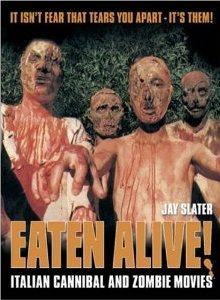
3) Eaten Aliveby Jay Slater — This book offers an overview of the Italian film industry’s legendary cannibal and zombie boom. Along with reviewing every Italian movie to feature even the slightest hint of cannibalism or the living dead (this is one of the few books on Italian cinema that discusses both Pasolini and Lucio Fulci as equals), Eaten Alive also features some very revealing interviews with such iconic figures as Catriona MacColl, Ian McCullough, and especially Giovanni Lombardo Radice. Radice, in fact, also contributes a memorable “guest” review of one of the movies featured in the book. (“What a piece of shit!” the review begins.) Memorable reviews are also contributed by Troma film founder Lloyd Kaufman who brilliantly (and correctly) argues that Cannibal Holocaust is one of the greatest films ever made and Ramsey Campbell who hilariously destroys Umberto Lenzi’s infamous Nightmare City.
2) The Book of the Deadby Jamie Russell — If, like all good people, you love zombies then you simply must do whatever it takes to own a copy of this book. Starting with such early masterpieces as White Zombie and I Walked With A Zombie, Russell proceeds to cover every subsequent zombie film up through George Romero’s Land of the Dead. Russell offers up some of the best commentaries ever written on Romero’s Dead films, Fuci’s Beyond Trilogy, Rollin’s Living Dead Girl, and Spain’s Blind Dead films. The pièce de résistance, however, is an appendix where Russell describes and reviews literally ever zombie film ever made.
1) All The Colors Of the Darkby Tim Lucas — This is it. This is the Holy Grail of All Film Books. If you’ve ever asked yourself if any book is worth paying close to 300 dollars, now you have your answer. This one is. Tim Lucas offers up the most complete biography of director Mario Bava ever written. In fact, this may be the most complete biography of any director ever written! Lucas examines not only Bava’s life but also every single movie that Bava was ever in any way connected to, whether as a director or as a cameraman or as the guy in charge of the special effects. This is 1,128 pages all devoted to nothing but the movies. This is the type of book that makes me thankful to be alive and I owe a huge debt of gratitude to Tim Lucas for writing it.




 Through the Shattered Lens