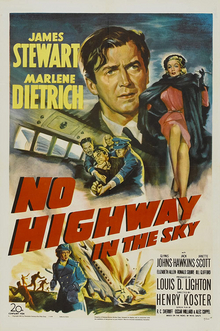
Film Review: No Highway In The Sky (dir by Henry Koster)


In 1951’s No Highway In The Sky, James Stewart stars as Dr. Theodore Honey.

In many ways, Theodore Honey is similar to the other roles that Stewart played after he returned from serving in World War II.  Dr. Honey is intelligent, plain-spoken, and good-hearted.  He’s eccentric and he sometimes has a difficult time relating to other people.  He’s also deeply troubled.  Dr. Honey is an engineer, one who specializes in determining how many hours an airplane can fly before it starts to fall apart.  Dr. Honey is in England, working for an airline and testing his hypothesis that their newest model’s tail will fall off after the plane accumulates a specific number of hours.  As is usually the case with these things, Dr. Honey’s employers are skeptical about his claims.  There’s a lot of money to be made in air travel and the last thing they need is some eccentric American scaring everyone.

When Honey sets out to investigate a recent crash site, he finds himself on the same type of airplane that he’s been testing.  After the plane takes off, Dr. Honey talks to the pilots and discovers, to his horror, that the plane is closing in on the time limit.  While flight attendant Marjorie Corder (Glynis Johns) tries to keep him calm, Dr. Honey explains his theory to a film star named Monica Teasdale (Marlene Dietrich), who just happens to be a passenger on the flight.  Both Marjorie and Monica find themselves falling in love with Dr. Honey and who can blame them?  He may be an eccentric and it may be hard to follow what he’s talking about but he’s still Jimmy Stewart!

I’ve often thought that Stewart was “Jimmy” before World War II but he was definitely James afterwards.  Stewart, unlike a lot of Hollywood stars who enlisted and were then used solely for PR purposes, actually flew several combat missions and saw firsthand the devastation of the war.  He returned to America deeply disturbed by what he had seen and there’s a definite sense of melancholy to be found in all of Stewart’s post-war performances.  That’s certainly the case here.  Dr. Honey is a widower, his wife having been killed by a rocket attack during the war.  He’s raising his 12 year-old daughter on his own and he deals with his sadness by throwing himself into his work.  He’s someone who has seen and experienced great tragedy firsthand and it’s left him more than a little obsessed. There’s a very authentic sadness at the heart of Stewart’s performance and it elevates this film, making what could have been a by-the-book corporate thriller into a character study of a man standing at the dawning of a new age, the post-war era of commercial air travel, and saying, “Well, hold on one minute.”

Unfortunately, Honey’s obsessive nature makes it easy for some to dismiss him.  When Dr. Honey purposefully sabotages the plane to keep it from flying again, he finds himself forced to defend his actions.  Can he prove that his theory is true?  And who will he end up falling in love with?  You can probably guess the answers but it doesn’t matter if the latter half of the film is a bit predictable.  James Stewart’s performance carries the film and keeps you watching.
Film Review: The Shoes of The Fisherman (dir by Michael Anderson)


The 1968 film, The Shoes of The Fisherman, opens in a snowy Siberian labor camp.  For the past twenty years, this camp has been the home of Kiril Pavlovich Lakota (Anthony Quinn), the Ukrainian archbishop of Liviv.  Kiril is unexpectedly released by Russia’s new leader, Piotr Ilyich Kamenev (a very British Laurence Olivier).  After explaining to Kiril that Russia and China are on the verge of nuclear war due to a famine that has been instigated by U.S. sanctions, Kamenev tells Kiril that he is being released on the condition that he tell no one about the conditions at the Russian labor camp.  Kiril starts to protest just for Father Telemond (Oskar Werner), the Vatican’s representative, to say that the conditions have already been agreed to.

In Rome, Kiril meets the Pope (John Gielgud), who makes the humble Kiril a cardinal, over Kiril’s objections that he just a “simple man.”  Later, when the aged Pope suddenly dies, Kiril is unexpectedly elected, as a compromise candidate, to succeed him.  Still humble and considering himself to be a simple man with a simple mission, Kiril suddenly finds himself as one of the most revered and powerful men on the planet.  With Father Telemond as his secretary, Kiril tries to make the Vatican responsive to the needs of the people and sets out to bring peace between the Russians and the Chinese. That turns out to be easier said than done, especially when Telemond himself is eventually accused of heresy for his progressive views.

(And yes, Telemond is a Jesuit….)

The Shoes of the Fisherman is a type of film that should be familiar to anyone who has any knowledge of the Hollywood studios in the 60s.  It’s the type of big and self-serious film that was meant to tell audiences, “You won’t find anything this opulent and important on television!”  The cast is designed to appeal to everyone.  Anthony Quinn and Laurence Olivier are there for the older viewers (especially the older viewers who made up the majority of the Oscar voters in 1968) while, for the younger voters, there’s handsome Oskar Werner as a Jesuit who interpretation of the Gospels is so radical that even Pope Francis would probably tell him to step back a little.  For the older, anti-communist viewers, there are scenes that portray the harsh conditions at a Siberian labor camp.  The commies put Kiril in prison so he must be one of the good guys.  And for the younger, more liberal viewers, there was the suggestion that the threat of World War III was largely due to the actions of the American government.  And, just in case there was still anyone who thought that television was preferable to a prestige picture, TV star David Janssen shows up as a cynical reporter whose wife (played by Barbara Jefford) is a doctor who Kiril helps to get some medicine for one of her dying patients.  Director Michael Anderson includes enough sudden zoom shots to let younger viewers know that he’s with them while still directing in a stately enough manner to appeal to the older viewers.

The end result is a film that is big and grand but also rather slow.  The film gets bogged down in subplots that don’t really add much to the overall story.  We spend way too much time with the reporter and his wife.  Anthony Quinn does a good enough job as Kiril, giving a rather subdued performance by Quinn standards.  (A scene where Kiril recites a Jewish prayer for a dying man is wonderfully acted by Quinn, who seems to truly be emotionally invested in the film’s message of togetherness.)  Laurence Olivier is not at all convincing as a Russian but still, he has the stately bearing of a man used to being in power.  Like many of the studio productions of the late 60s, The Shoes of The Fisherman tries a bit too hard to strike a balance between old school Hollywood and the counterculture and the film ultimately feels rather wishy-washy as a result.  It’s a noble film with good intentions but it’s not particularly memorable.

Horror On TV: The Veil Episode 11 “Jack the Ripper” (dir by David MacDonald)


For our final episode of The Veil, we have a look at one of the most infamous real world monsters of all time, Jack the Ripper.

In this atmospheric episode, a London clairvoyant (Niall MacGinnis) is haunted by visions of the Whitechapel murders.  Unfortunately, his attempts to help the police only leads to them treating him like a suspect!  Each episode of The Veil was usually described as being “based on a true story.”  In this case, it’s actually true.  A medium named Robert Lees — renamed Walter in this episode — actually did go to the police with claims that he had seen the murders and could identify the killer.

This is the only episode of The Veil in which Boris Karloff acts only as host.  That’s because this episode was not originally made for the series.  Instead, it was intended for an unrelated British anthology show.  The producers of the Veil later bought the episode and tacked on an introduction by Boris Karloff.  Of course, because The Veil itself never actually aired on television as a result of the production company running into financial problems, Jack the Ripper never aired in the U.S.  It was, however, later included in an anthology film that was put together using four episodes of The Veil.

Enjoy!  That’s it for The Veil.  Tomorrow, we start a whole new series!

Lisa Reviews An Oscar Nominee: 49th Parallel (dir by Michael Powell)


Hello and welcome to the TSL’s continuing coverage of Oscar Sunday!  Today, along with some other Oscar-related things, I’m going to post reviews of some of the films that have been nominated for best picture over the years!  Let’s start things off with the 1941 Best Picture nominee, 49th Parallel!

Before anything, I should clear up some confusion about this film.  This is a British film about Nazis trying to reach the border between Canada and the U.S.  When it was first released in the UK, it was named after the coordinates of the border.  However, in the actual film, the Nazis never actually go to the 49th Parallel.  Instead, the film concludes at Niagara Falls.  However, it was probably reasonable assume that British audiences would not necessarily know or care whether Niagara Falls was actually located on the 49th Parallel.  Considering that they were currently at war with Germany, they had more important things to concern themselves with.

However, it was apparently felt that American audiences would notice that Niagara Falls wasn’t actually located on the 49th Parallel.  (Personally, I think the British may have been giving us too much credit.)  So, when the film was released in the United States, the title was changed to The Invaders.  When the film was subsequently nominated for Best Picture, it was nominated under the name The Invaders.  I’ve actually come across some online sources that claim that The Invaders and 49th Parallel are two separate films.  No, they’re the same film, it’s just that the film in question has two different titles.  Out of respect to the people who actually made the movie, I’ve decided to use the original title in this review.

When watching 49th Parallel (it’s available on YouTube), it helps to know something about history.  Today, there’s a tendency to overlook the fact that World War II had already been raging for nearly two years before the United States got involved.  Though the U.S. was an ally to Britain, it remained officially neutral until the Japanese bombed Pearl Harbor.  Up until that moment, many prominent Americans were isolationists and took the attitude that the war was Europe’s problem.  (On the other hand, Canada, as a Dominion of the British Empire, followed Britain into the war in 1939.)  Though the 49th Parallel may have been a British film that was largely set in Canada, it was also meant to frighten Americans and hopefully bring them over to the British side.

(When interviewed about the film, screenwriter Emeric Pressbruger said, “”Goebbels considered himself an expert on propaganda, but I thought I’d show him a thing or two.”)

Directed by Michael Powell, 49th Parallel opens with a German U-boat creeping into the waters around Canada.  The Nazis are hoping to disrupt shipping operations but it turns out that they’re no match for the Royal Canadian Navy.  (GO CANADA!)  When the U-boat sinks into the Hudson Bay, only six Nazis manage to survive.  Led by the arrogant Lt. Hirth (Eric Portman), the Nazis attempt to make their way to the border and to the safety of America.

Of course, it doesn’t turn out to be an easy journey.  Not only are the Germans in an unfamiliar country but they also keep running into Canadians.  Without fail, nearly every Canadian they meet is polite but willing to fight and die for his country.  The Canadians themselves are played by actors who, in the 40s, would have been familiar faces.  Laurence Olivier plays a fur trapper, getting top-billing for his cameo appearance.  Raymond Massey, who was best known for playing Abraham Lincoln, shows up as a Canadian solider.  Leslie Howard is the writer who discovers that Nazis have no respect for art.  Anton Walbrook is a German-Canadian farmer who rejects the attempts of Lt. Hirth to bring him over to the Nazi side.  The Canadians are so sympathetic that one of the Nazis is even moved to reject the Third Reich and is promptly executed by his compatriots, showing the audience the foolishness of hoping that the “good Germans” would ever be able to overthrow the bad ones.

It’s pure propaganda but it’s anti-Nazi propaganda so that’s not really a problem.  Powell keeps the story moving at a steady pace and all of the actors get impassioned performances.  You can tell this movie was more than just a job for them.  Instead, it was their way of fighting for their country and hopefully inspiring others to join in the battle against Hitler.  The film is both a love letter to Canada and a plea to the United States to renounce neutrality.  (Interestingly enough, by the time 49th Parallel made it to U.S. screens, America had finally declared war on the Axis Powers.)

49th Parallel was nominated for best picture but it lost to another World War II propaganda film, Mrs. Miniver.

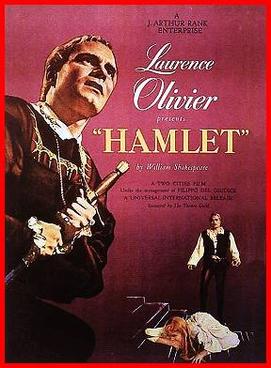
Lisa Reviews An Oscar Winner: Hamlet (dir by Laurence Olivier)


(With the Oscars scheduled to be awarded on March 4th, I have decided to review at least one Oscar-nominated film a day.  These films could be nominees or they could be winners.  They could be from this year’s Oscars or they could be a previous year’s nominee!  We’ll see how things play out.  Today, I take a look at the 1948 best picture winner, Hamlet!)

Hamlet is a film of firsts.

It was the first British production to win the Oscar for Best Picture.  In winning, it beat out three American films (Johnny Belinda, The Snake Pit, and The Treasure of the Sierra Madre) and one other British film (The Red Shoes).

It was also the first adaptation of Shakespeare to win Best Picture.  Of course, it wasn’t the first Shakespeare adaptation to be nominated.  That honor would go to 1935’s A Midsummer Night’s Dream.  Adaptations of Romeo and Juliet would be nominated in 1936, 1961, and 1968.  Henry V (which, like Hamlet, was directed by and starred Laurence Olivier) was a 1946 nominee.  Then there was 1953’s Julius Caesar.  The Dresser featured scenes from Shakespeare.  Shakespeare in Love imagined the circumstances behind the writing of Romeo and Juliet.  However, Hamlet was the first to win.

It also remains the only traditional Shakespearean adaptation to win.  West Side Story updated Romeo and Juliet while Shakespeare in Love … well, let’s just not get into it.

It was the first Best Picture winner to be directed by the man starring in the movie.  Laurence Olivier was nominated for both Best Director and Best Actor.  He lost the directing Oscar to John Huston but he won for his performance as Hamlet.  In winning, he became the first actor to direct himself to an Oscar.

Finally, Hamlet was the first of 24 films to feature both Peter Cushing and Christopher Lee!  In fact, this was Lee’s film debut.  Now, before anyone gets too excited, I should point out that Cushing and Lee don’t actually interact.  In fact, Lee doesn’t even speak in the film.  He appears in the background as a Spear Carrier and it’s pretty much impossible to spot him.  He has no dialogue and wasn’t even listed in the final credits.  From what I’ve read, I don’t think Lee and Cushing even knew each other at the time and, when they later met, they were surprised to learn that they had both appeared in the film.  For his part, Cushing plays Osiric, the courtier who everyone remembers because he had such a cool name.

It’s always fun to play “what if.”  Rosencrantz and Guildenstern do not appear in Olivier’s adaptation of the play.  To modern audiences, that might seem strange but, really, that’s just because we’re all familiar with the two characters from Tom Stoppard’s Rosencrantz and Guildenstern Are Dead.  When Olivier filmed Hamlet, he excised portions of the play in the interest of time.  (Hamlet uncut runs over four hours.  Olivier’s version clocks in at nearly three.)  Rosencrantz, Guildenstern, Fortinbras, and the second gravedigger are all dropped from Olivier’s version and, to be honest, none of them are particularly missed.

And yet … as I watched Hamlet, I found myself wondering what would have happened if Olivier had kept Rosencrantz and Guildenstern around and had cast Cushing and Lee in those roles.  It probably wouldn’t have happened, of course.  Cushing maybe but Lee was a total unknown at the time.  Still, how amazing would that have been?

As for the actual film, Olivier’s Hamlet turned out to be far more cinematic than I was anticipating.  Olivier’s camera snakes through the darkened hallways of Elsinore Castle while Olivier’s Hamlet veers between self-righteous fury and apparent madness as he seeks revenge on his Uncle Claudius (Basil Sydney).  As Hamlet grows more obsessed with death and vengeance, the castle seems to grow darker and the hallways even more maze-like, as if the castle’s changing shape to conform with the turmoil in Hamlet’s mind.  Among the cast, Jean Simmons is poignantly fragile as Ophelia while Eileen Herlie is the perfect Gertrude, despite being 12 years younger than the actor playing her son.  Olivier gives a wonderfully physical performance as Hamlet, killing Polonious with a demented gleam in his eye and literally leaping towards his uncle at the end of the film.

If you’re one of those people who thinks that Shakespeare is boring … well, Olivier’s Hamlet probably won’t change your mind.  One thing I’ve noticed about the “Shakespeare is boring” crowd is that nothing can change their minds.  But, for the rest of us, Olivier’s Hamlet is an exciting adaptation of Shakespeare’s more difficult play.

You won’t miss Rosencrantz and Guildenstern at all.  And seriously, Fortinbras who?

http://www.youtube.com/watch?v=9G8LjlR60bw

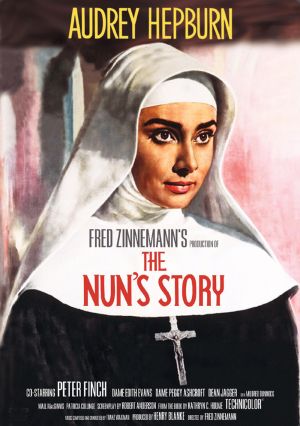
Lisa Watches An Oscar Nominee: The Nun’s Story (dir by Fred Zinnemann)


Nun_story

Happy Ash Wednesday!

So, earlier today, I got off work early so I could go to Noon Mass with my sister and we both got our ashes.  And I’m sure that will take some people by surprise because I’m not exactly the most faithful or devout of Catholics.  But what can I say?  I love the ornate ritual of it all.

And, as a part of my own personal ritual, I washed my forehead before I left the church.  Erin and I had a great vegetarian lunch at Cafe Brazil and then we came home and I turned on the TV and what should be finishing up on TCM but the 1959 best picture nominee, The Nun’s Story.  Fortunately, I had already set the DVR to record The Nun’s Story and so, on this most Catholic of days, I was able to watch this most Catholic of best picture nominees.

The Nun’s Story tells the story of Gaby (Audrey Hepburn), the daughter of a famous Belgian doctor (Dean Jagger).  At the start of the film, Gaby has entered a convent because she wants to become a missionary nursing sister in the Belgian Congo.  However, before Gaby can go to the Congo, she has to learn to give up her own rebellious streak and individual independence.  Taking the name Sister Luke, she excels at her medical training but, because it is felt that she is still too independently minded, she is not sent to the Congo but instead assigned to work in a mental hospital.  It’s there that her independent streak nearly gets her killed when she is fooled by a dangerous patient who claims to be the Archangel Gabriel.  It is only after she takes her final vows that Sister Luke is finally sent to the Congo and it is there that she’s forced to work with the abrasive agnostic Dr. Fortunati (Peter Finch).  Of course, as Sister Luke goes through her own spiritual struggles, the world inches closer and closer to the start of a second world war.  When war does break out, Sister Luke finds herself torn between her vow of obedience (which includes remaining political neutral) and the realities of living in a country that’s been occupied by the Nazis.

1959 was apparently a good year for religious films.  Not only did Ben-Hur win best picture, but The Nun’s Story also received 8 nominations.  Reportedly, The Nun’s Story was the most financially successful film to be released by Warner Bros, up to that point.  If Wikipedia is to be believed, it was also Audrey Hepburn’s personal favorite of the many movies that she made.

When seen today, probably the first thing that people notice about The Nun’s Story is that it’s extremely long and occasionally rather slow.  The film follows Gaby from the minute she enters the convent to the moment that she makes her final choice about whether to be obedient to herself or to her vows and, during that time, it examines every single detail of her life in glorious Technicolor.  A lot of emphasis is put on the rituals that Sister Luke goes through on her way to taking her final vows.  Now, if you’re like me, all of the rituals are fascinating to watch and produce a whole host of conflicting emotions.  Even as I found myself admiring Sister Luke’s dedication and her sacrifice, I still kept wondering — much as she did —  if it was all really worth giving up her independence.  But, I also have to admit that I found myself wondering if someone from a Protestant background would feel the same way.

To a certain extent, I really hate to say that you probably have to come from a Catholic background to truly enjoy any film.  But I certainly think that’s the case with The Nun’s Story.  But, even Protestants and skeptics will appreciate Audrey Hepburn’s wonderful lead performance.  She keeps this film grounded and makes her mostly internal conflict of faith compelling.  In a career that was full of great performance, this is one of Audrey’s best.

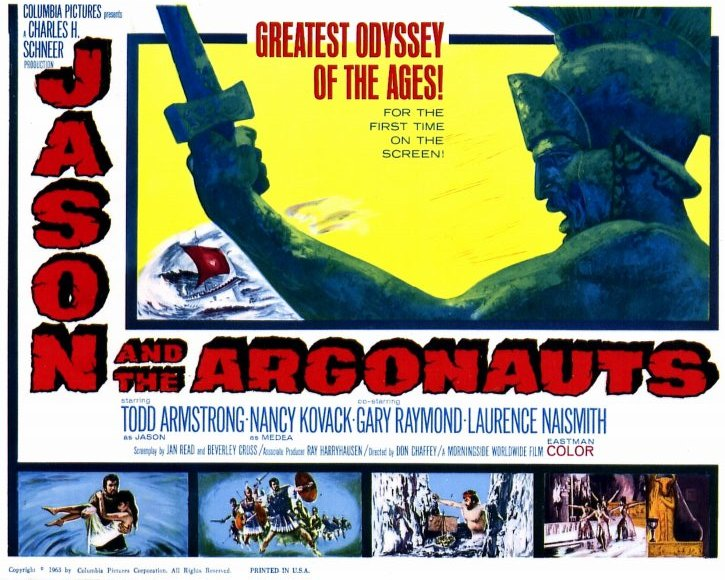
Quickie Review: Jason and the Argonauts (dir. by Don Chaffey)


While I have been buying and collecting dvds for some ten years now (collection around 2500-3000 titles) I have seen those purchases dwindle and wane to almost just a few a year now. I blame the convenience of Netflix and my resurgence in gaming with my Xbox 360 as the main cause for my slacking off in the dvd collecting. While  I still see myself collecting dvds and, most likely, moving onto blue-rays, I have seen why people love their Netflix accounts so much. Last night I was able to combine my love for my Netflix and my Xbox 360 and feed my need to always be watching a film. Using Netflix Instant I was able to watch streaming over my Xbox 360 one of the classic fantasy films ever made.

The film I speak of is the 1963 classic fantasy meets Greek mythology simply called Jason and the Argonauts. It is one of those films which has stood the test of time. I know of no film lover who hasn’t seen this at least once. It’s beloved and admired by millions of people of different generations for its simplicity and for the work of one man whose name overshadows everyone on the film from the director to the actors. This was the film which established for eternity the genius and imaginative creative of special effects guru Ray Harryhausen.

Jason and the Argonauts takes one of the more popular Greek myths about a son looking to re-take his father’s kingdom from a usurper but in the process goes through a journey that pits him against monsters, betrayers and the Gods themselves. The titular character and his crew must travel to the fabled island of Colchis at the edge of the world to find the legendary Golden Fleece purported to have magical properties of healing and even to grant peace throughout the land. I say that’s a piece of item worth fighting off a giant bronze warrior statue, screeching harpies, tempermental seaside cliffs and up to a many-headed hydra and skeleton warriors spawned from it’s teeth.

The acting is typical of most fantasy films of the 60’s and that’s they’re all bombastic, full of vigor and turns even the most simple dialogue into pronouncements of epic deeds to be done. Todd Armstrong leads a cast of British actors including such luminaries of their era like Nigel Green, Nancy Kovack, Honor Blackman and Douglas Wilmer. While the acting may seem quaint by today’s standards I still believe it’s what gives the film it’s timeless energy and quality. It makes the film flow like an epic poem that gave birth to it’s source material to begin with.

But what really makes this film stand out years after years and decade after decade since it’s release is the stop-motion animation effects created by the king of stop-motion effects himself, Ray Harryhausen. To say that the quieter moments where characters interact with each other almost feel like fillers to move the story along until it reaches one of several action sequences featuring Harryhausen’s work. It doesn’t diminish the work done by the actors or the efficient direction by filmmaker Don Chaffey. It just means that Harryhausen’s stop-motion work were so impressive that the audience just wants to see what new magic he has up next.

The climactic fight between Jason and his men versus skeleton warriors born from the teeth of a slain hydra (a stop-motion sequence which was in itself quite impressive) still goes down as one of the most impressive feats of filmmaking married with special effects today. There’s something to be admired about a four and a half minute action sequence where Harryhausen spent 4 months of meticulous frame-by-frame work to make the skeletal opponents come to life. There’s a reason why so many special effects magicians since then have pointed to this scene as one of their favorites and one reason why they got into the FX work to begin with.

Jason and the Argonauts may not have the technical wizardry of today’s fantasy epics and films with their million-dollar budgets spent on CGI-effects. It may not have the seriousness that today’s fantasy films have taken to heart (losing some of the fun, innocence of what makes fantasy films so great). What it does have is great storytelling which harkens back to a more innocent, hopeful and simple time. It also has the finest work of one of film history’s master magicians in Ray Harryhausen and that, in the end, is what makes this film of the the greatest of its kind and one every kid should be introduced to.