
Filmed in 1965 but not released until 1971, Blood Thirst takes place in Manila. Young women, many of whom work at or near the Bario Club, are turning up dead with all of their blood drained from their body. Inspector Miguel Ramos (Vic Diaz) thinks that the crimes are the work of one homicidal maniac but there are whispers that the women are falling victim to a cult of devil worshippers. Hoping to solve the case before a full-fledged panic breaks out, Ramos summons a friend of his from New York, Detective Adam Rourke (Robert Winston).
Detective Rourke, who is perhaps a bit too quick to smirk, thinks that it’s going to be easy to solve this case but it turns out the opposite is true. He goes undercover as a visiting writer and starts to hang out at the Bario Club. He gets to know the people who work there and he introduces himself to the club’s owner, Calderone (Vic Silayan). Calderone is immediately suspicious of Rourke, something that he ascribes to his natural concern for his employees. However, the club’s most popular dancer — the beautiful blonde Serena (Yvonne Nielsen) — informs Rourke that Calderone murdered his previous wife.
Both Detective Rourke and Miguel’s sister, Sylvia (Katherine Henryk), suspect that the killer is Calderone. However, the viewers have a bit more information than Rourke and Sylvia. We know that the killer is a horrifyingly disfigured monster who always seem to emerge from the shadows. What is the monster and why is it obsessed with draining the blood of young, beautiful women? That’s the mystery that Rourke will eventually have to solve.
Just from the plot description, Blood Thirst might not sound that impressive and I have to admit that I went into the film with low expectations. But I was actually surprised to discover that the film was far more effective than I was expecting. Visually, the stark black-and-white cinematography creates an appropriately ominous atmosphere and the scenes in the club feel like they could have been lifted from the best examples of film noir. Characters literally emerge and occasionally disappear into the darkness, with shadows often obscuring half an actor’s face as if to remind us that any one of the characters could be the murderer (and, by that same token, any of them could actually be innocent). When Serena performs in the club, her blonde hair and pale skin almost seem to glow in the darkness. The monster itself is effectively frightening as it makes it way through the film, moving like a crazed animal that has found itself outside of its natural habitat.
Of course, it’s hardly a flawless film. Rourke is a remarkably unlikable character, one who smirks his way through the entire film. The scenes where he flirts with Sylvia are cringeworthy and redeemed only by Sylvia’s habit of both slapping him and kicking him out of her car. There are a few moments of humor that don’t quite work. The film is at its best when it focuses on atmosphere and shadows as opposed to the characters. Blood Thirst works as a filmed dream, a vision of dark and disturbing things.
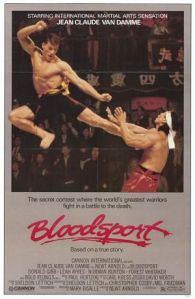 Bloodsport is one of Jean-Claude Van Damme’s earliest films and it is Damme good!
 Through the Shattered Lens