Film Review: Save The Tiger (dir by John G. Avildsen)


1973’s Save The Tiger tells the story of Harry Stoner (Jack Lemmon).

When Harry was a young man, he loved baseball and he felt like he could conquer the world.  He saw combat in World War II and spent the final part of the war on the Island of Capri, recuperating after being wounded in battle.  Harry went on to partner up with Phil Greene (Jack Gilford) and they started a clothing company in Los Angeles, Capri Casuals.

Now, Harry is a middle-aged man who is still haunted by nightmares about the war.  He’s married.  He has a daughter attending school in Switzerland.  He’s respected in the industry.  He lives in a nice house in Beverly Hills.  And he’s totally miserable.  He wakes up every day and wonders what is happening to the country.  He talks about witnessing a wild pitch at a baseball game, missing the days when something like that could seem like the most important thing in his life.  He spends all of his time at work, cheating to balance the books and keeping clients happy by setting them up with a sophisticated prostitute named Margo (played, with a weary cynicism, by Lara Parker).

Save The Tiger covers just a few days in the life of Harry Stoner, as he searches for some sort of meaning in his life.  He gives a ride to a free-spirited hippie (Laurie Heineman) who offers to have sex with him.  (Harry replies that he’s late for work.)  He accepts an award at an industry dinner and, as he tries to give his acceptance speech, he is haunted by the sight of dead soldiers sitting in the audience.  With Phil, he debates whether or not to balance the books by setting fire to one of their warehouses in order to collect the insurance.  Harry sees a poster imploring him to “Save the Tigers.”  Who can save Harry as he finds himself increasingly overwhelmed by the realities of his life?

As I watched Save the Tiger, I found myself thinking about two other films of the era that featured a middle-aged man dealing with a midlife crisis while searching for meaning in the counterculture.  In Petulia and Breezy, George C. Scott and William Holden each found meaning in a relationship with a younger woman.  And while Petulia and Breezy are both good films, Save The Tiger is far more realistic in its portrayal of Harry’s ennui.  There is no easy solution for Harry.  Even if he accepted the hippie’s offer to “ball” or if he acted on the obvious attraction between himself and Margo, one gets the feeling that Harry would still feel lost.  Harry’s problem isn’t that he’s merely bored with his life.  Harry’s problem is that he yearns for a past that can never be recaptured and which may only exist in his imagination.  If George C. Scott and William Holden were two actors who excelled at playing characters who refused to yield to the world’s demands, Jack Lemmon was an actor who played characters who often seemed to be desperate in their search for happiness.  Save The Tiger features Lemmon at his most desperate, playing a character who has yielded so often and compromised so much that he now has nowhere left to go.

It’s not exactly a cheerful film but it is one that sticks with you.  Jack Lemmon won his second Oscar for his performance as Harry and he certainly deserved it.  Lemmon does a wonderful job generating some sympathy for a character who is not always particularly likable.  Many of Harry’s problems are due to his own bad decisions.  No one forced him to use “ballet with the books” to keep his business open and no one is forcing him to hire arsonist Charlie Robbins (Thayer David, giving a performance that is both witty and sinister at the same time) to burn down not only his warehouse but also an adjoining business that belongs to an acquaintance.  Harry could admit the truth and shut down his business but then how would he afford the home in Beverly Hills and all the other symbols of his success?  Harry yearns for a time when he was young and his decisions didn’t have consequences but that time has passed.

This isn’t exactly the type of film that many would expect from the director of Rocky but director John G. Avildsen does a good job of putting the viewer into Harry’s seedy world.  I especially liked Avilden’s handling of the scene where Harry hallucinates a platoon of wounded soldiers listening to his awards speech.  Instead of lingering on the soldiers, Avildsen instead uses a series of a quick cuts that initially leave the audience as confused as Harry as to what Harry is seeing.  Both Rocky and Save The Tiger are about a man who refuses to give up.  The difference is that perhaps Harry Stoner should.

“You can’t play with us, mister!” a kid yells at Harry when he attempts to recreate the wild pitch that so impressed him as a youth.  In the end, Harry is a man trapped by his memories of the past and his dissatisfaction with the present.  He’s made his decisions and he’ll have to live with the consequences but one is left with the knowledge that, no matter what happens, Harry will be never find the happiness or the satisfaction that he desires.  The tigers can be saved but Harry might be a lost cause.
Late Night Retro Television Review: CHiPs 2.14 “Repo Man”


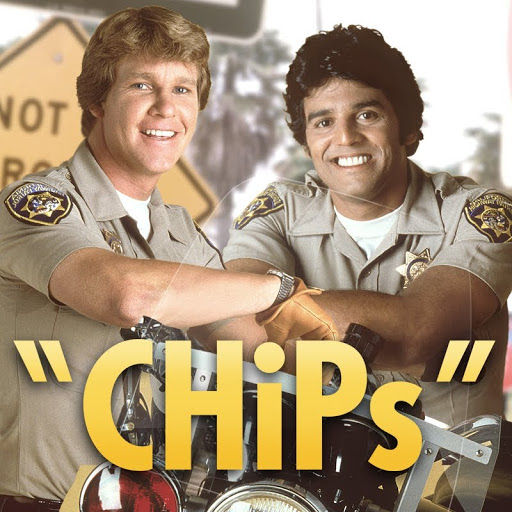
Welcome to Late Night Retro Television Reviews, a feature where we review some of our favorite and least favorite shows of the past!  On Mondays, I will be reviewing CHiPs, which ran on NBC from 1977 to 1983.  The entire show is currently streaming on Freevee!

This week, Jon Baker takes on …. THE REPO MAN!

Episode 2.14 “Repo Man”

(DIr by Alex Grasshoff, aired on January 6th, 1979)

This week features a truly memorable villain.

Doyle Ware (Mills Watson) is a repo man.  When people fall behind on their car payments, Doyle is the guy who shows up to repossess the vehicle.  That he’s a sleaze shouldn’t come as a surprise.  I mean, who likes a repo man, right?  But, as Baker and Ponch discover, Doyle is more than just a repo man.

He’s a criminal mastermind!

He steals cars and then informs the owner that the car has been destroyed in an accident.  Doyle offers to buy what little is left of the vehicle.  However, the truth is that the car hasn’t been destroyed.  And once Doyle gets the title, he proceeds to sell the car under the original owner’s name.  Then, once the buyer falls behind on their payments, he repossesses the car and sells it again.  What a sleazy guy!

When Baker and Ponch prevent Doyle from repossessing an old couple’s trailer, Doyle reacts by trying to destroy their credit.  He plants false reports that Baker and Ponch owe money.  Baker tries to buy an expensive saddle, just to be humiliated when the clerk (played by future playwright Terrence McNally) informs him that his credit score is awful.  Ponch starts to get notices at the police station, telling him that he owes money.  Getraer offers to help Baker but not Ponch.  Getraer can’t stand Ponch.

While dealing with his bad credit, Baker also becomes a local celebrity when he jumps, from a bridge, onto an out-of-control school bus.  Baker’s face appears on the local news and soon, people are demanding his autograph.  Baker is mortified.  Ponch is thrilled because, for some reason, people want his autograph too.  “Oh my God, you’re his partner!” someone says as they rush up to Ponch’s motorcycle.  Seriously, Ponch didn’t do anything!

Meanwhile, Grossman (who, as played by Paul Linke, is the most consistently likable member of the show’s supporting cast) gets an article published in a magazine.  Everyone at the station pretends like they haven’t read and enjoyed the article.  Poor Grossie!  Don’t worry, though.  A news crew films Grossie putting out a fire and he soon replaces Baker as everyone’s favorite local hero.  Baker’s happy to have both his good credit and his anonymity restored.

(This is actually a pretty big episode for Baker.  He also gets a subplot in which a watchmaker, played by Ned Glass, destroys Baker’s watch after he bring it in to get the wrist band fixed.)

This was a good episode.  The school bus rescue was genuinely exciting and Doyle Ware was a villain who was so sleazy that it was a lot of fun watching him get taken down.  CHiPs did a good job with Repo Man.

Horror on TV: Kolchak: The Night Stalker 1.11 “Horror In The Heights” (dir by Michael Caffey)


Tonight, on Kolchak, someone or something is eating the elderly and poor residents of Roosevelt Heights!  Carl Kolchak investigates!

After battling Native American monsters, Cajun monsters, and European monsters, Kolchak finds himself battling a Hindu demon in this episode.  Apparently, Chicago was quite a busy place in the 1970s.

This episode originally aired on December 20th, 1974, just in time for the Christmas season.

Enjoy!

http://www.youtube.com/watch?v=XcmRZuhSLXQ

Horror On TV: Kolchak: The Night Stalker 1.9 “The Spanish Moss Murders” (dir by Gordon Hessler)


Tonight, on Kolchak….

People are turning up dead.  Well, what else is new?  That’s pretty much been the plot of every Kolchak episode so far.  However, this time, they’re turning up dead while covered with Spanish moss!

Oh my God, could it be the Cajuns?

Well, as a matter of fact, it is.  As Kolchak discovers when he investigates, all of the dead people were somehow connected to a comatose Cajun….

Richard Kiel, who played the monster in the previous episode of Kolchak, returns here to play yet another monster.

The episode originally aired on December 6th, 1974!

http://www.youtube.com/watch?v=WcvJMqWRsVs

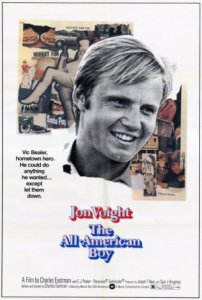
A Movie A Day #149: The All-American Boy (1973, directed by Charles Eastman)


Vic “The Bomber” Bealer is an amateur boxer who appears to be poised to escape from life in his dreary hometown.  He is such a good fighter that he is on the verge of making the U.S. Olympic Team and he is so good-looking that everyone, from his teenage girlfriend (Anne Archer) to his gay manager (Ned Glass) to a woman he meets at a gas station, automatically falls in love with him.  However, after his girlfriend tells him that she is pregnant, Vic abandons both her and boxing.  When she leaves town to have an abortion, Vic starts boxing again but then he learns that she may not have actually had an abortion and Vic leaves for Los Angeles, to see both her and his son.

Sadly, there is something about boxing that has always brought out the pretentious side of some filmmakers and that is the case with The All-American Boy.  This episodic film (which claims to portray “The Manly Art In Six Rounds”) tries to present Vic as being an anti-hero but mostly, he just seems to be vacant loser.  Vic sulks through the entire film, despite not really having much to sulk about.  When one of his conquests asks him what he is thinking, Vic replies, “I ain’t thinkin'” and the movie provides no reason to doubt him on this point.  I was not surprised to learn that The All-American Boy was filmed in 1969 and was deemed unreleasable until the combined success of Midnight Cowboy and Deliverance made Voight into a star.  On the plus side, when he made the film, Jon Voight looked like he could actually step inside the ring and throw a few punches.  On the negative side, the boxing scenes go heavy on the slow motion which, when overused, just looks stupid.  Raging Bull, this film is not.

When it comes to The All-American Boy, Duke has the right idea:

Embracing the Melodrama Part II #25: West Side Story (dir by Robert Wise and Jerome Robbins)


West_Side_Story_poster

Nearly two weeks ago, I started on something that I call Embracing the Melodrama, Part II.  For the next month or so, I will be reviewing, in chronological order, 126 examples of cinematic melodrama.  I started things off by reviewing the 1927 classic Sunrise and now, 24 reviews later, we’re ready to start in on one of my favorite decades, the 1960s!

And what better way to start the 60s than be taking a look at the 1961 best picture winner, West Side Story?

Being a lifelong dancer, I have to admit that I’ve lost track of how many times I’ve seen West Side Story.  If you love to dance, this is one of those films that you simply have to see.  Of the various musicals that have won best picture, West Side Story is arguably the best.  Based on a hit Broadway show (which was itself rather famously based on William Shakespeare’s Romeo and Juliet), West Side Story was co-directed by the great choreographer Jerome Robbins and it features some of the greatest dance numbers ever filmed.  If you don’t get excited while watching the Sharks and the Shark Girls arguing about America, then there’s really no hope for you.  Tonight Quintet, Somewhere, A Boy Like That, Maria … even Gee, Officer Krupke, has there ever been another musical score that just leaves you wanting to sing as much as West Side Story does?

(I mean, I’ll be the first admit that I absolutely love the theme song from Santa Claus Conquers The Martians but it can’t even compare to West Side Story!)

What’s funny is that, in between viewings of the film, I always seem to forget just how good West Side Story actually is.  (Fortunately, this also means that I’m pleasantly surprised every time I watch the movie.)  In theory, this is an easy film to joke about.  It tells the story of street gangs who are apparently just as good at dancing as they are at fighting.  The all-white Jets snap their fingers and tell us that when you’re a jet, you’re the best.  The Puerto Rican Sharks are moving in on the Jets’s territory.  The two leaders of the gangs — Riff (Russ Tamblyn) and Bernardo (George Chakiris) — want to settle thing with a “rumble.”  And it’s easy for contemporary audiences to laugh because “rumble” is such an old-fashioned way of saying things that it’s now one of those terms that’s only used when one is trying to be ironic or snarky.

(For instance, I was with some friends at the movies and the people sitting behind us kept talking.  One of my friends told them to shut up.  One of the loud people replied that we were the ones who need to shut up.  As the insults escalated, I finally said, “Y’all — do we really have to have a rumble right now?”  Unfortunately, everyone was too busy arguing to appreciate my pitch perfect delivery.)

Riff’s best friend is Tony (Richard Beymer).  Tony was a co-founder of the Jets but now, he wants to move on from the gang.  He meets a girl named Maria (Natalie Wood) and the two of them fall in love.  However, Maria is Bernardo’s younger sister.  Her best friend, Anita (Rita Moreno), is Bernardo’s girlfriend.  Loving Tony, in other words, is prohibido.

And, since West Side Story is based on Romeo and Juliet, you can probably guess to what type of tragedy all of this leads.

Now, before I heap too much praise of West Side Story, I do need to admit that, in the role of Tony, Richard Beymer does not exactly radiate charisma.  He’s handsome enough but you never quite buy that he was former member of the Jets.  Since Tony’s singing voice was dubbed by Jimmy Bryant, you do believe everything that he sings.  But otherwise, Richard Beymer comes across as being stiff and rather awkward.

And it doesn’t help, of course, that he’s acting opposite Russ Tamblyn who, in the role of Riff, is a whirlwind of unstoppable energy.  Tamblyn is the one who you remember at the end of the film, followed by George Chakiris.  Compared to those two, Richard Beymer’s performance is just dull.

Fortunately, there’s Maria (played by Natalie Wood with Marni Nixon doing the singing).  Natalie Wood is one of my favorite of the classic Hollywood actresses.  She’s certainly one of the actresses with whom I most idenitfy.  With Richard Beymer sleepwalking through the role of Tony, it falls on Natalie to provide some true emotion to the film’s love story and that’s exactly what she does.  Every time I see West Side Story, I want to be Natalie Wood and I want to have a best friend like Rita Moreno and I want to meet someone like Riff…

Sorry, Tony.

West Side Story is one of the best musicals ever made.  If you’re not dancing and then crying and then dancing while crying as you watch West Side Story, then you’re doing it wrong.

http://www.youtube.com/watch?v=yA_aFprGzyc