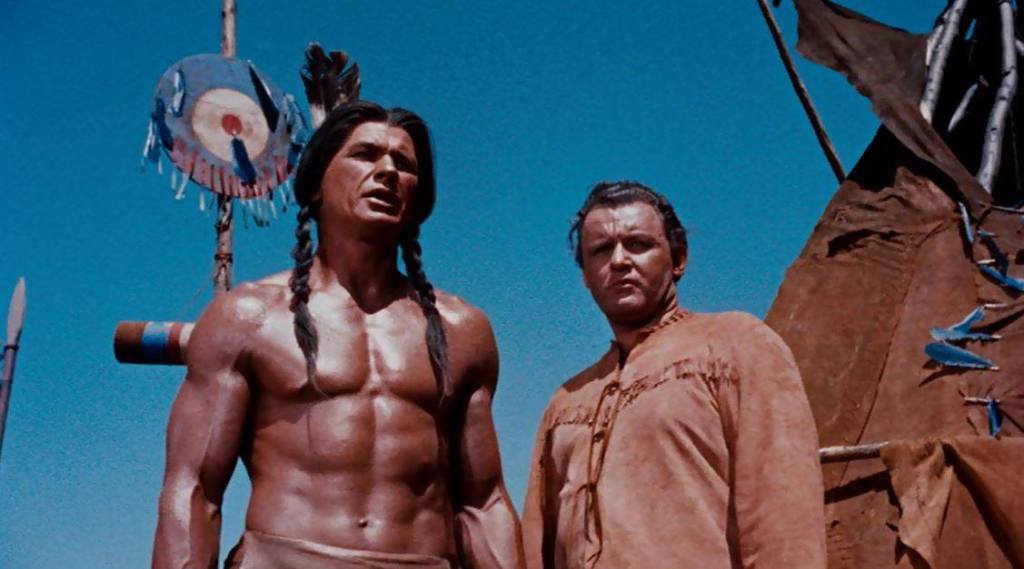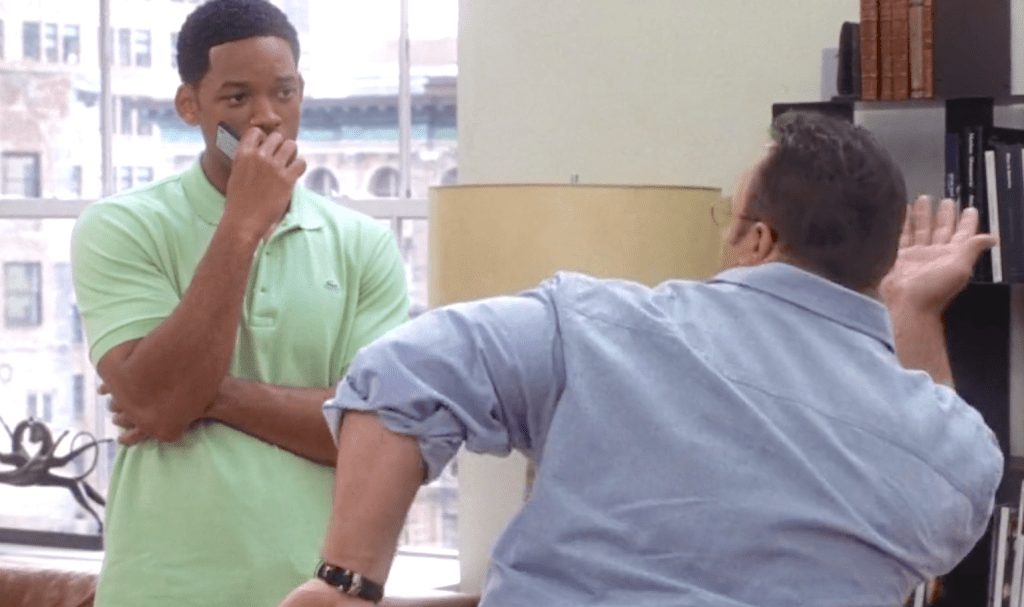
Brad reviews HITCH (2005), starring Will Smith and Kevin James!


I guess you can call this the holiday season of love for me, as I turn my attention today toward the 2005 romantic comedy HITCH. Will Smith stars as Alex “Hitch” Hitchens, a somewhat legendary and highly discreet consultant based in New York City. His specialty… helping less than perfect, even slightly awkward, men win the hearts of beautiful women. His methods are very effective, but he only works with men who are genuinely in love and not just chasing a one-night stand. His latest lovelorn client, the sweet and clumsy tax accountant Albert Brennaman (Kevin James), is smitten with a famous heiress named Allegra Cole (Amber Valletta), a client of the tax firm he works for. As Hitch works his magic for Albert, he also meets the cynical, but extremely beautiful tabloid journalist Sara Melas (Eva Mendes). Hitch finds himself falling for Sara at the same time that she’s on the trail of an urban myth of a “Date Doctor,” mistakenly believing that he is exploiting the emotions of women in the city for his own personal gain. When Sara and Amber discover who Hitch really is, will the guys’ true love win the day, or will the ladies believe it was all just a sleazy, manipulative setup?

HITCH is one of my favorite romantic comedies, and I watch it every year, usually multiple times. I’m a romantic at heart, and I really enjoy a film that plays with the idea of characters who truly care about, and respect, each other. This dynamic plays out through several different relationships. My favorite is the genuine friendship that develops between Hitch and Albert Brennamen. Hitch recognizes the sincere feelings that Albert has for Allegra, and he then goes all in to help him win her heart. While Will Smith is effortlessly charming and in peak movie star form, unsurprisingly, the character I identify the most with is Kevin James as Albert. His character is so sweet and earnest in his pursuit of Allegra that you just can’t help but pull for him. Balance that part of his character with James’ excellent physical comedy, whether it be his natural clumsiness or his unfounded confidence in his dance moves, and James gives the performance that takes this movie over the top for me. When teaching Albert the dance moves that he should stick with when he’s out on a date with Allegra, Hitch utters the line, “Don’t you bite your lip. Stop it!” It was that moment when I realized that, like Albert, I never dance without biting my own lip!

While the fraternal love between Hitch and Albert is my favorite relationship in the film, I also like the romantic relationship that develops between Hitch and Sara. I appreciate the way both characters step out of their comfort zones and risk their own hearts for each other. This is not easy for either of them, as Hitch’s charm and confidence actually masks deep insecurities based on his past relationships. Sara, on the other hand, has allowed herself to become very cynical towards all men, building walls so tall that no man can climb them. The fact that they truly open themselves up to each other, even if there are some serious complications along the way, gave me a strong rooting interest in their happiness.

The last performance I wanted to highlight in HITCH is that of Jeffrey Donovan, who plays sleazy narcissist Vance Munson. Munson tries to hire Hitch to help him get a vulnerable woman into bed, and in a moment of pure audience satisfaction, he pays the price for his disrespect. About the time I watched HITCH, Donovan was starring in a T.V. series that I really enjoyed called BURN NOTICE. I’m a big fan of Donovan, and he’s perfect here as a man you love to hate. In a movie full of likable characters, Vance Munson was a needed counterpoint, and his A-hole character really stands out.

No movie is perfect, but if you’re in the mood for something that’s lighthearted, funny, and makes you want to fall in love, then HITCH is about as close as it gets.
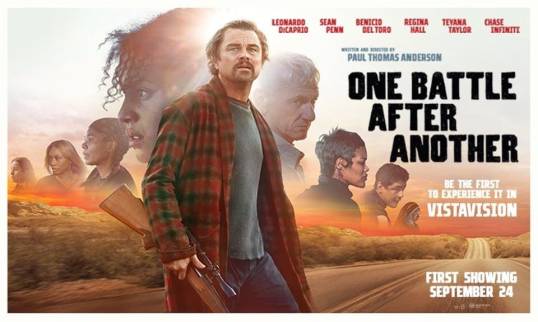
The New York Film Critics Circle Honors One Battle After Another


The New York Film Critics Circle has announced its picks for the best of 2025.  And here they are:

Best Film: One Battle After Another

Best Actress: Rose Byrne, If I Had Legs I’d Kick You

Best Director: Jafar Panahi, It Was Just An Accident

Best Screenplay: Marty Supreme

Best Actor: Wagner Moura, The Secret Agent

Cinematography: Sinners

Supporting Actress: Amy Madigan, Weapons

Best Non-Fiction Film: My Undesirable Friends: Part I – Last Air in Moscow

Best Animated Film: KPop Demon Hunters

Best First Film: Eephus

Best Supporting Actor: Benicio Del Toro, One Battle After Another

Best International Film: The Secret Agent

The Gothams Honor One Battle After Another


Last night, Awards Season began with the Gotham Awards!  One Battle After Another, which I really don’t want to have to sit through but I guess now I have no choice, won Best Feature.  (Oddly enough, that was the only award that One Battle After Another won, suggesting that the award had more to do with the film’s politics than its quality.)  Far more interesting is the fact that Iranian dissident (who is facing prison if he even returns to his native country) Jafar Panahi won Best Director and Best Screenplay for It Was Just An Accident.  Will the Academy have the courage to also honor him?

The winners are listed in bold below.

Best Feature
Bugonia
East of Wall
Hamnet
If I Had Legs I’d Kick You
Lurker
One Battle After Another
Sorry, Baby
The Testament of Ann Lee
Train Dreams

Best Director
Mary Bronstein – If I Had Legs I’d Kick You
Jafar Panahi – It Was Just an Accident
Kelly Reichardt – The Mastermind
Paul Thomas Anderson – One Battle After Another
Oliver Laxe – Sirât

Outstanding Lead Performance
Jessie Buckley – Hamnet
Lee Byung-hun – No Other Choice
Rose Byrne – If I Had Legs I’d Kick You
Sopé Dìrísù – My Father’s Shadow
Ethan Hawke – Blue Moon
Jennifer Lawrence – Die My Love
Wagner Moura – The Secret Agent
Josh O’Connor – The Mastermind
Amanda Seyfried – The Testament of Ann Lee
Tessa Thompson – Hedda

Outstanding Supporting Performance
Benicio Del Toro – One Battle After Another
Jacob Elordi – Frankenstein
Inga Ibsdotter Lilleaas – Sentimental Value
Indya Moore – Father Mother Sister Brother
Wunmi Mosaku – Sinners
Adam Sandler – Jay Kelly
Andrew Scott – Blue Moon
Alexander Skarsgård – Pillion
Stellan Skarsgård – Sentimental Value
Teyana Taylor – One Battle After Another

Best Original Screenplay
If I Had Legs I’d Kick You
It Was Just an Accident
The Secret Agent
Sorry, Baby
Sound of Falling

Best Adapted Screenplay
No Other Choice
One Battle After Another
Pillion
Preparation for the Next Life
Train Dreams

Best International Feature
It Was Just an Accident

No Other Choice
Nouvelle Vague
Resurrection
Sound of Falling

Best Documentary Feature
2000 Meters to Andriivka
BLKNWS: Terms & Conditions
My Undesirable Friends: Part I – Last Air in Moscow
The Perfect Neighbor
Put Your Soul on Your Hand and Walk

Breakthrough Director
Constance Tsang – Blue Sun Palace
Carson Lund – Eephus
Sarah Friedland – Familiar Touch
Akinola Davies Jr. – My Father’s Shadow
Harris Dickinson – Urchin

Breakthrough Performer
A$AP Rocky – Highest 2 Lowest
Sebiye Behtiyar – Preparation for the Next Life
Chase Infiniti – One Battle After Another
Abou Sangaré – Souleymane’s Story
Tonatiuh – Kiss of the Spider Woman

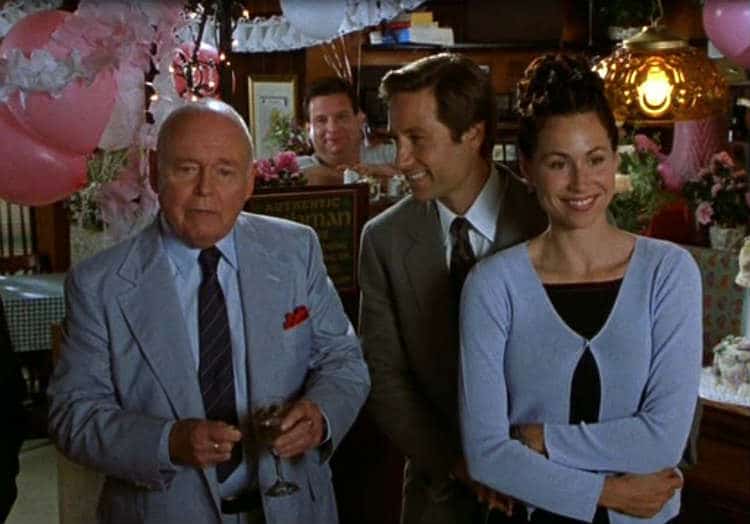
Brad reviews RETURN TO ME (2000), starring David Duchovny and Minnie Driver!


I’m a sucker for a good romance. Every year during tax season, I like to stream romantic films while I prepare my clients’ tax returns late into the evening. They make me feel good and help my mood as I work the necessary 80 to 90 hours every week leading up to April 15th. My list of favorites includes movies like HITCH (2005) with Will Smith, NOTTING HILL (1999) with Julia Roberts and Hugh Grant, and YOU’VE GOT MAIL (1998) with Tom Hanks and Meg Ryan. I also really enjoy the period romance movies based on the novels of Jane Austen, films like Ang Lee’s SENSE AND SENSIBILITY (1995) and the five-hour mini-series version of PRIDE AND PREJUDICE (1995) starring Colin Firth and Jennifer Ehle. There’s a decent chance that if you walk into my office at the end of one of these films you might even catch me wiping a tear from my eye as the obstacles finally clear, and we’re left with two people in love embarking on their specific “happily-ever-after” together. One such movie, that I don’t hear mentioned very often, but that I personally love, is the 2000 romantic film RETURN TO ME.

RETURN TO ME opens by introducing us to two families. First, we meet Bob Rueland (David Duchovny), a successful architect, and his wife Elizabeth (Joely Richardson), a kind-hearted zoologist, who are clearly very much in love. We follow the couple as they attend a fund-raising dinner that’s been organized to help expand the zoo’s gorilla habitat, a cause that’s very dear to Elizabeth’s heart, with Bob volunteering his own time and talents to design the new facility. The evening includes many sweet words and some quality slow dancing. Next, we meet Grace Briggs (Minnie Driver), who is very sick and in need of a heart transplant in the worst possible way. Her Catholic family and her friends, which includes her loving grandpa Marty O’Reilly (Carroll O’Connor) and her best friend Megan Dayton (Bonnie Hunt), are a wonderful support system, but without the new heart, she won’t be able to live much longer. On the same night that unspeakable tragedy strikes the Rueland’s on their way home from the fundraiser, Grace and her Grandpa’s prayers are answered when they get the call that a healthy heart is now available. A year later, Bob and Grace meet by chance at Marty’s business, O’Reilly’s Italian Restaurant. Bob has been a shell of the man he once was as he’s been unable to deal with his wife’s passing, while Grace has attempted to figure out life with her new heart. There’s just something about Grace though, so Bob asks her out and, after a series of sweet dates, it seems the two may be falling in love. But when Grace accidentally discovers that the heart that Bob is falling in love with was once beating inside the chest of his deceased wife Elizabeth, Grace doesn’t know how to tell him. Feeling guilty, as well as fearful of how Bob may respond to the shocking information, Grace decides she has no choice but to tell him. Will their blossoming love survive this unexpected and tragic revelation?

I love RETURN TO ME, and the main reason is that I love the characters, and especially the world that director Bonnie Hunt creates inside the film. The love story at the center is played well by Duchovny and Driver, but the greater love of family and friends is what sets this movie apart for me. In a way, Hunt creates a world that contains the kind of friends and family that we’d all love to have in real life. She does this by spending a lot of time with the entertaining supporting characters, showing them to be kind and decent people, the kind who make our lives valuable. As an example, O’Connor’s performance as the doting grandpa to Grace is wonderful, but we also get to see the interplay between Grace, Marty and their “family” at the restaurant, played by such great character actors as Robert Loggia, Eddie Jones, William Bronder and Marianne Muellerleile. Hunt herself is excellent in the role as Grace’s best friend Megan, but the time we spend with her blue-collar husband, played perfectly by James Belushi, and their kids are some of the best and funniest of the film. Based on the time and attention to these characters, as well as the time spent at “O’Reilly’s Italian Restaurant,” Hunt has created a scenario that feels like we’re watching real family and friends, in the best possible way. I never watch this film that I don’t want to go eat a big plate of spaghetti afterwards. The relationship between Bob and his best friend Charlie (David Alan Grier) isn’t quite as successful, but it has its moments as well.

RETURN TO ME is the kind of romantic film that we don’t get to see very often these days. A snarky, cynic would probably have a field day with this film, with its outrageous set-up, its old-fashioned values, and even older-fashioned characters. But that’s what I love about this film. As an example, this is the kind of movie where characters ask each other to pray, they do it, and the only purpose of it being shown is so we know how much these people care about each other. That feels very old-fashioned for 2025, but based on my own experiences in life, it’s something I can completely identify with.

Ultimately, RETURN TO ME is not a perfect film. Clocking in at almost 2 hours, there are definitely some scenes that could have been shortened or eliminated all-together. And it may seem like a criticism that I find the central love story of the film less appealing than the love shown by the main characters’ family and friends, but it’s really not. RETURN TO ME is a movie I return to every year because, at the end of the day, it’s an entertaining film that helps me appreciate the love of a family and the possibility that sometimes love is just meant to be.

4 Shots From 4 Christmas Films


4 Shots From 4 Films is just what it says it is, 4 shots from 4 of our favorite films. As opposed to the reviews and recaps that we usually post, 4 Shots From 4 Films lets the visuals do the talking.

Happy holidays!

Let’s get December started with….

4 Shots From 4 Christmas Films

The Godfather (1972, dir by Francis Ford Coppola, DP: Gordon Willis)

Lethal Weapon (1987, dir by Richard Donner, DP: Stephen Goldblatt)

Die Hard (1988, dir by John McTiernan, DP: Jan de Bont)

Die Hard 2 (1990, dir by Renny Harlin, DP: Oliver Wood)

Lisa Marie’s Oscar Predictions For November


I guess the question right now is whether or not Wicked: For Good will receive a Best Picture nomination.  Tradition would seem to dictate that, like The Lord of the Rings films and the Dune films, Wicked: For Good would get a nomination to go along with the first part of the story.  However, the reviews of Wicked: For Good have not been particularly good.

That said, those reviews have not had much effect when it comes to the film’s box office.  And that’s why I think, despite bad reviews, Wicked: For Good will be nominated.  I don’t think it’s going be quite the Oscar powerhouse that some were expecting but it will still, at the very least, be nominated.  It’s too big to fail at this point.

Here are my review for November.  Click here for my April and May and June and July and August and September and October predictions!

Best Picture

Avatar: Fire and Ash

Frankenstein

Hamnet

Jay Kelly

Marty Supreme

One Battle After Another

Sentimental Value

Sinners

Train Dreams

Wicked For Good

Best Director

Paul Thomas Anderson for One Battle After Another

Ryan Coogler for Sinners

Josh Safie for Marty Supreme

Joachim Trier for Sentimental Value

Chloe Zhao for Hamnet

Best Actor

Timothee Chalamet in Marty Supreme

George Clooney in Jay Kelly

Joel Edgerton in Train Dreams

Ethan Hawke in Blue Moon

Wagner Moura in The Secret Agent

Best Actress

Jessie Buckley in Hamnet

Cynthia Erivo in Wicked For Good

Kate Hudson in Song Sung Blue

Renate Reinsve in Sentimental Valure

Amanda Seyfried in The Testament of Ann Lee

Best Supporting Actor

Benicio del Toro in One Battle After Another

Paul Mescal in Hamnet

Sean Penn in One Battle After Another

Adam Sandler in Jay Kelly

Stellan Skarsgard in Sentimental Value

Best Supporting Actress

Elle Fanning in Sentimental Value

Ariana Grande in Wicked For Good

Regina Hall in One Battle After Another

Inga Ibsdotter Lilleaas in Sentimental Value

Amy Madigan in Weapons

Brad reviews BREAKING IN (1989), starring Burt Reynolds!


BREAKING IN (1989) opens with veteran safecracker Ernie Mullins (Burt Reynolds) pulling a job at a rich guy’s house, only to be surprised when a young, amateurish thief named Mike (Casey Siemaszko) turns up at the same place to raid the fridge. Immediately taking a liking to the kid, Ernie decides to offer Mike a chance to learn his trade. Thus begins a partnership, and odd-couple friendship, where the two men pull a series of jobs together, with Ernie passing on his knowledge to his young protege who seems to be enjoying the sudden influx of cash into this life. Unfortunately, the generation gap causes some problems as Mike doesn’t necessarily take heed to Ernie’s advice to never being too greedy or flashy. Soon, Mike is renting high rise apartments and buying fancy cars with cash. When they pull a big job on the 4th of July, will Mike’s less than frugal ways drag them both down?!

Written by the excellent, independent writer and director John Sayles (MATEWAN, EIGHT MEN OUT) and directed by Scottish director Bill Forsyth (LOCAL HERO), BREAKING IN is a reminder of just how great Burt Reynolds is in the right role. In his 50’s at the time this was filmed, Reynolds gives a relaxed, lived-in, character performance that comes across as effortlessly cool, and he does it without having to rely on his trademark charm and big grin. The late 80’s were a time when Burt was no longer a box office superstar, and BREAKING IN seems to be an unjustly forgotten entry in his hugely successful career. After this, Burt would find TV success on EVENING SHADE, and he’d be nominated for an Oscar for his role in BOOGIE NIGHTS (1997), but his Ernie Mullins stands out to me as one of his last great film roles. Casey Siemaszko is good as Mike, but this is Reynolds’ show and he’s overshadowed even in a solid performance. As far as the other supporting performances, Sheila Kelley stood out to me as a sharp-tongued prostitute who Siemaszko falls in lust with. The poem she shares about a man’s “balls” is a highlight of the film as far as I’m concerned, and further illustrates the quality of Sayles’ screenplay!

I like the way that BREAKING IN feels low-key, even as the characters engage in their various criminal heists. This can be credited to director Bill Forsyth who turns what could have been a standard master / apprentice crime film into something that feels somewhat realistic. The pacing is slow as Reynolds passes on his knowledge, and for some people it may be too slow, but that’s one of the things I really liked about the movie. The two men really get to know each other. That way, when they have disagreements and blow ups a couple of times, they’re still able to respect each other and patch things up. That’s how things are in the real world, as opposed to most movies where a simple disagreement will almost certainly lead to ridiculous consequences. BREAKING IN respects its characters in a way that’s unique to most crime films. 

At the end of the day, BREAKING IN is a gem that is at its best as a lighthearted character study of a professional thief whose time is passing him by. Burt Reynolds rarely got to play roles this subtle, and I think he made the most of the opportunity. As a big fan of Reynolds, I highly recommend this one. 

4 Shots From 4 Films: Special Mark L. Lester Edition


4 Shots From 4 Films is just what it says it is, 4 shots from 4 of our favorite films. As opposed to the reviews and recaps that we usually post, 4 Shots From 4 Films is all about letting the visuals do the talking.

Today, the Shattered Lens wishes a happy birthday to director Mark L. Lester.  It’s time for….

4 Shots From 4 Mark L. Lester Films

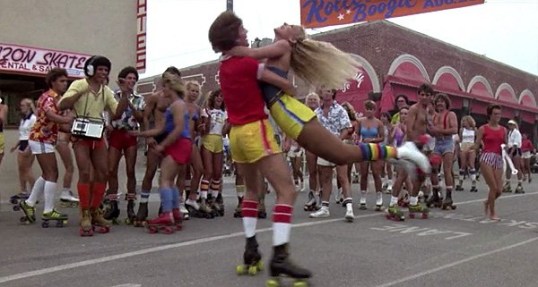
Roller Boogie (1979, dir by Mark L. Lester, DP: Dean Cundey)

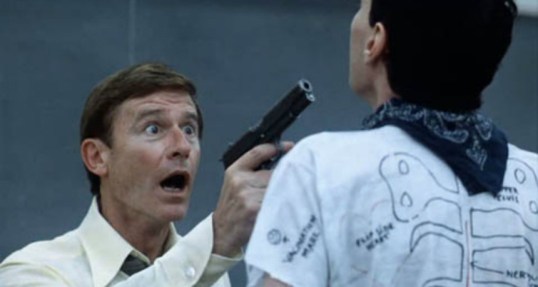
Class of 1984 (1982, dir by Mark L. Lester, DP: Albert Dunk)

Commando (1985, dir by Mark L. Lester, DP: Matthew Leonetti)

Public Enemies (1996, dir by Mark L. Lester, DP: Misha Suslov)


4 Shots From 4 Films: Special Udo Kier Edition


4 Shots From 4 Films is just what it says it is, 4 shots from 4 of our favorite films. As opposed to the reviews and recaps that we usually post, 4 Shots From 4 Films is all about letting the visuals do the talking.

In memory of Udo Kier, here are…

4 Shots From 4 Udo Kier Films

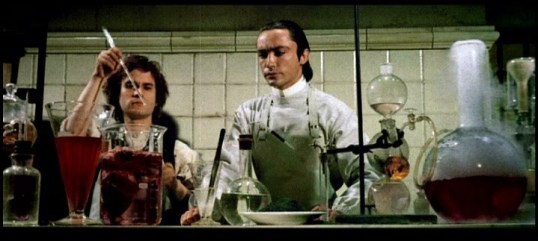
Flesh For Frankenstein (1973, dir by Paul Morrissey, DP: Luigi Kuveiller)

Blood For Dracula (1974, dir by Paul Morrissey, DP:Luigi Kuveiller)

Europa (1991, directed by Lars Von Trier, DP: Henning Bendtsen,
Edward Kłosiński, Jean-Paul Meurisse.  Released as Zentropa in North America)

Swan Song (2021, dir by Todd Stephens, DP: Jackson Warner Lewis)


Brad reviews Samuel Fuller’s RUN OF THE ARROW (1957), starring Rod Steiger and Charles Bronson! 


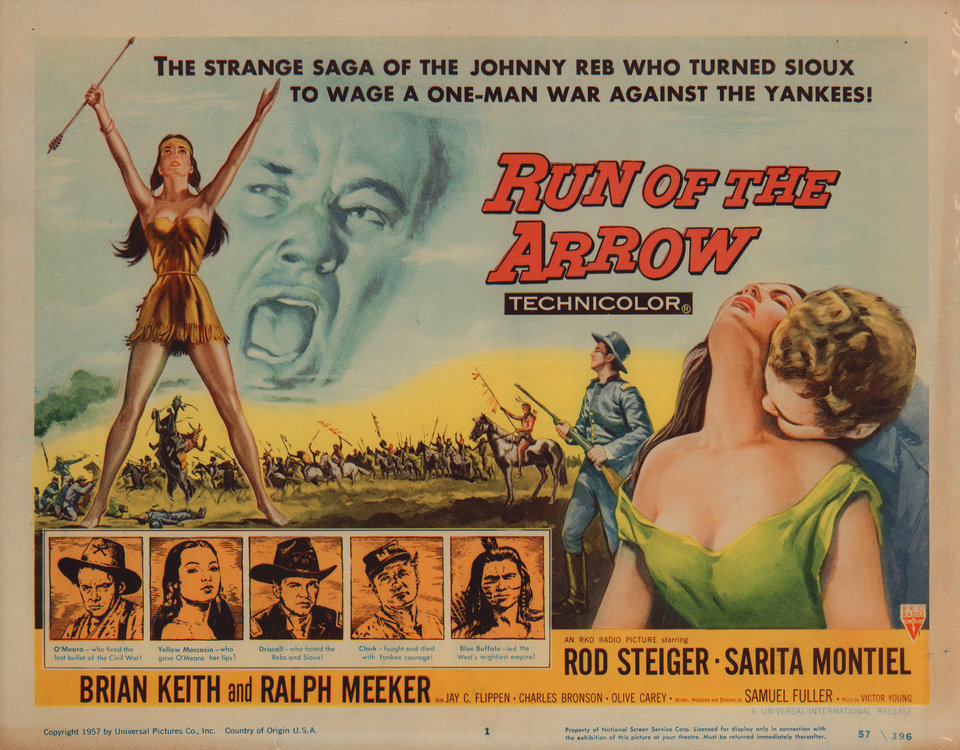
RUN OF THE ARROW opens up on April 9th, 1963, with confederate sharpshooter O’Meara (Rod Steiger) shooting a Union lieutenant named Driscoll (Ralph Meeker). This turns out to be the final shot fired in the Civil War as General Lee is in the process of surrendering to General Grant. It also turns out to be Driscoll’s lucky day, as a slight warping of the bullet causes O’Meara’s aim to be off just enough for him to survive. With no more war to fight and with a heart full of hate for the Yankees, O’Meara declares himself to be a man without a country and decides to head out west towards the land of the Indians. As part of his travels he happens across Walking Coyote (Jay C. Flippen), an aging, renegade Sioux scout who’s headed back home to die. Walking Coyote takes O’Meara under his wing and teaches him the Sioux language, as well as many of their customs. When they’re captured by a band of Sioux warriors led by Crazy Wolf (H.M. Wynant), and are being prepared to be killed, Walking Coyote invokes the “run of the arrow”, a ritualistic game that could save their lives. Unfortunately, no one has ever survived the run of the arrow. But today, it seems there’s a first time for everything, as O’Meara survives just long enough to be found, hidden, and saved by the beautiful Indian squaw Yellow Moccasin (Sarita Montiel). Yellow Moccasin nurses him back to health and presents him to her tribal chief, Blue Buffalo (Charles Bronson), who spares his life since he survived the run. Blue Buffalo also welcomes O’Meara into their tribe and allows O’Meara and Yellow Moccasin, who have fallen in love, to get married and adopt the mute orphan boy, Silent Tongue, as their own son. Things seem to be going well until Sioux Leader Red Cloud (Frank DeKova) and Army General Allen (Tim McCoy) reach an agreement that allows for an Army Fort to be built in a narrowly defined area. While the construction of the fort is entrusted to an honest man of integrity named Captain Clark (Brian Keith), the agreement is ultimately sabotaged by the murderous Crazy Wolf, and then further by the Indian hating Captain Driscoll… yes, that same Union soldier that O’Meara shot on the last day of the war! When the fighting starts again, will O’Meara prove himself to truly be a Sioux warrior willing to kill American army soldiers, or is a part of his heart still with his country?

Director Samuel Fuller’s RUN OF THE ARROW is a movie about the damage that occurs when human beings allow their hearts to be so filled with bitterness and hate that they quit caring about other people. It’s also about what happens when those same people run into rational people of good will, and we find out if they’re still capable of even considering the possibility that their own hate has blinded them from the truth. In other words, it’s a film that’s possibly more relevant today than it was when it was made in 1957. Bitterness and hate is represented by the characters of O’Meara (Steiger), Crazy Wolf (Wynant), and Lieutenant Driscoll (Meeker). O’Meara hates Yankees, Crazy Wolf hates the white man, and Driscoll hates the Indians. The rational people of good will are the characters of Yellow Moccasin (Montiel), Blue Buffalo (Bronson), and Captain Clark (Keith). Yellow Moccasin saves O’Meara, when everyone else would have just let him die. Blue Buffalo engages in honest conversation with O’Meara and even welcomes him into their tribe. Captain Clark shows O’Meara an empathetic ear and kindness when so many others have told him to just get over himself. The actions and fates of the characters play out against this dynamic of hatred versus humanity, with the results underscoring just how tragic it is when people focus on the things that separate us rather than the things that unite us. It’s all so unnecessary, but it’s also a realistic vision of the world we live in. The film also struck me as particularly violent for a 50’s western, which also underscores that reality.

Some of the performances are very effective in the film. Rod Steiger’s Irish, confederate Sioux is an interesting character and the actor gives it his all as you’d expect. I’m a big fan of Steiger and his performance here only solidifies my respect for him. Brian Keith’s Captain Clark arrives fairly late in the proceedings and comes across as a tough, but honest man of integrity at a point when the movie really needs him. He has an excellent scene with Steiger where he debates the old confederate’s reasons for renouncing his citizenship with both sound logic, empathy, kindness and a hint of likable sarcasm all at the same time. It’s one of the best scenes in the film. And likewise, Charles Bronson, the most buff Hollywood Indian to ever strip down to a loincloth, comes across as a reasonable and kind tribal chief in his dealings. Bronson had played Indians before, but he was usually more of the renegade, warpath variety, so it was nice seeing him as a good guy here. H.M. Wynant took the renegade Indian role here which you might have expected for Bronson at the time. He’s suitably fierce but one-dimensional. The same can be said for Ralph Meeker as Lieutenant Driscoll. He’s pretty much just a stereotypical jerk. He’s good at being a jerk though! And Sarita Montiel, voiced by Angie Dickinson, is quite the beauty as Yellow Moccasin. We discussed H.M. Wynant and RUN OF THE ARROW with author Steven Peros on the “This Week in Charles Bronson Podcast.” Check out that interview below:

I’ve recently heard RUN OF THE ARROW compared to Kevin Costner’s DANCES WITH WOLVES, and there are definitely many similarities. I won’t go into all of those here, but one of the things I appreciated the most about RUN OF THE ARROW is the fact that the movie makes its feelings known about politics. In a movie filled with characters who have had their lives upended by the various decisions of political leaders, director Samuel Fuller has crafted a story that focuses most sharply on defining the quality of men based on what’s in their “hearts.” When it’s all said and done, oftentimes the only control we have is the way we respond to the events in our lives, and that’s not politics, it’s personal. To drive this home, in one of their conversations, Walking Coyote tells O’Meara that he could have been a chief if he had wanted to be. When O’Meara pushes the old scout on why he didn’t want the position, Walking Coyote responds with, “Because I hate politics!” On that point, I couldn’t agree more.