WatchingSuburban Sasquatch last night and then reviewing it today reminded me of how much more I enjoyed Birdemic. Suburban Sasquatch would have been improved by a dance scene.
I wonder how the birds could possibly want to destroy a civilization that is capable of something like Hanging Out With My Family.
This October, I’m going to be doing something a little bit different with my contribution to 4 Shots From 4 Films. I’m going to be taking a little chronological tour of the history of horror cinema, moving from decade to decade.
In 2004’s Suburban Sasquatch, Bigfoot is stalking the suburbs.
Bigfoot appears out of thin air.
Bigfoot vanishes whenever he’s feeling stressed or local Native American badass Talla (Sue Lynn Sanchez) starts shooting arrows at him.
Bigfoot pulls off arms and legs and tosses them in the air.
Bigfoot likes to drag his victims off to a cave where he apparently just leaves them laying around.
Bigfoot has to eat.
Bigfoot has really big tits.
Yes, you read that last one correctly. Groucho Marx once said that he wouldn’t be seeing a movie starring Victor Mature and Hedy Lamarr because, “‘I never go to movies where the hero’s tits are bigger than the heroine’s,” and let’s just say that Victor Mature had nothing on the Suburban Sasquatch. The sasquatch costume itself is covered in coarse, dark fur except for its belly and chest, both of which are left pretty much bare. It makes me wonder where exactly the production purchased the sasquatch costume. The film was apparently shot in Pennsylvania and Pennsylvania seems like it’s a bit too blue collar to be home to an S&M-themed furry community but who knows?
(Maybe the costume was ordered from Austin.)
As for the film, it’s basically just the Suburban Sasquatch killing people. It was obviously made for next to no money and the dialogue is just bad enough to leave you wondering whether or not the director was specifically trying to satirize no-budget, direct-to-video horror films or if he was just trying to do what he could with what he had available. Personally, I couldn’t hep but smile at the fact that no one seemed to be that panicked about a Sasquatch being on the loose. Throughout the film, people continue to wander around outside as their friends and neighbors aren’t getting ripped apart by Bigfoot.
(“Actually, Lisa, it’s not Bigfoot. It’s a Suburban Sasquatch.” I don’t care. Everyone keeps looking at his footprints and gasping. He’s Bigfoot.)
A few other things I liked about Suburban Sasquatch:
The special effects, especially the scenes of blood-spraying, appear to have been done with MS Paint.
There were only two cops in the entire town and they were both useless.
Reporter Rick Harlan (Bill Ushler) kept showing up at the crime scenes and talking about how the people had the right to know about the killings but he didn’t really put much effort into getting the word out there.
Suburban Sasquatch likes to rip off people’s limbs and smash their heads, all in full MS Paint glory. But, somehow, whenever the bodies are found, the limbs have reattached and the heads are no longer smashed.
The character of Talla, assigned by her Native American ancestors to kill the sasquatch, was incredibly badass, even if she was something of a stereotype. Seriously, if I was told that I had to be someone from Suburban Sasquatch, I would want to be Talla because she shows up, shoots her arrows, tells Rick to get lost, and then she goes somewhere else and shoot even more arrows. She’s the one character in the film who is actually actively trying to do something.
Finally, I should not that there’s an online rumor that the late Neil Hope, who played Wheels on Degrassi High, appeared in Suburban Sasquatch but I definitely didn’t see him and, considering that Hope apparently spent his entire post-Degrassi life in Canada, I have a hard time believing that he hopped down to Pennsylvania to appear in a nothing-budget film. One of the first victims does have a Wheels-style mullet but I’m pretty sure that wasn’t Neil Hope as Hope himself was sporting a bald look at the time this film was made. (That said, on Degrassi: The Next Generation, Jimmy, Spinner, Craig, and Marco did play in a band called Downtown Sasquatch and Jimmy and Spinner briefly owned a clothing store called Squatch Wear.)
Suburban Sasquatch came out in 2004 and probably would have been forgotten if not for Joel McHale featuring a clip from it on The Soup. Much like Bigfoot himself, the film lives on.
First released in 1958, Fiend Without A Face takes place around an American Air Force base in rural Canada.
The base is home to several nuclear experiments, which have left the local residents uneasy. They grew even more uneasy when people start to turn up dead. Local farmers are found deceased, missing their brains and spinal columns. Two puncture marks are found at the base of each skull. Air Force Major Jeff Cummings (Marshall Thompson) is investigating the deaths, determined to prove to the locals that American nuclear energy is not to blame. Cummings suspects that Prof. R.E. Walgate (Kynaston Reeves) might be involved. Walgate claims to have telekinetic powers and has made a name for himself through his psychic experiments. Cummings has recently become a big believer in the idea of thought projection. Could Walgate’s psychic powers, combined with nuclear power, be at the heart of the mystery?
Of course, they are! Who is responsible for the murders? It turns out that there’s more than enough blame to go around. Yes, Walgate’s psychic experiments have indeed backfired and now, there’s an invisible monster stalking the Canadian countryside. Whoops! Sorry, Canada! And, at the same time, all of the nuclear energy has made that monster far more powerful than it would be under normal circumstances. Whoops! Sorry again, Canada!
(Actually, I guess we should be happy that this happened in Manitoba as opposed to a place that people actually care about, like North Dakota.)
To understand why this is all happening at an American base that happens to be located in Canada, it’s important to know that Fiend Without A Face was a British film that hoped to appeal to both Brits and Americans. As a result, the film may have been shot in England but it needed to be set somewhere closer to America. At the same time, if the film actually did take place in North Dakota, British audiences would have said, “Bloody yanks,” and failed to show up at the theater. Canada was the logical compromise. That’s one thing I love about B-movies. They’ll shamelessly twist the plot any which way that may be necessary in order to appeal to the biggest possible audience.
Speaking of loving B-movies, I absolutely love Fiend Without A Face. The film not only has a morbid streak that one doesn’t necessarily expect to find in a low-budget production from 1958 but it also features the sight of brains (with their spinal column trailing behind them) attacking humans and crawling through the base. Because the effect was achieved with stop-motion animation, the brains move in a somewhat herky-jerky fashion, which just makes them all the more frightening. The brains spend the majority of the film in a state of invisibility. When they are suddenly revealed, it’s a great moment. It’s what Lucio Fulci used to call “pure cinema.”
Clocking in at only 77 minutes and featuring a lot of stock Air Force footage to go along with the moving brains, Fiend Without A Face is a gloriously ludicrous movie that also happens to be one of the best B-pictures of the 1950s.
In 1973’s The Invasion of Carol Enders (Meredith Baxter) is attacked while walking in the park with her boyfriend (Christopher Connelly) and strikes her head. At the same time, Diana Bernard (Sally Kemp) crashes her car while driving home in the rain. Both women end up at the hospital at the same time. Both die but Carol is brought back to life. Except now, there’s someone else in Carol’s head….
This is a bit of an odd made-for-TV movie, even by the standards of the 70s. It’s only 69 minutes long and it was shot on video tape, giving the whole thing the look of an old daytime drama. It’s easy to watch this movie and imagine that it’s just a supernaturally-tinged episode of General Hospital or Days Of Our Lives. Both the acting and the plot add to the daytime drama feel of the production. This is a movie that fully embraces the melodrama.
I think the most interesting thing about this film is that everyone is very quick to accept that Diana has somehow willed her spirit into Carol’s body. There’s very little hesitation about accepting Diana/Carol at her word and no one even thinks to suggest that maybe Carol is having some sort of mental episode as a result of the attack. Adam hears that his girlfriend has been possessed and he immediately gets to work helping out the woman who has possessed her. I mean, good for Adam. I like a man who is willing to do whatever has to be done. Still, everyone acts as if possession happens every day.
This is kind of a silly movie, which is probably why I enjoyed it. It’s short, it’s simple, and it embraces the melodrama. What’s not to enjoy?
2020’s Beckman is one of the most violent faith-based films I’ve ever seen.
Usually, when a religious film is full of death and violence, it’s apocalypse-themed. The rapture has happened. The Anti-Christ is in power. All bets are off. Beckman, however, is not an apocalypse-themed film. Instead, it’s a John Wick rip-off, one in which the Wick-character also happens to be a preacher.
David A.R. White plays Beckman, a former contract killer who stumbled into a church and meets Rev. Philip (Jeff Fahey). Philip converts Beckman, baptizing him and showing him that even a viscous killer can be redeemed. (A Vietnam vet, Philip killed eleven people during the war and it still haunts his nightmares. Incidentally, Jeff Fahey deserves roles in better movies.) When Philip grows sick and dies, Beckman takes over as the church’s pastor. When Philip’s runaway niece, Tabitha (Brighton Sharbino), shows up at the church, Beckman adopts her as his daughter.
One year later, all Hell breaks loose. Gunmen working for rich cult leader Reese (William Baldwin, looking like someone cosplaying Alec for Halloween) storm the church and they kidnap Tabitha. Beckman snaps. He goes back to his old ways, leaving a trail of bodies throughout Los Angeles as he searches for Tabitha. The film becomes a cross of Taken and John Wick with a religious angle tossed in as well. Beckman kills but he constantly hears a voice in the back of his head telling him that he needs to reject his anger.
Beckman does indeed kill a lot of people and I have to admit that it bothered me a bit, just how casual the film got about killing. It made the film’s ending, with Beckman suddenly realizing that he doesn’t need to kill everyone, feel rather hollow. Reese is an Jeff Epstein-like madman who kidnaps teenage girls and makes them a part of his cult. He associates with human traffickers. And yet, when Beckman has a chance to kill him, Beckman suddenly realizes that he doesn’t want to lower himself to Reese’s level. Okay, what about all the people Beckman killed beforehand? I mean, if you’ve already killed 12 people, you might as well take out the worst of them all.
(It reminded me a bit of how Cecil B. DeMille would always be sure to include plenty of sin in the first half of his films so that audiences could enjoy themselves before the second half became all about chastity and redemption. The film portrays a countless number of deaths but still wants its message to be Thou Shalt Not Kill. It feels a bit hypocritical.)
Beckman takes a lot of its cues from JohnWick and there are a few effective fight scenes. The film is also divided into chapters and there’s a lot of time jumps, showing that the filmmakers have, at the very least, seen at least one Tarantino film. But the film itself lacks the self-aware humor and the shameless style that made the JohnWick films memorable. David A.R. White is not a bad actor but he’s better at light comedy than at killing people. The film ends with what appears to be the promise of a sequel but I’m not sure how many more people Beckman can kill while still claiming to be a preacher.
This 2024 movie imagines what would happen if a bunch of …. well, space sharks …. were developed by a group of mad scientists in a space station and then were sent down to Earth where they were invisible except for when they bit someone’s head off. This is one of those films where new characters are continually introduced, just to be killed a few minutes later. There’s a subplot about a bunch of former drug addicts taking a hike through the wilderness which leads to some of them getting space sharked.
On the one hand, the movie is pretty bad. Even though it’s only 70 minutes (and about 15 of those minutes is taken up with the opening and the end credits), it moves extremely slowly. The plot never makes any sense. The special effects aren’t very special. The Space Sharks are a lot more impressive on the poster than in the actual movie. In fact, the poster has absolutely nothing to do with the actual movie. You get the idea.
On the other hand, as is so often the case with low-budget horror films, it’s hard not to be fascinated by the dedication that was put into making such a bad movie. There’s an undeniable charm to these DIY productions. At least, there is for me. This film has “Wow, someone actually made this!” appeal to it. Your mileage may vary. What director Dustin Ferguson has done here — coming up with a great title and then making a mediocre film — is what we regularly praise Roger Corman, Sam Arkoff, Herschell Gordon Lewis, and William Castle for doing.
The movie also has a surprisingly effective synth score and Eric Roberts! Eric is in the film for maybe two minutes and, in the role of a random scientist on the space station, he’s playing a minor character that any actor could have played. But who cares? It’s Eric Roberts!
Previous Eric Roberts Films That We Have Reviewed:
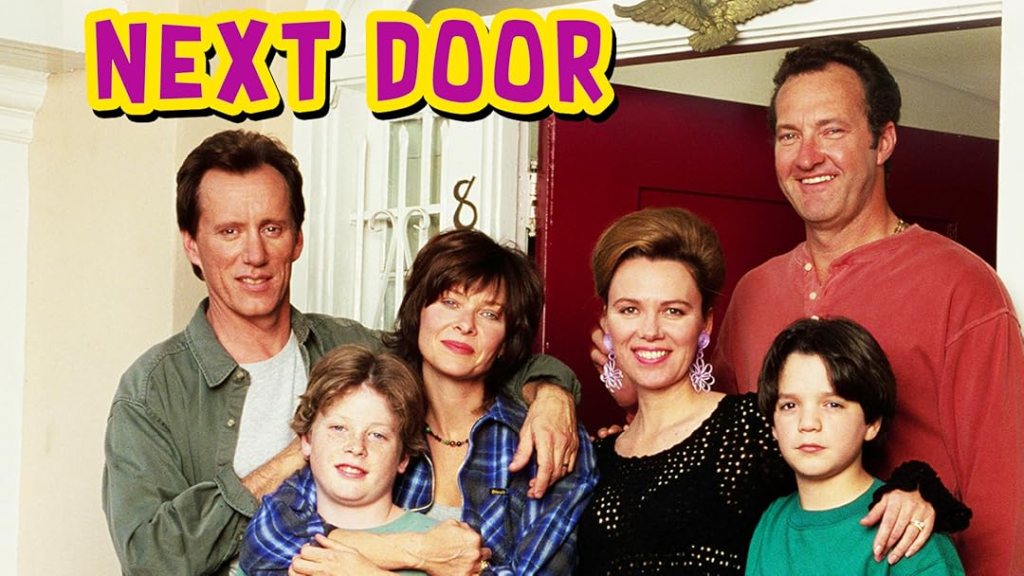
This sitcom looking picture is not a good indicator of the dark places this movie will go!
NEXT DOOR (1994) is a dark suburban satire that introduces us to college professor Matt Coler (James Woods), his lovely wife Karen (Kate Capshaw), and their son Bucky, who have recently moved out to the suburbs. As the movie begins, Matt, Karen and even Bucky seem to be slightly obsessing over their next-door neighbors, Lenny and Marci Benedetti (Randy Quaid and Lucinda Jenney). For one, Lenny and Marci enjoy engaging in sexual intercourse on their backyard lawn furniture within view of each of the Coler family members. That’s quite awkward, but more irritatingly, Lenny insists on constantly watering his front yard near Matt’s property, which is having an extremely damaging effect on Matt and Karen’s beloved azaleas. Invited over to the Benedetti’s house for a cookout, Matt and Karen hope to get to know their neighbors a little better, as well as make a polite request of Lenny to not water the area near the boundary of their yards quite so much. We soon find out that Lenny, who works at the local meat packing plant, is loud, obnoxious, smarter than he looks, and seems to have a really big chip on his shoulder towards Matt, who he doesn’t see as being much of a man. He even tells Karen that her husband is a child, and that’s why he went into teaching rather than getting “a real job.” This upsets Karen so she tells Matt it’s time to leave, but before going, they ask Lenny not to water the part of his yard near their flowers so much. That night, Lenny moves the sprinkler even closer to Matt’s yard, which puts the final death knell in the azaleas. Very annoyed, but not wanting to go too far, Matt gets even by spraying Lenny’s outdoor patio furniture with a lot of water as a prank. Lenny doesn’t handle Matt’s prank very well, and this is where things begin getting out of hand, igniting a full-blown feud between the two men. Soon the annoyances of wet furniture and dead flowers give way to outright horror involving poisoned family pets, police investigations, attempted sexual assault, and even attempted murder!
NEXT DOOR, which is a made for Showtime original, starts out as an amusing and entertaining film involving innocent pranks between James Woods’ meek teacher and Randy Quaid’s boorish butcher. As the intensity of the feud picks up between the men, and the retaliations become more and more sinister, I had to pick my jaw up off the floor as it goes to places that aren’t funny at all. The story seems to be trying to make a statement about the class divide, the survival of the fittest, and the danger that lurks behind the picket fences and in the backyards of the innocent looking neighborhoods around us. It does that job well, as I certainly sensed the real danger that the more “civilized” man found himself in when he came up against a man who didn’t really concern himself with societal norms. I have to give a lot of credit to Randy Quaid’s performance as Lenny for making me feel that way. He is simply a force of nature, and his portrayal of the beer guzzling, opinionated, blue collar bully is excellent in its unhingement! Sadly, I’ve known quite a few people who acted way too much like Lenny for my comfort. James Woods is also excellent as the somewhat timid, intelligent college professor who keeps thinking he can talk his way out of this predicament. We know how intense James Woods can be in his best roles, but he’s quite different here as the man who tries to remain reasonable until the very end of the film when he’s finally forced to take a stand for his family’s safety. He doesn’t have the showy role here, but I can definitely identify with his character, as that would be me in this situation. Kate Capshaw and Lucinda Jenney are both appealing as the suffering wives, providing some good support and wit to the proceedings, but this show belongs to the men.
NEXT DOOR is a true horror film as far as I’m concerned, because if I found myself in this kind of situation with my own neighbor, I would consider it a nightmare. There have been a couple of times in my own life where I have found myself in situations with a neighbor that made me uncomfortable. One of those times involved our next-door neighbor driving across the boundary between their yard and ours and then taking our driveway out to the main road instead of using their own, less maintained driveway. This really bothered my wife as they had never asked if they could do it, and it had practically made a “path” that looked like a road at the boundary. Since it bothered my wife, we ended up having a polite conversation with our neighbors, they understood our concerns, and we worked out a plan that worked for all of us. A different time, however, one of our neighbors across the road left their pitbull out and it attacked our small dog in our own yard. It almost killed our dog, requiring her to have emergency surgery from our veterinarian to save her leg, and it also led to high vet bills. Our neighbors refused to discuss the situation with us, and being from West Virginia, my wife wanted us to take the situation to more extreme levels, including getting local law enforcement involved. In a situation like this, you have to truly consider how far you want to take a situation and then be prepared for the whatever events could follow. There’s a lot of unknown, and it’s pretty scary to be honest with you.
Ultimately, I would have to admit that I didn’t really enjoy NEXT DOOR very much, but I did find it fascinating. I appreciated the great performances of Woods and Quaid, but the movie made me very uncomfortable. If my discomfort was director Tony Bill’s (MY BODYGUARD, FIVE CORNERS, FLYBOYS) goal, it certainly worked. I just think that the farcical nature of the black humor at the beginning didn’t quite mesh with the dark and disturbing elements at the end. Or maybe it just took me places I wasn’t really prepared to go. Either way, it’s still an interesting relic of the 90’s made-for-premium-cable-TV movie. You never knew where those movies were headed! If you’re interested, as of this writing, it’s available for streaming on Tubi.
2000’s The Stalking of Laurie Show takes place in Pennsylvania, a wonderful state as long as you don’t count Philadelphia. Even more specifically, the film takes place in Pennsylvania Dutch country. An Amish man occasionally appears, sitting in his buggy when it moves down the road. One character, a lunkhead named Butch (Rel Hunt), goes to an Amish coffeeshop while his girlfriend is committing a horrific murder.
The Amish don’t play a huge role in The Stalking of Laurie Show, which is ultimately a story of a murder amongst high school students. Still, seeing them in the background is a reminder of a simpler life and also a reminder that not everyone is consumed by hate. That’s a welcome reminder because this film, much like our present world, is full of irrational hate.
Michelle Lambert (Marnette Patterson) is, at least when the film starts, the queen of her high school. Everyone wants to be her friend and everyone fears getting on her bad side. She’s a master manipulator, someone who obviously feels that she has the right to take whatever she wants. And yet, when we first meet her, it’s hard not to feel at least a little sympathy for her. Her homelife isn’t the best. She doesn’t get along with her father. She’s very protective of her younger siblings. Despite appearances, she’s not rich. The only reasons she has expensive clothes and makeup is because she’s very good at shoplifting. When I was a teenager, I was very good at shoplifting too so I could …. well, I don’t want to say that I related to her because there is a difference between pocketing purple eyeshadow and stealing an entire wardrobe. As well, it soon becomes clear that Michelle has a mean streak that no amount of a bad family life could justify.
Michelle takes a new student, innocent Laurie Show (Jennifer Finnigan) under her wing and, for a while, she and Laurie are best friends. But then, when Michelle’s lunkhead boyfriend Butch takes an interest in Laurie, things change. Michelle is fiercely jealous of Butch and soon, Michelle and her friends are conspiring on ways to humiliate Laurie. When Michelle gets pregnant, she drops out of school, moves into a trailer with Butch, and eventually alienates almost all of her friends after she attacks Laurie in a bowling alley parking lot. Only Tabitha (Joanne Vannicola) remains loyal to Michelle. Soon Tabitha and Michelle are plotting Laurie’s death….
Agck! It’s a disturbing story, especially since it’s true. Michelle and Tabitha murdered Laurie Snow in December of 1991, just five days before Christmas. (There’s some debate as to whether or not Butch took part in the actual murder or not.) Michelle is currently in prison while Tabitha, a juvenile at the time of the murder, was paroled in 2019. Today, of course, Michelle and her friends would have hounded Laurie online, sending her anonymous messages, filming every fight between the two of them, and telling her to “kill yourself.” Every time I read about a teenager who committed suicide due to cyberbullying, my immediate response is that they didn’t kill themselves. They were murdered. Anyone who would taunt a fragile person to the point of suicide is as guilty as if they pulled the trigger or tightened the noose themselves. And don’t give me any of that, “They didn’t know it would happen” crap either. In every case, they knew what they were doing.
As for the film itself, it’s definitely sensationalized. Marnette Patterson fully embraces the melodrama as Michelle, at first playing her as just being a standard mean girl before then going totally over-the-top as Michelle’s grip on reality becomes more and more loose. Jennifer Finnigan is sympathetic as Laurie and Jessica Greco gives a good performance as a friend of Laurie’s who is also drawn into Michelle’s crowd. If the film wasn’t based on a true story, it would probably be a camp classic. But since it is based on a true story, it works best as a plea for people to stop turning a blind eye to bullying. That’s not a bad message.



 Through the Shattered Lens