Horror on the Lens: The Hound of the Baskervilles (dir by Sidney Lanfield)


For today’s horror on the lens, we have 1939’s The Hound of the Baskervilles!

Based, of course, on the novel by Arthur Conan Doyle, The House of the Baskervilles is well-remembered for being the first of many Sherlock Holmes films to star Basil Rathbone as the detective and Nigel Bruce as his loyal sidekick, Dr. Watson.  Interestingly enough, Holmes is absent for a good deal of the film, leaving it up to Watson to do the majority of the investigating.  That said, you can still see why Rathbone’s interpretation of the character proved to be so popular that he would go on to play Holmes in a total of 14 movies and one radio series.

Enjoy!

Film Review: The Loves of Edgar Allan Poe (dir by Harry Lachman)


I have to admit that the 1942 film, The Loves of Edgar Allan Poe, turned out to be far different from what I was expecting.

Just based on the title, I was expecting it would be a highly fictionalized, borderline silly film about Edgar Allan Poe defeating his romantic rivals and winning the hand of the woman he loved while still finding time to write The Raven.  I figured that there would be at least a few gentlemanly fisticuffs, with Poe portrayed as a combination of Rhett Butler and Cary Grant.  Looking at the title, it was easy for me to imagine the film closing with Poe kissing his future wife and then looking straight at the camera.  “Quoth the Raven!” he would say and wink while romantic music swelled in the background…

But no.  The Loves of Edgar Allan Poe is actually a very conventional biopic.  With a running time of only 67 minutes, the movie often feels rather rushed but it still manages to include most of the better known details of Edgar Allan Poe’s short but eventful life.  (An ever-present narrator is always ready to fill us in on every thing that happens off-screen.)  The film doesn’t spend much time on what initially inspired Poe’s macabre imagination.  There’s a scene of Poe, as a child, standing on a desolate hill and looking at a raven perched in a dead tree.  With the exception of an extended section that deals with Annabel Lee, that’s about as deep as the movie is willing to get as far as Poe’s art is concerned.

When Poe grows up, he’s played by actor Sheppard Strudwick, who has a good mustache but never exactly comes across as being the type of tortured genius who would eventually end up both revolutionizing literature and drinking himself to death.  The majority of the film deals with Poe’s advocacy for copyright reform, which is an important issue but not exactly the most cinematic of concerns.  Poe survives college.  Poe tries to sell The Raven for $25.  Eventually, Poe marries Virginia Clemm (Linda Darnell) and her subsequent sickness and death leads to not only Poe’s greatest work but also his own tragic end.

Along the way, Poe meets both Thomas Jefferson and Charles Dickens.  Jefferson shows up long enough to tell a young Poe that he’s a good writer and that he needs to stop gambling.  Dickens meets Poe and encourages him to continue to advocate for better copyright laws.

It is known that Poe and Dickens actually did meet but did Poe also meet Thomas Jefferson?  Legend says that he did but no one knows for sure.   Here’s what we do know:

Poe attended the University of Virginia in 1826.  The University’s founder, former President Thomas Jefferson, was still alive in 1826 and would often invite promising students to Monticello.  Whether Jefferson was still doing that when Poe enrolled at the University of Virginia is questionable.  Jefferson died five months after Poe started his studies.

As for Dickens, Charles Dickens and Edgar Allan Poe admired each other’s writing and they met in Philadelphia during Dickens’s 1842 tour of North America.  No record has been kept of what they discussed, though some think that Dickens told Poe about his pet raven and perhaps inspired Poe’s best-remembered poem.  In the movie, they discuss copyright laws, which is nowhere near as much fun.

(When it comes to Poe’s meetings with both Jefferson and Dickens, it is perhaps best to remember the lesson of The Man Who Shot Liberty Valance and print the legend.)

The Loves of Edgar Allan Poe is a very short film and an obviously low-budget one as well.  When the presence of that somewhat pedantic narrator, The Loves of Edgar Allan Poe feels more like an educational special than a real movie.  It’s an okay introduction to Poe’s life but, ultimately, the best way to get to know Edgar Allan Poe is to sit down and start reading.

Horror Film Review: The Picture of Dorian Gray (dir by Albert Lewin)


picture-of-dorian-gray-32

Hello and welcome to the start of TSL’s annual October horrorthon!  All through the month of October, our focus will be on horror.  We will be sharing reviews and thoughts on some of the best (and worst) horror films ever made!  I have to admit that this is my favorite time of the year.  I love horror … like all good people!

I want to start things off by taking a look at a film from 1945.  The Picture of Dorian Gray is based on the famous novel by Oscar Wilde (a novel that some people think was inspired by the Jack the Ripper murders).  Dorian Gray (played by Hurd Hatfield) is a young and handsome aristocrat who lives in 19th century London.  When we first meet him, Dorian is intelligent, kind and virtuous.  He’s also more than a little boring.  He is the bland face of the establishment, a man destined to be celebrated for his position in society and largely forgotten after his death.

Dorian is posing for a painting that’s being done by his friend, an artist named Basil Hallward (Lowell Gilmore).  One day, Lord Henry Wotton (George Sanders) stops by the studio while Basil is painting Dorian.  Lord Henry is everything that Dorian Gray is not.  He’s a worldly and cynical man and he is very proud to live a life devoted to complete and total hedonistic pleasure.  He immediately sets out to corrupt Dorian and it turns out to be a lot easier than he was expecting.  Henry convinces Dorian that he can have everything that he wants as long as he’s young and handsome.  Dorian announces that he wishes the painting could age instead of him…

Now, here’s where the film takes a huge departure from Wilde’s novel.  In the novel, the painting ages while Dorian stay young.  No specific reason is given.  Instead, it’s just something that happens.  In the film, it turns out that Basil owns an ancient Egyptian statue and that the statue has mystical powers.  Dorian makes his wish in front of the statue and that’s why the painting starts to age.  Personally, I think the bit with the Egyptian statue is unnecessary and a little bit silly.  To me, the story is a lot more effective if the painting starts to age without an explanation.  The filmmakers obviously disagreed.

But no matter!  In the end, the Egyptian statue isn’t that important.  What is important that, freed from getting old or physically suffering for his actions, Dorian transforms into a different person.  Soon, he’s even more hedonistic than Lord Henry.  When he breaks the heart of a tragic singer named Sybil Vane (Angela Lansbury, in a poignant and Oscar-nominated performance), Dorian sees that the painting is now cruelly smirking while his own face remains innocent and untouched.  When Dorian eventually commits a murder to keep his secret from getting out, the blood appears on the painting’s hands while his own remain clean.

And the years pass.  Dorian finds himself both being hunted by Sybil’s brother (Richard Fraser) and falling in love with the niece (Donna Reed) of a man that he earlier murdered.  Dorian never ages but his portrait becomes more and more twisted.  What’s particularly interesting is that we see little of Dorian’s evil actions.  Instead, we watch and listen as other characters whisper about the horrific things that he’s done.  Physically, Dorian remains an innocent and young aristocrat.  But all we have to do is look at the picture and we can see what a monster Dorian has become…

The Picture of Dorian Gray is an absolutely gorgeous film, one that is full of elaborate sets that are often cast in shadow.  (It’s interesting to note that the more corrupt Dorian becomes, the darker and more shadowy his estate becomes.)  The film is in black-and-white, with the exception of three scenes in which the portrait is revealed in all of its Technicolor glory.  If that sounds like a gimmick … well, it is.  But it’s an amazingly effective gimmick.

The Picture of Dorian Gray is a classic exercise in psychological horror.  See it the next chance you get!

portrait-de-dorian-gray-1945-01-g

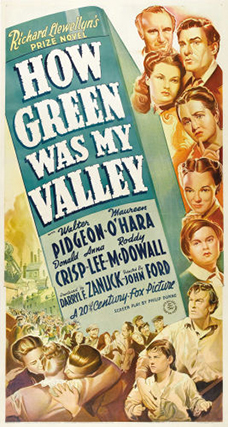
Cleaning Out The DVR #18: How Green Was My Valley (dir by John Ford)


(For those following at home, Lisa is attempting to clean out her DVR by watching and reviewing 38 films by this Friday.  Will she make it?  Keep following the site to find out!)
How_Green_Was_My_Valley_poster

Before I really get into this review, I should admit that I watched How Green Was My Valley with a bias.

Before the movie started, I was expecting to be disappointed with it.  I think that a lot of film lovers would have felt the same way.  How Green Was My Valley won the 1941 Oscar for best picture.  In doing so, it defeated three beloved films that have only grown in popularity and renown since they were first released: Citizen Kane, The Maltese Falcon, and The Little Foxes.  (As well, just consider some of the 1941 films that weren’t even nominated for best picture: Ball of Fire, The Devil and Daniel Webster, Dr. Jekyll and Mr. Hyde, High Sierra, The Lady Eve, Never Give A Sucker An Even Break, The Sea Wolf, The Wolf Man, and Sullivan’s Travels.)  Because it defeated so many great films and since we’re all used to the narrative that the Academy always screws up, there’s a tendency to assume How Green Was My Valley was really bad.

Well, after years of assumptions, I finally actually watched How Green Was My Valley?  Was it bad?  No, not really.  Was it great?  No, not all.  If anything, it felt rather typical of the type of films that often win best picture.  It was well-made, it was manipulative enough to be a crowd-pleaser while serious enough to appeal to highbrow critics, and, perhaps most importantly, it never really challenged the viewer.  Unlike Citizen Kane and The Maltese Falcon, How Green Was My Valley is a film that doesn’t require that you give it too much thought and, as such, it really shouldn’t be surprising that it was named the best picture of the year.

How Green Was My Valley was directed by John Ford and, as you might expect from Ford, it deals with a changing way of life and features good performances and a few impressive shots of the countryside.  Taking place in the late 1800s, How Green Was My Valley tells the episodic story of the Morgans, a large family of Welsh miners.  The film is narrated by Huw (Roddy McDowall), a youngest member of the family.  Though Huw’s eyes, we watch as his once idyllic and green village is transformed by the growing mining industry and blackened with soot, poverty, and death.

The film starts out as a fairly even mix of sentiment and drama.  Huw has a crush on his brother’s fiancee.  His sister, Angharad (Maureen O’Hara), has a flirtation with the new preacher, Mr. Gruffydd (Walter Pidgeon).  Much emphasis is put on communal gatherings.  There is a wildly joyful wedding celebration.  We often see the villagers in church and hear them singing both hymns and folk songs.  In their isolate village, they are are united against a changing world.

Or, at least, they think they are.  As the mining industry grows, that united front and sense of community starts to vanish.  A strike sets family members against each other, as each miner is forced to decide whether to side with management or with his fellow workers.  Each year, the wages become lower.  When management realizes that its cheaper to just continually hire new miners, several of the veteran workers are fired and end up leaving the village to seek a living elsewhere.  As new people come to the village, even Mr. Gruffydd finds himself the subject of gossip.

As for Huw, he grows up.  He goes to school, deals with a sadistic teacher, and learns how to defend himself against bullies.  And eventually, like everyone in his family, he is sent down into the mines and soon, his once innocent face is covered in soot.

And, of course, there’s a big tragedy but you probably already guessed that.  How Green Was My Valley is not a film that takes the viewer by surprise.

For the most part, it’s all pretty well done.  The big cast all inhabit their roles perfectly and Roddy McDowall is extremely likable as Huw.  Maureen O’Hara shows why she eventually became a star and even Walter Pidgeon gives a surprisingly fiery performance.  How Green Way My Valley is a good film but it’s too conventional and predictable to be a great film, which is why its victory over Citizen Kane and The Maltese Falcon will always be remembered as a huge Oscar injustice.

But, taken on its own terms and divorced from the Oscar controversy, How Green Was My Valley may be a conventional but it’s not a bad film.  It’s just no Citizen Kane.