As some of our regular readers undoubtedly know, I am involved in a few weekly live tweets on twitter. I host #FridayNightFlix every Friday, I co-host #ScarySocial on Saturday, and I am one of the five hosts of #MondayActionMovie! Every week, we get together. We watch a movie. We tweet our way through it.
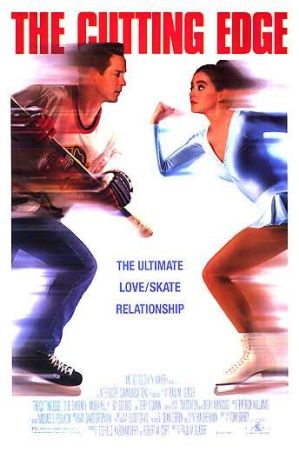
Tomorrow, at 10 pm et, I will be hosting #FridayNightFlix! The movie? 1992’s The Cutting Edge!
It’s figure skating, hockey, and love! D.B. Sweeney is a former hockey star. Moira Kelly is a figure skater with a reputation for being a diva. Terry O’Quinn and Roy Dotrice are the distinguished character actors who are brought in to class the joint up. Can Sweeney and Kelly win the gold and fall in love at the same time!?
If you want to join us this Friday, just hop onto twitter, start the movie at 10 pm et, and use the #FridayNightFlix hashtag! I’ll be there tweeting and I imagine some other members of the TSL Crew will be there as well. It’s a friendly group and welcoming of newcomers so don’t be shy.
This movie is a personal favorite of mine and I can’t wait to play host tomorrow night!
This weekend's live tweets, hosted by me:#FridayNightFlix (Friday, 10 pm et) — The Cutting Edge (1992)#ScarySocial (Saturday 9 pm et) — The Texas Chainsaw Massacre Part 2 (1986)
John (Keith Carradine) and his wife, Leanne (Daryl Hannah) are two white trash murderers who are on the run with the police. When the cops catch them in the act of burglarizing a house (and murdering the people who live there), John and Leanne manages to narrowly escape but they’re forced to leave behind their 6 year-old daughter, Janie (Julia Devlin).
Traumatized by her former life, Janie is adopted by an architect named Russell (Vincent Spano) and his wife, Dana (Moira Kelly). Dana, who lost her previous baby, and Russell are convinced that they can give Janie a loving home and help her overcome her past traumas. And it seems like they might be correct, even though Janie is still terrified of a mysterious monster that she calls “the tooth fairy.”
However, John and Leanne are determined to get their daughter back and they’ve just found out where Russell and Dana live.
The Tie That Binds is a stupid movie from 1995 that, like a lot of stupid movies from the 90s, was put into heavy rotation on HBO and Cinemax after a brief box office run. The main problem with the film is that everyone consistently makes the dumbest decisions possible but then we’e expected to sympathize with them when everything goes wrong. John and Leanne may be extremely evil but they’re also extremely stupid so it’s hard to really buy into the idea that they could somehow successfully evade being caught by the police long before the inevitable scene where they confront Russell and Dana in the unfinished house that Russell’s spent the entire movie working on.
The Tie That Binds does feature good performances, all from actors who deserved better. Keith Carradine and Daryl Hannah are frightening and Moira Kelly and Vincent Spano are convincing as a normal couple who just want to do the right thing. Both Kelly and Spano should have been bigger stars back in the day but instead, it seems like they usually just ended up in stuff like The Tie That Binds.
Last night, I watched the latest Lifetime original film, Deadly Sorority!
Why Was I Watching It?
You have to give the people at Lifetime some credit. I often give them a hard time for the way that they retitle movies to give them more of a “Lifetime-y” feel but Deadly Sorority is a perfect title. According to the imdb, this movie was originally called Undergrad Nightmare. Deadly Sorority is such an improvement that I don’t even know where to begin. It was enough to convince me to watch.
(Of course, I would have watched anyway because the movie was on Lifetime but, for the purpose of this review format, let’s pretend like the title was the sole reason.)
What Was It About?
Sam (Greer Grammer) and Kris (Emilija Branac) have been BFFs since high school but, once they arrive at Barclay University, things start to change. Kris gets accepted into an exclusive sorority and soon, her new “sisters” are telling Sam to stay away. When Kris is murdered, Sam suddenly finds herself as the number one suspect. Everyone says that Sam was obsessed with Kris and jealous over her new friends.
In order to prove her innocence, Sam is going to have to catch the real murderer. Was it Kris’s frat boy boyfriend? Was it the lecherous professor or his wife? Was it the creepy guy who lives upstairs from her? Was it one of Kris’s sorority sisters? Was it … well, actually, that’s all the suspects. It’s a small school.
What Worked?
I absolutely loved Barclay University, which was located up in the mountains, had nice, big dorm rooms (during my first year of college, I lived in a dorm that didn’t even have air conditioning), and — as far as I could tell — only three or four professors. There weren’t many students either. Sam and Kris’s history class only had about 12 students in it. As someone who hated the anonymous feeling of being one of many students in a gigantic lecture hall, I appreciated that.
The sorority was effectively creepy. However…
What Did Not Work?
…the sorority itself really didn’t figure much into the plot. There were a few effective scenes of all of the sisters staring at Sam dismissively but otherwise, the sorority was just a big, pink-clad red herring. Deadly Sorority is a great title but Undergrad Nightmare was actually a more accurate title. Usually, I don’t mind a misleading title but, when you promise a deadly sorority, you need to deliver.
The identity of the murderer also felt a bit random to me.
“Oh my God! Just like me!” Moments
I related to Sam, who had a wonderfully snarky attitude and said whatever was on her mind. Unlike Sam, I was actually invited to join a sorority but I turned them down because I was busy being a nonconformist. I kind of regret that choice because, according to what I’ve seen on Lifetime, joining a sorority would have led to several years of adventure and melodrama. At the very least, I would have had a few hundred more closets to borrow from.
— Phillip Jeffries (David Bowie) in Twin Peaks: Fire Walk With Me (1992)
Even among fans of the show, Twin Peaks: Fire Walk With Me is controversial.
If you read Reflections: An Oral History of Twin Peaks, you’ll discover that many members of the television show’s cast either didn’t want to be involved in the film or didn’t care much for it when it came out. Fearful of being typecast, Kyle MacLachlan only agreed to play Dale Cooper on the condition that his role be greatly reduced. (Was it that fear of being typecast as clean-cut Dale Cooper that led to MacLachlan later appearing in films like Showgirls?) Neither Lara Flynn Boyle nor Sherilyn Fenn could work the film into their schedules.
When Twin Peaks: Fire Walk With Me premiered at Cannes, it was reportedly booed by the same critics who previously applauded Lynch’s Wild at Heart and who, years later, would again applaud Mulholland Drive. When it was released in the United States, the film was savaged by critics and a notorious box office flop. Quentin Tarantino, previously a fan of Lynch’s, has been very outspoken about his hatred of Twin Peaks: Fire Walk With Me. When I first told people that we would be looking back at Twin Peaks for this site, quite a few replied with, “Even the movie?”
And yet, there are many people, like me, who consider Twin Peaks: Fire Walk With Me to be one of David Lynch’s most haunting films.
It’s also one of his most straight forward. Twin Peaks: Fire Walk With Me is a prequel, dealing with the events leading up to the death of Laura Palmer. Going into the film, the viewer already knows that Laura Palmer (Sheryl Lee) is full of secrets. They know that she is using drugs. They know that she is dating Bobby (Dana Ashbrook), while secretly seeing James (James Marshall). They know about her diary and her relationship with the reclusive Harold (Lenny Von Dohlen). They know that she is a friend to innocent Donna Hayward (Moria Kelly, somewhat awkwardly taking the place of Lara Flynn Boyle). Even more importantly, they know that she has spent the last six years of her life being abused by BOB (Frank Silva) and that BOB is her father, Leland Palmer (Ray Wise). The viewer starts the story knowing how it is going to end.
Things do get off to a somewhat shaky start with a nearly 20-minute prologue that basically plays like a prequel to the prequel. Theresa Banks, who was mentioned in the show’s pilot, has been murdered and FBI director Gordon Cole (David Lynch) assigns agents Chester Desmond (Chris Isaak) and Sam Stanley (Kiefer Sutherland) to investigate. Chester and Sam’s investigation basically amounts to a quick reenactment of the first season of Twin Peaks, with the agents discovering that Theresa was involved in drugs and prostitution. When Chester vanishes, Dale Cooper is sent to investigate. Harry Dean Stanton shows up as the manager of a trailer park and David Bowie has an odd cameo as a Southern-accented FBI agent who has just returned from the Black Lodge but otherwise, the start of the film almost feels like a satire of Lynch’s style.
But then, finally, we hear the familiar theme music and the “Welcome to Twin Peaks” sign appears.
“And the angel’s wouldn’t help you. Because they’ve all gone away.”
— Laura Palmer (Sheryl Lee), Twin Peaks: Fire Walk With Me (1992)
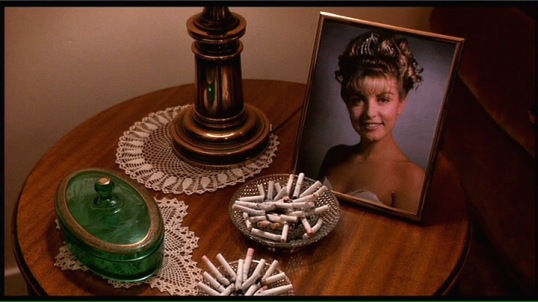
A year has passed since Theresa Banks was murdered. The rest of the film deals with the final few days of the life of doomed homecoming queen Laura Palmer. Laura smiles in public but cries in private. She is full of secrets that she feels that she has to hide from a town that has literally idolized her. She has visions of terrifying men creeping through her life and each day, she doesn’t know whether it will be BOB or her father waiting for her at home. She knows that the world considers her to be beautiful but she also know that, within human nature, there is a desire to both conquer and destroy beauty. When she sleeps, she has disturbing dreams that she cannot understand but that she knows are important. At a time when everyone says she should be happy to alive, all she can think about is death. Everywhere she goes, the male gaze follows and everything that should be liberating just feels her leaving more trapped. For all the complaints that Twin Peaks: Fire Walk With Me is somehow too strange to be understood, it’s not a strange film at all. This is David Lynch at his most straight forward. Anyone who thinks that Laura’s story is incomprehensible has never been a 17 year-old girl.
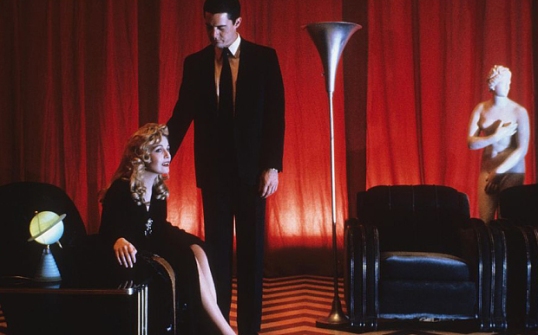
This is the bleakest of all of David Lynch’s films. There is none of broad humor or intentional camp that distinguished the TV show. After the show’s occasionally cartoonish second season, the film served as a trip into the heart of the darkness that was always beating right underneath the surface of Twin Peaks. It’s interesting how few of the show’s regulars actually show up in Twin Peaks: Fire Walk With Me. None of the characters who represented goodness are present. There’s no Doc Hayward. No Sheriff Truman. No Deputies Andy or Hawk. No Pete Martell. No Bookhouse Boys. Scenes were filmed for some of them but they didn’t make it into the final cut because their tone did not fit with the story that Lynch was seeking to tell. The Hornes, Dr. Jacoby, Josie, none of them are present either.
Instead, there’s just Larua and her father. As much as they try to deny it, Laura knows that she is going to die and Leland knows that he is going to kill her. Killer BOB and the denziens of the Black Lodge may be scary but what’s truly terrifying is the sight of a girl living in fear of her own father. Is Leland possessed by BOB or is BOB simply his way of excusing his own actions? If not for Leland’s sickness, would BOB even exist? When Laura shouts, “Who are you!?” at the spirit of BOB, she speaks for every victim of abuse who is still struggling to understand why it happened. For all the talk of the Black Lodge and all the surreal moments, the horror of this film is very much the horror of reality. Leland’s abuse of Laura is not terrifying because Leland is possessed by BOB. It’s terrifying because Leland is her father
David Lynch directs the film as if it where a living nightmare. This is especially evident in scenes like the one where, at the dinner table, Leland switches from being kindly to abusive while Laura recoils in fear and her mother (Grace Zabriskie) begs Leland to stop. It’s a hard scene to watch and yet, it’s a scene that is so brilliantly acted and directed that you can’t look away. As brilliant as Ray Wise and Grace Zabriskie are, it’s Sheryl Lee who (rightly) dominates the scene and the rest of the film, giving a bravely vulnerable and emotionally raw performance. In Reflections, Sheryl Lee speaks candidly about the difficulty of letting go of Laura after filming had been completed. She became Laura and gave a performance that anchors this absolutely terrifying film.
“Mr. Lynch’s taste for brain-dead grotesque has lost its novelty.”
— Janet Maslin
“It’s not the worst movie ever made; it just seems to be”
— Vincent Canby
If you need proof that critics routinely don’t know what they’re talking about, just go read some of the original reviews of Twin Peaks: Fire Walk With Me.
And yet, having just rewatched the show and now the movie, I can understand why critics and audiences were baffled by this film. This is not Twin Peaks the TV show. There is no light to be found here. There is no comic relief. (Even Bobby Briggs, who had become something of a goofy anti-hero by the time the series ended, is seen here shooting a man in the head.) There is no exit and there is no hope. In the end, the film’s only comfort comes from knowing that Laura was able to save one person before dying. It’s not easy to watch but, at the same time, it’s almost impossible to look away. The film ends on Laura’s spirit smiling and, for the first time, the smile feels real. Even if she’s now trapped in the Black Lodge, she’s still free from her father.
Since this was a prequel, it didn’t offer up any answers to the questions that were left up in the air by the show’s 2nd season finale. Fortunately, those questions will be answered (or, then again, they may not be) when the third season premieres on Showtime on May 21st.
So, I just watched the Opening Ceremonies of the 2016 Summer Olympics! And I have to say that I really enjoyed them but then again, I always enjoy the Olympics and not just the gymnastic stuff that everyone loves. It’s odd because I’m really not into sports at all. I guess I just like the idea behind the Olympics. I like the idea of people from all nations gathered together in one country, linked together in the spirit of fair competition and, most importantly, not killing each other.
Plus, I can’t help but love the spectacle of it all!
I figured that, for the duration of the games, I would attempt to post one Olympic-themed film a day. Now, I have to admit that this is one of those things that seemed easier when I was thinking about it then it does now that I’m actually trying to do it. But we’ll see what happens!
Originally, I was going to limit myself to films about the Summer Olympics but then I realized that, by doing that, I wouldn’t be able to write about the 1992 film, The Cutting Edge! And that would be a shame because I really like The Cutting Edge!
The Cutting Edge tells a story that is both thoroughly predictable and yet thoroughly charming at the same time. Doug Dorsey (D.B. Sweeney) is a likable and kinda dorky blue collar guy who also happens to be one of the best hockey players in the world. Kate Moseley (Moira Kelly) is a world-class figure skater who has been totally spoiled by her father (Terry O’Quinn) and whose imperious attitude has managed to alienate every partner that she’s ever had.
At the 1988 Olympics, Doug and Kate run into each other. Literally, they collide with each other in the arena. Doug is apologetic. Kate snaps at him to watch where he’s going. Later, Doug is injured in a game and is forced to retire from hockey. Meanwhile, Kate’s latest partner deliberately drops her during their program and Kate is forced to settle for a silver medal.
Two years pass. Doug is working at a steel mill when he’s approached by a Russian coach named Anton Pamchenko (Roy Dotrice). Anton explains that Kate needs yet another new partner. Desperate to return to the Olympics, Doug agrees to skate with her.
And things go about the way you would expect. At first, Kate hates Doug. But slowly, Doug starts to win her over and Kate starts to lower her defenses and warm up to him. Kate teaches Doug how to be a champion figure skater. Doug teaches Kate how to be nice. Soon, they’re in love but unfortunately, Kate already has a boyfriend — a lawyer named Stuffy Q. McBorington (Dwier Brown).
(Actually, he might not be a lawyer. And his name isn’t Stuffy Q. McBorington. But it might as well be!)
Convincing Kate to leave her boyfriend is actually the easy part. The hard part is going to be winning the gold! Doug still has some rough edges and Kate can still be demanding but they love each other and we all know that love conquers all!
The Cutting Edge is one of those movies that used to be on cable all the time when I was growing up and I always loved watching it! I wanted a boyfriend like Doug and I wanted to wear cute costumes like Kate and I wanted to win a gold medal.
Yes, it’s a totally predictable movie. Not a single moment or line will surprise you. But it’s such a likable movie! Sweeney and Kelly have a really sweet chemistry and the skating action is well-directed and what more can you ask for a romantic comedy about ice skating?




 Through the Shattered Lens