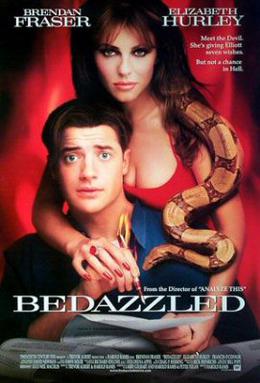
Elliot (Brendan Fraser) has a go-nowhere job at a computer company and an unrequited crush on Alison (Frances O’Connor), a co-worker who doesn’t even know who he is. One night, at a bar afterwork, he’s approached by the Devil (Elizabeth Hurley), who offers Elliot seven wishes in return for his soul. Elliot agrees but then he discovers that the Devil is tricky and his wishes always have an complication. Elliot wants to be powerful so the Devil turns him into a Columbian drug lord. Elliot wants to be sensitive and the Devil turns him into a whiny crybaby. Elliot wants to be president and suddenly, he’s Abraham Lincoln being told to get ready for the theater. Whenever things start to get too dangerous, the Devil brings Elliot back to reality so that she can continue to taunt him.
An Americanized remake of a British comedy that starred Dudley Moore and Peter Cook, Bedazzled was unfairly savaged by the critics when it was first released. While it can’t match the wit and heart of the original and not all of the wishes are equally effective, the remake has its charms. When Bedazzled first came out, most people talked about Elizabeth Hurley’s sexy performance of the Devil. When she appears as a school teacher, it’s not a surprise that every student brings her an apple at the start of the day. Hurley is so sexy that it’s easy to miss that she’s also giving a really good performance. Hurley’s Devil is a prankster. She likes to steal souls but mostly, she’s just having fun ruining all of Fraser’s wishes. Brendan Fraser is likable as Elliot and the way he responds to each wish gives him a chance to show off his comedic skills. Finally, the movie has a good ending, with Elliot growing up and realizing the truth about his crush on Alison.
Bedazzled may not be up to the level of some of director Harold Ramis’s otherfilms but it’s still better than its reputation.
I hope that Bradley Cooper will win an Oscar soon.
It’s obvious that Cooper wants that Oscar and really, who can blame him? After spending years being dismissed as a lightweight comedy actor, Cooper has really come into his own over the past thirteen years. 2012 was the year that he starred in Silver Linings Playbook and received his first Best Actor nomination. In the years that followed, he was nominated for American Sniper, American Hustle, A Star Is Born and Maestro. He deserved to be nominated for both Nightmare Alley and Licorice Pizza. Cooper has shown himself to be both a talented actor and director. He may not have been nominated for his direction of A Star Is Born but everyone knows that he should have been. He’s come a long way from being the star of The Hangover films and it makes sense that he would want an Oscar to make it official.
(The Oscar itself may not carry the cultural cachet that it once did but seriously, an award is an award.)
That desire for an Oscar is probably the best way to explain 2023’s Maestro, a film that really might as well have just been called Oscar Bait. Not only did Cooper direct and co-write Maestro but he also donned a prosthetic nose (and was briefly the center of some online controversy) to play the role of composer Leonard Bernstein. Filmed in both black-and-white and color, the film follows Leonard Bernstein from his young debut as a conductor through his marriage to Felecia (Carey Mulligan). Throughout the film, Felecia remains Leonard’s strongest supporter and his muse, even when she’s embarrassed by the rumors of his own impulsive behavior and his habit of cheating on her with men. The film is a portrait of the struggle to be a genius, the struggle to support a genius, and the love that can hold two people together even during the most difficult of times. And it’s all very Oscar bait-y, giving both Bradley Cooper and Carey Mulligan several scenes that, while well-executed, still feel as if they were designed specifically to appeal to the voters.
I had mixed feelings about Maestro when I watched it. On the one hand, I definitely admired the craft and the skill that went into the production. I admired the performances of both Bradley Cooper and Carey Mulligan. The movie’s soundtrack is full of the best of Bernstein’s compositions, all performed by the London Symphony Orchestra. The movie looked wonderful and it sounded wonderful but it also felt strangely hollow. Watching it, I realized that the movie really didn’t know what it wanted to say about Bernstein and Felecia. The movie was so consumed with technical perfection that the emotions of the story sometimes felt rather remote. It was a film about Leonard Bernstein that, despite Cooper’s strong performance, failed to really give us a reason to care about Bernstein. Maestro is a film that you admire while you watch it but it doesn’t really stick with you afterwards. It’s the epitome of Oscar bait.
Maestro did not win Cooper any Oscars, though it did bring some nominations. The film was also nominated for Best Picture but it lost to Oppenheimer. That said, I’m looking forward to the year when Bradley Cooper does finally win his Oscar and hopefully, he’ll win it for a film that’s more like the emotion-filled A Star Is Born than the rather detached Maestro. He’s one of my favorite actors and he’s due.
For all of his skill as an actor, George Clooney is a remarkably mediocre director.
Yes, I know. Clooney was nominated for an Oscar for directing Good Night, and Good Luck but that film was honored more for what it was about than what it actually was. All of Clooney’s directorial efforts — from the Oscar-nominated to the Razzie-embraced — have suffered from two huge problems.
Number one, George Clooney can occasionally set up an interesting shot but he appears to have no idea how to create or maintain narrative momentum. His films tend to lay flat, with incidents piled on top of each other but you never get the feeling that there’s some sort of internal motor moving the action along. It’s not easy creating and maintaining a narrative flow but it’s something that all good film directors can do. It’s also something that Clooney has never managed to master. Instead, he seems to assume that his own good intentions and broader concerns will provide the film with whatever momentum it needs. Unfortunately, good intentions are not the same as storytelling talent and, as a director, Clooney rarely brings any of the nuance that’s makes him such a good actor. George Clooney could play Michael Clayton but he could never direct the film named for him.
This bring us to Clooney’s other problem as a director, which is that he approaches his films with this sort of dorky earnestness that feels incredibly old-fashioned. On the one hand, dorky earnestness can be a likable trait. On the other hand, when watching his directorial efforts, you do find yourself wondering if George Clooney has seen any films made after 1989. There’s nothing terribly subversive about George Clooney’s artistic vision. He’s not a director who takes you by surprise nor is he a director who is capable of making you look at the world in a different way. While other filmmakers are challenging preconceived notions and attempting to reinvent the cinematic language, Clooney is busy trying to revive live television productions and making the type of stolid films that haven’t been relevant since the end of the studio system. It’s a shame because, as an actor in films like Michael Clayton and Up In The Air, Clooney expertly revealed the insecurity that lurked underneath the seemingly perfectly façade of the seemingly successful alpha male. But as a director, he’s a third-rate Taylor Hackford. And while it’s true that not every director can be Martin Scorsese, is it too much to ask for a director who at least tries to do something unique or different? For someone who has enough money and international clout that he can basically get away with just about anything and who has worked multiple times with the Coen Brothers and Steven Soderbergh, Clooney is an oddly risk-adverse filmmaker.
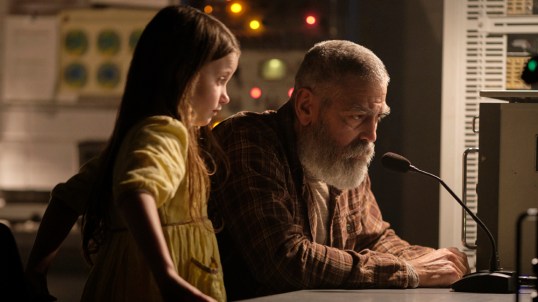
Unfortunately, all of Clooney’s directorial weaknesses are on display in The Midnight Sky, a rather slow science fiction film that would have made a good episode of The Twilight Zone but which falls flat as a movie. In this one, the world is ending and George Clooney is basically the last man left in the Arctic. Clooney is playing an astronomer who has spent his life searching for habitable planets and who is now dying of a terminal disease. He thinks he’s alone but then he comes across a mysterious girl named Iris. Iris rarely speaks and when she does speak, it’s to ask questions like, “Did you love her?” While Clooney is trying to figure where the little girl came from, he’s also trying to get in contact with a space mission so that he can warn them that the Earth is no longer inhabitable and they should relocate to one of Jupiter’s moon.
The space mission, meanwhile, is made up of Felicity Jones, David Oyelowo, Kyle Chandler, Demian Bircher, and Tiffany Boone. They’re stuck in space and trying to figure out why they can’t communicate with Earth. There’s a scene where their station gets bombarded by asteroids. The special effects are impressive (and this is a film that, despite being released on Netflix, really is meant to be viewed on a big screen) but during the whole scene, I was like, “Hey, it’s Gravity all over again!” Clooney never makes the familiar material his own. Instead, you find yourself thinking about all of the other sci-fi films that you’ve seen about the end of the world. Clooney doesn’t have the eccentricity of Alfonso Cuaron nor does he have the frustrating but intriguing megalomania of Christopher Nolan. Instead, he’s still same the director who thought that Edward R. Murrow was never more compelling than when he was complaining about people wanting to be entertained.
Lest anyone think that I’m going overboard in my criticism, allow me to say that The Midnight Sky isn’t really terrible as much as it’s just incredibly bland and forgettable. As I said before, the special effects are impressive. Clooney manages a few properly desolate shots of the Arctic, though making the Arctic look like the end of the world isn’t exactly the most difficult task in the world. As an actor, Clooney wears a beard in The Midnight Sky. Whenever the beard makes an appearance, you know that Clooney means for us to take him seriously and he gives an okay performance. He delivers his lines convincingly but his character is a bit dull and you can’t help but feel that Clooney the director wasted the talents of Clooney the actor. The film probably would have been improved if he and Kyle Chandler had switched roles.
The Midnight Sky didn’t really work for me. The end of the world should never be this boring.
Lost Girls tells the true and infuriating story of Mari Gilbert and her search for her oldest daughter, Shannan.
Mari Gilbert is a single mother who is works as a waitress and struggles to give her children the best life that she can. She’s still haunted by a decision that she made years ago to temporarily put her three daughters into foster care. Though she eventually reclaimed two of her daughters, her eldest — Shannan — has basically been on her own since she was sixteen. Shannan, who is now 24, visits her mother and her sisters on a semi-regular basis. Despite the fact that Shannan claims that she’s just a waitress (like her mother), Shannan always seems to have a lot of money on her. Mari has her suspicions about what Shannan’s doing to make that money but she keeps them to herself.
Then, one day in May, Shannan disappears. Mari can’t get the police to take her seriously when she says her oldest daughter has vanished. They say that Shannan left on her own and will probably return at some point. They dismiss Mari’s concerns, telling her that her daughter was a prostitute and therefore, by their logic, unreliable. Even when Mari gets strange phone calls from a doctor who lives in a gated community in Long Island, the police refuse to take her seriously.
However, Mari then discovers that Shannan called 911 the night that she disappeared. Despite the fact that Shannan sounded panicked, the police waited an hour before responding to her call and, by the time they arrived, Shannan had disappeared. It’s only when Mari goes to the media that the police actually start to search the area of Long Island where Shannan disappeared. The police discover the bodies of several sex workers, all murdered by the same unknown killer.
However, they still don’t find Shannan’s body. Though Mari and her daughter, Sherre (Thomasin McKenzie), are convinced that Shannan is one of the killer’s victims, the police continue to insist that Shannan probably just ran off on her own. In fact, the local police commissioner (Gabriel Byrne) finds himself being pressured to do something about Mari because her now constant presence on TV is making the entire community look bad.
Meanwhile, Mari finds herself caught up in a personal feud between two men who live in the gated community, an amateur investigator (Kevin Corrigan) and a shady doctor (Reed Birney) who has a history of making inappropriate phone calls….
Lost Girls is an interesting but frustrating film. Some of that is because the story on which the film is based did not have a happy ending. The Long Island serial killer has never been identified or captured. The most obvious suspect was never charged with anything and subsequently moved down to Florida. Mari never got justice for Shannan and, sadly, was eventually murdered by her youngest daughter. (The murder is acknowledged via a title card but it is not actually depicted in the film.) As a result, the film itself doesn’t really offer up any of the payoff that you would normally expect to get after devoting 90 minutes of your life to it. It’s frustrating but, at the same time, its understandable.
Amy Ryan gives a great performance as Mari. That shouldn’t shock anyone. She makes you feel Mari’s pain, fury, and guilt. To its credit, the film does shy away from the fact that Mari often looked the other way when it came to how exactly Shannan was making the money that she regularly sent back to her family and Amy Ryan perfectly captures Mari’s struggle to not only get justice for her daughter but also to forgive herself. Unfortunately, the film is a bit less convincing when it deals with the police and the suspects. The film, for instance, can’t seem to decide whether or not Gabriel Byrne’s character is indifferent, incompetent, or just overwhelmed by a bad situation. By that same token, the doctor and his neighbor both seem oddly underwritten and underplayed. Obviously, the film can’t just come out and accuse a real, living person of murder (especially when that person hasn’t been charged with anything) but it still makes for a frustrating viewing experience.
Where Lost Girls succeeds is at creating a properly ominous atmosphere. Every scene seems to be filled with dread and, from the minute that Mari starts her investigation, you feel nervous for her. She’s taking a true journey into the heart of darkness. The film leaves you angry that the police refused to search for Shannan. Sex workers are regularly preyed upon and, because of what they do for a living, society often looks the other way. That’s how you end up with killers like The Green River Killer and the Long Island serial killer. They don’t get away with their crimes because they’re clever. They get away with it because, far too often, society refuses to care about their victims. Lost Girls is an imperfect film but its heart is in the right place and its message is an important one.
 Elliot (Brendan Fraser) has a go-nowhere job at a computer company and an unrequited crush on Alison (Frances O’Connor), a co-worker who doesn’t even know who he is. One night, at a bar afterwork, he’s approached by the Devil (Elizabeth Hurley), who offers Elliot seven wishes in return for his soul. Elliot agrees but then he discovers that the Devil is tricky and his wishes always have an complication. Elliot wants to be powerful so the Devil turns him into a Columbian drug lord. Elliot wants to be sensitive and the Devil turns him into a whiny crybaby. Elliot wants to be president and suddenly, he’s Abraham Lincoln being told to get ready for the theater. Whenever things start to get too dangerous, the Devil brings Elliot back to reality so that she can continue to taunt him.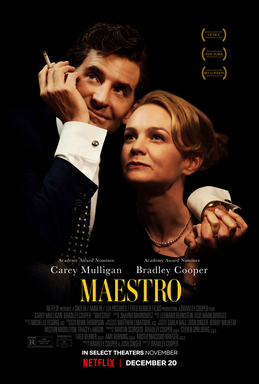

 Through the Shattered Lens