Oh look, it’s another Nigel Dick-directed hair metal video.
And it’s another Cinderella video featuring the band doing their version of rocking while being watched by a bunch of hot woman who were probably hoping Bon Jovi would show up instead.
But wait? Who’s that? It’s Wayne and Garth!
This song appeared on the Wayne’s World soundtrack and the video was shot to promote the film. Dana Carvey and Mike Myers show up as the duo who, at the time, were America’s favorite cable access hosts. Wayne and Garth were Cinderella fans? Guys, even Beavis and Butthead knew better than that!
Today’s music video of the day is here to help you to get in the mood to party on New Year’s Eve. If you don’t have plans to visit a castle and dance with Austin Powers and Taye Diggs, why don’t you?
Enjoy and here’s hoping for happiness (for Britney and all of us) in 2024!
Can a film be a box office hit and win the most Oscars of the year while also ending the career of the man who was credited as directing it?
If it’s Bohemian Rhapsody, it can.
The story is well-known but it is worth repeating. From the moment that the film went into production in 2017 until it was finally released in November of 2018, the buzz was that Bohemian Rhapsody was going to be a disaster. Despite the fact that he sometimes claimed that directing a biopic about Queen lead singer Freddy Mercury was a bit of a passion project for him, reports from the set indicated that director Bryan Singer was behaving just a little bit erratically. He argued with lead actor Rami Malek. He frequently disappeared from the set. Shooting was delayed for days because no one knew where Singer was. At the same time, with the #MeToo movement at the height of its cultural power, Singer was being accused of being one of Hollywood’s worst abusers. Eventually, 20th Century Fox suspended the production, fired Bryan Singer, and brought in Dexter Fletcher to finish shooting the film. By most accounts, Fletcher did a professional and exemplary job of getting the production back on track but, due to the DGA bylaws, he wasn’t credited with directing the film. Instead, he had to settle for an executive producer credit and the opportunity to direct the Elton John biopic, Rocketman.
As such, no one was expecting much from Bohemian Rhapsody. There were, of course, reports that Rami Malek did an unusually good job as Freddy Mercury. If somehow the film could be saved in editing, Malek might even pick up an Oscar nomination. But everyone knew that Bohemian Rhapsody was going to have to overcome a lot to be a successful film. While everyone appreciated that Dexter Fletcher had finished the film after Singer flaked out, there was a lot of doubt as to whether or not Fletcher’s work would mesh with Singer’s vision.
And indeed, the initial reviews were not positive. Malek was praised by most (but certainly not all) critics but the film itself was described as being disjointed and full of clichés. The film’s historical accuracy was criticized, as was its reticence in seriously exploring Mercury’s sexuality. Bohemian Rhapsody‘s editing was also heavily criticized, with the film’s sloppiness felt to be a result of the editor trying to put a coherent story together out of scenes that were filmed by two very different directors.
Here’s the thing, though.
The critics may have dismissed the film but what about the audiences? What about the people who pay money to see a film in a theater on the weekend that it comes out? What about the people who are motivated not by the opinions of film critics but instead by the recommendations of their friends and family? Those people, they didn’t care. They flocked to see Bohemian Rhapsody and, judging by the film’s box office, quite a few people saw it more than once. After all the drama and bad publicity, Bohemian Rhapsody became a huge hit.
It also became an Oscar contender. The film received five Oscar nominations, including for Best Picture of the Year. (Among the films that were not nominated for Best Picture were Eighth Grade, First Reformed, First Man, The Ballad of Buster Scruggs, and If Beale Street Could Talk.) Though the award for Best Picture went to Green Book (another film that was more popular with audiences than with critics), Bohemian Rhapsody won the other four awards for which it was nominated. In fact, Bohemian Rhapsody won the most Oscars that year. It won more Oscars than BlackKklansman, Black Panther, A Star is Born, The Favourite, and Roma. Bohemian Rhapsody even won the Oscar for Best Editing.
Even at the time that Bohemian Rhapsody was winning all of those Oscars, people seemed to be rather embarrassed by the film’s success. (Not one winner mentioned Bryan Singer in their speech, though most did take the time to thank Dexter Fletcher.) In the years since, Bohemian Rhapsody has developed a reputation for being one of the worst films to ever be nominated for Best Picture.
So, when I rewatched the film on Hulu, the main question on my mind was, “Is Bohemian Rhapsody as bad as everyone remembers?”
Well …. it’s not great. At the same time, it’s not terrible. It’s one of those films that’s very much in the middle. All those complaints about Bohemian Rhapsody being disjointed were and are valid. The script indulges in just about every rock star biopic cliché and the other members of Queen are portrayed as being ciphers. Perhaps most surprisingly, Rami Malek’s acclaimed, Oscar-winning performance doesn’t hold up particularly well. Malek has the charisma necessary to be a believable rock star but his performance is all on the surface and you never really get any ideas as to what exactly was going on inside of Mercury’s head. This is a biopic that doesn’t seem to be sure what it wants to say about its main subject, other than “Thanks for the music.” And really, there’s nothing wrong with saying “Thanks for the music.” But that could have just as easily been said by re-releasing a Queen concert film. That said, the story moves quickly, the 70s and 80s fashion is enjoyably over the top, and the concert scenes are nicely put together. I’m not really a Queen fan but I know that I’m in the minority and there’s enough Queen music in the film to keep the majority happy. The film, after all, was made for the fans.
So, I guess my opinion is that Bohemian Rhapsody isn’t good enough to justify all of those Oscars but it’s not quite bad enough to justify all of the hate either. The film would probably have a better reputation if it hadn’t won all those Oscars. Without all of those Oscars, it would be remembered as an uneven biopic with some good musical scenes and a lot of enjoyably tacky fashion choices. Instead, it’s destined to forever be remembered as the film that won Best Editing over The Favourite. Sometimes, it’s better to not be nominated.
It will also be remembered as the film that, along with a series of serious sexual misconduct allegations, ended Bryan Singer’s career as a major filmmaker. Singer was briefly attached to direct a new version of Red Sonja but, after the resulting outcry, that project was canceled. As far as I know, he hasn’t been attached to any major films since then. With the X-Men now a part of the MCU, it’s doubtful he’ll be invited to have anything else to do with that franchise. Much as happened with Sam Peckinpah and Convoy, Bohemian Rhapsody was a box office success that made its credited director a pariah in the industry. Dexter Fletcher, meanwhile, was acclaimed for his work as director of Rocketman and he recently directed two of the better episodes of The Offer.
“A guy named Steve Rubell had a dream: To throw the best damned party the world had ever seen and to make it last forever. He built a world where fantasy was put up as reality and where an 80-year-old disco queen could dance till dawn. Where models mingled with mechanics, plumbers danced with princes. It was a place where all labels were left behind. A place where there were no rules.”
— Shane O’Shea (Ryan Phillippe) in 54 (1998)
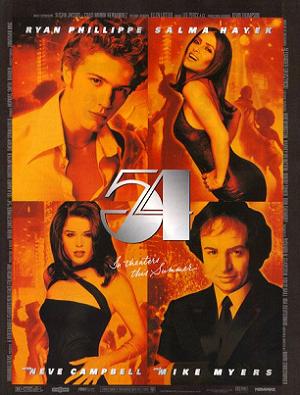
So, did you actually read that quote at the beginning of the review? I don’t blame if you didn’t because not only is it ludicrous overwritten but it just goes on and on. It’s one of those quotes that you read in a script and you think to yourself, “They better get absolutely the best actor in the world to deliver these lines,” and then you realize Ryan Phillippe has been cast in the role.
Except, of course, I doubt that any of those lines were found in the original script for 54. 54 is one of those films where, as you watch it, you can literally imagine the chaos that must have been going on during the editing process. Subplots are raised and then dropped and the mysteriously pop up again. Characters change both their personalities and their motives in between scenes. Huge dramatic moment happen almost at random but don’t seem to actually have anything to do with anything else happening in the film.
In short, 54 is a mess but it’s a mess that’s held together by incredibly clunky narration. Shane O’Shea, who spent the waning days of the 1970s working at Studio 54, narrates the film. And, despite the fact that Shane is presented as being kinda dumb (think of Saturday Night Fever‘s Tony Manero, without the sexy dance moves), his narration is extremely verbose and reflective. It’s almost as if the narration was written at the last-minute by someone desperately trying to save a collapsing film.
I watched 54 on cable because I saw that it was about the 70s and I figured it would feature a lot of outrageous costumes, danceable music, and cocaine-fueled melodrama. And it turns out that I was right about the cocaine-fueled melodrama but still, 54 is no Boogie Nights. It’s not even Bright Lights, Big City.
54 does have an interesting cast, which makes it all the more unfortunate that nobody really gets to do anything interesting. Poor Ryan Phillippe looks totally lost and, in the film’s worst scene, he actually has to stand in the middle of a dance floor and, after the death of elderly Disco Dottie (that’s the character’s name!), yell at all the decadent club goers. Breckin Meyer is cute as Phillippe’s co-worker and Salma Hayek gets to sing. Neve Campbell plays a soap opera actress who Phillippe has a crush on and…oh, who cares? Seriously, writing about this film is almost as annoying as watching it.
Mike Myers — yes, that Mike Myers — plays the owner of the club, Steve Rubell. The role means that Myers gets to snort cocaine, hit on Breckin Meyer, and vomit on the silk sheets of his bed. I think that Myers gives a good performance but I’m not really sure. It could have just been the shock of seeing Mike Myers snorting cocaine, hitting on Breckin Meyer, and vomiting on the silk sheets of his bed.
If you want to enjoy some 70s decadence, avoid 54 and rewatch either Boogie Nights or American Hustle.

 Through the Shattered Lens