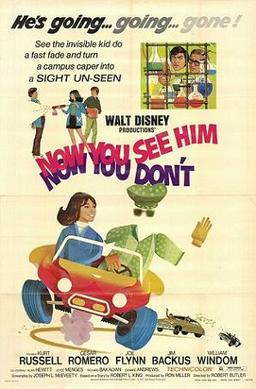
I Watched Now You See Him, Now You Don’t (1972, Dir. by Robert Butler)


Dexter Riley (Kurt Russell) is back and just in time because Medfield College is on the verge of getting closed down again.

In The Computer Wore Tennis Shoes, buying a computer was supposed to be the solution to all of Medfield’s financial problems.  I guess it didn’t work because Medfield is broke again and corrupt businessman A.J. Arnoe (Cesar Romero) is planning on canceling the school’s mortgage so that he can turn it into a casino.

There is some hope.  Dexter has accidentally created an invisibility spray.  Not only does it tun anything that it touches invisible but it also washes away with water so there’s no risk of disappearing forever.  Dexter and his friend Schuyler (Michael McGreevey) know that they can win the science fair with their invention but the science fair doesn’t want to allow small schools like Medfield to compete unless they really have something big to offer.  Dexter tells the Dean (Joe Flynn) that he has a sure winner but Dexter also refuses to reveal what it is because he doesn’t want word to leak before for the science fair.  The Dean decides to raise the money to pay off the mortgage by becoming a golfer, as one does.  Schulyer works as the Dean’s caddy while Dexter uses the invisibility spray to help the Dean cheat.  That’s a good message for a young audience, Disney!  But when Arno finds out about the spray, he wants to steal it so he can rob a bank.

This was even dumber than The Computer Wore Tennis Shoes but it was also hard to dislike it.  The comedy was too gentle, Kurt Russell and the rest of the cast were too likable, and the special effects were too amusingly cheap in that retro Disney way for it to matter that the movie didn’t make any sense.  When a bunch of college kids learn the secret of invisibility and use it to cheat at golf, you know you’re watching a Disney film.

Retro Television Reviews: Call Her Mom (dir by Jerry Paris)


Welcome to Retro Television Reviews, a feature where we review some of our favorite and least favorite shows of the past!  On Sundays, I will be reviewing the made-for-television movies that used to be a primetime mainstay.  Today’s film is 1972’s Call Her Mom!  It  can be viewed on YouTube!
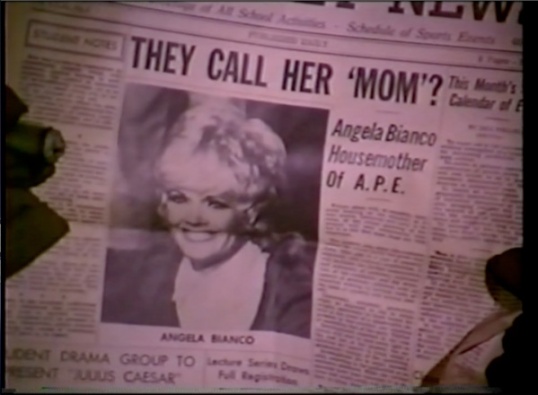
While all of the other college campuses across America are in turmoil with protests and student walk-outs, Beardsley College remains at peace.  It’s a place where the 50s never ended.  Everyone is perfectly behaved.  No one is into politics.  Fraternity Row is a peaceful place, largely due to the elderly housemothers who keep the frats in order.

Except for Alpha Phi Epsilon, that is.  The A.P.E. House is known for being the wildest house on campus and every housemother that they get walks out on them.  If they can’t find a new housemother, they’ll lose their charter.  President Chester Hardgrove (Van Johnson) and Assistant Dean Walden (Charles Nelson Reilly) are practically salivating at the possibility of kicking A.P.E. off of campus.  And who can blame them?  Take a look at how wild these guys are:
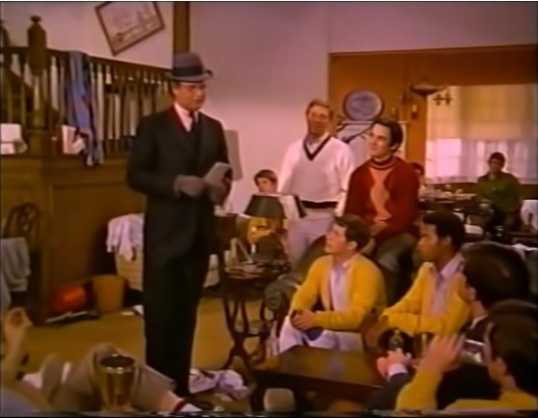
These guys are crazy!  They wear yellow sweaters!  They play tennis indoors!  Occasionally, they leave a towel or two hanging on the bannister.  A.P.E. is out of control!

A.P.E. tries to find a new housemother but the word is out that A.P.E. is no good.  Not a single elderly woman in town is willing to work with them.  However, when the members of the frat realize that there’s not actually an age requirement for housemothers, they offer the job to Angie Bianco (Connie Stevens), who works as a waitress at the local pizza place.  Angie accepts the job.
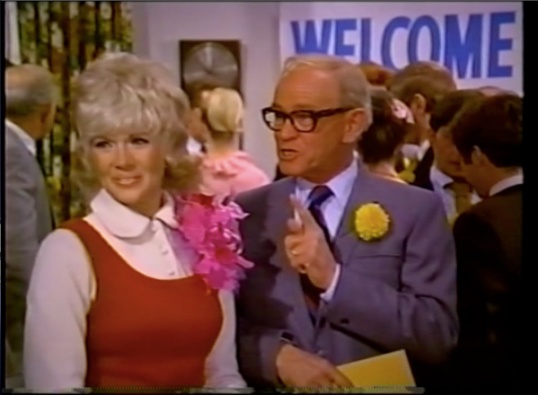
It’s a scandal!  All of the older folks say that Angie is too young and too attractive to be trusted as the housemother for A.P.E.  Angie, however, proves herself to be a lot tougher than anyone was expecting.  The members of the frat soon come to respect her.  However, President Hardgrove is determined to force her out of the job and off of the campus.  Rumor has it that she’s encouraging the A.P.E. brothers to hold rollicking 20s style parties and she’s also allowing them to dance!

Check out this decadence!
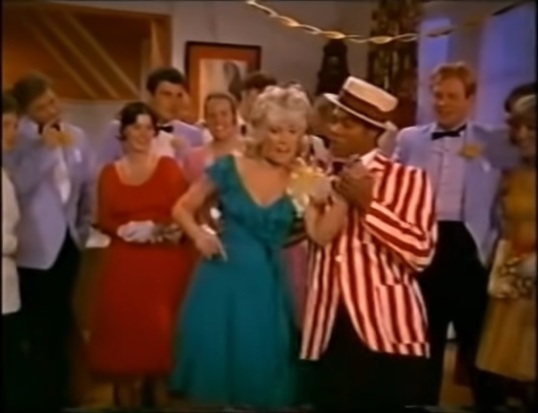
The attempts to force Angie out of her job makes national news.  Soon, Angie and the frat brothers are featured in Time Magazine.  President Hardgrove points out that he’s never appeared in Time Magazine.  While an group of middle-aged women march outside of the A.P.E. House and demand that Angie be fired, the younger female students rally to Angie’s side.  Suddenly, Beardsley College is home to a protest!  (The protest is about as a wild as the 20s dance party at the A.P.E. House.)  President Hardgrove realizes that keeping Angie at the A.P.E. House will actually lead to the college getting more donations but Angie has decided that she has to quit.  Not only is she in love with A.P.E.’s sponsor, Prof. Calder (Jim Hutton), but a member of the fraternity has decided that he’s in love with her and he’s going to drop out of school to be with her.

Can A.P.E. convince Angie to come back?

Call Her Mom is a silly movie that was obviously meant to serve as a pilot for a television show, one in which I imagine Angie would have solved the fraternity’s problems on a weekly basis.  Seen today, it’s mostly memorable for its thoroughly innocent portrayal of college life.  A.P.E. House is the wildest frat on campus but no one is ever seen drinking.  Certainly no one is indulging in anything stronger than perhaps a Coke or a Pepsi.  I imagine this show was an accurate portrayal of what most parents hoped college was like.  That said, Connie Stevens and Jim Hutton made for a cute couple.  Hopefully, there were many good times in the future for the residents of A.P.E. House.
The TSL’s Horror Grindhouse: The House on Skull Mountain (dir by Ron Honthaner)


Before I say anything else about 1974’s The House on Skull Mountain, I just want to say how much I love the film’s poster.  Seriously, that poster is everything that you could hope for from an exploitation film print ad.  Everything about it, from the lightning to the giant skull to the mansion to the unfortunate person plunging to her doom is pure perfection.  I especially like the question at the bottom of the poster: “Which of these five will come down alive?”

And, to be honest, it’s actually a fairly honest poster.  The majority of the film really does take place in a house on a mountain that has features that look like a skull.  Of course, the skull in the movie is not quite as prominent as the one in the poster.  The house actually does look a lot like the one on the poster.  There’s also a lot of lightning in the movie.  It’s the same basic lightning stock footage that has appeared in almost every film ever produced by Roger Corman.  In The House on Skull Mountain, it’s used as a transitional device.  “Is that scene over?” you might find yourself wondering.  Well, don’t worry.  The lightning stock footage will let you know.

One reason that I’m focusing on the poster is because the film itself is kind of anemic.  In the movie, the house on top of Skull Mountains belongs to Pauline Christophe, a direct descendant of the first king of Haiti.  Upon her death, Pauline’s four great granchildren are invited to hear the reading of her will.  None of the four have ever met Pauline or each other.  Phillippe (Mike Evans) is an alcoholic who says stuff like, “Baby, what’s the scene?”  Harriet (Xernona Clayton) is fragile and nervous and it certainly doesn’t help her nerves when she briefly sees a hooded skeleton sitting a few rows in front of her on her flight to Atlanta.  Lorena (Janee Michelle) drives too fast but is otherwise responsible and mature.  And then there’s Dr. Andrew Cunningham (Victor French), who shows up late and turns out to be white.

“You’re the wrong color!” Phillippe snaps at him.

Andrew shrugs and says that he’ll explain it all later.  He does eventually tell a story about being abandoned on the front steps of an orphanage but the dialogue is so awkwardly-written and delivered that I’m not sure if he is being serious or if he is poking fun at Phillippe’s shock.

Because Andrew showed up late, the four of them have to stay in the house for a week until Pauline’s lawyer returns to read the will.  Keeping them company is the butler, Thomas (Jean Durand), and Loutte (Ella Woods) the maid.

And that’s not all!  It also appears that there is a robed skeleton wandering around the house as well!  Add to that, the relatives start having visions.  One falls down an elevator shaft.  Another has a heart attack after someone stabs doll with a pin.  Could all of this have something to do with the fact that Pauline and her servants were all dedicated practitioners of voodoo?

Sad to say but the House on Skull Mountain is pretty dull.  The film does provide a brief history lesson concerning how Haiti was the only nation to be formed as a result of a slave rebellion and how the real-life Henri Christophe went from being a slave to a king but the film doesn’t really do much with the information.  It’s tempting to look for some sort of subtext in the film’s plot but it’s really just not there.  Much like Andrew being the only white member of a historically important black family, the history of Haiti and the actual origins of Haitian voodoo are elements that are brought up and then quickly abandoned.   There is one good and lengthy voodoo ceremony but otherwise, the whole film is almost all filler.  When it’s not showing us the same lighting stock footage, it’s showing us Andrew and Lorena wandering around Atlanta.

But seriously, that movie poster is to die for.