They had the hook in me, and I was caught like a large mouth bass. The bait was the stuff my dreams were made of, a heady concoction of gangsters and femmes fatale, of faded Hollywood stars and references to Mickey Spillane and Ross MacDonald. I had let my guard down and plunged headlong into the trap, forgetting you can’t judge a book by its cover, especially one luridly titled PULP.
It all started so promisingly. I was introduced to Mickey King, a second-rate English hack writing under the pseudonym “Guy Strange”, scribbler of paperback trash like “Kill Me Gently” and “My Gun is Long”. Mick’s paid a visit by a gravel-voiced goon called Dinuccio, a Neanderthal throwback who hires the wordsmith to ghost a biography for his mysterious boss. Next thing Mickey knows, he’s on a tour bus and told he’ll be contacted. An American named Miller could be the one, but Miller…
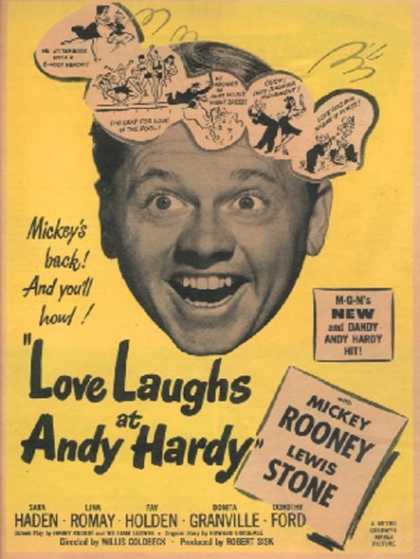
I cringed a little when I saw that the 45th film in Mill Creek’s Fabulous Forties box set was 1946’s Love Laughs At Andy Hardy.
This was because I had never seen an Andy Hardy film before but I did know enough to know that, starting in the 1930s, MGM made a series of films that featured Mickey Rooney in the role of a “nice, young man” named Andy Hardy. Andy was a well-meaning kid who grew up in Middle America under the watchful eye of his father, Judge Hardy (Lewis Stone). What little I had heard of the Andy Hardy films led me to suspect that they were very much a product of their time and had not aged particularly well.
Having now watched Love Laughs At Andy Hardy … well, I can confirm that it is a product of its time. And it is definitely an uneven film, though perhaps I would have felt differently if I had seen any of the other Andy Hardy films. (Love Laughs was the 15th film about Andy Hardy and it pretty much assumes that the viewer already knows who Andy and all of his friends and family are.) But I will say this: Mickey Rooney was a really good actor. In fact, as I watched Love Laughs At Andy Hardy, I was shocked by just how good a performance Rooney gave. When I think of Mickey Rooney — well, to be honest, it’s rare that I ever do. But when I do, it’s usually in relation to the exploitation films he made after he was a star. These were movies like The Manipulator or Silent Night Deadly Night 5, all of which feature an elderly and obviously unwell Mickey acting up a storm. In contrast to those film, in Love Laughs At Andy Hardy, Mickey gives a totally empathetic and, at times, even subtle performance. Even by contemporary standards, his performance feels real and, as I watched, I started to understand how there actually could have been 16 separate films about Andy Hardy. You really do find yourself caring about the little guy,
As for this film, it opens with Andy returning from serving in World War II. Apparently, he left college to enlist in the army. Now that he’s back in America, he’s ready to return to college and ask his old girlfriend, Kay (Bonita Granville) to marry him. However, to Andy’s shock and disappointment, Kay has moved on and has other plans. Why, it’s almost enough to make Andy want to drop out of school, give up his dreams of becoming an attorney, and try to find work as an engineer in South America!
Fortunately, Judge Hardy is there to talk some sense into his son.
It’s all fairly predictable and, as I said before, definitely uneven. I get the feeling that a lot of the scenes in Love Laughs At Andy Hardy were meant to serve as call backs to previous films in the series. Watching this film without a context can lead to a lot of confusion. But, again, it’s all saved by Mickey Rooney’s performance. While I can’t really give this film a strong recommendation, I imagine if you’re fan of Rooney’s or the Andy Hardy films, you’ll enjoy it.
Perhaps the best scene in the film comes when Andy is set up on a blind date with a girl named Coffy (Dorothy Ford). When Andy goes to Coffy’s dorm to pick her up, he can’t understand why all the other girls keep looking at him and laughing. However, once Coffy shows up, it quickly becomes obvious. Coffy is 6’2 while Andy is a full foot shorter.
However, when Andy and Coffy arrive at the college dance, they defy all the laughs and the snide remarks. Instead of surrendering to the expectations of snarky society, they perform a dance to end all dances and I’m going to conclude this review by sharing it below.
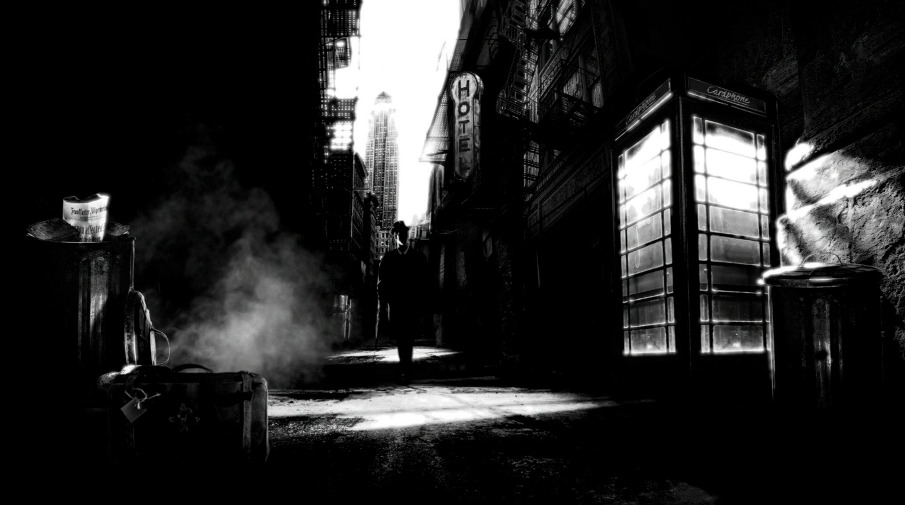
I first got my DVR service from DirecTV just in time for last year’s TCM Summer of Darkness series, and there’s still a ton of films I haven’t gotten around to viewing… until now! So without further ado, let’s dive right into the fog-shrouded world of film noir:
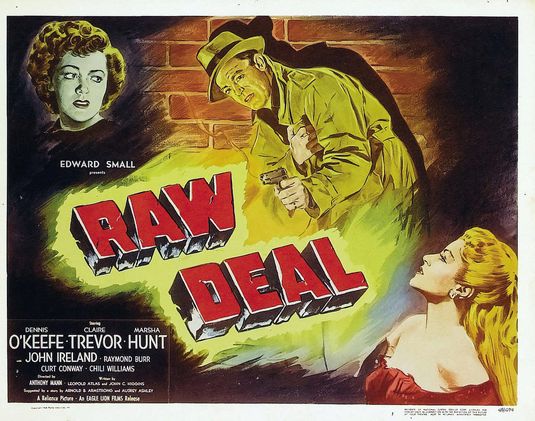
RAW DEAL (Eagle-Lion 1948, D: Anthony Mann)
This tough-talking film seems to cram every film noir trope in the book into its 79 minutes. Gangster Dennis O’Keefe busts out of prison with the help of his moll ( Claire Trevor ), kidnaps social worker Marsha Hunt, and goes after the sadistic crime boss (Raymond Burr) who owes him fifty grand. Director Mann and DP John Alton make this flawed but effective ultra-low budget film work, with help from a great cast. Burr’s nasty, fire-obsessed kingpin is scary, and John Ireland as his torpedo has a great fight scene with O’Keefe. The flaming finale is well staged…
For the last few days, I’ve been desperately trying to clean out my DVR. Ever since this year began, I have been obsessively recording movies and now, I suddenly find myself with just a few hours of space left! Now, I know that the simple solution would be to just start erasing stuff but that’s just not the way I do things. I recorded that stuff so you better believe I’m going to watch and review every single minute of it!
Last night, I did a quick count and discovered that I have 38 movies to watch before I can officially declare the DVR to have been “cleaned out.” While that may sound like a lot, it’s not if you consider that — by watching and reviewing 4 movies a day — I can have the whole job done by the end of the next week! That’s my plan and my challenge to myself. Can I watch and review 38 movies in 10 days?
Let’s find out!
So, I started things out by watching the 1937 film, Captains Courageous.Captains Courageous was aired on TCM as a part of their 31 Days of Oscar. Not only was Captains Courageous nominated for best picture but it won Spencer Tracy his first Oscar. Tracy was one of the quintessential American actors so it’s interesting to note that he won his first Oscar for playing a Portuguese fisherman who speaks in exaggeratedly broken English.
Spencer Tracy may have won the Oscar for Best Actor but his role is really a supporting one. Instead, Captains Courageous is about an extremely spoiled, obnoxious, and annoying 15 year-old named Harvey Cheyne (Freddie Bartholomew). From the minute that Harvey first appears on screen, it’s difficult to like him. The son of a rich businessman (Melvyn Douglas), Harvey is hated by everyone. His family’s butler rolls his eyes whenever Harvey calls for him. His classmates (and, of course, Harvey attends a snooty private school) want nothing to do with him. When his father takes him on a trans-Atlantic cruise, even the sailors seem like they want to toss him overboard.
However, before they get a chance to give him one quick shove over the railing, Harvey does their job for them. He falls overboard and he nearly drowns before being rescued by a fisherman named Manuel (Spencer Tracy). Manuel takes him back to the fishing schooner, where that ship’s captain (Lionel Barrymore) refuses to believe that Harvey is rich. Since the rest of the crew quickly decides that they dislike Harvey as much as everyone else does, the captain saves Harvey from being thrown back overboard by “hiring” him as a fisherman. And, of course, the captain makes Manuel responsible for him.
Though initially hostile, Harvey and Manuel slowly start to bond. Harvey learns about the importance of hard work and starts to grow up. And, eventually, it all leads to tragedy. That’s just how things work in the movies.
As you can probably guess from the plot description above, there’s not a subtle moment to be found in Captains Courageous but, as is so often the case with 1930s Hollywood, that’s actually what makes the film appealing. Captains Courageous wears its sentiment on its sleeve and it makes for an interesting contrast to the more cynical films of today. While it takes a while to get used to seeing Spencer Tracy giving such a theatrical performance, he does eventually win you over. Freddie Bartholomew is vulnerable enough to you can forgive his character for being so obnoxious. Meanwhile, Lionel Barrymore and Mevlyn Douglas are well-cast in their supporting roles and, if you keep an eye open, you’ll see everyone from John Carradine to a young Mickey Rooney working on the schooner. Ultimately, Captains Courageous is a well-made and likable coming-of-age film that still holds up today.
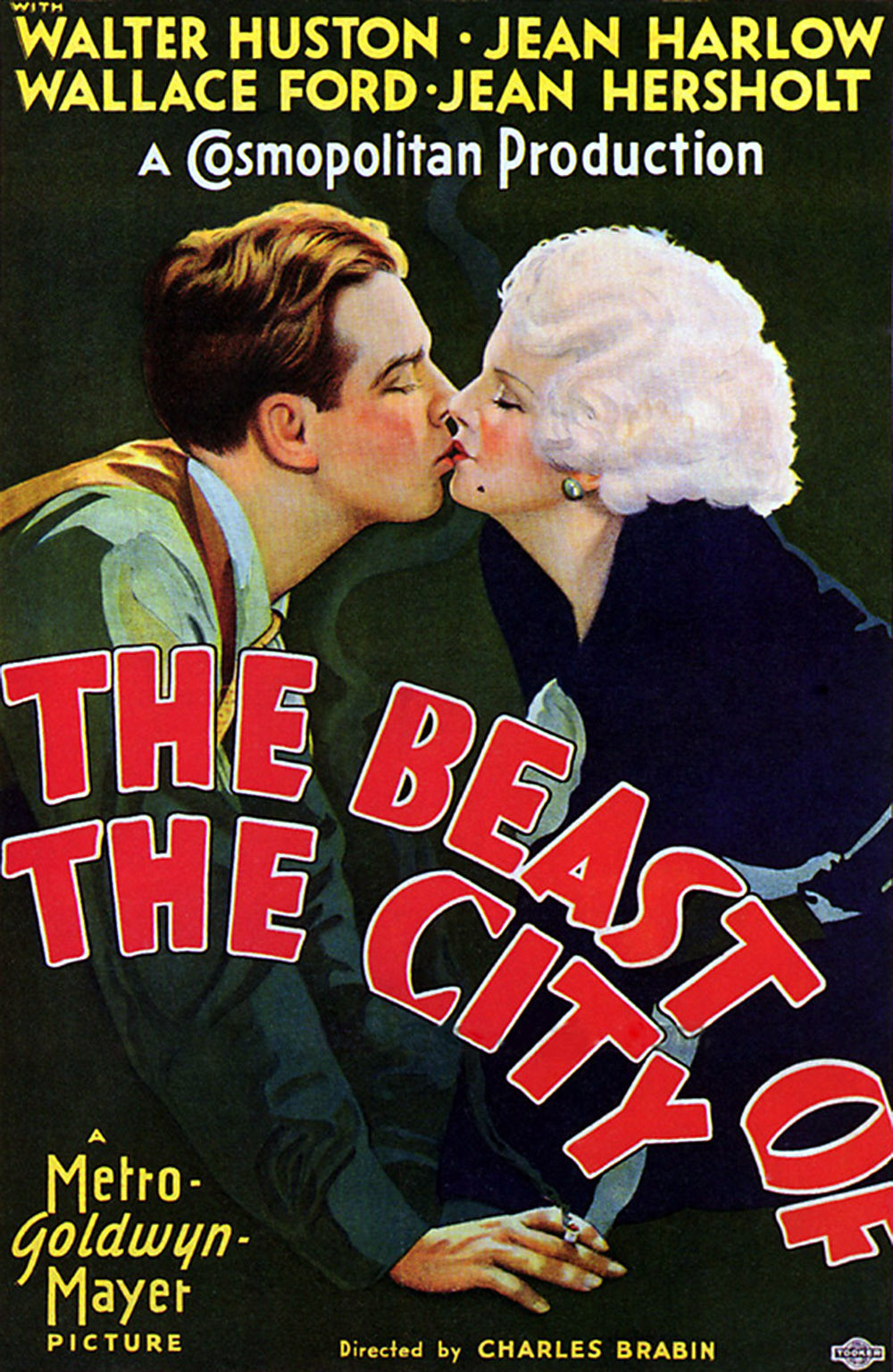
In honor of Jean Harlow’s birthday (born March 3, 1911), TCM ran a Harlow marathon today. Since I was at work, I recorded a few of them. I couldn’t wait to get home and view THE BEAST OF THE CITY for three reasons: 1) Harlow, of course, 2) it’s a Pre-Code film I’ve never seen, and 3) it was directed by Charles Brabin, who gave us the devilishly decadent THE MASK OF FU MANCHU. I’d heard a lot about this movie and its violent ending, and though not nearly as gruesome as today’s films, it’s vigilante justice packs a punch that must’ve been pretty shocking in 1932.
The movie starts off with a forward from President Hoover (that’s Herbert, kids, not J. Edgar) decrying the glorification of gangsters in films, and saying we should be glorifying the police instead. We then get into the story, as we find Captain Jim Fitzgerald (aka “Fighting…
Thanks to TCM’s 31 Days of Oscar, I now have several movies on my DVR that I need to watch over the upcoming month. Don’t get me wrong — I’m not complaining. I’m always happy to have any reason to discover (or perhaps even rediscover) a movie. And, being an Oscar junkie, I especially enjoy the opportunity to watch the movies that were nominated in the past and compare them to the movies that have been nominated more recently.
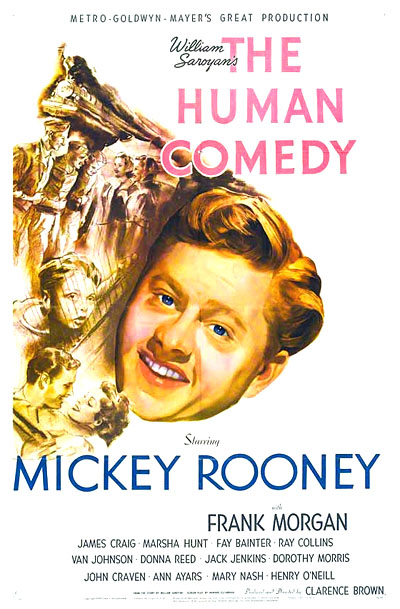
For instance, tonight, I watched The Human Comedy, a film from 1943. Along with being a considerable box office success, The Human Comedy won on Oscar (for Best Story) and was nominated for four others: picture, director (Clarence Brown), actor (Mickey Rooney), and black-and-white cinematography. The Human Comedy was quite a success in 1943 but I imagine that, if it were released today, it would probably be dismissed as being too sentimental. Watching The Human Comedy today is something of a strange experience because it is a film without a hint of cynicism. It deals with serious issues but it does so in such a positive and optimistic manner that, for those of us who are used to films like The Big Short and Spotlight, a bit of an attitude adjustment is necessary before watching.
And yet that doesn’t mean that The Human Comedy is a bad film. In fact, I quite enjoyed it. The Human Comedy is a time capsule, a chance to look into the past. It also features a great central performance, one that was quite rightfully nominated for an Oscar. As I watched Mickey Rooney in this film, I started to feel guilty for some of the comments I made when I reviewed Mickey in The Manipulator last October.
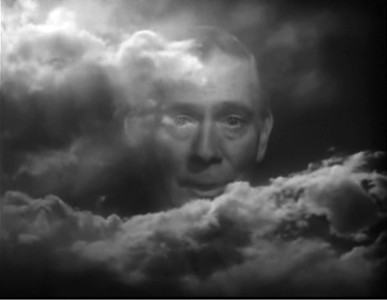
The Human Comedy opens with an overhead shot of the small town of Ithaca, California. The face of Mr. McCauley (Ray Collins, who you’ll recognize immediately as Boss Jim Gettys from Citizen Kane) suddenly appears in the clouds. Mr. McCauley explains that he’s dead and he’s been dead for quite some time. But he loves Ithaca so much that his spirit still hangs around the town and keeps an eye on his family. Somehow, the use of dead Mr. McCauley as the film’s narrator comes across as being both creepy and silly.
But no sooner has Mr. McCauley stopped extolling the virtues of small town life than we see his youngest song, 7 year-old Ulysseus (Jack Jenkins), standing beside a railroad track and watching a train as it rumbles by. Sitting on the cars are a combination of soldiers and hobos. Ulysseus waves at some of the soldiers but none of them wave back. Finally, one man waves back at Ulysseus and calls out, “Going home, I’m going home!” It’s a beautifully shot scene, one that verges on the surreal.
That opening pretty much epitomizes the experience of watching The Human Comedy. For every overly sentimental moment, there will be an effective one that will take you by surprise. The end result may be uneven but it’s still undeniably effective.
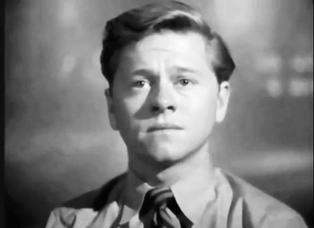
The majority of the film deals with Homer McCauley (Mickey Rooney). Homer may still be in high school but, with his older brother, Marcus (Van Johnson), serving overseas and his father dead, Homer is also the man of the house. Homer not only serves as a role model for Ulysseus but he’s also protector for his sister, Bess (Donna Reed). (At one point in the film, she gets hit on by three soldiers on leave. One of them is played by none other than Robert Mitchum.) In order to bring in extra money for the household, Homer gets a job delivering telegrams.
In between scenes of Homer in Ithaca, we get oddly dream-like scenes of Marcus and his army buddies hanging out. Marcus spends all of his time talking about how much he loves Ithaca and how he can’t wait for the war to be over so he can return home. One of his fellow soldiers says, “I almost feel like Ithaca is my hometown, too.” Marcus promises him that they’ll all visit Ithaca. As soon as the war is over…
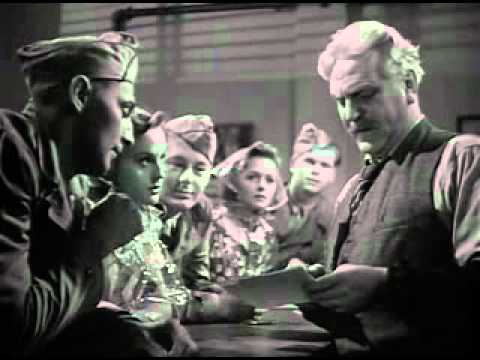
With World War II raging, Homer’s job largely consists of delivering death notices (and the occasional singing telegram, as well). Telegraph operator Willie Grogan (Frank Morgan) deals with the burden of having to transcribe bad news by drinking. Homer, meanwhile, tries to do his job with compassion and dignity but one day, he has to deliver a telegram to his own house…
The Human Comedy is an episodic film, full of vignettes of life in Ithaca and Homer growing up. There’s quite a few subplots (along with a lot of speeches about how America is the best country in the world) but, for the most part, the film works best when it concentrates on Homer and Mickey Rooney’s surprisingly subdued lead performance. By today’s standards, it may seem a bit predictable and overly sentimental but it’s also so achingly sincere that you can’t help but appreciate it.
The Human Comedy was nominated for best picture but it lost to a somewhat more cynical film about life during World War II, Casablanca.
For tonight’s episode of The Twilight Zone, we present to you The Last Night of A Jockey. In this episode, Mickey Rooney plays a jockey who has just been banned, for life, from horse racing. The self-pitying jockey is offered the chance to change his life with “one wish.” He wishes that he could be a “big man” and, unfortunately, he gets his wish.
This episode is basically a one-man show for Mickey Rooney and he makes the most of it. I almost feel like I have to share this episode, just in case my earlier review of The Manipulator inspired anyone to see that misbegotten film. Needless to say, Rooney is a lot more impressive in Last Night Of A Jockey than he was in The Manipulator.
This episode originally aired on October 25th, 1963.
Up until recently, I firmly believed that Love and Other Drugs was the most annoying movie ever made. But then, a few nights ago, I cracked open my Mill Creek 50 Drive In Movie Classic box set and I watched a little film from 1971. I was just looking for a horror film to review for October. Little did I know that I would soon be watching the most annoying movie ever made!
The name of that movie?
The Manipulator.
The star of that movie?
Mickey Freaking Rooney.
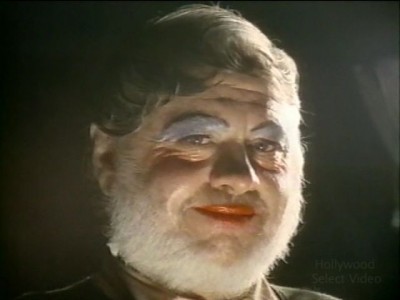
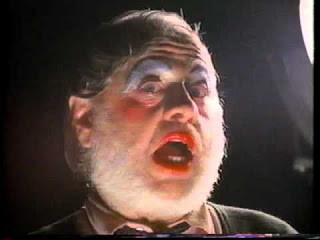
In The Manipulator, Mickey plays B.J. Lang, a former Hollywood makeup artist who has had a mental breakdown. He now lives in a dusty warehouse, surrounded by old movie props and mannequins. B.J. spends a lot of time talking to himself and trying on makeup. Sometimes, he wears a fake nose and pretends that he’s Cyrano de Bergerac. And then, at other times, he imagines all of his mannequins coming to life and taunting him. (It’s kind of like the final scene of Maniac, except nobody’s head gets ripped off.) Occasionally, he has weird flashbacks, which are all about giving the filmmaker an excuse to utilize the fish-eye lens and psychedelic lighting.
Eventually, we learn that BJ (and, as I watched the film, I kept wondering if his name was supposed to make viewers think about oral sex) is not alone in his warehouse. There’s a woman (Luana Anders) who is being held prisoner. He has her tied up in a chair and, whenever she begs to eat, he feeds her baby food. BJ calls her Carlotta, though that’s apparently not actually her name. The woman yells a lot. Her first five minutes of screen time consist of her repeating, “MR. LAAAAAAAAAANG” over and over again.
BJ spends most of his time delivering monologues about how Hollywood used to be and occasionally, he demands that Carlotta help him put on a play. At one point, BJ appears to have a heart attack and this leads to Carlotta going, “DON’T DIIIIIIIIIIIIIIIIIEEEEEE, MR. LAAAAAAAAANG” over and over again.
And then a homeless bum (Keenan Wynn) shows up and wanders about for five minutes before dying.
The problem with writing about a film like The Manipulator is that, just by describing the plot, you make it sound more interesting than it actually is. You’re probably reading this and thinking, “Wow, this sounds really weird! I need to see it at least once…”
No, you don’t. It may sound weird but ultimately, it’s more emptily pretentious than anything else. This was both director Yabo Yablonsky’s first and final film and there is not a single camera trick that he does not employ. We get the weird angles, the random moments of slow motion, the even more random moments when the film is suddenly sped up, the extreme close-ups, the sudden blackouts, the ragged jump cuts, and, of course, lots of rack focus and zoom lens use. Compared to The Manipulator, the direction of Getting Straight appears to be mild and conventional! The film does feature three talented performers but none of them seem to have the slightest idea what the movie is about or who they are supposed to be playing. In particular, both Rooney and Wynn seem to be making up their dialogue as they go along.
And really, that’s why The Manipulator is so annoying. It should have, at the very least, been an insane misfire. Instead, it’s just boring.




 Through the Shattered Lens